
You own less of an AI film than the generator's terms suggest, and more than the headlines do. In the United States, frames produced by a model carry no copyright. Your screenplay, your cut, your sound and your score do. Register those, disclaim the generated imagery, and the claim holds.
A platform's terms and copyright law answer two different questions. The terms say the company will not come after you. Copyright decides whether you can stop anybody else. Treating the first as the second is the most expensive misunderstanding in AI filmmaking right now.
Registration of the text is covered already, by how to copyright a screenplay and copyrighting AI-assisted work. The finished film is a different problem, and it sits inside the AI filmmaking guide. None of what follows is legal advice. It is what the published guidance and the terms you clicked through actually say.
Two questions wearing the same word
The first one is contractual. You signed up to a service, the service made a file, and what you want to know is whether the company has any claim over it. The terms settle that, and for the major generators the answer is reassuring.
The second is proprietary. Can you stop someone reuploading your short to their channel, cutting a trailer out of it, selling a frame as a print? Copyright law settles that one, and the terms have no say in it whatsoever. A company can assign you every right it holds. If it holds none, you receive none.
A filmmaker reads "you own the output", ships a short, finds it reposted on three aggregator accounts, and then discovers there is nothing underneath the takedown notice. The clause did its job. It was just answering a different question.
What the generators actually promise
Three of the biggest services word it three different ways, and the differences matter more than they look.
| Service | The operative clause | What it is |
|---|---|---|
| OpenAI (Terms of Use, effective 1 January 2026) | You "own the Output", and OpenAI "hereby assign[s] to you all our right, title, and interest, if any, in and to Output" | An assignment, hedged by "if any" |
| Google (Terms of Service) | "Some of our services allow you to generate original content. Google won't claim ownership over that content." | A promise not to claim |
| Runway (Terms of Use) | Outputs fall inside "Your Content"; the company owns "all rights, title and interest in the Services", expressly excepting Your Content | An allocation by definition |
Read the OpenAI clause again and look at the two words doing the real work: if any. The lawyers who drafted that knew exactly what they were handing over, which is whatever rights happen to exist, and nothing beyond. The same terms add that Output "may not be unique and other users may receive similar output", and that the assignment does not reach other users' Output or third-party Output.
Google's wording gives away even less. A promise not to claim ownership is a promise about Google's behaviour. It says nothing about the world.
So the honest summary of every one of these clauses: the vendor will not sue you over your own render. That is worth having. It is not a title deed.
What the Copyright Office will actually register
The US position hardened over 2025 and 2026 rather than loosening.
The Copyright Office published its report in parts: Part 1 on digital replicas on 31 July 2024, Part 2 on the copyrightability of generative AI outputs on 29 January 2025, and a pre-publication Part 3 on training on 9 May 2025. Part 2 is the part that applies to your film.
Then the courts closed the argument. On 2 March 2026 the Supreme Court denied certiorari in Thaler v. Perlmutter, leaving the DC Circuit's ruling standing: the Copyright Act "requires all eligible work to be authored in the first instance by a human being". With cert denied, the route to changing that now runs through Congress rather than the courts.
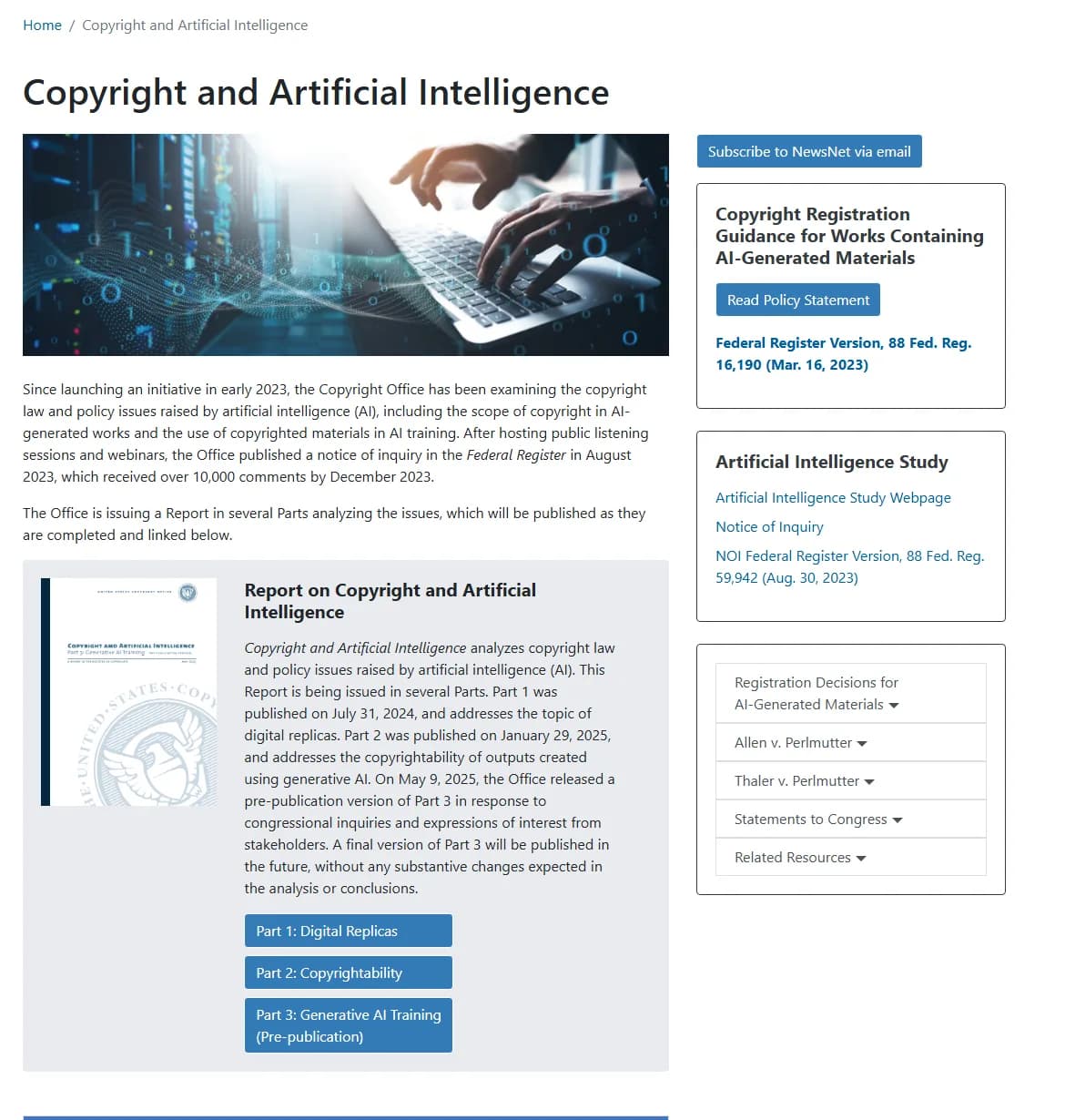
The Copyright Office's AI page listing the three parts of the report and the 2023 registration guidance, captured 2 October 2026.
The encouraging half of the story sits in the same office. By April 2026 it had issued more than six thousand registrations for works containing AI-generated material, and Register of Copyrights Shira Perlmutter has been citing the number publicly. Those registrations went through because the applicants did two things: they claimed the human authorship, and they disclaimed the rest.
The mechanics come from the March 2023 registration guidance{rel="nofollow"}, which is still the operative instruction. AI-generated material that is more than de minimis has to be excluded from the claim. You describe your own contribution in the "Author Created" field, then open the Limitation of Claim section and name the generated material under "Material Excluded". A short description is enough. "Video footage generated by artificial intelligence" clears the bar; you are not expected to itemise which shots.
Failing to disclose is the part worth taking seriously. A registration obtained without disclosing appreciable AI content can be cancelled, and a cancelled registration is worse than none, because by the time it gets cancelled you are usually already in a dispute.
A film is not one work
A film is a stack of contributions. Even when every frame came out of a model, the stack holds a lot of human authorship, and most of it is independently protectable. So stop asking whether your film is copyrightable and start asking which layers of it are yours.
| Layer | Who authored it | Registers? |
|---|---|---|
| Screenplay, treatment, dialogue | You | Yes, as a literary work |
| Shot selection and arrangement (the cut) | You | Yes, as compilation authorship |
| Prompt text as literary text | You | Thin at best, and worth little |
| Generated frames and clips | The model | No, disclaim them |
| Recorded voice performance | The performer | Yes, and get the release |
| Original score and sound design | You or your composer | Yes |
| Grade, compositing, title design | You | Yes, where creative choices show |
The cut is the layer people undervalue. Choosing which forty of four hundred generated takes survive, in what order, at what length, with what rhythm, is selection and arrangement. Same authorship that protects an anthology or a photo book. If you kept your dailies notes, you already hold the evidence that those choices were yours.
Which is why "I only wrote prompts" is a weak position and "I directed, cut and scored this" is a strong one. The wording is irrelevant. What matters is whether the file backs it up.
Registering an AI short, field by field
- Decide what you are registering. For most AI shorts the sensible claim is the motion picture, with the screenplay registered separately if it was not already.
- Use the Standard Application. Group options and the single-application route do not fit a work with excluded material.
- In "Author Created", describe only human contribution. Something like: screenplay, selection and arrangement of audiovisual material, editing, sound recording, musical composition.
- In Limitation of Claim, under Material Excluded, tick the relevant categories and describe the generated material in the Other field in one line.
- Deposit the finished film, not the raw generations.
- Keep the correspondence. If the Office writes back asking about the AI content, a straight answer resolves it; an evasive one escalates it.
Steps 1 and 3 are easier when the film was built from a script and a shot plan rather than assembled from whatever the model produced that week, which is the argument for working the way making an AI film lays out.
If a performer's voice or likeness is anywhere in the film, that is a separate right from copyright and it travels separately. Part 1 of the Office's report exists because digital replicas were becoming a problem, and a signed release is still the only thing that fixes it.
Try it free
Try Screenweaver for free on your script
It is free. Import your existing project, get a clearer view of your outline, and regain control of your story structure in minutes.
Start FreeThe log that makes the claim survivable
You cannot fill in that form honestly if you do not know which parts of your own film came from where. Six months after picture lock, with four generators and three revision rounds behind you, reconstructing that from memory is guesswork, and guesswork is what the disclosure field punishes.
Keep a one-line-per-shot record while you work:
- Shot number and final timecode.
- Which model and version produced it, or "practical" if it was shot.
- Whether it was reframed, retimed, painted over or composited, and by whom.
- Whether a real person's voice or face is in it, and where the release is filed.
- Any third-party asset in the shot, with its licence tier.
That last line catches people out. A music licence that covers "online use" often stops short of festival exhibition, which the sound workflow goes into. Rights you do not have are a bigger problem than rights you cannot register.
For scripts going out to readers before any of this, the Script Watermarker stamps per-recipient copies in the browser so you can tell whose copy leaked. It is a provenance habit, and the same habit applied to shots is what makes a registration defensible.
Labelling is a different obligation
Disclosure and ownership get mixed up constantly. They run on separate tracks.
In the EU, Article 50 of the AI Act has applied since 2 August 2026. Deployers of a system that generates or manipulates image, audio or video content constituting a deep fake "shall disclose that the content has been artificially generated or manipulated". Filmmakers get a real carve-out: where the content "forms part of an evidently artistic, creative, satirical, fictional or analogous work or programme", the obligation shrinks to "disclosure of the existence of such generated or manipulated content in an appropriate manner that does not hamper the display or enjoyment of the work". A line in the end credits satisfies that. Stamping a warning across the frame does not, and was never required.
Separately, providers have to mark synthetic outputs in a machine-readable format under Article 50(2), which is why content credentials keep appearing in your exports whether you asked for them or not.
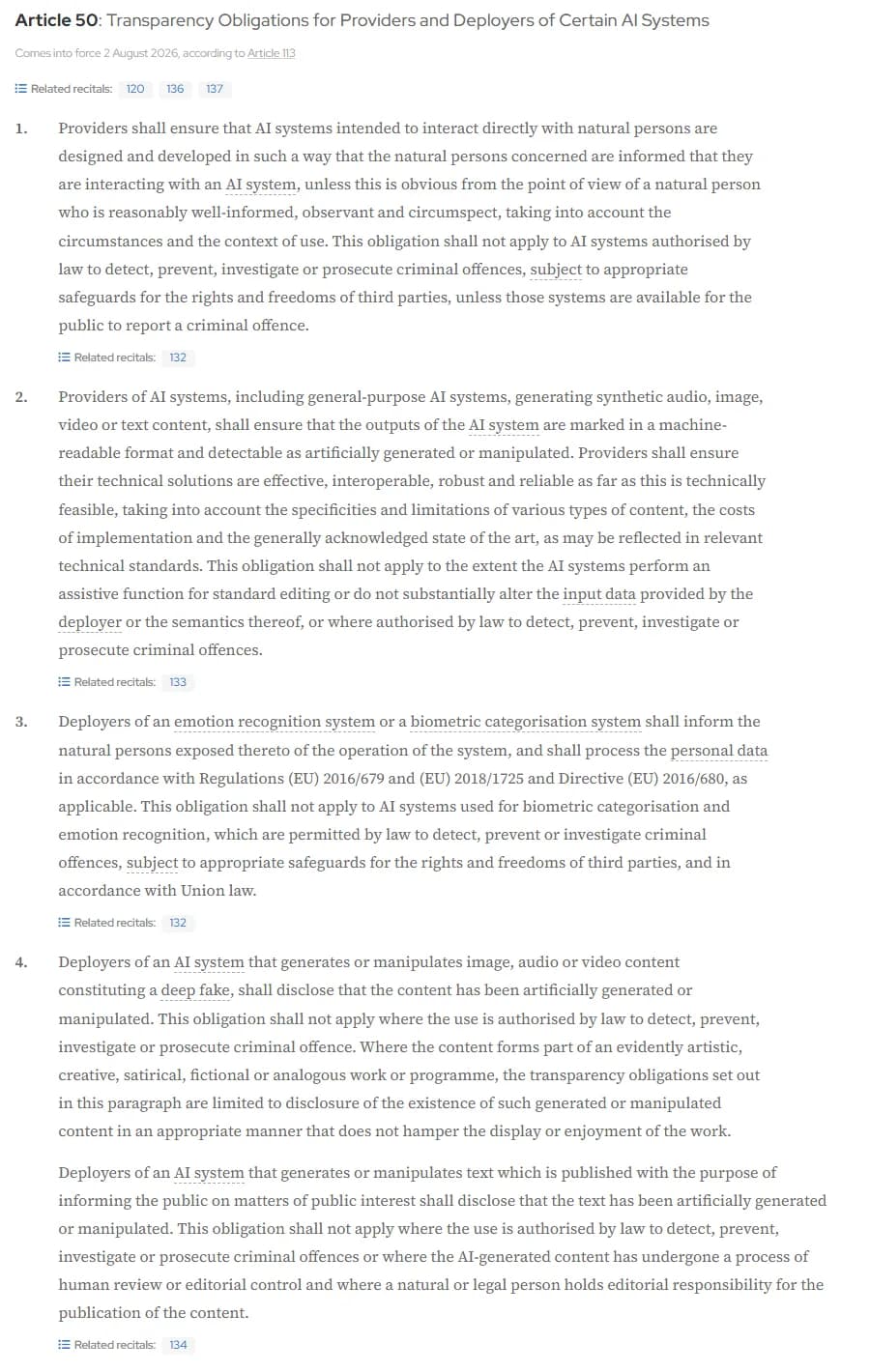
Article 50 on artificialintelligenceact.eu, paragraphs 1 to 4, captured 2 October 2026.
Labelling your film does not weaken your copyright claim in it. Platform and festival rules are covered in AI film disclosure rules, and the festivals that accept AI work are listed in AI film festivals 2026. The registration risk runs the other way: the cancellations happen to people who said too little.
What happens when someone reposts your film
Practically, less turns on the law than you would expect.
Platform takedowns run on claims, not adjudications. A DMCA notice on a reuploaded short usually works, because the uploader does not file a counter-notice and the platform does not examine your chain of title. That is true whether your frames were generated or shot on an Alexa.
The law starts to matter when the other side pushes back, and that is when the registration and the log earn their keep. A registered claim over the screenplay and the edit gives you something concrete to point at. "The terms of service say I own it" gives you a contract with a company that is not a party to the dispute.
So register the narrow claim. Your screenplay, your cut, your sound, with the generated imagery disclaimed on the face of the application. That survives examination. A broad claim that quietly implies you authored every frame gets cancelled, and it gets cancelled during the fight you filed it for.
FAQ
Can I copyright a film made entirely with AI video generators?
Not the generated frames. In the United States, autonomous machine output has no human author and no copyright, and the Supreme Court's refusal to hear Thaler v. Perlmutter on 2 March 2026 left that settled. You can register the human layers: the screenplay, the selection and arrangement of shots, the sound, the score.
The generator's terms say I own the output. Is that not enough?
It is enough to stop the vendor claiming it. OpenAI's assignment of its rights in Output is qualified by "if any", which is the drafters conceding there may be nothing there to assign. A contract between you and a company cannot create a right that does not exist against third parties.
Do I have to tell the Copyright Office I used AI?
Yes, when the AI-generated material is more than de minimis. Describe your own contribution in the Author Created field and exclude the generated material under Limitation of Claim. A one-line description is sufficient. Registrations obtained without that disclosure can be cancelled.
Does my prompt count as authorship?
Barely, and not in a way you should build on. The Office's position is that prompts "function more like instructions to a commissioned artist", because the machine decides how they get implemented. The edit, the script and the sound are far stronger ground.
Does the EU AI Act change who owns my AI film?
No. Article 50 is a transparency rule, not an ownership rule, and copyright in the EU is governed separately by national law and the acquis. Labelling a film as containing generated content has no bearing on what you own in it.
I used a real actor's voice clone. What changes?
Everything about permissions, nothing about copyright. Voice and likeness are personality rights, separate from copyright and often governed by state or national law, and they need a signed release naming the use. Part 1 of the Copyright Office report exists specifically because digital replicas outran the paperwork.
Final Step
Build your next script with Screenweaver
Move from ideas to production-ready pages faster with timeline-native writing and AI-assisted story flow.
Try Screenweaver