The Day They Took Our Light by Adekunle Bryan Oyetunde, from Nigeria, won Best of Festival at the first African AI Film Festival (AAIFF). The festival announced its nine winners at its Hollywood premiere in Los Angeles on 21 November 2026. Nigerian films took three of the nine awards, and the other six went to films from the United Kingdom, Brazil, Mauritius, France, Kenya and Uganda.
We read the festival's winners page, its press release of 5 November and its FAQ on 23 November. The winners page gives each film's award, director and country, and nothing more: no jury notes, no synopses, no prize amounts. We have not seen the films.
The nine winners
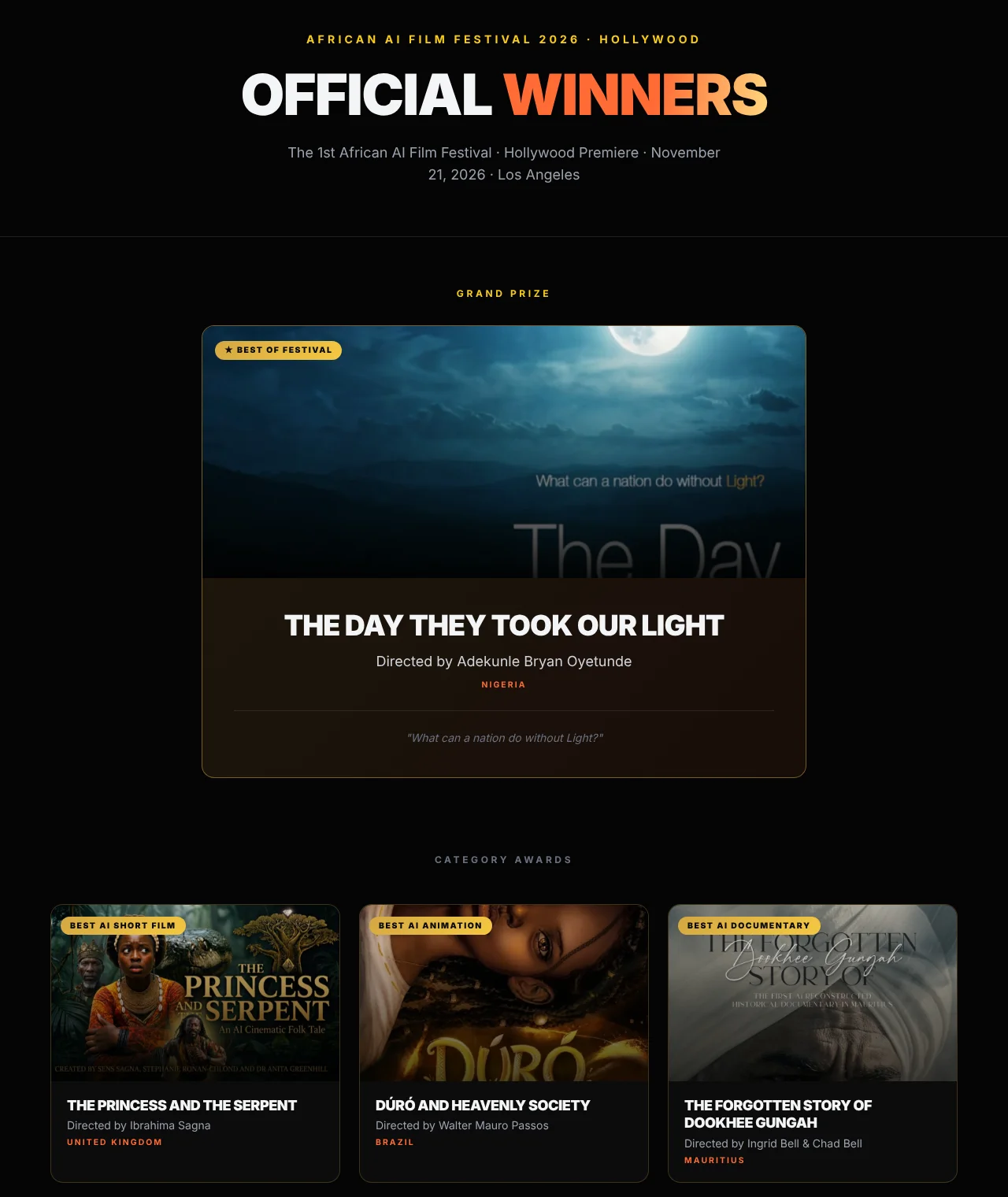
| Award | Film | Director | Country |
|---|---|---|---|
| Best of Festival | The Day They Took Our Light | Adekunle Bryan Oyetunde | Nigeria |
| Best AI Short Film | The Princess and the Serpent | Ibrahima Sagna | United Kingdom |
| Best AI Animation | DÚRÓ and Heavenly Society | Walter Mauro Passos | Brazil |
| Best AI Documentary | The Forgotten Story of Dookhee Gungah | Ingrid Bell and Chad Bell | Mauritius |
| Best Director | Zaïre 1978 | Matteo Lamrani | France |
| Best African-Based Film | Queen Idia (The Blood of the Queen) | Nathaniel Joshua Ogwuche | Nigeria |
| Cultural Resonance | The Star Weaver | Craig Nyanjom | Kenya |
| Best Emerging Film | Blood Passages: The Return of the Crimson King | Ronald Kayima, Aliguma Mugisa and Hannington Kisembo | Uganda |
| Audience Award | Echoes of the Bronze & The Gods | Favour Babalola | Nigeria |
The only line the site gives about the grand prize winner is its tagline: "What can a nation do without Light?" Several winners take history as their subject. Queen Idia is named after a queen mother of the Benin Kingdom, Zaïre 1978 points to a year, and the full title of the audience winner in the selection list is Echoes of the Bronze & The Gods: Nigeria's Stolen Memory.
A festival with an eligibility rule, not a borders rule
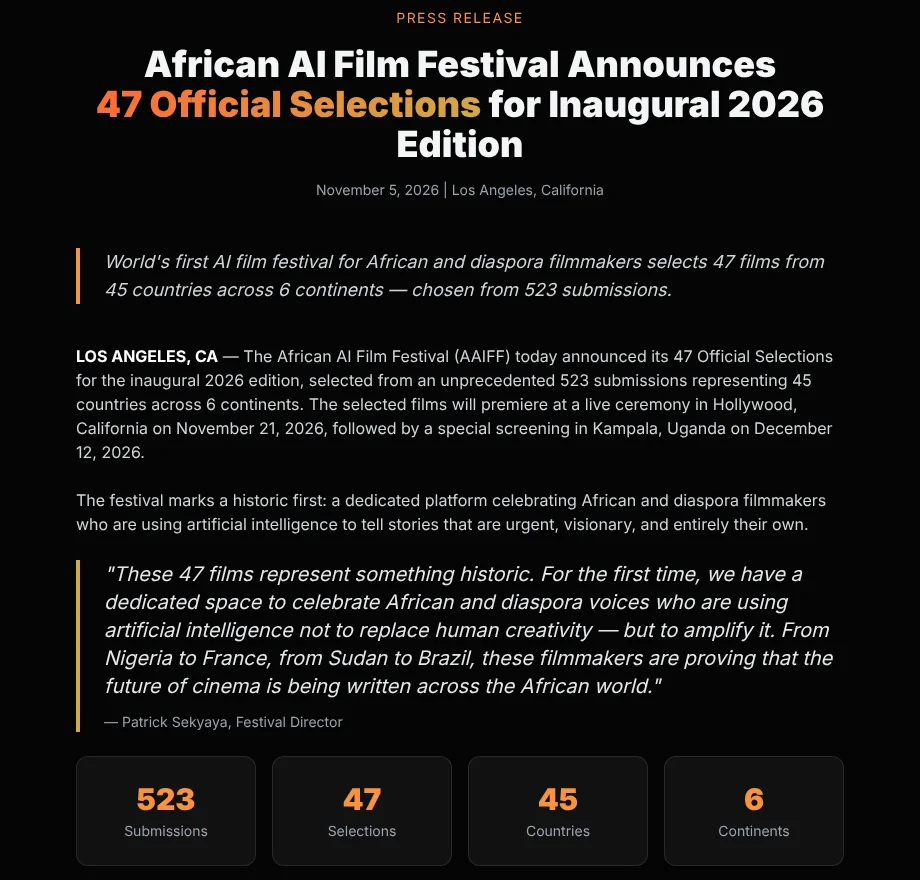
AAIFF calls itself the first film festival dedicated to African and African-diaspora filmmakers who use AI. It was founded in Los Angeles in 2026 by Patrick Sekyaya, a Ugandan diaspora filmmaker, and is run by the African AI Arts & Culture Institute, a California nonprofit. The jury had four members: Amira Sayed (Egypt), Joan Kabugu (Kenya), T.J. Seaman (Nigeria) and Pauline Nabbosa (Uganda).
The eligibility rule explains why a British, a Brazilian and a French film won here. Under the FAQ, a film qualifies if its lead filmmaker is of African or diaspora heritage, or if it centres African stories, languages, history or culture, or if it is an African collaboration. Generative AI also has to be "central to the film's creation". A film that used AI only for minor colour correction does not count.
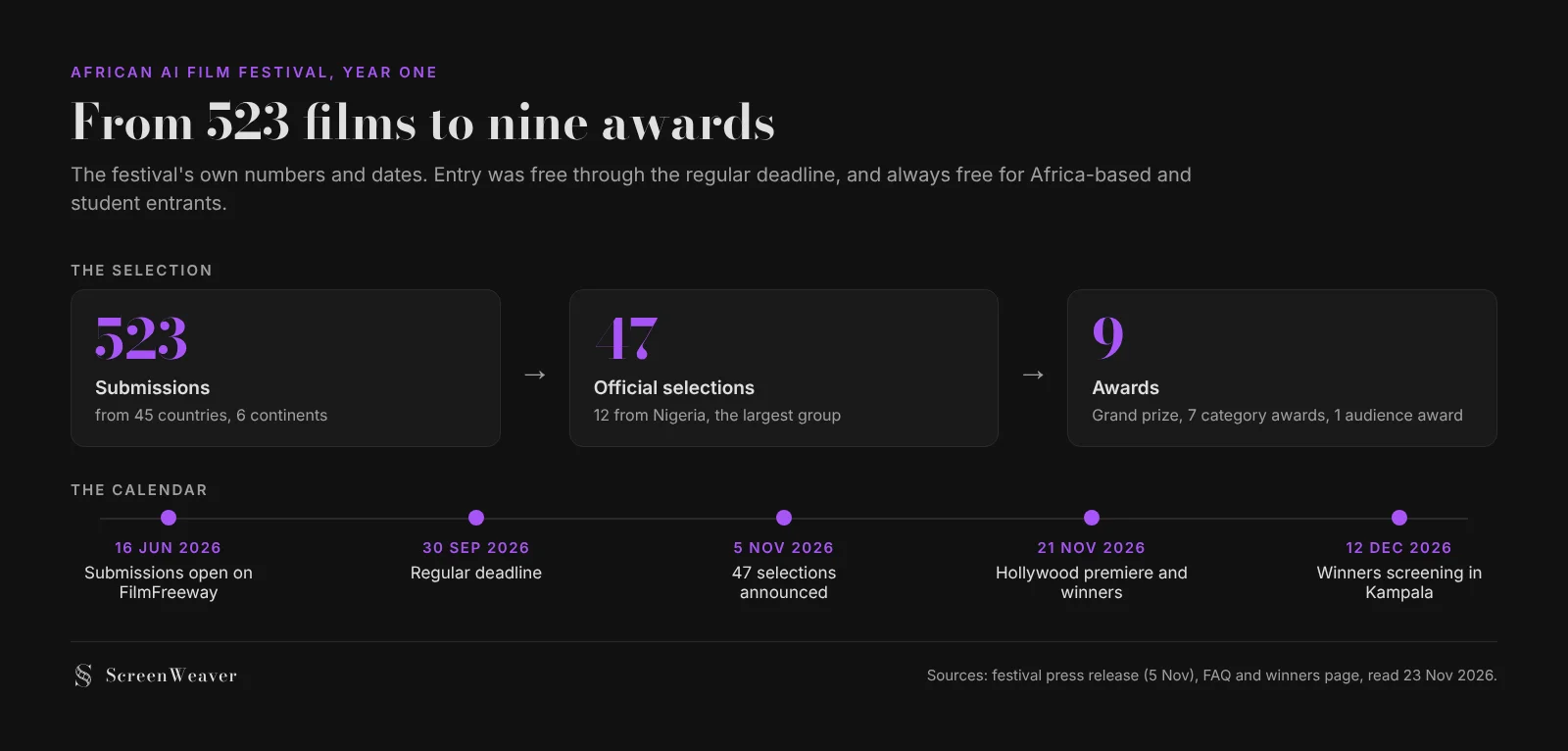
The numbers come from the festival itself: 523 submissions from 45 countries, 47 official selections, nine awards. Nigeria had the largest group in the selection, with 12 films, followed by the United States with 9 and Egypt with 7. The winners screen again in Kampala, Uganda, on 12 December 2026.
What it means for AI filmmakers
Entry was free through the regular deadline of 30 September, and the FAQ says it is always free for Africa-based filmmakers and for the Student & Emerging category. Many AI film festivals charge an entry fee, so it is worth noting. Year one also accepted films already screened elsewhere, as long as they were finished on or after 1 January 2024.
Three points carry over to any entry next year.
Check the eligibility link before the subject. AAIFF does not ask where you live. It asks how your film connects to Africa: heritage, subject or collaboration. If the link is the story, make it clear in the logline and the synopsis.
Disclose your tools. The submission form asks which AI tools you used, and the festival's "Responsible AI" line rules out non-consensual likenesses and deepfakes meant to deceive. Keep a list as you work. Our guide to AI film disclosure rules covers what other festivals and platforms ask for.
Pick the category for the film you made. A film can enter only one category. Shorts and animation run 1 to 10 minutes, documentaries 5 to 20.
Our African AI Film Festival guide covers the event and how to prepare, and the AI film festivals hub lists the calls that are open now. In Melbourne three days earlier, the DISRUPT AI Film Festival winners came with a full jury report, which is worth reading next to this list.
Try it free
Try ScreenWeaver for free on your script
It is free. Import your existing project, get a clearer view of your outline, and regain control of your story structure in minutes.
Start FreeWhat this means if you work in ScreenWeaver
Several of these winners are period pieces about real people and places: a queen of Benin, a stolen heritage, a year in Zaire. That kind of film depends on the look of a character or a place holding from shot to shot. In ScreenWeaver, each character, place and object is a story element with its own reference sheet, and every shot panel cites those references, so the face and the setting stay the same across the board before you generate a single clip. Our storyboard-first workflow shows that order. We have no link with the festival, and the site does not say which tools any winning film used.
Checklist before you enter AAIFF 2027
- Check which eligibility link your film meets: heritage, subject or collaboration.
- Make sure generative AI is central to the film, not a finishing touch.
- Keep a list of every AI tool you used, for the submission form.
- Clear the rights to every real face and voice in the film.
- Choose one category and cut to its length limit.
- Enter before the regular deadline, when entry is free for everyone.
FAQ
Who won the African AI Film Festival 2026? The Day They Took Our Light by Adekunle Bryan Oyetunde (Nigeria) won Best of Festival. Eight other awards went to films from Nigeria, the United Kingdom, Brazil, Mauritius, France, Kenya and Uganda.
When and where were the winners announced? At the festival's Hollywood premiere in Los Angeles on 21 November 2026. A winners screening follows in Kampala, Uganda, on 12 December 2026.
How many films entered? 523 submissions from 45 countries, according to the festival's press release of 5 November 2026. The festival selected 47 films.
Who can enter the African AI Film Festival? Filmmakers of African or African-diaspora heritage, films that centre African stories, languages, history or culture, and African collaborations. Entrants must be 18 or over, or enter the Student & Emerging category with a guardian's consent.
Is it free to enter? In 2026 entry was free for everyone until the regular deadline of 30 September, and always free for Africa-based and Student & Emerging filmmakers. Late entries from outside Africa paid $5 to $10.
Will there be a 2027 edition? The site calls 2026 "Year One", but it has not published dates or a call for a second edition. See our African AI Film Festival guide for what to prepare.
From script to shots
Turn your script into a film, shot by shot
Write the scene, get its storyboard, then generate each shot with consistent characters. You direct every step.
Start your film free