Manchester Animation Festival (MAF) will not accept films made with generative AI from its 2027 edition. The festival announced the rule on 13 November 2026, the day after its 2026 awards ceremony, and opened its call for MAF 2027 under it. The test is strict: if any part of the final moving image was generated or transformed by a generative audio, image or video model, the film is ineligible.
MAF calls itself the UK's only Oscar and BAFTA qualifying animation festival, so this is not a fringe event drawing a line. We read the festival's announcement, dated Friday 13 November 2026, its submission terms and FAQ, and the two-page "Generative A.I Policy for Filmmakers" PDF linked from the announcement, all on 14 November. Cartoon Brew reported the change on 13 November. Here is what the policy says, what it leaves open, and what it changes if you make films with AI.
What MAF announced
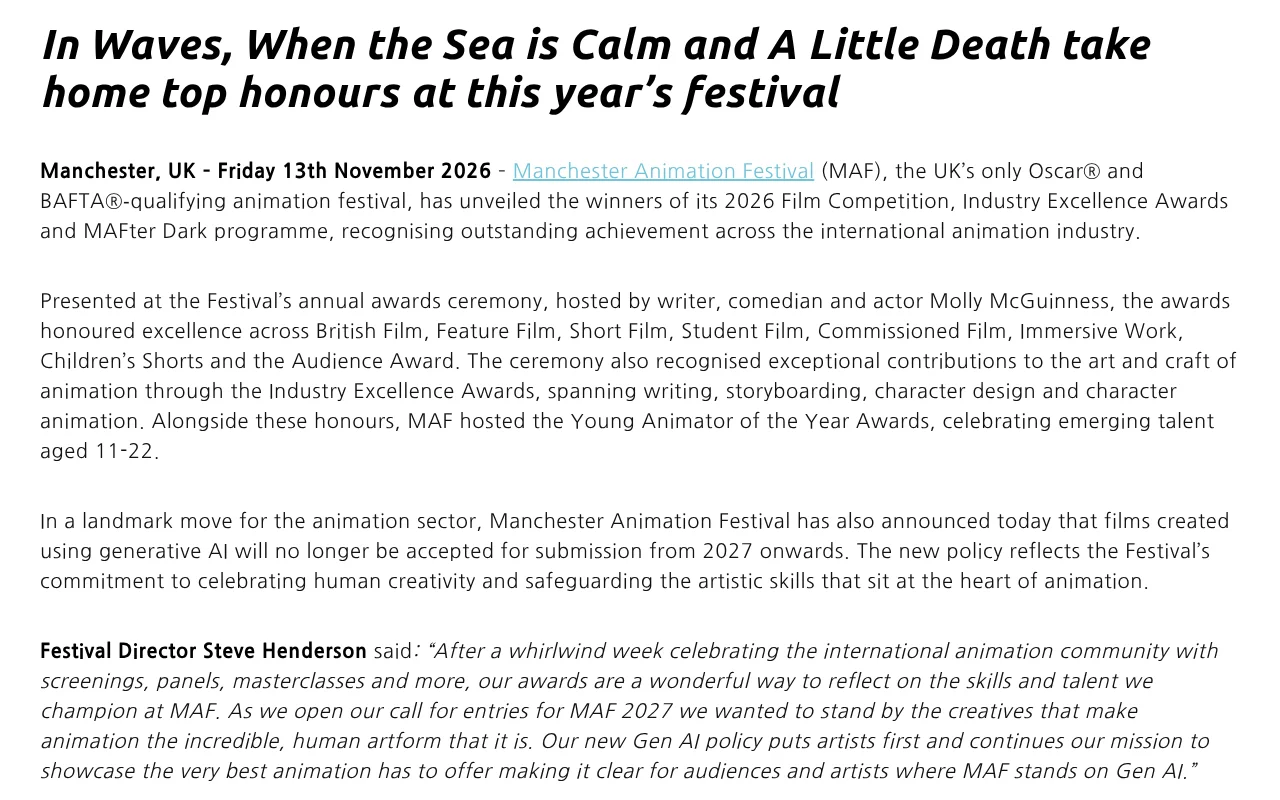
The announcement calls the change "a landmark move for the animation sector" and says the policy reflects the festival's "commitment to celebrating human creativity". Festival director Steve Henderson tied it to the new call for entries: "As we open our call for entries for MAF 2027 we wanted to stand by the creatives that make animation the incredible, human artform that it is. Our new Gen AI policy puts artists first."
The same release named the 2026 winners. Phuong Mai Nguyen's In Waves won the Feature Film Award, Mamuka Tkeshelashvili's When the Sea Was Calm won the Short Film Award, and A Little Death by Leto Meade and Jonathan Rockefeller won Best British Short. The festival ran from 8 to 12 November at HOME and other venues in Manchester, and Cartoon Brew reports nearly 12,000 admissions, its highest total so far.
Where the line falls
The policy PDF is more interesting than the headline, because it does not ban computers. It separates three kinds of filmmaking: animation, "the creation of movement", live action, "capturing movement", and generative AI, "a calculation of movement".
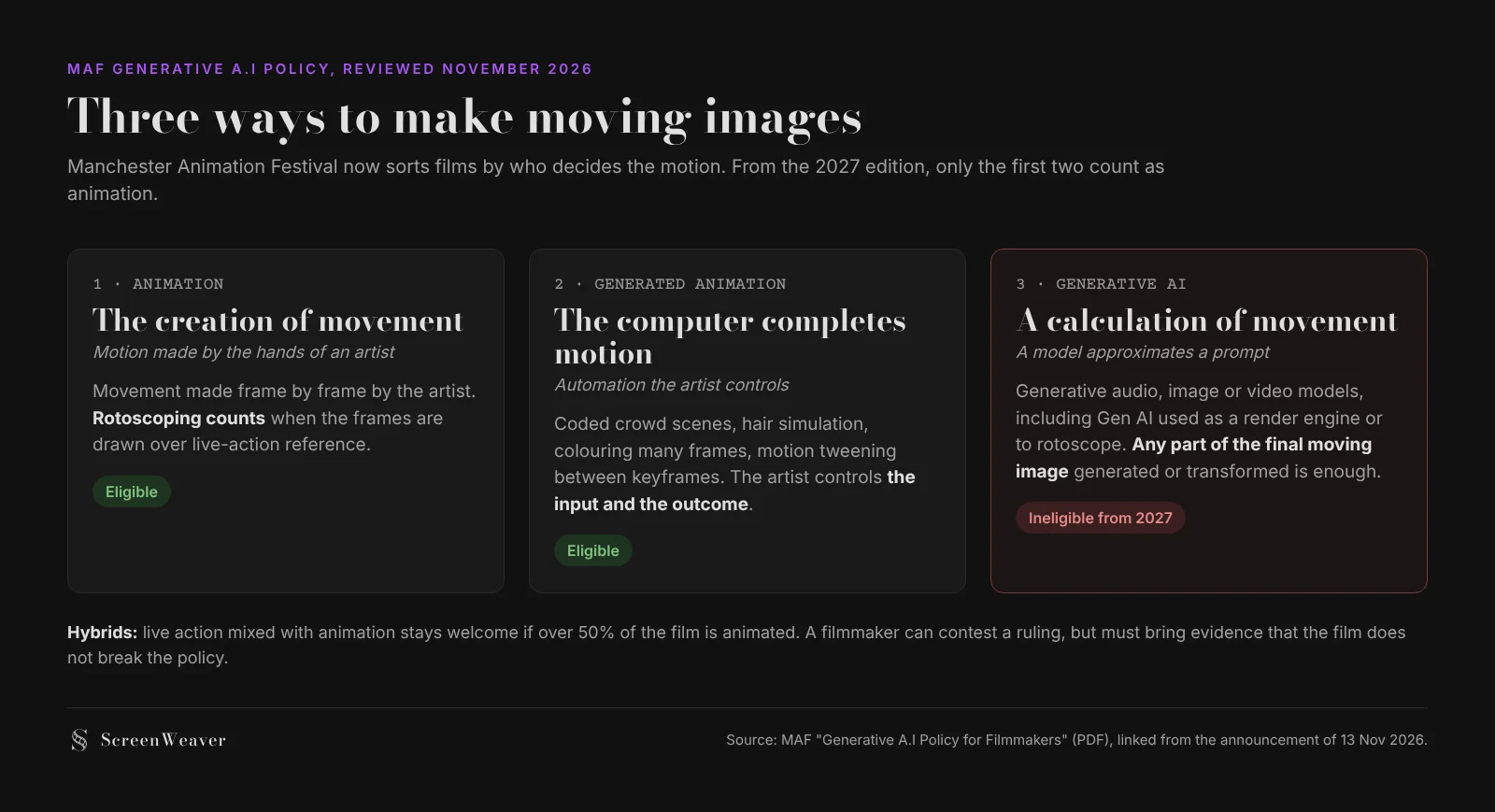
What MAF calls "generated animation" stays eligible: coded crowd scenes, hair simulation, colouring many frames, motion tweening between keyframes. The condition is that "the artist is in control of the input and the outcome". Generative AI is defined as "final pixel, on screen work" produced with generative audio, image or video models, where an operator gives a prompt and the model calculates an approximation of it.
Rotoscoping shows how fine the line is. A film drawn frame by frame over live-action reference is fully animated and eligible. A film that uses generative AI to rotoscope, or uses it as a render engine over animated work, counts as fully generated and is not. The PDF puts it in one sentence: "If it has been put through a Gen A.I model, it is the product of a Gen A.I."
Hybrids with live action remain welcome as long as more than 50% of the film is animated. The festival also gives its reasons: it cites copyright and environmental impact as open questions, and says that "whilst these questions remain unanswered we will not exhibit Gen A.I film". The PDF lists August 2027 as its next review date.
How it is enforced
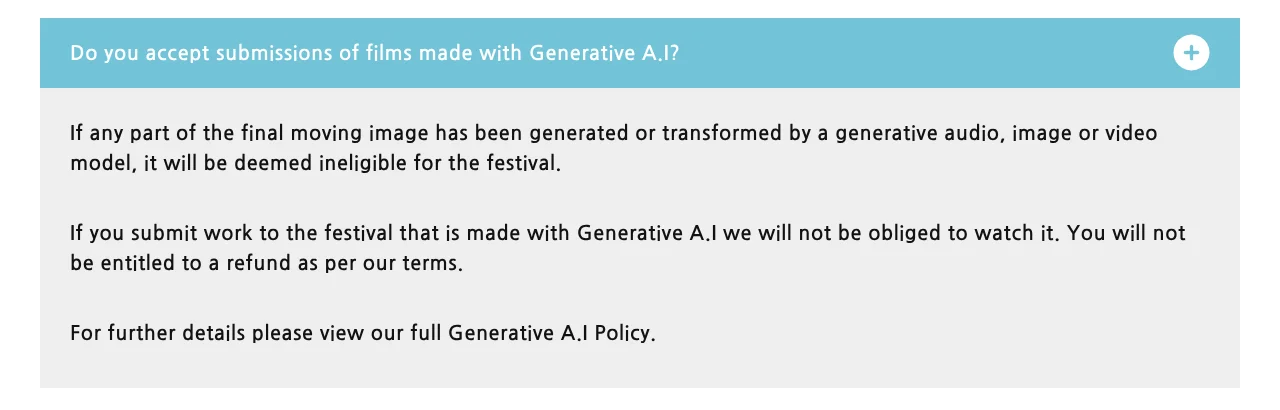
There is no detection system in the policy. A film found to use generative AI is ineligible, the festival says it is not obliged to watch it, and the entry fee is not refunded under the submission terms. A filmmaker who thinks a method was misread can contact the team under a "Right to Reply" clause, but has to bring evidence that the film does not break the policy, which the festival team or third parties will review.
The MAF 2027 calendar
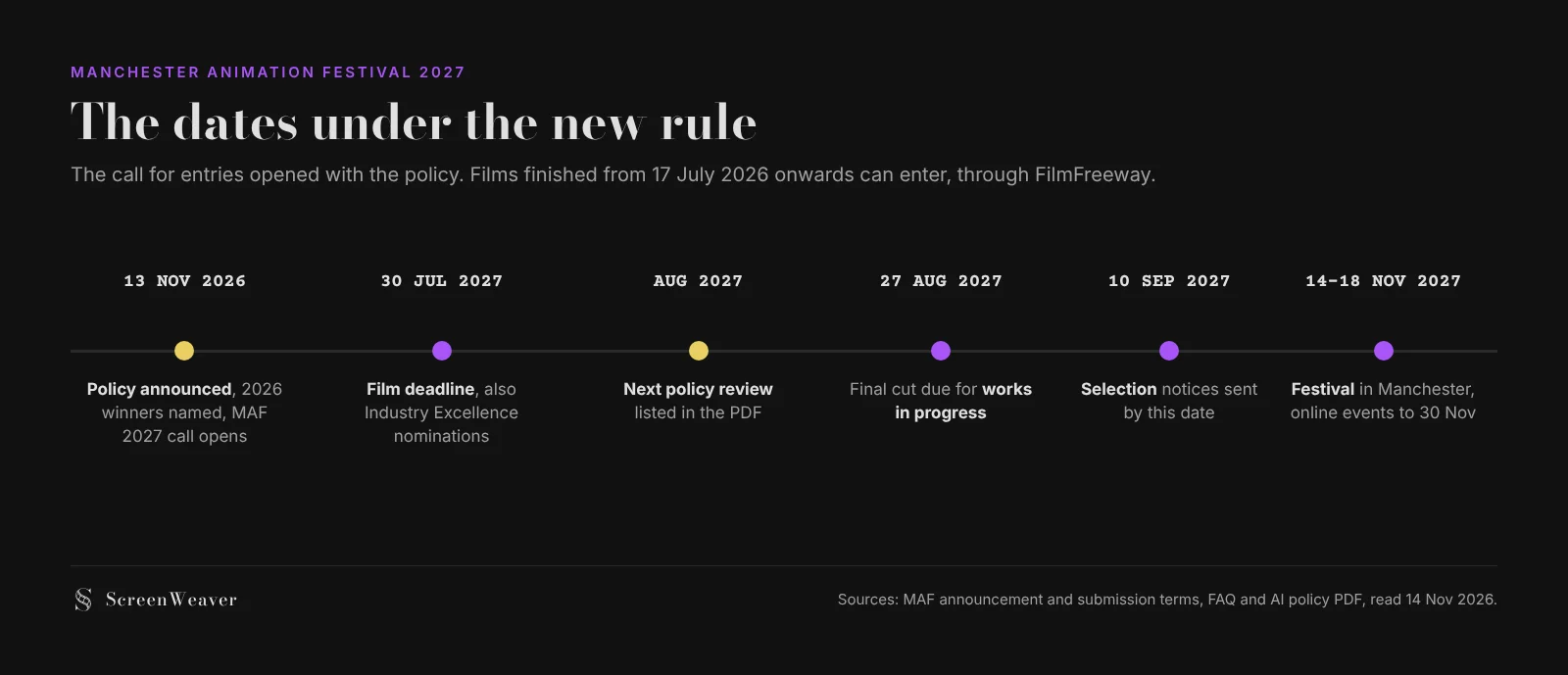
Films must be completed after 17 July 2026 and received by Friday 30 July 2027, through FilmFreeway. Works in progress can be entered if the finished film reaches the team before 27 August 2027. Selected filmmakers hear by 10 September 2027, and the festival returns from 14 to 18 November 2027, with online events from 19 to 30 November. The festival does not publish its entry fee on its own pages, and FilmFreeway refused our request, so we cannot confirm the amount.
What it means for AI filmmakers
The short version: if your film has generated shots in it, MAF 2027 is closed to you. Plenty of other doors are open. Our AI film festivals hub lists the events that welcome AI work, with deadlines and rules, and the AI film festivals guide for 2026 explains how to pick where to enter.
Three points are worth taking away anyway.
Read the rule, not the headline. MAF's line is about the final moving image. It is not a ban on software, and it says nothing either way about scripts, storyboards or animatics made with AI. If your pipeline used AI only before production, the PDF does not answer whether that counts, so ask the festival before you pay a fee. Other festivals draw the line elsewhere: some require disclosure, some run separate AI sections. Our guide to AI film disclosure rules covers the declarations platforms and festivals ask for.
Festivals do not agree, even in animation. Annecy's 2026 terms had no AI clause for competition films and asked for a disclosure only at the Mifa Pitches market, as our page on AI films at Annecy explains. Seoul's independent festival went the other way and built a section for AI shorts by known directors. Check the AI clause of every festival in your plan, every year: MAF reviews its policy annually.
Keep proof of your process. The Right to Reply clause puts the burden on the filmmaker. Whatever festival you target, keep your project files, source drawings and a short production note. It costs little and it answers the question before it is asked.
Try it free
Try ScreenWeaver for free on your script
It is free. Import your existing project, get a clearer view of your outline, and regain control of your story structure in minutes.
Start FreeWhat this means if you work in ScreenWeaver
ScreenWeaver is a writing and pre-production tool: script, story elements, storyboard and animatic, with generated images and clips where you choose to use them. If you aim at a festival with a rule like MAF's, plan it from the start. Use the storyboard as a guide for hand-made animation, keep generated frames out of the final cut, and keep the board as evidence of how the film was built. If you aim at an AI-friendly festival instead, the same board is where character and place references are fixed before any shot is generated, as our storyboard-first workflow explains.
Checklist before you enter an animation festival
- Read the festival's AI policy itself, not only the call for entries page.
- Map every step of your pipeline: which tools touched the final image, which only the planning.
- If a model generated or transformed any final frame, do not enter MAF 2027.
- Ask the festival in writing about grey areas (AI storyboards, AI upscaling, AI sound) before paying.
- Keep project files, source drawings and a dated production note.
- For hybrids with live action, check that more than half of the film is animated.
- Recheck the rule each year: MAF's next review is August 2027.
FAQ
Does Manchester Animation Festival accept AI films? Not from 2027. The festival announced on 13 November 2026 that films made with generative AI will not be accepted from the 2027 edition onwards.
What counts as generative AI for MAF? Final on-screen work produced with generative audio, image or video models. If any part of the final moving image was generated or transformed by such a model, the film is ineligible.
Are computer-assisted techniques still allowed? Yes, when the artist controls the input and the outcome. The policy names coded crowd scenes, hair simulation, colouring frames and tweening between keyframes. Rotoscoping by hand is eligible; rotoscoping with generative AI is not.
What happens if I submit an AI film anyway? It is ineligible, the festival is not obliged to watch it, and you are not refunded. You can contest a decision under the Right to Reply clause, with evidence.
When is the MAF 2027 deadline? Films completed after 17 July 2026 must be received by Friday 30 July 2027. The festival runs from 14 to 18 November 2027 in Manchester.
Who won Manchester Animation Festival 2026? In Waves by Phuong Mai Nguyen won the Feature Film Award, When the Sea Was Calm by Mamuka Tkeshelashvili the Short Film Award, and A Little Death by Leto Meade and Jonathan Rockefeller Best British Short, according to the festival's announcement of 13 November 2026.
From script to shots
Turn your script into a film, shot by shot
Write the scene, get its storyboard, then generate each shot with consistent characters. You direct every step.
Start your film free