Sin Cámara 2027 · Guide

How to win Sin Cámara, the Spanish AI short film festival.Two minutes. Free to enter. The public votes first.

The second edition's rules, the 17 genre prizes, the language rule and a plan to the 5 May 2027 upload deadline. Then write, storyboard and generate your short with ScreenWeaver.
  • Upload by 5 May 2027
  • 30 to 180 seconds
  • Spanish or no dialogue
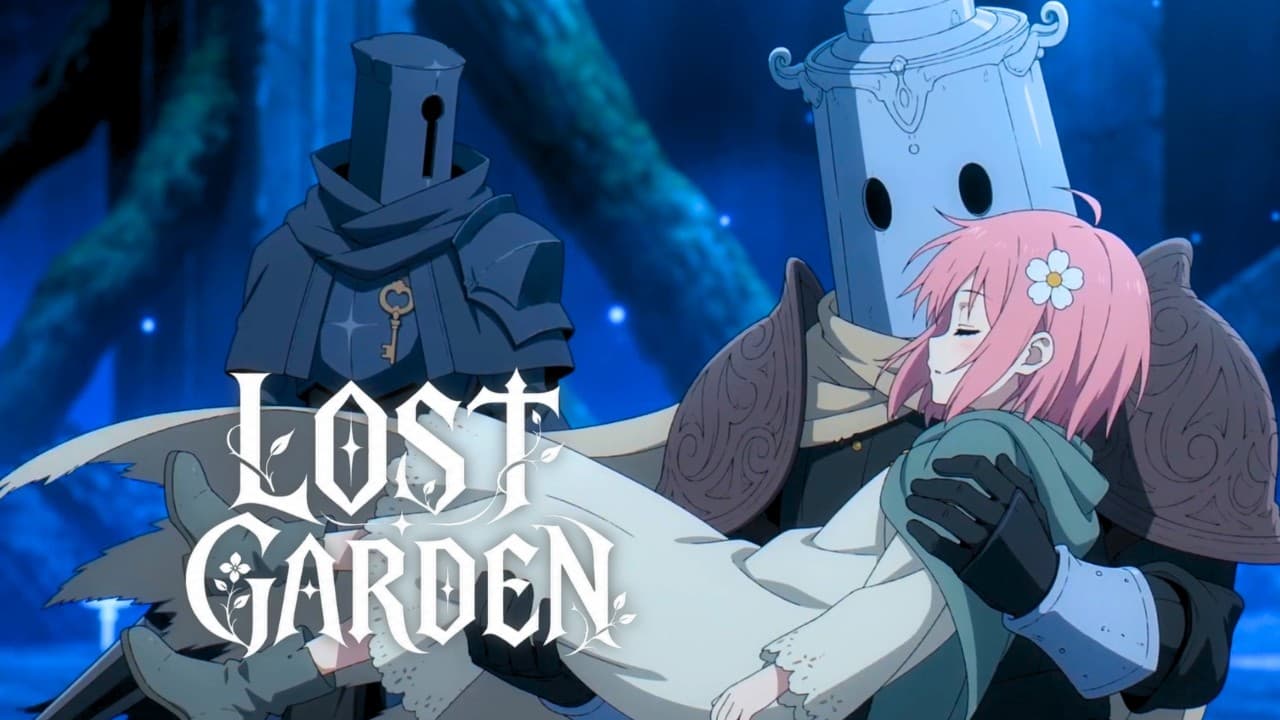
Lost Garden · Episode 1

Independent guide. ScreenWeaver does not organise Sin Cámara and is not affiliated with Aplimedia. Rules read on 1 October 2026. Official rules

Available today in ScreenWeaver: free screenwriting, and a storyboard generated from your screenplay with Storyboard Beta, $9.99 a month.

Rolling out: video generation of each shot, powered by Seedance, with the Filmmaker plan. The festival allows any AI tool, so you can generate with the one you already use.

The rules on one card

What Sin Cámara asks for.

Sin Cámara is organised by Aplimedia, a software company in Bilbao, for Spanish speakers in Spain and Latin America. The first edition ran in 2026. The second is in preparation: the site already takes registrations, and Festhome lists the call as opening on 1 January 2027.
Edition
2nd edition, 2027
Upload deadline
5 May 2027
Running time
30 to 180 seconds
Language
Spanish, or no dialogue
Entry fee
Free, one film or several
AI requirement
Wholly or partly made with AI, any tool
Files
MP4, MOV or WebM, 1 GB, Full HD at most
Prizes
Diploma and laurel: 3 overall, 1 per genre

Source: the rules page, the About page and the 2026 results on sincamara.click, read on 1 October 2026. The Festhome listing of the same rules still says a 90 second maximum, while the festival's own page says 180 seconds. The organiser can change the rules: check the page the week you upload.

Key dates

Seven months, and the public clock starts early.

The festival's own timeline is short: upload, vote, gala. Count backwards from 5 May, and remember that voting is open while the festival runs.
  1. Now

    Create your account

    The festival site takes registrations for the second edition. Accounts are verified by email, and the form asks for real, verifiable details.

  2. 1 Jan 2027

    Call opens on Festhome

    This is the date Festhome shows. The festival's own pages give no opening date, only the end of uploads.

  3. 5 May 2027

    Upload deadline

    Last day to upload. A film uploaded in January has four months of votes behind it, a film uploaded on 5 May has a few weeks.

  4. May 2027

    Shortlist by public vote

    The most voted films move to the final phase. Voting runs to 31 May, and the final judging procedure is announced before that phase.

  5. June 2027

    Closing gala

    Winners are announced and awarded. Festhome lists 6 June 2027.

How films are judged

A public vote, then five criteria.

Every verified user can score each film from 1 to 10. The most voted films reach the final phase. The About page then lists five criteria, with no weights, and says the final procedure will be announced later.
  • Image

    The festival's word is technical aspects. In two minutes that means one look held from the first shot to the last, a character who keeps the same face, and no frame that makes the viewer wonder what they just saw.

  • Sound

    Quality and design. A voice that matches the mouth, a room tone, a music cue that arrives on a cut. Sound is where a short made in a week can sound like a film.

  • Originality

    Unique creativity, says the page. The first edition's top films did not look strange, they felt specific: a metro car, a wartime farewell, a street at night.

  • Script

    Story and narrative. Two minutes holds one situation, one turn and one image to remember. Write it before the first prompt, and keep every line of Spanish short enough to say in one breath.

  • Beauty

    Visual aesthetics. Light, colour and composition, chosen once. A restrained palette beats a different style on every shot, and it is much cheaper to keep consistent.

A film's average score stays hidden until it has 100 votes. Votes the system finds suspicious do not count: inflated scores from accounts that voted for a single film, and sunk scores aimed at a rival.

Who decides

Three gates, in this order.

The festival does not publish a jury. It does publish the sequence your film goes through, and the first gate is not a jury at all.
  • The festival team

    Every film is first marked pending validation, then suitable or not suitable. A film that is not suitable is not published and cannot be voted on. The organiser does not have to explain why.

  • The verified voters

    Registered users with a verified email score films from 1 to 10 and can change their vote at any time. In 2026, 171 verified voters scored 113 films, so a few dozen real fans can move a ranking.

  • The final judging

    How the finalists are judged is announced before the final phase, so it is not known today. Plan for the criteria on the About page and for a film that works with the sound off and with the sound on.

The genres

Seventeen genres, one prize each.

Besides the three overall prizes, the festival gives one award per genre, from Action to Western. A genre prize is a second way to win. Five that suit a short AI film, with the angle we would take.
  • 01

    Animation

    The first edition's second prize went to Madrid, 1936, an animation about a family separated by the civil war and reunited in one embrace.

    A flat, painterly style hides small glitches and keeps a character stable. Choose a look you can reproduce on every shot and keep the story to a single emotion.

  • 02

    Drama and romance

    The first edition's best film, El metro, is a romance. Las últimas monedas, a drama about an old man who lives on the street, took the organisation's Most Impactful award.

    One place, two people, one gesture. The cheapest story to stage is also the easiest to keep consistent: few locations, few faces, no crowd.

  • 03

    Comedy

    Tolerante, by Xavier, won Best Comedy in 2026, the same year he won Best Film with a romance.

    Comedy lives on timing, and AI shots arrive in short blocks. Cut tight, build to the last five seconds and write the joke in the Spanish line, not in the prompt.

  • 04

    Fantasy and science fiction

    Rainbow Brite took fantasy and MADRE NATURALEZA took science fiction in 2026.

    A world in one image, one rule in one sentence. Do not explain the universe: show one corner of it and let the viewer imagine the rest.

  • 05

    Documentary and Latin identity

    A documentary about Alzheimer's took its genre prize in 2026. The rules also say that works reflecting Latin and Hispanic culture and identity get special consideration.

    A real subject with generated images works when you say what is generated. A story from your own street, family or town fits the festival's stated preference better than a generic sci-fi city.

The 2026 edition

What the first palmarés shows.

The first palmarés was published on 6 June 2026: 113 films in competition and 171 verified voters. Best Film went to El metro, a romance by Xavier. Second went to the animation Madrid, 1936 and third to the adventure The Fat Mummies.

  1. 01

    Small stories won. El metro is two parallel lives on one subway line and one exchange of glances. Madrid, 1936 packs a lifetime of absence into a single embrace.

  2. 02

    Genre prizes multiply your chances. Xavier took Best Film and Best Comedy, and Voragine took science fiction and drama, each with a different short. The rules allow one film or several per person.

  3. 03

    The electorate was small. With 171 verified voters for 113 films, the shortlist is decided by hundreds of votes, not thousands. Your own audience matters, as long as it votes honestly.

  4. 04

    Some sections were left vacant. The palmarés lists genres with no award. A genre prize is not automatic: a film has to earn it.

From script to screen

Lost Garden: one scene, six shots, one set.

Here is the Source Tree scene from Lost Garden, episode 1, the animated fantasy series the ScreenWeaver team makes with Seedance. Six shots on one set and one idea: the size of a Sin Cámara short. Its dialogue is in English. For this festival you would write it in Spanish, or cut it down to a silent film.

Logline. A small knight wakes up in a dead world and learns he is the last guardian of a seed that could bring the garden back.

Screenplay · episode 1 · the Source Tree

INT. HEART OF THE ROOTS - NIGHT

Living roots coil around LANTERN and pin him down. A voice stops them.

THE SOURCE TREE

Stop. He is my guest.

A giant woman of roots and white lilies opens her arms over the cavern.

Her eyes open. Blue, and vast.

THE SOURCE TREE

Welcome to you, Lantern Knight.

She lifts him in her palm, like a lamp.

THE SOURCE TREE

Do not be afraid. I will not harm you.

In the dark, a seed of light opens. Inside the flower, a sleeping child.

THE SOURCE TREE

You must find yours. Protect her.

CUT TO:

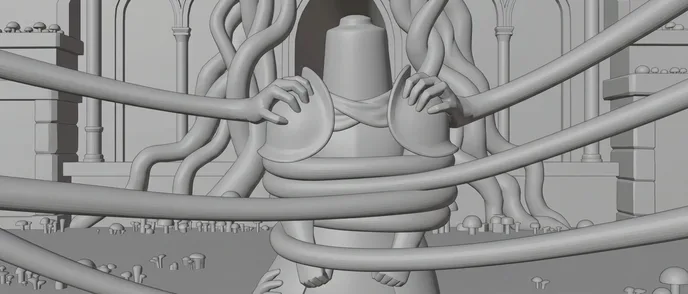
  1. A small lantern-helmed knight bound by thick roots in a ruined hall
    Storyboard frame of the trap shot, in grey
    01

    Medium · the trap

    Medium shot, Lantern bound by thick living roots in a ruined hall, glowing blue mushrooms on the floor, cold light

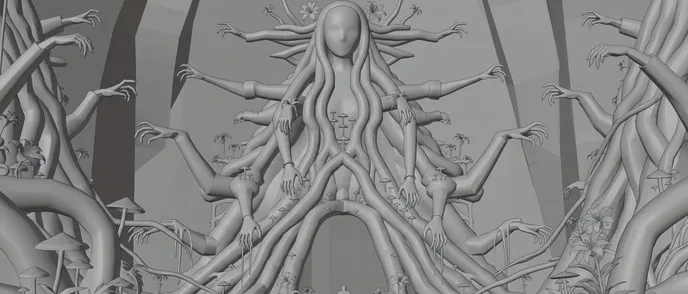
  2. A giant woman made of roots and white lilies spreads her many arms in a dark cavern
    Storyboard frame of the wide shot, in grey
    02

    Wide · the Source Tree

    Symmetrical wide shot, a giant woman made of roots, arms spread with many hands, white lilies, blue glyphs

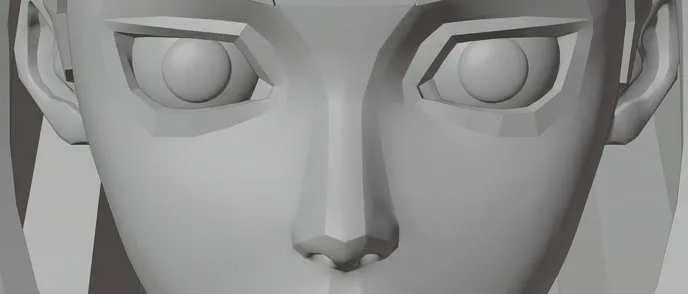
  3. Extreme close-up of a giant pale face with piercing blue eyes
    Storyboard frame of the eyes close-up, in grey
    03

    Extreme close-up · the eyes

    Extreme close-up on the giant's face, piercing blue eyes opening, pale skin, soft light from below

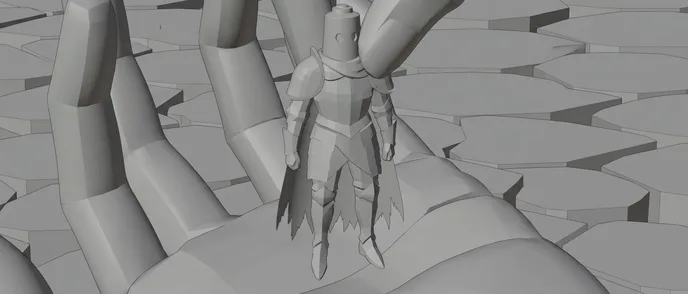
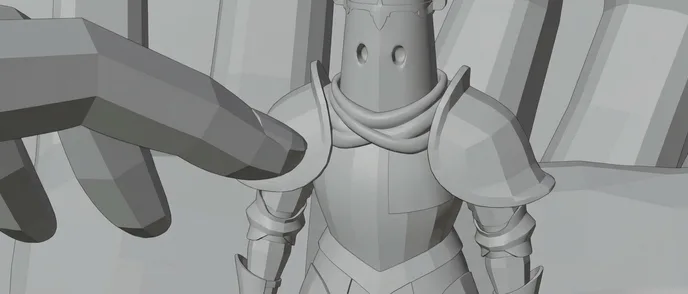
  4. A tiny armored knight stands in the middle of a giant open hand
    Storyboard frame of the palm shot, in grey
    04

    High angle · the palm

    High angle, the tiny knight standing in the center of a giant open palm, stone floor far below

  5. A giant fingertip gently touches the chest of a small armored knight
    Storyboard frame of the touch close-up, in grey
    05

    Close-up · the touch

    Close-up, a giant fingertip gently touches the knight's armored chest, faceless helm, emotion through posture

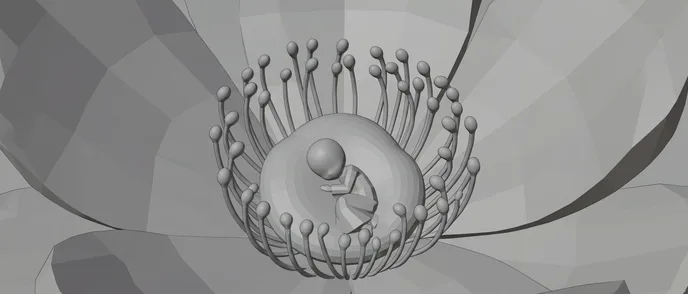
  6. A sleeping pink-haired child curled inside a glowing blue flower
    Storyboard frame of the seed insert, in grey
    06

    Insert · the seed

    Top-down insert, a glowing pale blue flower opening, a sleeping child with pink hair curled inside

Lost Garden, episode 1 is 17 minutes long and was a finalist at the AI London Festival. A scene like this one, six shots on a single set, is what a 90 to 180 second short is made of. The player opens on the Source Tree, about 7 min 35 in.

The script

A 2 minute 30 film in five movements.

Aim for 2:30. That sits inside the 30 to 180 second window with room to trim, and it is about 25 to 35 shots of 4 to 6 seconds.
  1. 0:00 to 0:10

    The image

    One striking frame, no title card. The voter decides in these seconds whether to stay.

  2. 0:10 to 0:35

    The situation

    Who, where, and what is wrong. Two lines of Spanish at most.

  3. 0:35 to 1:35

    The turn

    Something shifts. This is the longest movement, and where the story earns its genre.

  4. 1:35 to 2:10

    The gesture

    The character acts. A look, a hand, a decision, with no explanation after it.

  5. 2:10 to 2:30

    The echo

    Return to the first image, changed. Then a short credit.

Dialogue must be in Spanish, so write it first and keep it sparse. A film with no dialogue is allowed and needs only sound design, which also makes it easier to enter from any country.

Month by month

From the blank page to the upload button.

Seven months to 5 May 2027. The plan below finishes in April, so that the film collects votes for as long as possible.
  1. 01

    October 2026

    A genre, a place, a gesture

    Pick the genre prize you want. Write five loglines of one sentence each and tell them to someone who speaks Spanish. Keep the one they can repeat.

  2. 02

    November 2026

    The screenplay

    Two pages, a handful of lines. Write it for free in ScreenWeaver, in industry format, and read the Spanish lines aloud before you move on.

  3. 03

    December 2026

    Characters, set and storyboard

    One reference per character and one for the set. Generate the shot breakdown and the storyboard from the screenplay, then adjust framing and duration shot by shot.

  4. 04

    January and February 2027

    Generate the footage

    Scene by scene from the storyboard and the references, with any AI tool the rules allow. Keep the prompts and versions: they are your proof of process if anyone asks.

  5. 05

    March 2027

    Edit and sound

    Cut to 2:30, record or generate the Spanish voices, add music you may use, then export MP4 in Full HD, under 1 GB.

  6. 06

    April 2027

    Upload early and share

    Register the film in its genre and ask people who really watch your work to score it. One honest 8 is worth more than ten inflated 10s, which the system removes.

Rejection traps

Seven ways to be left out.

The rules are short, and a film marked not suitable is not published. Read them before you generate anything.
  • The wrong language

    Films must be in Spanish or have no dialogue. The rules call this requirement fundamental. A film in English with Spanish subtitles is not what they describe.

  • Two different limits

    The rules page says 30 to 180 seconds. The About page headlines 90 seconds and the Festhome listing says 90. If you can, deliver 90 seconds or less and you are safe under every version.

  • A file that is too heavy

    Maximum 1 GB and Full HD, 1920 by 1080 or 1080 by 1920 for vertical. MP4, MOV or WebM, with H.264 or H.265. A 4K master has to be downscaled.

  • Content that is not allowed

    No extreme violence, explicit sexual content, discrimination, anything illegal or anything against human dignity. A horror short can still enter, but keep it restrained.

  • Rights you cannot give

    You declare you own all exploitation rights and that nothing infringes a third party. Unlicensed music is the usual way to break that. Use music you made, generated or hold a licence for.

  • A broad licence

    You give the organiser a non-exclusive, unlimited licence to show your film anywhere in the world, including in promotions, ads and sponsor material. You keep ownership and credit. Think about it before you upload a film you plan to sell.

  • Voting games

    Accounts that vote 10 for one film and nothing else are filtered, and the organiser may block them. A campaign made of friends who join only to vote works against you.

Why ScreenWeaver

A two minute film is a one scene project.

ScreenWeaver takes a film from the first line to the last frame inside one connected project. A short for this festival is the smallest and cleanest case of that.
  • Free where it counts

    The festival is free to enter, and the writing can be too: the Screenwriter plan costs $0 with no expiry date. Storyboard Beta is $9.99 a month if you want the storyboard generated.

  • The same character in every shot

    References for characters and sets carry from shot to shot, which is what stops a hero changing face halfway through two minutes.

  • Any tool allowed

    The festival names Runway, Sora, Midjourney, Pika and others and imposes none. Footage pipelines in ScreenWeaver run on Seedance 2.0 and 2.5, and are rolling out with the Filmmaker plan.

  • A process you can show

    Every shot keeps a link to its scene, its frame and its prompt, since the pipelines start from the script. Useful for your own edit, and for the day someone asks how it was made.

Real productions

International festival-recognized films have been written and produced with ScreenWeaver.

ScreenWeaver is already being used as a creative workspace for real AI film productions, from cinematic shorts to animated series pilots selected, nominated, and awarded by international festivals.

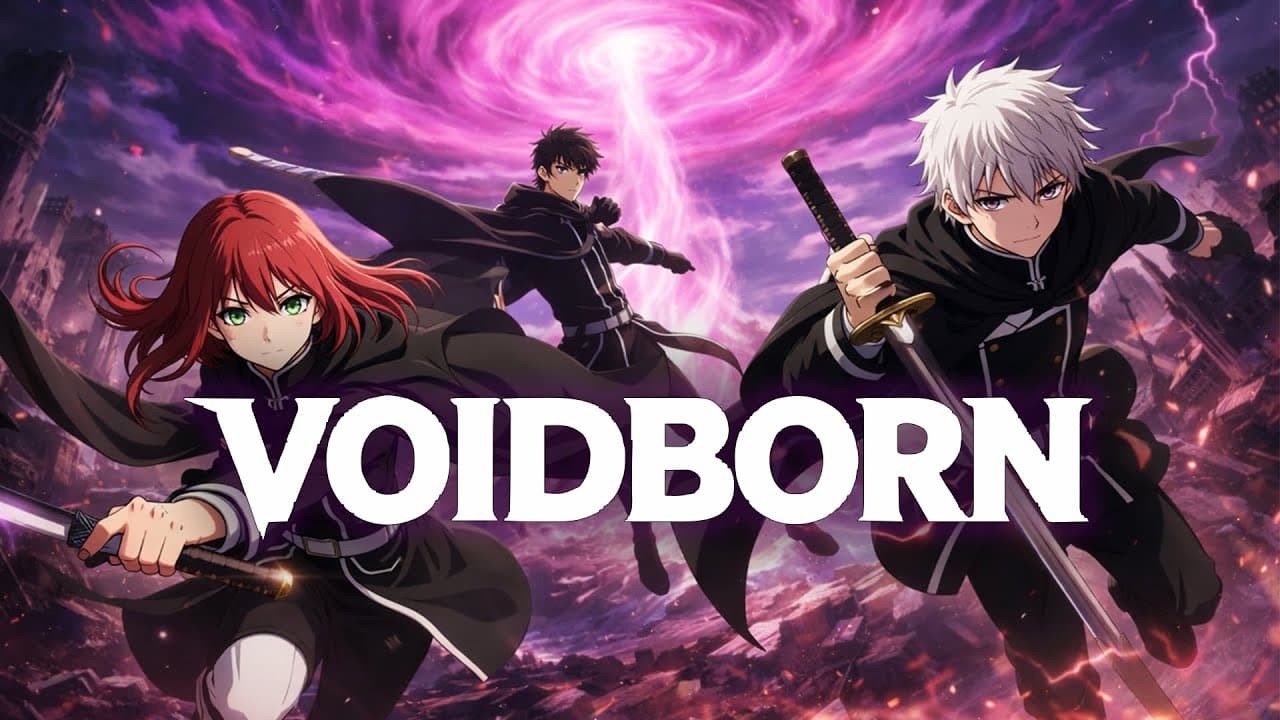
  • Video thumbnail for VOIDBORN

    VOIDBORN

    AI animated / cinematic short

    Festival recognition

    • 1st Place Silver

      Mondial Chroma Awards

    • 2nd Place Dreamina

      Mondial Chroma Awards

    • Award Winner

      Seoul International AI Film Festival

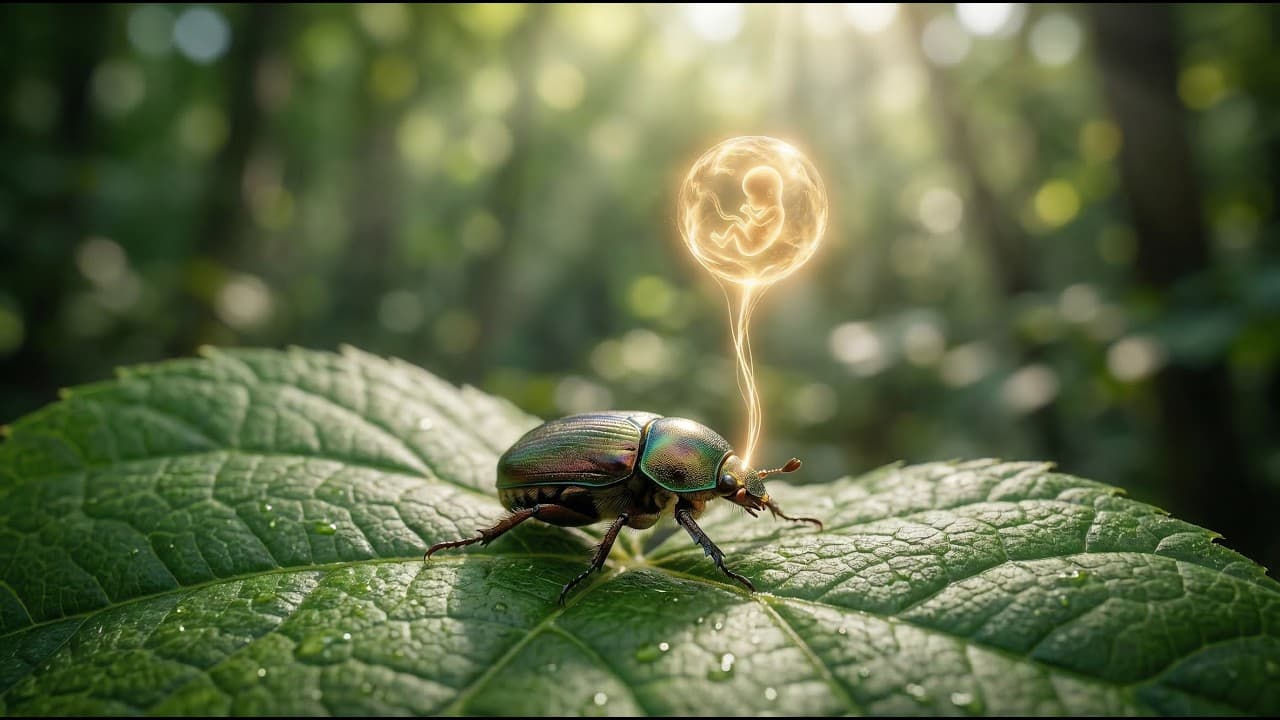
  • Video thumbnail for Les Fils du Vinnana

    Les Fils du Vinnana

    AI short film

    Festival recognition

    • Honorable Mention

      Top Quark Film Festival

    • People's Choice Nominee

      Illuminate Oneness of Humanity

    • Nominee

      ALTFF Supershort

  • Video thumbnail for Lost Garden

    Lost Garden

    AI animated series pilot

    Festival recognition

    • Finalist

      AI London Festival

The pipeline

Write. Board. Produce.

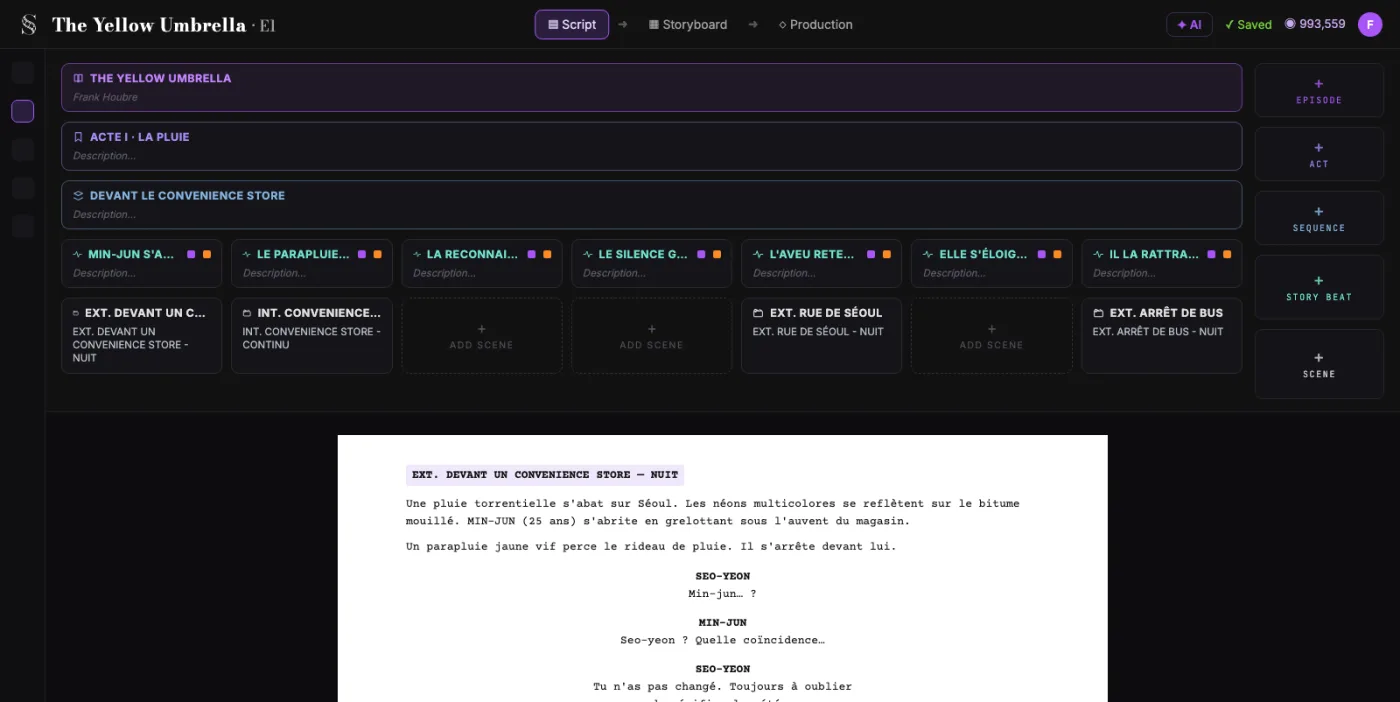
  1. ScreenWeaver screenplay editor: acts, sequences and beats above the formatted script of The Yellow Umbrella

    01The screenplay, enriched

    An industry-standard screenplay editor, and more: a visual outline and beat editor, your writing inspirations (notes, photos, audio) kept next to the page, and an AI researcher to support your writing, not replace it.

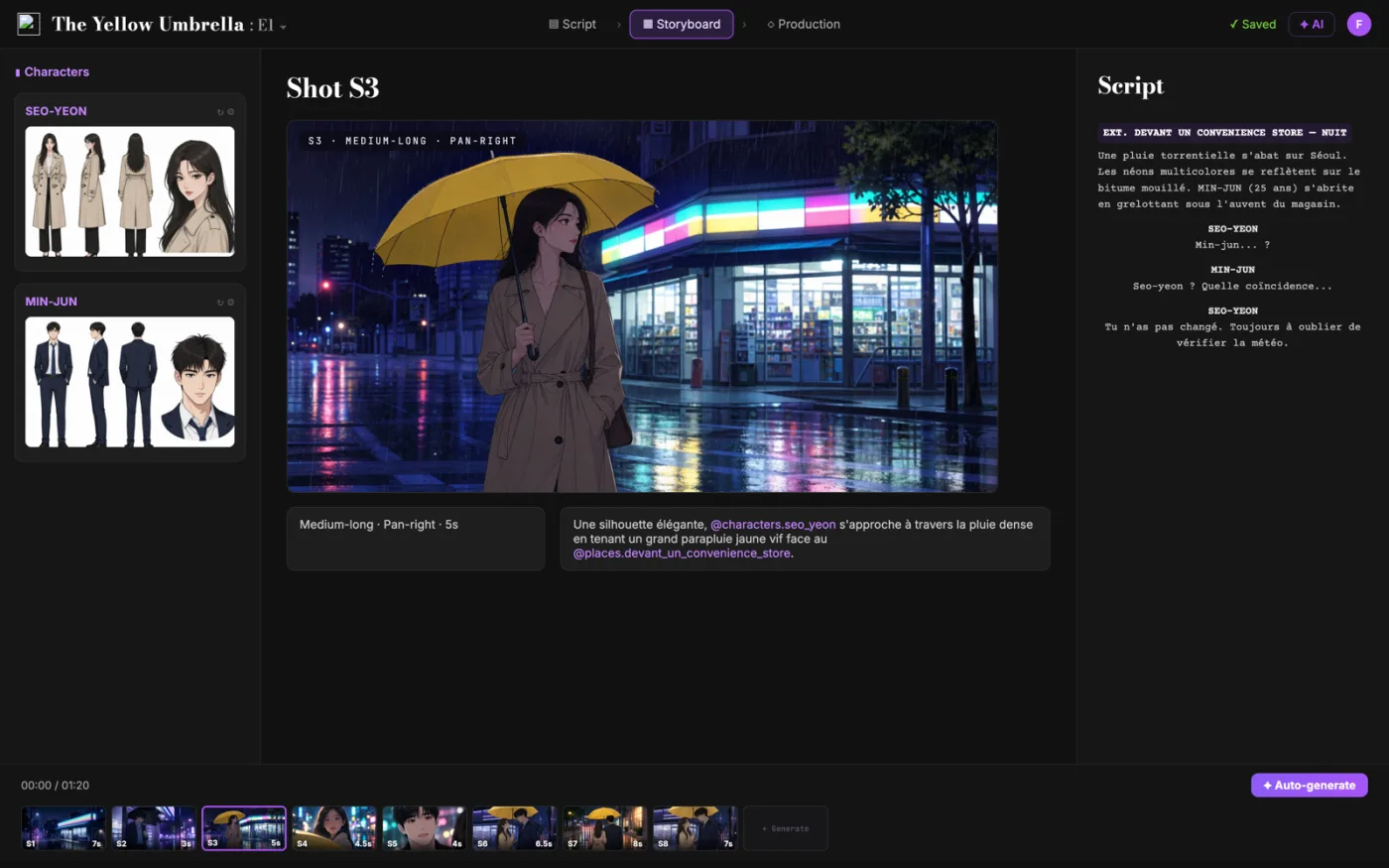
  2. ScreenWeaver storyboard: shot S3 of The Yellow Umbrella with characters, shot settings and the script beside it

    02The storyboard, made easy

    Shot breakdown generated from your screenplay, manual control over every shot (frame, angle, movement, duration), and generative AI previsualization in one click.

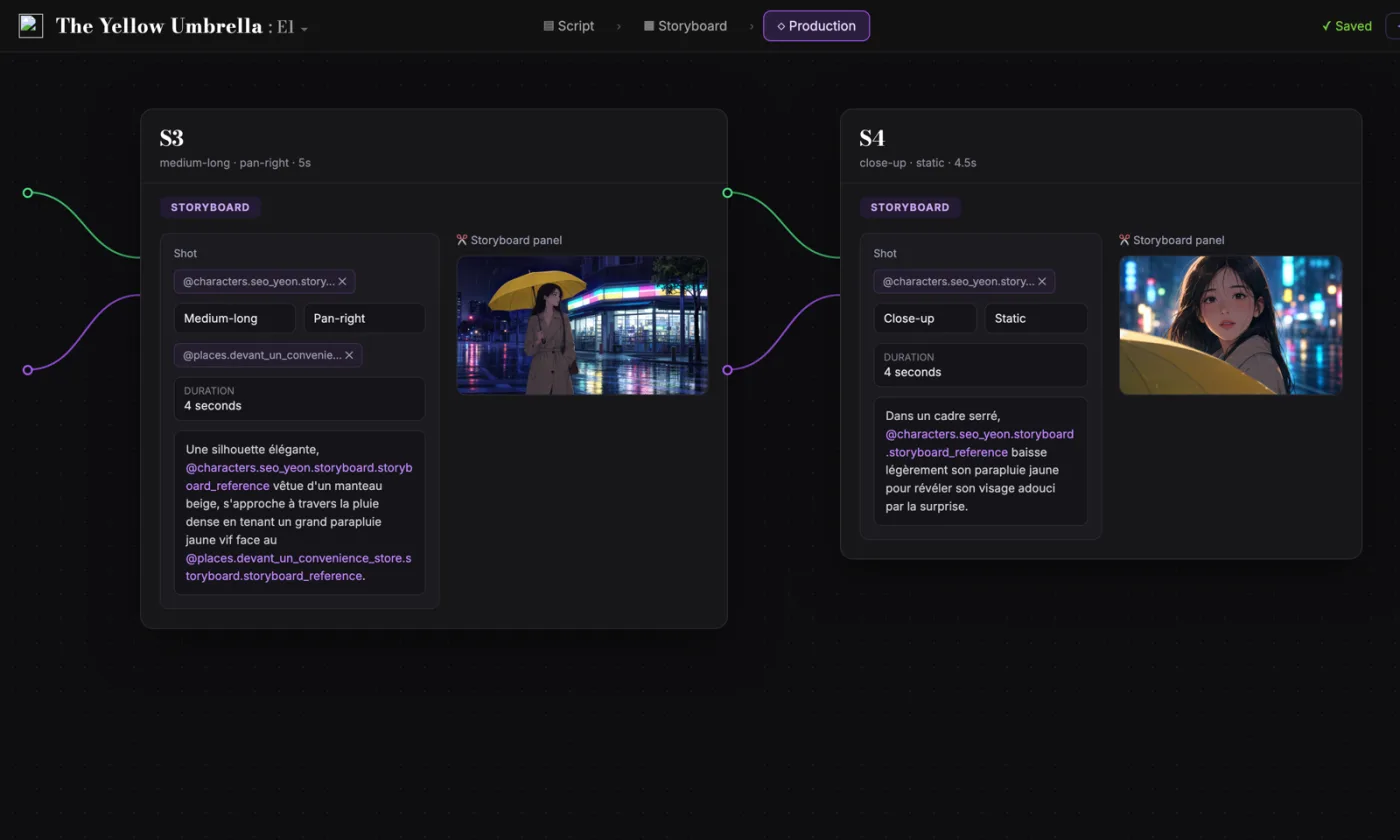
  3. ScreenWeaver production canvas: shots S3 and S4 as connected nodes carrying their storyboard panels and prompts

    03AI production, with finesse

    Footage generation pipelines connected to your screenplay and storyboard. Optimized out of the box, fully editable workflow.

FAQ

Sin Cámara, your questions

How do you win Sin Cámara?
Win the public vote first. Verified users score every film from 1 to 10, and the most voted films reach the final phase. Then a final judging, announced later, picks the three overall prizes and one prize per genre. The About page lists image, sound, originality, script and beauty as criteria.
Can I make my film for Sin Cámara with ScreenWeaver?
The festival accepts any AI tool, so yes. ScreenWeaver covers the screenplay and the storyboard today, and its footage pipelines, powered by Seedance 2.0 and 2.5, are rolling out with the Filmmaker plan. Until then, generate the shots with the tool you already use.
How long can the film be?
The rules page says 30 to 180 seconds. The About page and the Festhome listing still mention 90 seconds. Deliver 90 seconds or less if you want to be safe whichever version is right.
Does my film have to be in Spanish?
Yes, or it must have no voice or dialogue at all. The rules call this a fundamental requirement. The festival also says it gives special consideration to works that reflect Latin and Hispanic culture and identity.
Is it really free, and what do I give up?
Entry is free: no payment is needed to register or submit. In return you give the organiser a non-exclusive, unlimited, worldwide licence to show the film, including in promotion and sponsor material. You stay the owner and are credited.
Are there cash prizes?
The rules and the About page list a diploma and the festival laurel for the three overall prizes and the genre prizes, with public screening and promotion. The official pages show no cash amount, and the festival says the specific prizes are announced during the festival.
Can I submit more than one film?
Yes. The rules say each participant can submit one film or several, as long as each is original and within the limits. In 2026, two creators won in two genres with different films.
Who can enter?
Individuals aged 16 or over who register with real, verifiable details, including a national ID number and an address. The festival is aimed at the Spanish-speaking community of Spain and Latin America.

Seven months. Start with the page.

Put the first page down this week, at no cost. Storyboard it, then give it a Spanish voice.