AI Video Prompt Generator
Cinematic prompts for Veo, Sora, Runway & Kling
Describe your shot the way a director briefs a DP: subject, action, framing, movement, light. This free generator assembles those choices into a structured prompt that text-to-video models parse reliably, instead of a guessed string of adjectives.
AI video models respond best to real film grammar in a consistent order: shot size, subject, action, setting, camera movement, lighting, lens character, style, and mood. That is exactly the structure this tool builds, with copy-ready text or JSON output.
Prompt assembly is deterministic and runs entirely in your browser. Nothing you type is sent to any server.
Pick the framing, movement, and look. Leave anything empty to keep the prompt lean.
Your prompt
Describe a subject above and your prompt will assemble here.
How it works
The generator assembles your choices in the order text-to-video models parse best: framing first, then subject and action, then setting, then camera movement, lighting, lens, style, and mood. Every option comes from real cinematography vocabulary, the same shot sizes and movements a shot list would use, so the model receives instructions instead of atmosphere words. The JSON tab outputs the same shot as structured fields for pipelines and batch workflows.
How to write AI video prompts that actually work
The most common AI video failure is not the model, it is the prompt: a pile of style adjectives with no clear subject, no concrete action, and no camera instruction. The model fills every unspecified gap with its own inventions, which is why results drift between generations.
Strong prompts read like shot descriptions, not mood boards. One subject, one action a camera could film, one framing, one movement. 'Close-up of a weathered detective lighting a cigarette in a rain-soaked alley, slow push-in, neon night lighting' beats 'moody cinematic noir vibes, 4K, masterpiece' on every major model.
Consistency across shots comes from repetition, not luck. Lock your subject and setting descriptions word-for-word and reuse them in every prompt of the sequence, changing only the shot grammar. That is how AI filmmakers keep a character recognizable from the wide shot to the close-up.
Who this is for
- AI filmmakers: generate a matched set of prompts for a full sequence instead of improvising each clip from memory.
- Directors previsualizing: prompt the wide, medium, and close-up of the same moment to test coverage before a real shoot.
- Content creators and studios: get repeatable, commercial-grade shot prompts without learning prompt folklore from scattered forum threads.
Start from the screenplay.Get the storyboard.
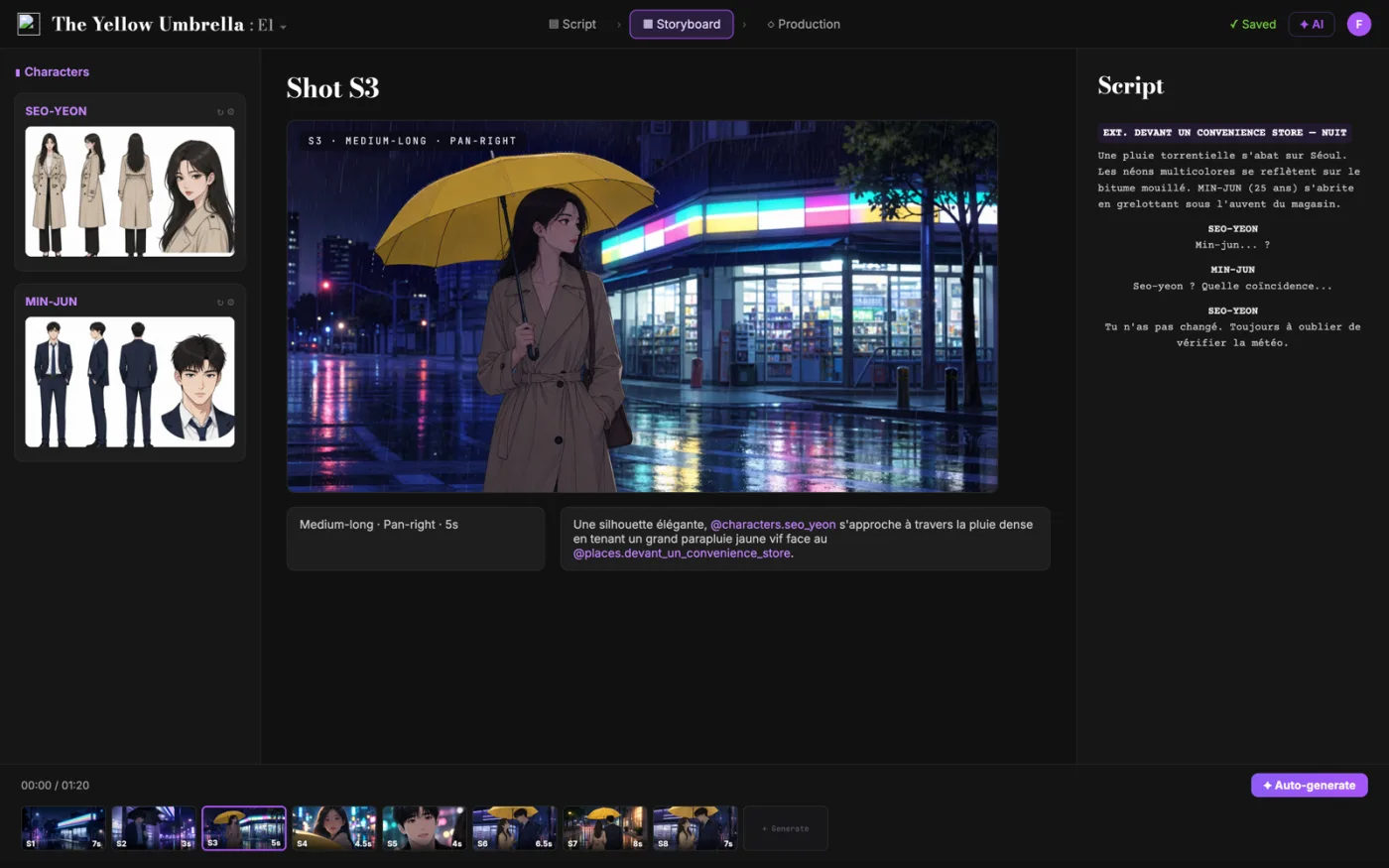
ScreenWeaver breaks your script into shots and generates the storyboard from it. You control framing, angle, movement and duration. Characters carry from shot to shot.
- $0, does not expire
- PDF and Final Draft export
- Mac, Windows, Linux, iPad
AI Video Prompt Generator: the complete guide
It assembles a structured cinematic prompt from real film language: shot size, camera movement, lighting, lens character, style, and mood, in the order text-to-video models parse best.
For this workflow, the central problem is clear: most AI video prompts are improvised strings of adjectives, so results drift between generations and never match the shot the creator actually imagined. Left unresolved, this creates downstream friction and slower decisions. The practical target is consistent, film-grammar-correct prompts that tell Veo, Sora, Runway, Kling, or Seedance exactly which shot to build.
Limitation to keep in mind: It builds the prompt, not the video: each model still interprets language differently, and character or location consistency across shots requires a workflow, not a single prompt.
Advanced workflow: Serious AI filmmakers keep a prompt sheet per scene, lock recurring subject and setting descriptions word-for-word across shots, and vary only the shot grammar between generations.
Step-by-Step Workflow
- Describe your subject and action in plain, concrete language: what a camera would actually see.
- Pick the shot size and camera movement the moment needs, the same way you would brief a DP.
- Choose lighting, lens character, style, and mood, then copy the assembled prompt or its JSON form.
- Reuse identical subject and setting wording across every shot in the scene to protect continuity.
Use Cases By Profile
- AI filmmaker: generate a matched set of prompts for a sequence instead of improvising each clip.
- Director: previsualize a scene's coverage by prompting the wide, medium, and close-up of the same moment.
- Content creator: get repeatable commercial-grade shots without learning prompt folklore from scattered threads.
Common Mistakes To Avoid
- Stacking ten style adjectives instead of one clear subject, one action, and one camera instruction.
- Changing the subject description between shots and wondering why the character's face drifts.
- Prompting emotional abstractions instead of physical, filmable descriptions of what is in frame.
Professional Best Practices
- One prompt, one shot: describe a single camera setup, not a whole scene of coverage.
- Concrete beats abstract: 'rain dripping from a fire escape' outperforms 'moody atmosphere'.
- Keep a locked description block for each recurring character and paste it verbatim into every prompt.
Treat this tool output as a decision support layer, not a replacement for authorship. Great scripts are remembered for specific choices, emotional precision, and clarity of dramatic movement. Tools help by removing noise so your energy can go where it matters: character, conflict, escalation, and payoff. If you review outcomes after each pass and keep an explicit log of accepted changes, your workflow becomes faster and more predictable from draft to draft. That consistency is exactly what professional collaborators value: fewer surprises, clearer rationale, and a script that evolves with intent.
Extended FAQ
What makes a good AI video prompt?
One clear subject, one concrete action, one camera instruction, then lighting and style. Models parse structured film grammar far better than a pile of adjectives, which is exactly what this generator assembles.
Do prompts work the same on Veo, Sora, Runway, and Kling?
The core structure transfers well across all major models, but each interprets language slightly differently. The generated prompt is a strong starting point; expect one or two iterations per model to dial in the result.
How do I keep a character consistent across AI video shots?
Lock the character's physical description word-for-word and reuse it in every prompt. Consistency comes from repeating identical wording across shots, which is easier when prompts come from a structured tool instead of memory.
Should I use text or JSON prompts?
Most models take natural-language prompts, which is the default output here. JSON is useful for structured pipelines, batch workflows, and models or tools that accept field-based input.
Why do my AI video results look different every generation?
Vague prompts leave the model free to reinvent everything. The more concretely you specify subject, action, framing, and lighting, the narrower the model's freedom and the more repeatable the result.
Can I use these prompts for a full AI short film?
Yes, treat each prompt as one shot in your shot list. Plan the sequence first, keep subject and setting descriptions locked across prompts, and generate shot by shot the way a production shoots coverage.
Frequently asked questions
Yes. The prompt structure it builds, framing, subject, action, setting, movement, lighting, style, transfers across all major text-to-video models. Each model interprets language slightly differently, so expect a refinement pass per model.
No. It assembles your choices deterministically using real film grammar, in your browser, with no API calls. You get the same prompt for the same inputs every time, which is exactly what shot-to-shot consistency needs.
Text works for every major model's prompt box. JSON is useful for structured pipelines, batch generation workflows, and tools that accept field-based input.
Reuse the exact same subject description word-for-word in every prompt of the sequence, and only change the shot type, movement, and action between generations.
Vague prompts leave the model free to reinvent everything it was not told. The more concretely you specify subject, action, framing, and lighting, the narrower its freedom and the more repeatable your results.
Related tools
Scene to Clip Splitter
Split a scene into AI video clips that fit your model's duration cap.
AI Character Consistency Sheet
Build a reusable character block that stops drift across AI video clips.
Camera Movement Prompts
Animated library of camera moves with copy-paste AI video prompts.
Storyboard Template Generator
Create printable storyboard sheets in any aspect ratio.
You can also browse the full library on /tools.
Core blog guides
- Idea → first draft (process hub)
- Screenplay format guide 2026
- Hidden costs of “free” software
- Affordable software & TCO
- Revision passes (structure → dialogue)
Film techniques
Film techniques to explore
Each one with a short clip, a screenplay excerpt and the shot list line.