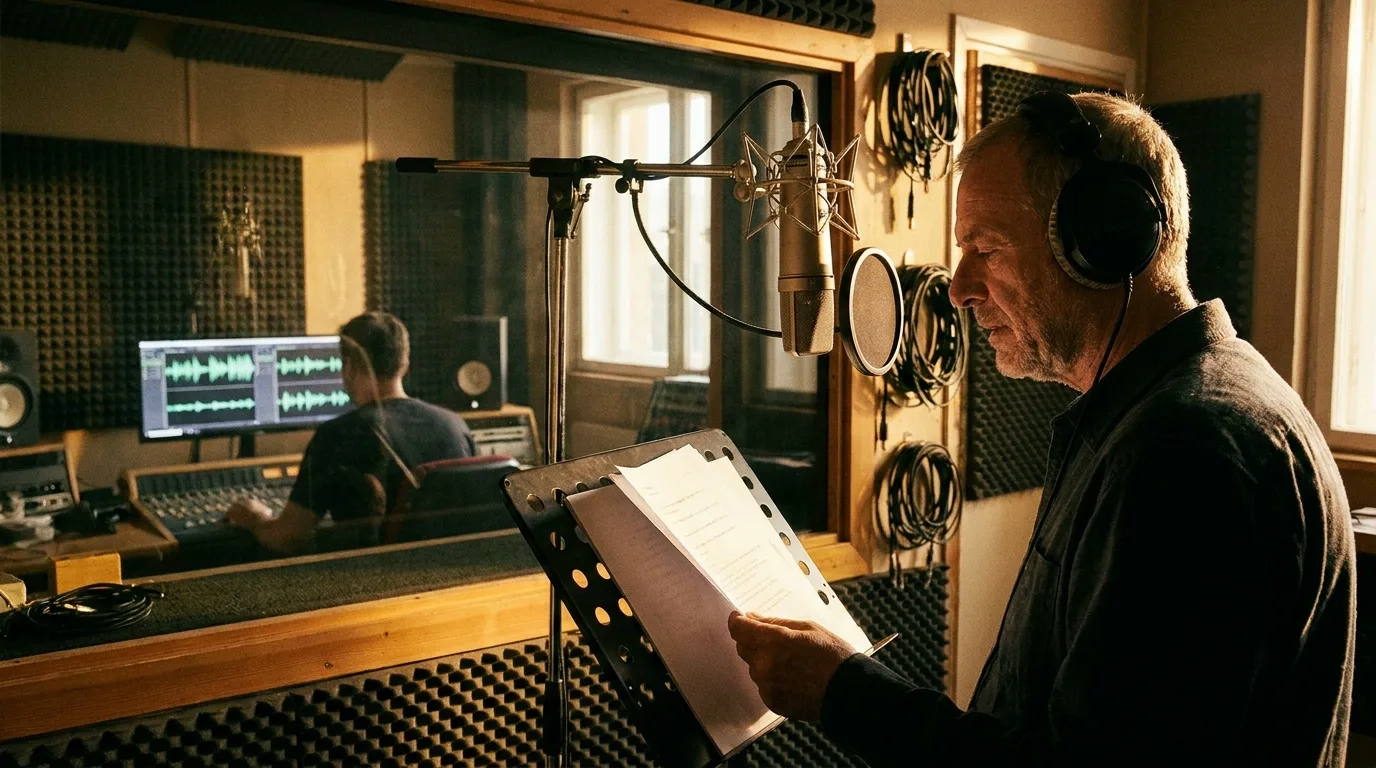

Jacek Rozenek has voiced Geralt of Rivia in Polish since the first Witcher game. He had a stroke in 2019, and his voice changed. For The Witcher 3: Songs of the Past, the late expansion CD Projekt Red has planned for 2027, the studio found a way to keep him in the role: he recorded every new line himself, and an AI tool from Respeecher brought the sound closer to how he sounded in 2014.
This is not a story about an actor being replaced. It is about the narrow space where AI fixes a performance instead of making one, and about the consent that had to come first. We read Game File's report (Stephen Totilo, 11 November 2026, partly paywalled), VGC (Rhiannon Bevan, 11 November) and Game Developer (Imran Khan, 13 November) on 17 November 2026.
What CD Projekt Red did
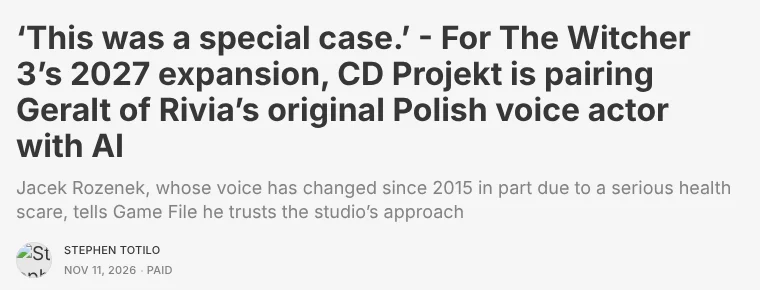
According to Game File, Rozenek recorded about 10,000 lines for The Witcher 3 in 2014, then the two expansions that followed. After his stroke he could not speak for months. When he came back in 2021 to record a few lines for the next-gen update, he said: "I was so exhausted after this recording."
For Songs of the Past, CDPR's localization director Mikołaj Szwed invited him to the studio "to kind of see how his voice sounds now". It had become lower and gruffer, Game File reports. The expansion adds new dialogue, but also battle cries and one-liners that play in areas of the original game. Old and new Geralt would sit side by side, and the gap would show.
So, VGC reports, Rozenek recorded all of his new lines as he always had. The recordings were then sent to Respeecher, whose tools were trained on his earlier Witcher work, to match them with how he sounded in the base game. He consented to it. "The point is that this voice should be as close as possible to my voice from 12 years ago," he told Game File, as quoted by VGC.

Szwed frames it as an exception, not a policy. "I do think this is one of those ways where you can use AI ethically, with consent and also to do something good," he said. Game Developer stresses that the studio made this exception only because of Rozenek's health, and that he is still hired and paid for the work.
Why it matters beyond games
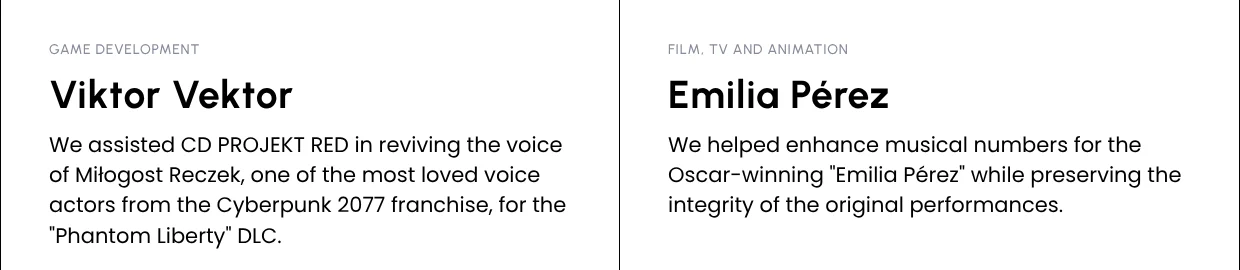
Respeecher is not a games-only tool. Its own site lists CDPR's Cyberpunk 2077: Phantom Liberty, where it revived the voice of the late actor Miłogost Reczek, and Emilia Pérez, where it says it enhanced the musical numbers "while preserving the integrity of the original performances".
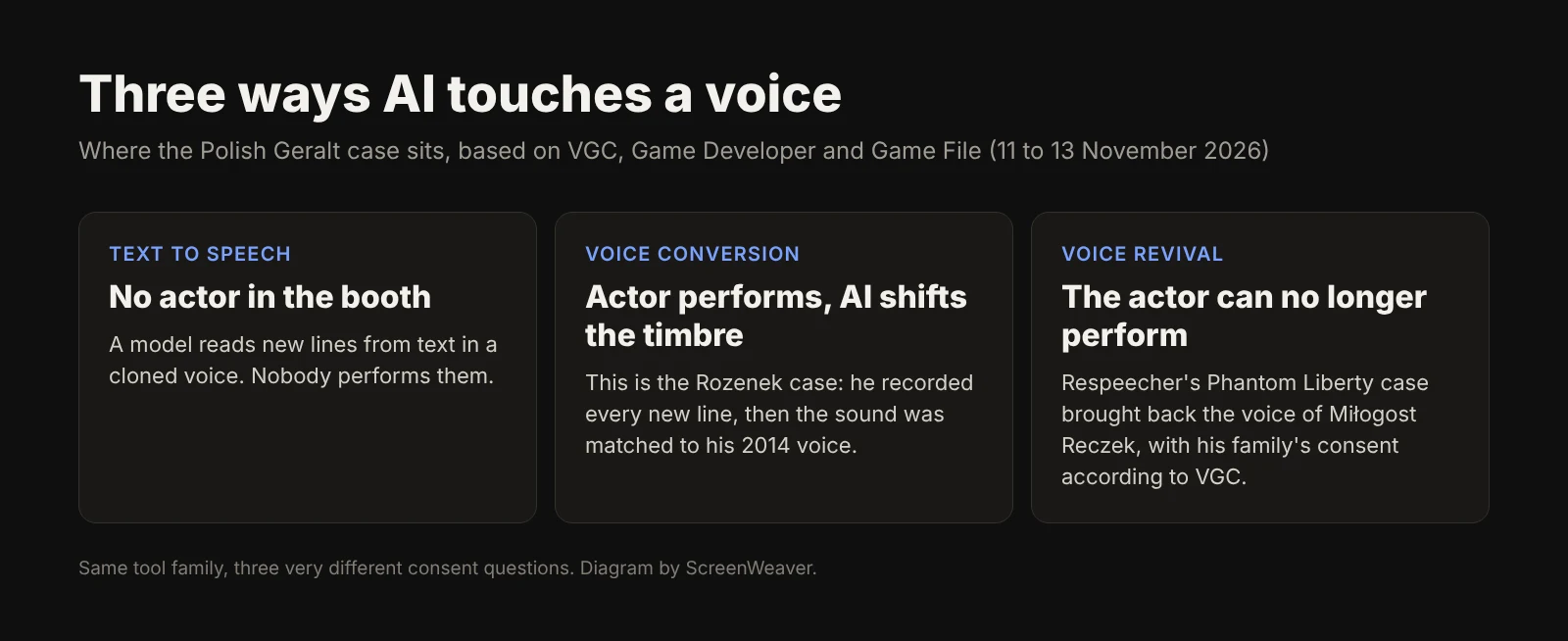
The same family of tools covers very different situations. A line read by a model from text. A line performed by the actor and reshaped. A voice brought back when the actor can no longer perform at all. Each one asks a different consent question, and the Polish Geralt case is the gentlest of the three: the person is in the booth, the acting is his, and only the timbre moves.
What it changes for writers and directors
If your project will be dubbed, re-recorded or extended years later, the voice is part of the character bible, not just the cast list. Three habits follow:
- Write down the reference performance. Which recording defines the character's voice? CDPR could match Rozenek's new lines because it had 10,000 old ones. A pilot or a first season plays the same role for a series.
- Separate "who performs" from "what it sounds like" in your agreements. The Witcher case works because the actor still performs. If a tool will reshape a voice, say so, and say who approves the result.
- Plan for the long tail. Expansions, sequels, director's cuts and ADR sessions often come years later. Our piece on AI voices and lip-sync in film covers the production side, and keeping a character's voice consistent covers the writing side.
Disclosure: ScreenWeaver is a pre-production tool where script, character sheets and storyboards live in one project. We have an interest in the idea that character decisions belong on the page, so weigh that against how your team works.
Try it free
Try ScreenWeaver for free on your script
It is free. Import your existing project, get a clearer view of your outline, and regain control of your story structure in minutes.
Start FreeWhat I would do this week
- Pick one recurring character in your current project and add a "voice" line to their sheet: who plays them, which take is the reference, and what may or may not be altered.
- Read the consent clause in your next voice or dubbing contract. Does it cover timbre matching, or only new synthetic lines?
- Compare with last week's case. Shortical built an actor-approved digital double for Inevitable. There, the double acts. Here, the actor acts and only the sound is adjusted.
What we don't know
- The terms of Rozenek's agreement. The readable sources say he consented and is paid, not what the contract allows beyond this expansion.
- The release date. Game File's headline says 2027, with no exact date.
- Other languages. None of the articles says AI is used on Geralt in other languages. Game File mentions the English voice, Doug Cockle, only as a comparison.
- What the paywalled part of Game File says. Our reading stops where the article goes behind its paywall.
FAQ
Did CD Projekt Red replace Geralt's Polish voice actor with AI?
No. According to VGC and Game Developer, Jacek Rozenek recorded all his new lines for Songs of the Past. Respeecher's tools then adjusted the recordings to sound closer to his voice in the original 2015 game.
Why was AI used on his voice?
Rozenek had a stroke in 2019 that changed his voice. CDPR wanted the new lines to match the thousands of lines he recorded in 2014, since some new lines play in areas of the original game.
Did the actor agree?
Yes. VGC reports he consented to the edits, and Game File's subtitle says he trusts the studio's approach.
Which AI company was involved?
Respeecher, a voice cloning and speech-to-speech company that CDPR already used for Cyberpunk 2077: Phantom Liberty.
Is the English Geralt affected?
Nothing in the coverage says so. Doug Cockle, the English voice, is only mentioned as a comparison.
What should a screenwriter take from it?
Treat the voice as part of the character. Note which performance is the reference, and write down what may be altered, by whom, and with whose approval.
From script to shots
Turn your script into a film, shot by shot
Write the scene, get its storyboard, then generate each shot with consistent characters. You direct every step.
Start your film free