
A feature treatment is not a shorter script. It is a decision document. Producers read treatments when they need to know if your movie is worth a meeting, a pass to a financier, or six weeks of your life before you draft page one again. They read fast. They read tired. They read many documents that sound like novels pretending to be movies.
The treatment that gets read is the one that makes structure visible on skim: who wants what, what blocks them, what changes by the end, and why this story must be a film rather than a podcast.
A treatment sells momentum. A treatment that sells vocabulary sells nothing.
Free tool: use the Beat Sheet Calculator to map these beats to exact page numbers for your script length.
What Producers Are Actually Looking For (In the First Three Pages)
They want premise clarity without adjectives doing all the work. They want protagonist agency even if the character is passive at the start; someone must choose eventually. They want act shape they can repeat back in thirty seconds. They want castable roles, which means emotional peaks, not only plot peaks. They want budget intuition, which does not mean you lie about scope. It means you do not hide a third-act war in paragraph nine.
They also want voice, but voice in a treatment is restraint. One vivid image beats five pretty sentences. One line of dialogue in the right place beats a page of banter summary.
If your feature script already exists, the treatment is a filter that tells them whether the script is worth requesting. If the script does not exist, the treatment is a blueprint that tells them whether to pay for development time. Either way, the reader is buying confidence.
Length expectations vary. Many indie producers want five to ten pages. Some studios want twelve to fifteen for genre projects with world rules. When you calibrate feature scale, pair treatment work with how long a feature script should be in 2026 so your promised scope matches the page band you will eventually hit.
Treatment vs Outline vs Synopsis (Stop Mixing Genres on the Page)
Writers collapse these forms because software templates encourage it. Producers notice.
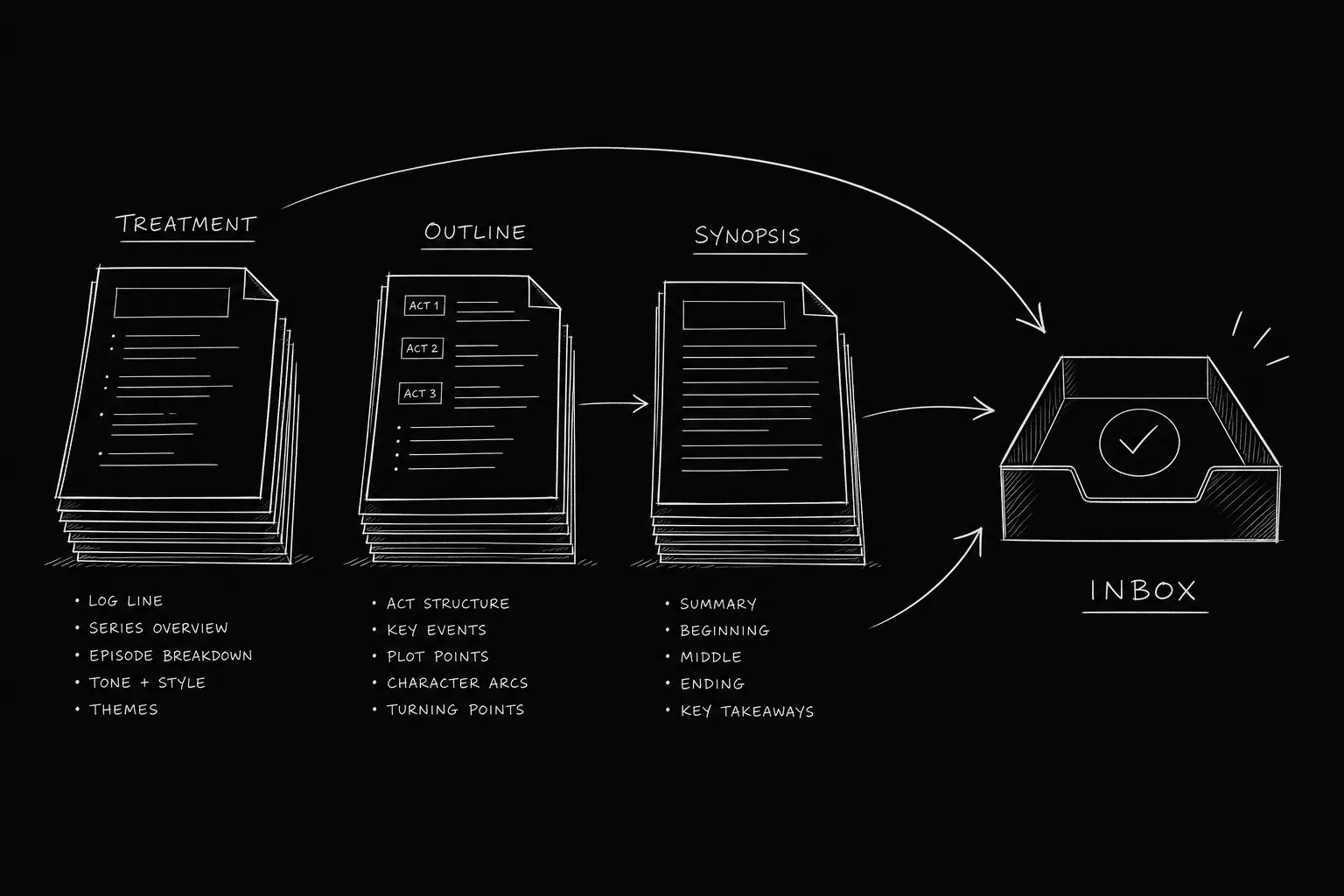
An outline is for you and your collaborators: beat list, scene order, mechanical. An synopsis is often marketing-facing: story summary that may spoil everything, used in packets and festivals. A treatment is craft-facing: present-tense cinematic prose that walks the reader through the film as if they are watching, with emphasis on turns, set pieces, and character change.
If your document reads like a Wikipedia plot summary, it is not a treatment. If it reads like stage directions for a novel, it is not a treatment. If it is only bullet beats, it is an outline wearing a title page.
The treatment's secret weapon is selective detail. You describe the opening image. You describe the act-one turn. You describe the midpoint reversal. You describe the climax choice. You do not describe every meal order unless the meal order is the turn.
A Producer-Read Shape Table (Adapt to Requested Length)
| Section | Pages (approx) | Must deliver | Skim test |
|---|---|---|---|
| Opening hook + world | 0.5-1 | Tone, genre, protagonist | Reader can picture minute one |
| Act one | 1-2 | Want, flaw, inciting event | Reader knows what starts the clock |
| Act two A | 1-2 | Escalation, allies, opponents | Reader feels pressure rising |
| Midpoint | 0.5-1 | Point of no return | Reader says "oh" out loud |
| Act two B | 1-2 | Cost, betrayal, plan failure | Reader fears for protagonist |
| Act three | 1-2 | Climax choice, resolution image | Reader sees the final shot |
| Why now / theme (optional) | 0.25-0.5 | One paragraph max | No thesis essay |
The table is a pacing guide. If you only have five pages, compress rows, do not delete turns. Producers forgive thin prose. They do not forgive missing midpoint.
Relatable Scenario: The Twelve-Page Mood Piece
Diego sends a treatment for a contained thriller. Twelve pages. Beautiful sentences. Fog. Guilt. The city "breathes." On page ten we learn someone might be a killer. The producer passes in two days.
Diego wrote atmosphere instead of events. Thrillers sell on turns: discovery, trap, reversal, exposure. Diego's fix was brutal. He kept one paragraph of atmosphere total. He rebuilt the treatment around six turns he could name in a hallway. He added one paragraph that made budget obvious: one primary location, three-night shoot window, small cast.
The next reader did not love fog more. They loved that Diego sounded like someone who could shoot the movie.
Relatable Scenario: The Treatment That Was a Secret Script
Morgan writes an eighteen-page treatment that includes large dialogue blocks and scene headers for act two. Financiers say it "reads long" and "feels unfilmable" even though the story is commercial.
Morgan was drafting in treatment clothing. Dialogue belongs in the script. Scene headers belong in the script unless a producer asked for a step outline. Morgan cut dialogue to one quoted line at the midpoint and one at the climax. Morgan replaced scene headers with visual verbs: "We see," "The camera finds," used sparingly.
The treatment dropped to nine pages. The same story felt faster because events carried the page.
When Morgan later needed a front-of-packet summary for email, they used our guide on the one-pager that summarizes your show as a parallel discipline: one page for the handshake, nine pages for the walk through the film.
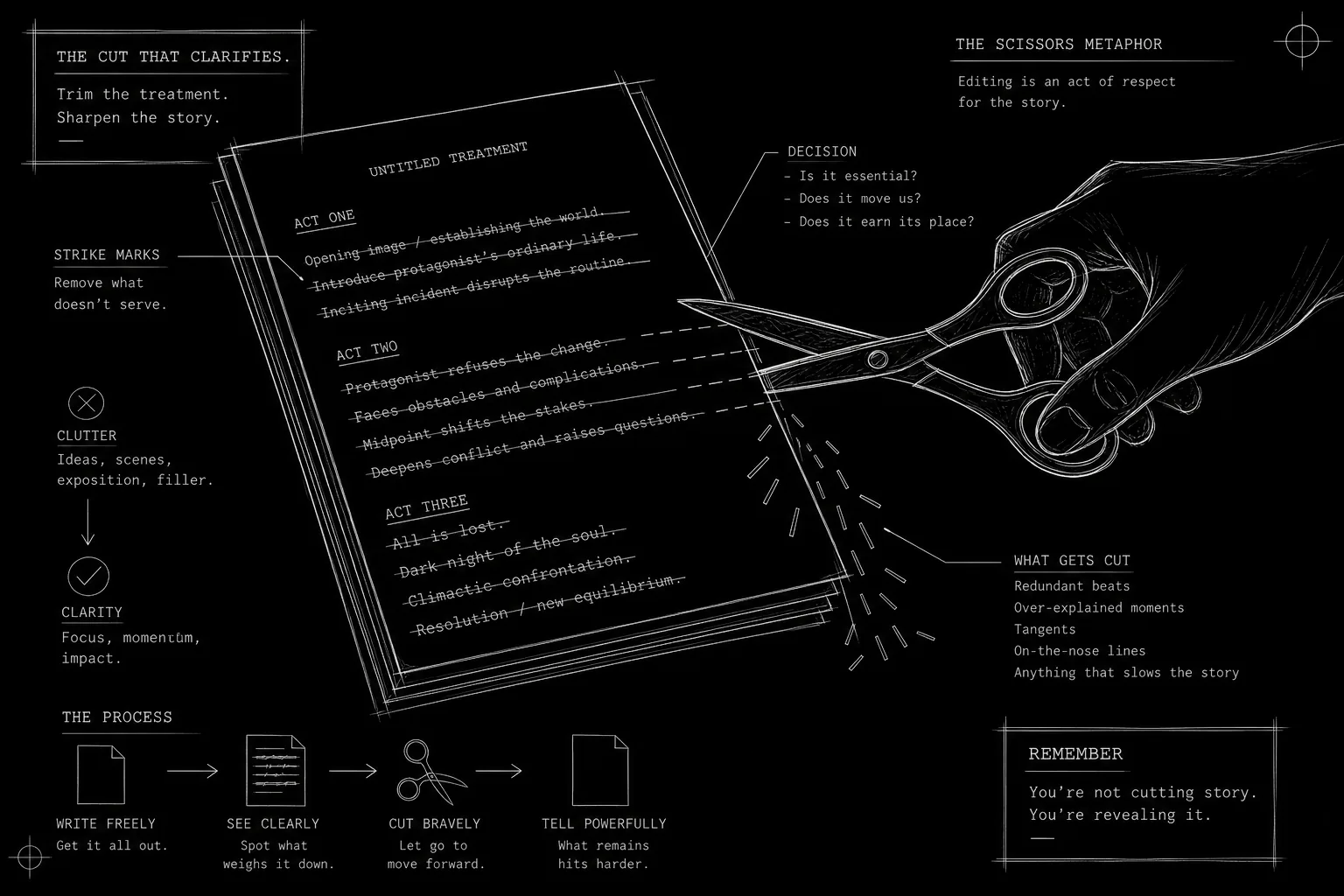
Granular Workflow: From Idea to Producer-Ready Treatment
Step one: write the pitch sentence before the treatment. One or two lines. Protagonist, goal, obstacle, stakes. If you cannot write it, your treatment will wander.
Step two: list twelve beats only for yourself. Inciting event, act breaks, midpoint, low point, climax, final image. Treatments fail when writers discover structure while typing prose.
Step three: draft in present tense with visual nouns. Not "she feels sad." "She washes the blood off her hands in a diner bathroom while children laugh outside."
Step four: assign one paragraph per major turn. If a turn needs three paragraphs, your turn might be three turns. Combine or escalate.
Step five: run the skim test. Print. Read only first sentences of paragraphs. Do you still feel escalation? If not, reorder.
Step six: add a short "film rationale" paragraph. Why cinema? Why now? Why you? Keep it humble and specific.
Step seven: proof for honesty. If act three is vague, you do not know your ending yet. Pause treatment. Solve ending on cards.
Voice Without Novel Disease
Treatments tempt writers into literary mode because prose feels like proof of talent. Producers read talent as clarity under pressure. Use metaphors rarely. Use strong verbs often. Name characters with consistency. Do not introduce five names in one paragraph.
Present tense keeps the reader in screening mode. Past tense can work for synopses, not for treatments you want financed.
Dialogue in treatments should function as evidence of voice, not as scene substitute. One line that reveals coping style is enough.
Genre controls diction. Comedy treatments can be playful in narration if jokes are not stacked as substitutes for plot. Drama treatments can be spare. Horror treatments should not over-explain the monster's psychology in prose; show the scare mechanism.
Try it free
Try Screenweaver for free on your script
It is free. Import your existing project, get a clearer view of your outline, and regain control of your story structure in minutes.
Start FreeRelatable Scenario: The Producer Forward You Never Hear About
Tessa sends a treatment to a mid-level producer. She gets a polite pass. Two months later, a different producer asks for the script because a junior reader forwarded an excerpt with the midpoint paragraph circled.
Tessa almost cut that paragraph because it felt "spoiler-y." The midpoint was the only place the treatment sounded like a movie instead of a mood. The lesson: spoilers for executives are often selling points. They need to see that you know where the story bends.
If you are protecting twists, protect only the final ten percent. Midpoint and climax direction should be legible. Mystery treatments work for mystery projects when the treatment proves the fair-play clue trail, not when it hides that there is a trail.
Adaptations, True Stories, and IP: Extra Paragraphs That Earn Their Space
Adapted treatments need a short source relationship paragraph: what you kept, what you changed, why film now. True stories need a rights and ethics sentence without sounding like a legal memo. IP treatments need franchise promise without pasting wiki lore.
In all three cases, producers still ask the same question: what is the movie in one night? Do not let research pride replace act shape. Put world rules after we care about the protagonist, unless the world rules are the protagonist's problem.
When your feature scale is unclear, anchor budget intuition with the same realism you use for page targets in feature film script length in 2026. A treatment that promises a hundred-twenty-page epic should not describe a contained two-hander unless you explain the expansion.
Revision Passes: Treatment Versioning Without Chaos
Name files like adults: TITLE_treatment_v3.pdf, not final_FINAL2.pdf. Keep a change log for yourself: what changed between v2 and v3. Producers rarely ask, but you will when notes contradict each other.
Version one is for you: messy, complete turns. Version two is for a trusted reader: skim test. Version three is for industry: shorter, sharper, no outline debris. Do not send version one because you are tired.
When a producer asks for "a short treatment," do not argue. Cut the middle of act two B first, not the midpoint. When they ask for more world, add one paragraph, not six. Responsiveness is part of the read.
Packaging: What Goes on the Cover Email vs the Document
The email is not the treatment. The email is traffic control: title, genre, logline, why this producer, attachment name that is not "draft7.pdf."
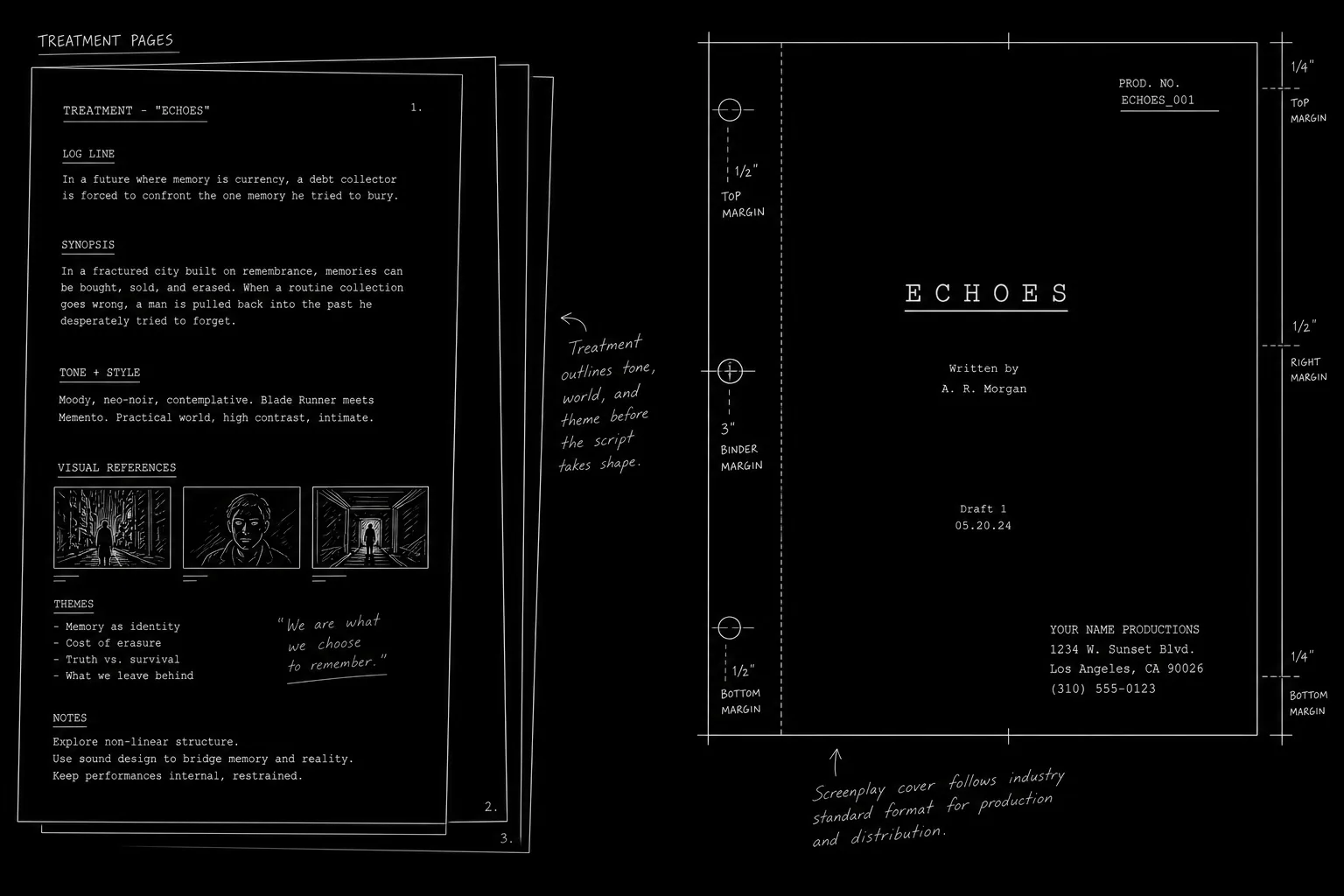
Inside the treatment, put title and writer name on page one. Optional: one-line logline under title. Do not put your life story on page one unless the producer asked for you specifically.
If you have comps, use them in the email, not as a crutch inside every paragraph. "It's X meets Y" in the treatment body often reads desperate. One comp line in the email is enough.
For legal and professional norms around submissions, the <a href="https://www.wga.org/" rel="nofollow">Writers Guild of America</a> site is a useful external anchor when you are navigating representation and industry-facing documents, even when your immediate reader is an indie producer.
The Trench Warfare Section: Treatment Mistakes That Kill Reads
Wrong: hiding the protagonist for three pages of world-building. Fix: attach world to want in paragraph one.
Wrong: no midpoint. Fix: name it. Write it as an event.
Wrong: vague climax. "They confront the truth" is not a climax. Fix: write the choice and the cost.
Wrong: treating theme as a lecture. Fix: one sentence of thematic promise, earned by plot.
Wrong: budget blindness. Fix: one honest scope paragraph if the piece is contained.
Wrong: copying beat sheets from unrelated films. Fix: turn list must match your premise.
Wrong: sending before the ending works. Fix: solve on index cards, then prose.
Wrong: using the treatment to apologize for the script. Fix: if the script is weak, fix the script or treat the treatment as the true draft zero.
Producers do not fund your potential to figure out act three later. They fund your ability to describe act three now.
After the Read: Meetings, Notes, and the Script Request
If the treatment works, you get questions. Good questions sound like: "What is the antagonist's plan in act two?" Bad questions sound like: "What is this?" Treatments that work create specific curiosity.
In meetings, bring the treatment plus the pitch sentence plus optional lookbook material if you have it. Do not read the treatment aloud line by line unless asked.
When notes arrive, sort them into structure notes and taste notes. Structure notes change beats. Taste notes change execution. If a note says "make it bigger," ask whether they mean scale or stakes. Scale costs money. Stakes cost writing.
If you move to script, keep the treatment as a regression test. When the draft drifts, compare scenes to treatment turns. If a scene does not serve a named turn, cut or relocate.
Relatable Scenario: The Financing Room Where Numbers Follow Story
Rafael pitches a contained sci-fi drama with a treatment, not a script. The financier asks about cast size, nights, and VFX shots. Rafael answers from the treatment's scope paragraph: one primary location, two leads, three supporting roles with under five scenes each, VFX limited to two set-piece moments described on page six.
Because the treatment named those moments, the conversation stayed on feasibility instead of drifting into vague promises. Rafael still had to write the script, but the treatment did the job of proving he was not accidentally writing a franchise pilot disguised as an indie.
That is the hidden product of a readable treatment. It aligns creative ambition with production grammar before anyone spends real money.
Why Treatments Still Matter When "Just Send the Script" Is Common
Scripts are long. Treatments respect time. Treatments also reveal whether the writer can think in film. Many polished scripts hide broken spines behind good lines. Treatments strip the disguise.
Writing a readable treatment trains you for rooms, for pitch festivals, for grant applications, for packaging documents that sit next to lookbooks and mood reels. It is the same muscle as a great one-pager, stretched longer with act discipline.
Write the treatment you would want if you had thirty minutes between flights and three stacks of paper. Clear turns. Visual prose. Honest scope. An ending you can see. That document is not a formality. It is the movie, briefly lit, asking for permission to exist at full length.
Before you attach, run one last pass for producer-shaped kindness: short paragraphs, strong verbs, named turns, no apology paragraphs, no thesis essays. Then send and go write the script that makes the treatment feel inevitable rather than optimistic.
Final Step
Build your next script with Screenweaver
Move from ideas to production-ready pages faster with timeline-native writing and AI-assisted story flow.
Try Screenweaver