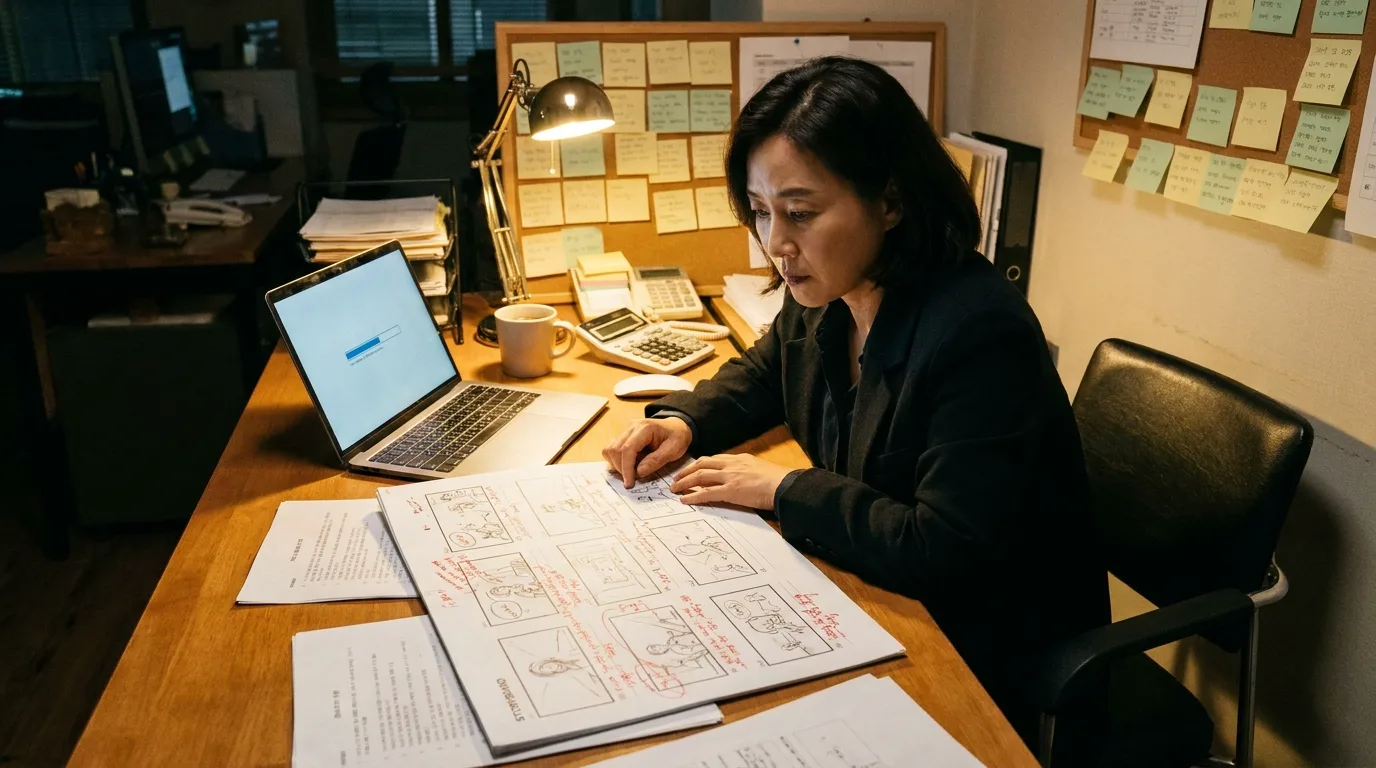

Two of Korea's most active AI production teams told the Taiwan Creative Content Fest (TCCF) in Taipei that AI will not automatically make feature films cheap. It is already slashing the cost of commercials. But on a feature, paid re-renders and scattered revision notes could leave a producer spending more than in the days of 35mm film stock.
The warning came from Kim Kwang-jib, founder and CEO of Studio Meta-K, and Lee Sang-wook, head of the AI Content Lab at MBC C&I, a subsidiary of Korean broadcaster MBC. What follows comes from Variety's report by Naman Ramachandran, published on 7 November 2026 and read on 9 November. The figures are the speakers' own estimates, not audited budgets.
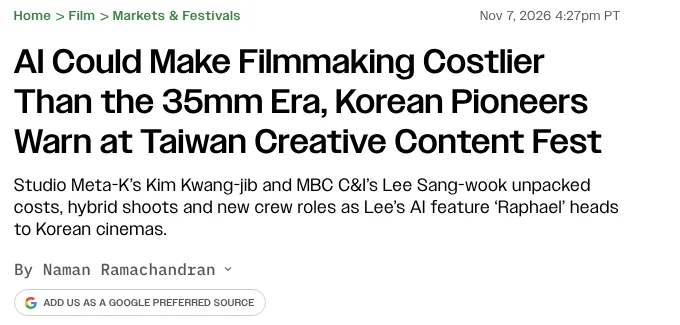
The numbers Kim put on the table
Kim's point is about tokens, the units AI generation tools bill by.
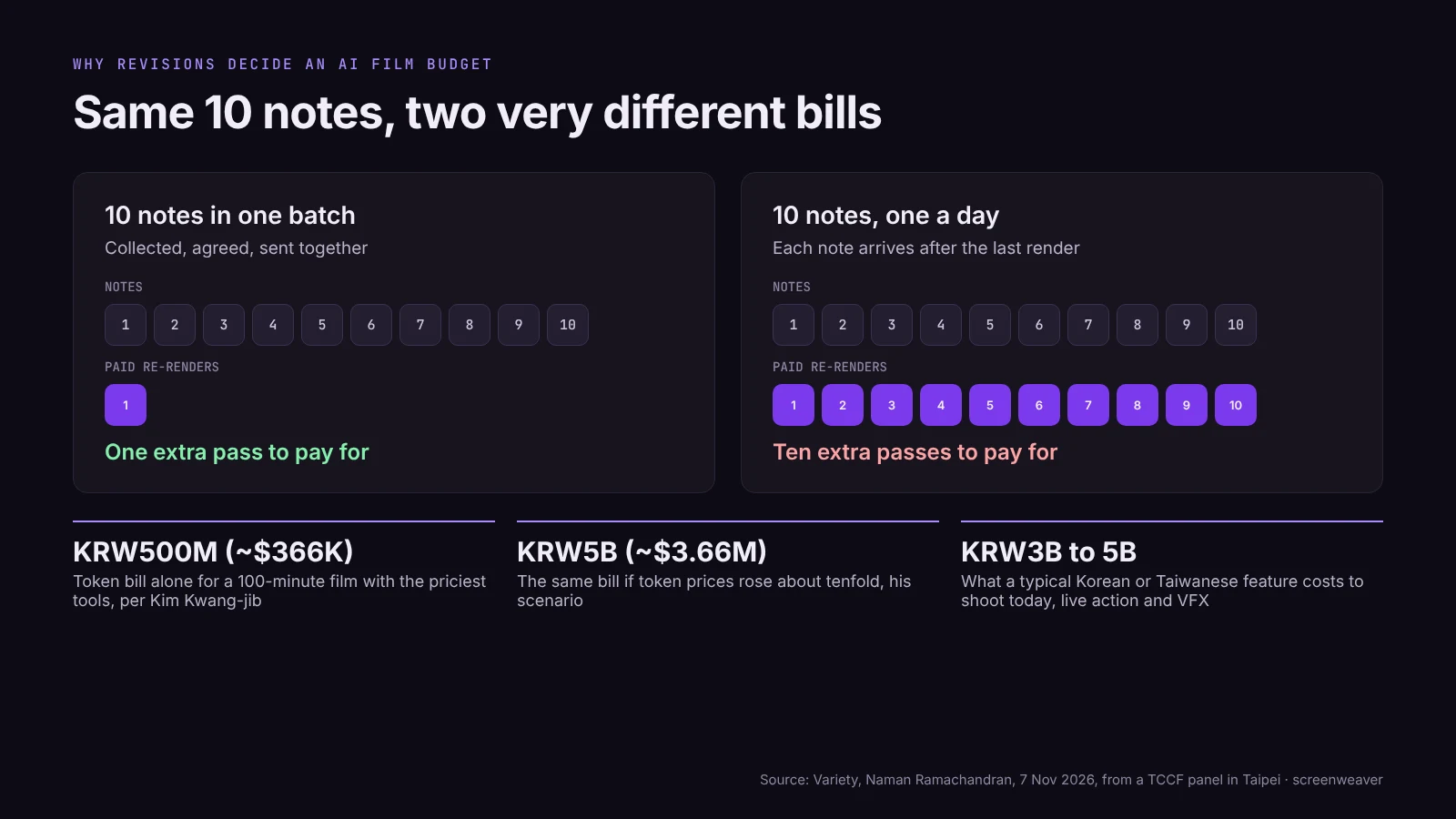
- About KRW500 million ($366,000): the token bill alone for a 100-minute film made with the most expensive commercial tools, by his estimate.
- About KRW5 billion ($3.66 million): the same bill if AI companies raised token prices roughly tenfold. He says those companies are all losing money and keep prices low as a marketing play.
- KRW3 billion to KRW5 billion ($2.2 million to $3.66 million): what Korean, Taiwanese and other Asian features typically cost to shoot today, live action and VFX included.
So a tenfold price rise would push the AI token bill alone to the level of a whole conventional feature. A Hollywood studio with a $146 million budget could absorb that, Kim said. A Korean or Taiwanese producer would have to ask whether AI is efficient at all.
Commercials tell a different story. Kim cited a TV spot that took about eight months and roughly KRW2 billion ($1.4 million) to make. Studio Meta-K's in-house version took about two weeks and around KRW30 million ($22,000), roughly 2% of the cost. In advertising, he said, production costs can fall by more than 90%.
The real cost driver: how you handle notes
This is the part of the panel every producer should read twice. Kim compared AI to celluloid. When every take burned film stock, preproduction was meticulous. Digital made shooting and cutting almost free, and crews got used to deciding late. With AI, every re-render is paid for again.
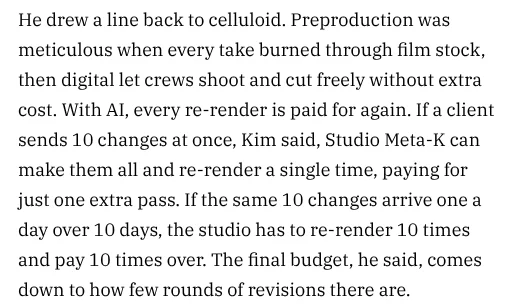
His example is simple. Ten changes sent together mean one extra render. The same ten changes sent one a day over ten days mean ten extra renders, paid ten times. "Unless the preproduction stage is made solid," he said, "AI could end up spending even more money than in the 35mm film era."
Lee added a second problem: the tools keep moving. His lab's 139-minute feature Raphael took about a year and four months to make, with new tools and updates arriving weekly. "If you apply technology from a year ago, the scenes look very old," he said. A single shot sometimes tied up around ten artists for a whole day. Raphael opens in Korean cinemas on 25 November.
Reversing the pipeline
Kim's bigger pitch is to flip the order of work. Instead of calling in AI after the shoot and the edit have eaten the budget, Studio Meta-K is testing a whole 100-minute film built at film-like quality in preproduction, then reshooting in live action only what feels off, such as emotional close-ups. For now he thinks about 50 of those 100 minutes would still need a live shoot.
Lee predicted new crew roles that fit this shape: previsualization artists who break scripts down into previs, and continuity supervisors who keep locations and characters consistent. He said spatial consistency is harder than character consistency. And he gave an example of previs winning over actors: on a daily drama, a previs of a dangerous accident scene turned the cast's skepticism into approval once they saw AI would handle the shots that could injure them.
The two companies disagree on open-source models. Kim uses them for easy shots and keeps paid tools for hard ones. Lee steers away from them because he cannot verify their training data, and says MBC C&I has joined C2PA, the content provenance standard.
Try it free
Try ScreenWeaver for free on your script
It is free. Import your existing project, get a clearer view of your outline, and regain control of your story structure in minutes.
Start FreeWhat this means if you plan AI shots
The lesson is not "AI is expensive". It is that the bill follows your decisions, and late decisions cost the most. A few habits follow from Kim's example:
- Lock the shot before you render it. Framing, action, camera move, duration and who is in the frame should be agreed on a storyboard panel, not discovered in the fifth render.
- Batch your notes. Collect every note on a sequence, agree on them, then render once. A director's note that arrives on day six costs a full pass.
- Make continuity a document, not a memory. If characters and places are defined once and every shot points to them, a note about a costume changes one reference, not twenty prompts.
- Track cost per shot, not per month. A monthly subscription hides the shot that took eleven renders.
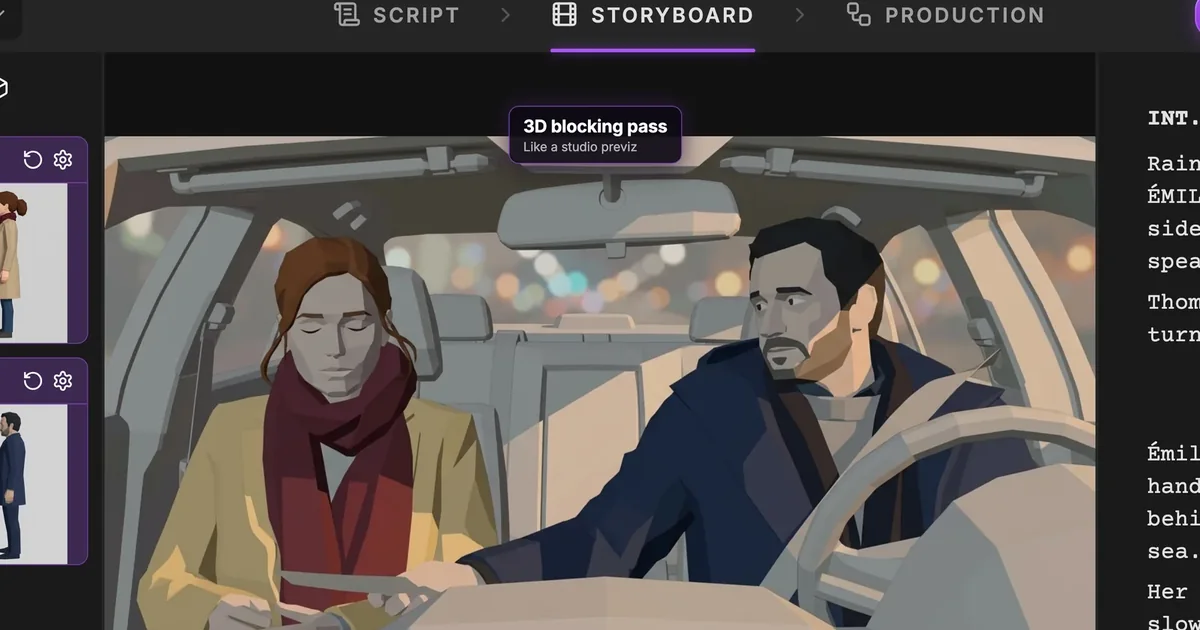
This is the workflow ScreenWeaver is built around: the script is broken into scenes and shots, characters, places and objects live as story elements, and each panel is cheap to change before anything expensive is generated. Our guide to previz from a script walks through it, and our breakdown of what an AI film actually costs shows where the money goes. Korea's AI cinema scene is moving fast on this too: the Seoul Independent Film Festival is premiering seven AI shorts in a new AI Cinema Special.
What we don't know
- How Kim reached KRW500 million. Variety reports the estimate, not the tool mix, resolution or number of takes behind it.
- Whether token prices will rise. The tenfold scenario is his hypothesis, not an announced price change.
- Raphael's budget. Lee described the time and the crew effort, not the final cost.
FAQ
Can AI make a feature film more expensive than shooting on 35mm? According to Studio Meta-K founder Kim Kwang-jib, speaking at TCCF in Taipei and reported by Variety on 7 November 2026, it can if preproduction is weak. Every change means a paid re-render, so scattered revisions multiply the bill. He estimates the token bill alone for a 100-minute film at about KRW500 million ($366,000) with the priciest tools, and about ten times that if token prices rose tenfold.
Why do revisions cost so much in AI filmmaking? Because each re-render is billed again. Kim's example: ten changes sent together need one extra render, while the same ten changes sent one a day need ten. With film stock, crews planned carefully because every take cost money. AI brings that discipline back.
Is AI cheaper for commercials? Kim says yes. He cited a TV spot that took about eight months and KRW2 billion to make, which Studio Meta-K redid in about two weeks for around KRW30 million, roughly 2% of the cost. He says advertising production costs can fall by more than 90%.
What is Raphael? A 139-minute AI feature made by the AI Content Lab at MBC C&I, a subsidiary of Korean broadcaster MBC, with emerging directors discovered by the lab. It took about a year and four months to make and opens in Korean cinemas on 25 November 2026, according to Variety.
How can I keep the cost of AI shots under control? Lock each shot on a storyboard before generating it, batch your notes instead of sending them one at a time, define characters and places once so every shot reuses them, and track how many renders each shot takes. In ScreenWeaver, the script, story elements and storyboard come before generation, so changes are made where they are cheap.
From script to shots
Turn your script into a film, shot by shot
Write the scene, get its storyboard, then generate each shot with consistent characters. You direct every step.
Start your film free