MetaMorph AI Film Award 2027 · Guide

How to win the MetaMorph AI Film Award.Half the process in AI. A statement that proves it.

The 2027 rules, the categories, the 150 to 300 word statement and a plan to the 15 May 2027 final deadline. Write the screenplay, storyboard it, then film it with Seedance in ScreenWeaver.
  • Final deadline 15 May 2027
  • AI in at least 50% of the process
  • Ceremony in London, 15 June
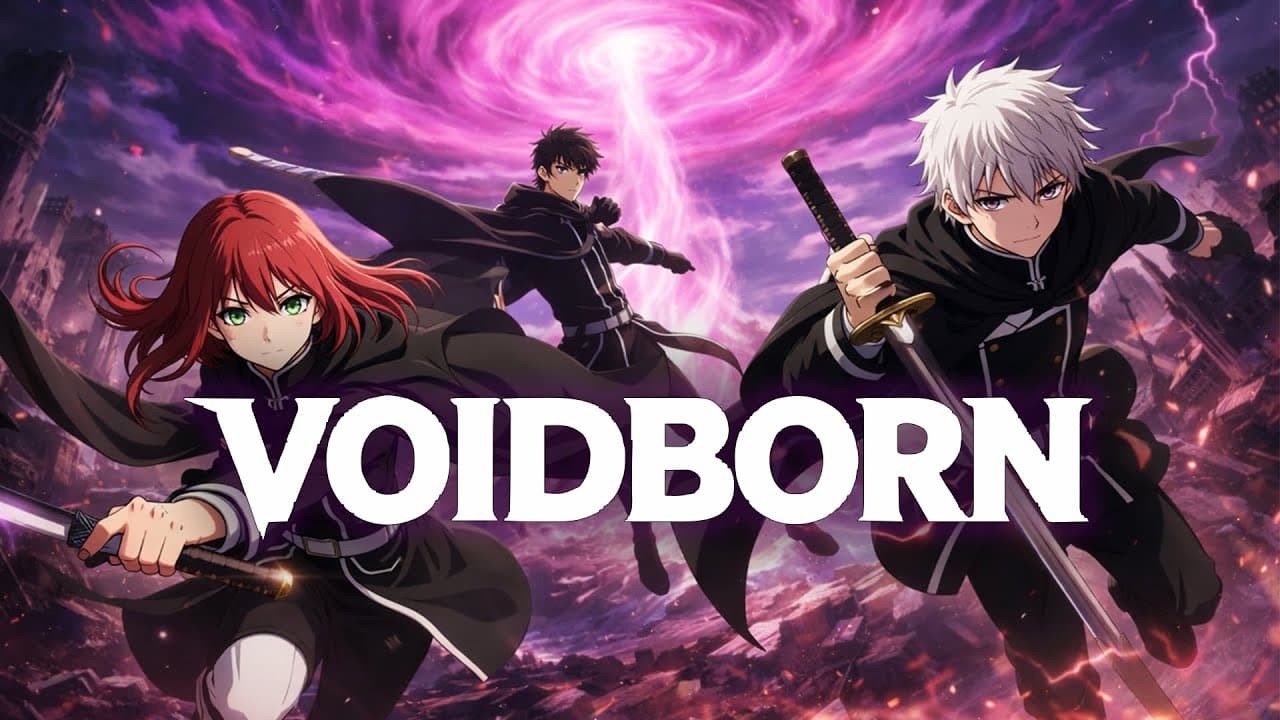
Voidborn · Episode 0

Independent guide. ScreenWeaver does not organise the MetaMorph AI Film Award and is not affiliated with MetaMorph or TapNow. Rules read on 1 October 2026. Official award site

Available today in ScreenWeaver: free screenwriting, and a storyboard generated from your screenplay with Storyboard Beta, $9.99 a month.

Rolling out: video generation of each shot, powered by Seedance, with the Filmmaker plan.

The 2027 call in brief

What the award asks for.

MetaMorph is a London award for AI film and music, now in its third edition, with TapNow as a partner. It names no tool: TapNow is a partner, not a requirement.
Ceremony
15 June 2027, London
Deadlines
Standard 30 April 2027, late 8 May, extended 15 May. The early deadline was 30 September 2026
Fees
Fully AI category: €23 early, €29 standard, €35 late and extended. Other sections vary
AI requirement
AI in at least 50% of the creative or production process, not of the frames
Statement
About 150 to 300 words on tools, human work, balance and intention
Categories
13 on the official site, 15 sections on the submission form
Prizes
A physical trophy, laurels, TapNow credits of unannounced value, an interview
Rights and language
Any language with English subtitles. You keep your copyright

Source: the 2027 Rules and Terms and the sections and fees on the Festhome listing, and the official site (categories, judges, prizes, ethical guidelines), read on 1 October 2026. Official pages disagree on the platform and on some dates: see the traps.

Key dates

The early window is shut. Seven months remain.

The call opened in July 2026 and the early deadline passed yesterday. <b>The long runway is on purpose</b>: the standard deadline is 30 April 2027.
  1. 12 Jul 2026

    Call for entries

    Entries open on Festhome, the platform named in the 2027 rules. The site's older page still points to FilmFreeway.

  2. 30 Sep 2026

    Early deadline

    The cheapest tier, which closed on 30 September. The fully AI category cost €23 in that window.

  3. 30 Apr 2027

    Standard deadline

    €29 in the fully AI category. This is the realistic target for a film made across the winter.

  4. 15 May 2027

    Extended deadline

    The final window, at €35, with late entries from 8 May. Nothing is accepted after the 15th.

  5. 15 Jun 2027

    Ceremony in London

    Winners and runners-up are honoured at the ceremony. Winning films screen in full, as an extract, or as a trailer.

How films are judged

Five lenses, and no numbers.

The rules list ten points that submissions may be assessed on, with no weights. Grouped into five lenses, transparency and human direction sit next to craft, not below it.
  • Creativity and innovation

    Originality, plus innovation and experimentation. The jury says it is not counting tools, so show a new idea, not a new button. The newest model is not the point.

  • Storytelling and impact

    Storytelling or artistic impact, and emotional or intellectual impact. A film that makes a viewer feel or think beats a polished showreel.

  • Purposeful AI, human direction

    The rules ask that AI integration have a purpose and that human ideas and judgement shaped the work. Judges look at the purpose and effectiveness of the technology, not at how many tools you used.

  • Technical and sensory quality

    Technical execution, visual quality and sonic quality. Clean image, stable faces, a mix that holds. Budget categories are read in context, and a bigger budget does not score higher.

  • Transparency and responsibility

    Transparency of process and responsible, ethical use are on the list. This is where the 150 to 300 word statement works for you, since it is read as part of the film.

The weights are not published, and the judging panel may vary between categories. Decisions are final, and scores and notes are not normally released.

Who decides

Two stages, and a jury of ad and film people.

The award names its judges, and the panel changes from year to year. The rules add that it may also vary by category.
  • Two stages

    An International Selectors Committee makes a long list, then a Jury Panel chooses the finalists and category winners. Your statement and your film go through both.

  • Who judged in 2026

    The 2026 judges page lists eleven people, among them Cassie Brooksbank, Dave Rolfe, John Rhys-Davies, Rocky Mudaliar, Wesley Ter Haar, Timbaland, Tiger Savage and Laura Gregory. The 2027 panel is not announced.

  • A panel from advertising and film

    The 2026 roles span directors, production heads, creative directors, a music producer and AI company founders. Expect people who have seen many demos. A clear idea reads faster than a technical flex.

  • Decisions are final

    The rules say selection and award decisions are made at MetaMorph's discretion, the number of winners may vary, and an award may be skipped if submissions do not meet the standard.

The categories

Thirteen categories to choose from.

The official 2027 categories page lists 13, and the Festhome form adds two budget sections: Low Budget under £1,000 and High Budget over £25,000. Six fit a ScreenWeaver film best, and under each is the angle we would take.
  • 01

    Fully AI Generated

    The finest achievement in a film created entirely by artificial intelligence.

    The category for a pipeline film. Still write the statement: the human decisions are the script, the storyboard and the cut.

  • 02

    Storytelling

    Innovative use of AI in crafting compelling, original narratives in various media formats.

    The category where a screenplay is the advantage. One character, one change, and a form that serves them.

  • 03

    Short Film

    Concise storytelling powered by AI, in films under five minutes.

    The most finishable category: four minutes, one world, a held look. A short film wins on idea and finish.

  • 04

    Animation

    Animation projects created through AI tools and techniques.

    A stylised look hides small flaws better than photorealism. Pick a style you can repeat for every shot.

  • 05

    Long Form

    AI-enhanced films over 20 minutes showing sustained cinematic storytelling.

    A series-sized ambition. The Festhome description says a long film must be at least 50% AI-generated, a stricter test than the general rule.

  • 06

    Low Budget

    A Festhome section for films made with a total production budget of £1,000 or less. The entrant declares the budget.

    AI productions often fit it easily. Declare the figure honestly, since a false budget can move the film or disqualify it.

The 2026 winners

What last year's lineup shows.

The 2026 winners were announced and honoured at a London ceremony. The site lists a winner and a runner-up in each of 13 categories, from The Well in Storytelling to The Chip Critic in Animation. We know titles and makers, not the tools or the scores, so these lessons come from the list.

  1. 01

    Thirteen winners and thirteen runners-up. Few awards offer so many chances. Choose the category where your film is the strongest of its kind, not the most prestigious.

  2. 02

    One maker took two places. Sebastian Strasser won Fully AI with TheRealReal - L'Ultimo Uomo Reale and was also runner-up with #3347. A filmmaker can enter several films.

  3. 03

    A character can be the whole film. Mike Bennion, who won Doc/Mockumentary with Kev, said in a MetaMorph interview that the film began with faces that were not generic. A strong character gives a project its spine.

  4. 04

    A contest film can be reused. Andrew Boer, runner-up in Short Film with Before Me, said it was first made for a 48 hour contest. The rules we read ask for originality and rights, and say nothing about premiere status.

  5. 05

    Trailers and music have their own categories. Children of a Dead Star won Trailer, and Music Composition is a category of its own. A great idea can be shown short.

From script to screen

Voidborn: a story told in six shots.

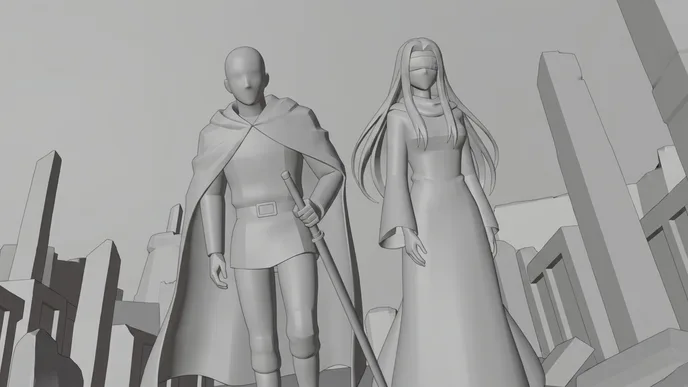
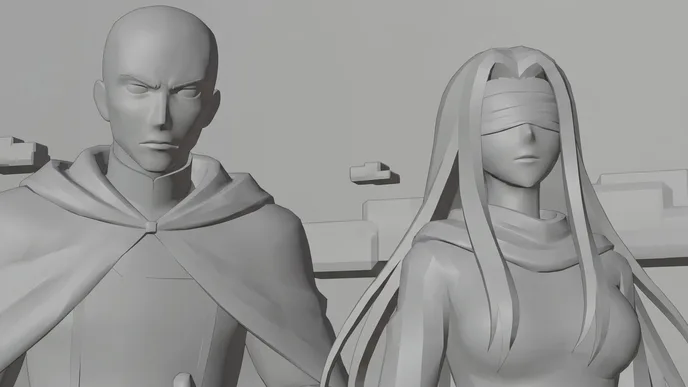
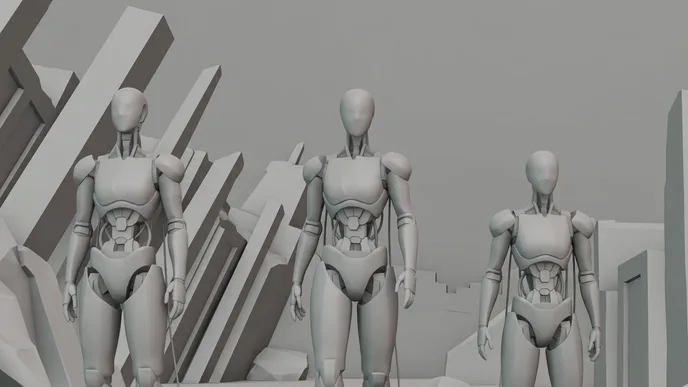
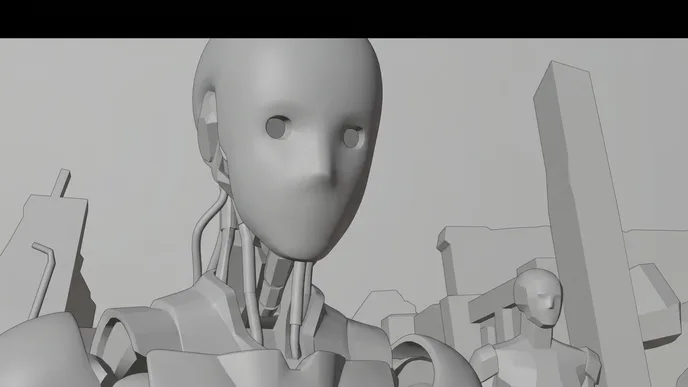
The jury says it judges the purpose of the technology, not the number of tools. This is a scene from Voidborn, episode 0, an anime by the ScreenWeaver team: the screenplay page, then each shot as a storyboard frame and as the final image, so you can see where the human decisions sit.

Logline. Every seven years, the Rift opens and swallows the world’s dreams. A swordsman sworn to a blind seer escorts her through its levels, toward a promise they made to a girl left behind.

Screenplay · episode 0 · English subtitles

EXT. RUINS OF THE FIRST LEVEL - NIGHT

Broken towers under a violet sky. SIM, a swordsman in a black cloak, walks beside LADY MARIA, blindfolded, all in white.

SIM

Tell me, Maria... do you think Leia believes we are still alive?

MARIA

We made a promise... the two of us.

A line of white automatons rises from the ruins.

AUTOMATON

The Rift will wait for no one.

SIM

What are machines doing at this level?

One automaton steps forward. Its face is blank.

AUTOMATON

We must return to the surface.

Its eyes ignite red.

SIM

I am Sim, guardian of Lady Maria... and I will proceed with your execution.

Steel meets steel. Lightning runs down the blade.

CUT TO:

  1. A swordsman in a black cloak and a blindfolded woman in white walk through ruins at night
    Storyboard frame of the wide shot, in grey
    01

    Wide · the pair

    Wide shot, a bald swordsman in a black cloak and a blindfolded red-haired woman in white walk through night ruins

  2. Medium two-shot of a bald swordsman and a blindfolded red-haired woman
    Storyboard frame of the two-shot, in grey
    02

    Two-shot · the promise

    Medium two-shot, the swordsman and the blindfolded seer side by side, violet night sky, broken towers

  3. Three white humanoid automatons stand in night ruins
    Storyboard frame of the automatons shot, in grey
    03

    Wide · the machines

    Wide low angle, three white humanoid automatons standing in the ruins, cold blue moonlight

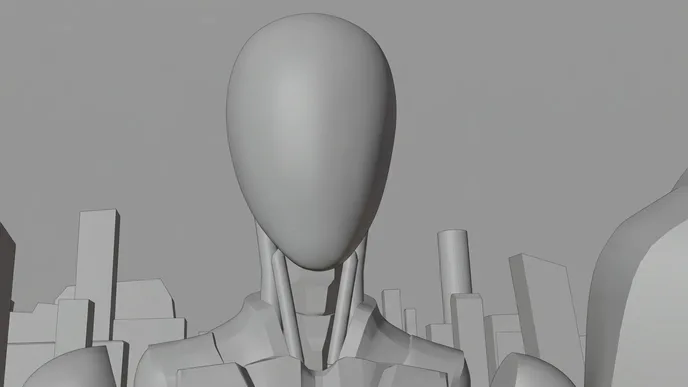
  4. Close-up of a white automaton with a smooth blank face
    Storyboard frame of the blank face close-up, in grey
    04

    Close-up · the blank face

    Close-up on an automaton's smooth faceless head, black eye slots, cables at the neck, ruins behind

  5. A white automaton's eyes glow red
    Storyboard frame of the red eyes close-up, in grey
    05

    Close-up · the red eyes

    Same framing, the automaton's eyes ignite red, the swordsman's shoulder out of focus in the foreground

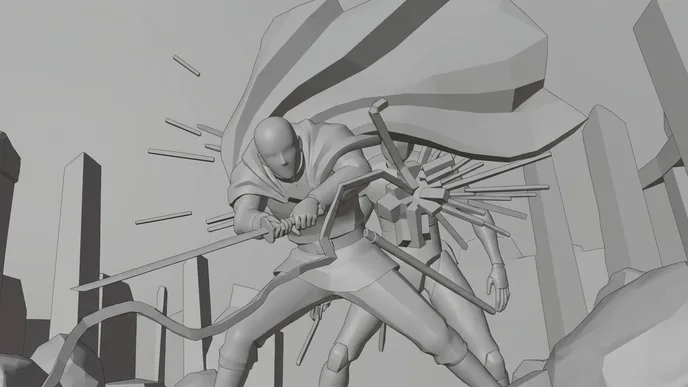
  6. A swordsman strikes with a katana wreathed in lightning and sparks
    Storyboard frame of the clash shot, in grey
    06

    Action · the clash

    Dynamic low angle, the swordsman strikes with his katana, lightning running along the blade, sparks, cape flying

Voidborn, episode 0 lasts 13 minutes. A cut of under five minutes from one sequence like this fits the Short Film category, and the Animation category suits an anime. The ScreenWeaver team made it, and it took 1st Place Silver and 2nd Place Dreamina at the Mondial Chroma Awards and an award at the Seoul International AI Film Festival. Press play to open on the ruins, around the 7 minute mark.

The script

A 4 minute short in four movements.

The Short Film category runs under five minutes. Four minutes holds about 4 screenplay pages and 40 to 60 shots of 4 to 6 seconds, and leaves a margin under the limit.
  1. 0:00 to 0:20

    The hook

    One strange, clear image. The long list is read by selectors who see many films.

  2. 0:20 to 1:20

    The character

    Meet the hero and the desire. Give them one detail that is theirs.

  3. 1:20 to 3:20

    The turn

    The problem grows, then flips. This is the idea the film exists for.

  4. 3:20 to 4:00

    The resolution

    A last beat that closes the idea. Keep the credits to a few seconds.

The statement is part of the film. Draft it as you cut: tools, human work, the balance, the intention.

Month by month

From the first idea to the final deadline.

Seven months remain until the final window. Aim at 30 April, so the 8 and 15 May windows stay as a safety net, and write the statement while you work.
  1. 01

    October 2026

    Category and idea

    Pick one category. Write ten loglines and keep the one that is easiest to finish. Read the 20 rules once, in full.

  2. 02

    November 2026

    Screenplay and statement notes

    Write the screenplay in ScreenWeaver, free. Open a notes file for the statement: which tools, which tasks, which parts you did yourself.

  3. 03

    December 2026

    References and storyboard

    One reference per character and set, then the shot breakdown and storyboard. Set framing, movement and duration yourself, shot by shot.

  4. 04

    January to February 2027

    Generate the footage

    Scene by scene with Seedance in ScreenWeaver as video generation reaches your plan, from the same references. Keep every prompt: the statement is built from them.

  5. 05

    March 2027

    Edit and sound

    Cut, mix and license every track. Keep any synthetic voice of a real person off the film unless you hold consent.

  6. 06

    April 2027

    Statement and submission

    Write 150 to 300 words, and add the budget declaration if you chose a budget category. Submit by 30 April, with a screener link that works throughout the selection.

Disqualification traps

Eight ways to be disqualified or moved.

Section 16 of the rules lists the grounds. Several concern what you write and declare, more than what you generate.
  • AI that is only basic automation

    Spell-checking, standard noise reduction or automatic subtitles alone will not normally satisfy the AI requirement. The film needs a meaningful role for AI.

  • A statement that is thin

    The statement must say which tools, how AI contributed, what was human, the balance, the intention and any ethical or technical considerations. It is part of the entry.

  • Not disclosing material AI use

    Failure to disclose material AI usage is listed as a ground for disqualification. If it matters to the film, write it down.

  • A face or voice you do not have the right to

    A synthetic recreation of a real person needs consent and a disclosure in the statement. Unauthorised impersonations and deceptive deepfakes may be disqualified.

  • A false budget

    In a budget category, you declare the total direct production budget. A false or misleading figure may move the film to another category or disqualify it.

  • Music or assets without a licence

    Music, voices, stock and archive must be original, licensed, in the public domain or used with permission. AI-generated music does not remove that duty.

  • Content outside the rules

    Hate speech, harassment, gratuitous violence, pornography and material that could cause serious harm are excluded. Challenging themes are fine with a clear artistic purpose.

  • Reading a stale page

    The How to Enter page still names 2025 and FilmFreeway, and the prizes page still talks of June 2026. The 2027 rules and dates are on Festhome. Confirm there, and write to info@metamorph-award.com if anything conflicts.

Why ScreenWeaver

The award wants a story and a method. This keeps both.

MetaMorph imposes no tool and asks how the film was made. ScreenWeaver gives you one project from screenplay to footage, with the evidence for your statement inside it.
  • Your statement, already in the project

    For every shot, the project keeps its scene, its storyboard frame and its prompt. Which tools, what was human, what was generated: the answers to your statement are already in there.

  • Seedance 2.0 and 2.5 behind it

    Footage in ScreenWeaver is generated with Seedance. TapNow is a partner of the award and the rules impose no tool, so declare ScreenWeaver and the Seedance version in your statement.

  • A story before a render

    The award speaks of storytelling, human direction and purpose. ScreenWeaver starts from a screenplay and a storyboard you control, so the render serves a plan.

  • Start for free today

    The Screenwriter plan is free for good: $0, no expiry. Storyboard Beta is $9.99 a month. Video generation is bundled with the Filmmaker plan, now rolling out.

Real productions

International festival-recognized films have been written and produced with ScreenWeaver.

ScreenWeaver is already being used as a creative workspace for real AI film productions, from cinematic shorts to animated series pilots selected, nominated, and awarded by international festivals.

  • Video thumbnail for VOIDBORN

    VOIDBORN

    AI animated / cinematic short

    Festival recognition

    • 1st Place Silver

      Mondial Chroma Awards

    • 2nd Place Dreamina

      Mondial Chroma Awards

    • Award Winner

      Seoul International AI Film Festival

  • Video thumbnail for Les Fils du Vinnana

    Les Fils du Vinnana

    AI short film

    Festival recognition

    • Honorable Mention

      Top Quark Film Festival

    • People's Choice Nominee

      Illuminate Oneness of Humanity

    • Nominee

      ALTFF Supershort

  • Video thumbnail for Lost Garden

    Lost Garden

    AI animated series pilot

    Festival recognition

    • Finalist

      AI London Festival

The pipeline

Write. Board. Produce.

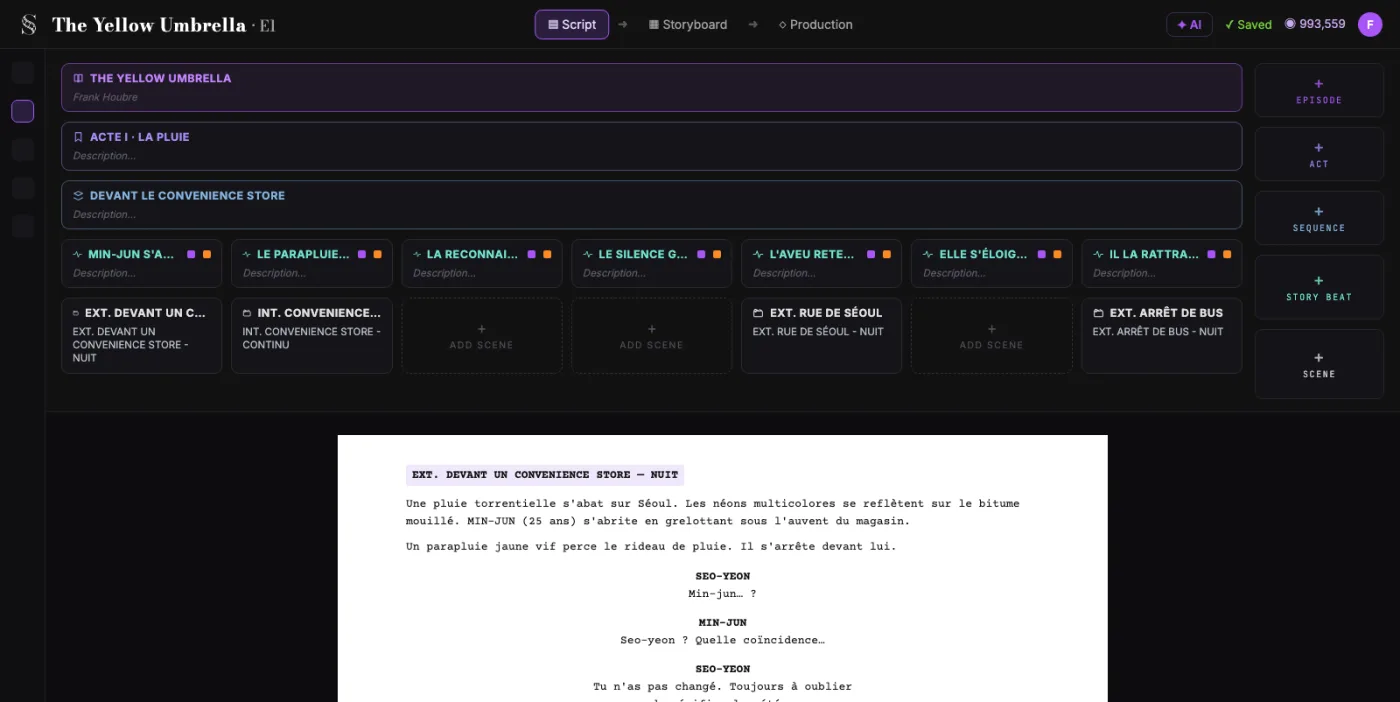
  1. ScreenWeaver screenplay editor: acts, sequences and beats above the formatted script of The Yellow Umbrella

    01The screenplay, enriched

    An industry-standard screenplay editor, and more: a visual outline and beat editor, your writing inspirations (notes, photos, audio) kept next to the page, and an AI researcher to support your writing, not replace it.

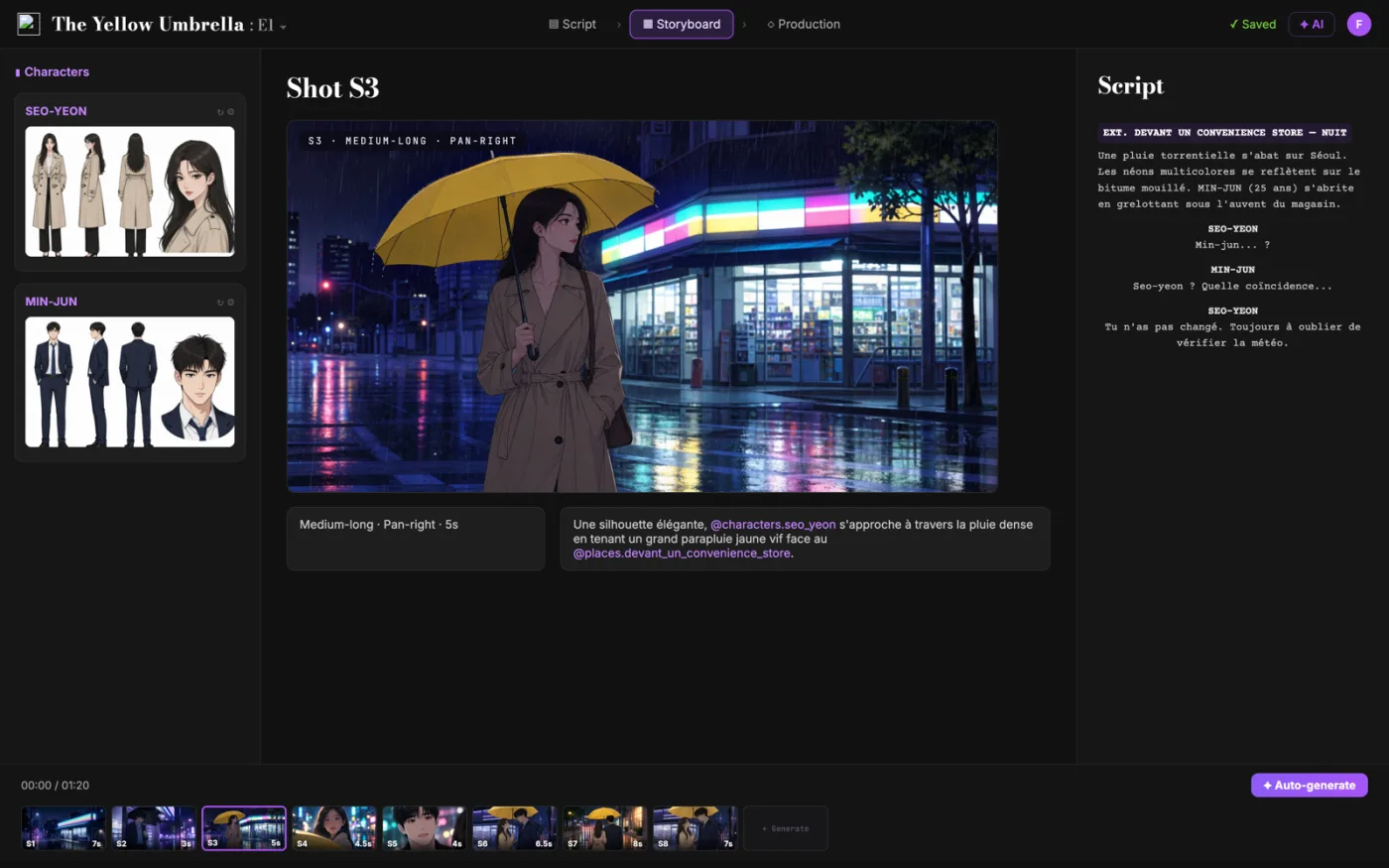
  2. ScreenWeaver storyboard: shot S3 of The Yellow Umbrella with characters, shot settings and the script beside it

    02The storyboard, made easy

    Shot breakdown generated from your screenplay, manual control over every shot (frame, angle, movement, duration), and generative AI previsualization in one click.

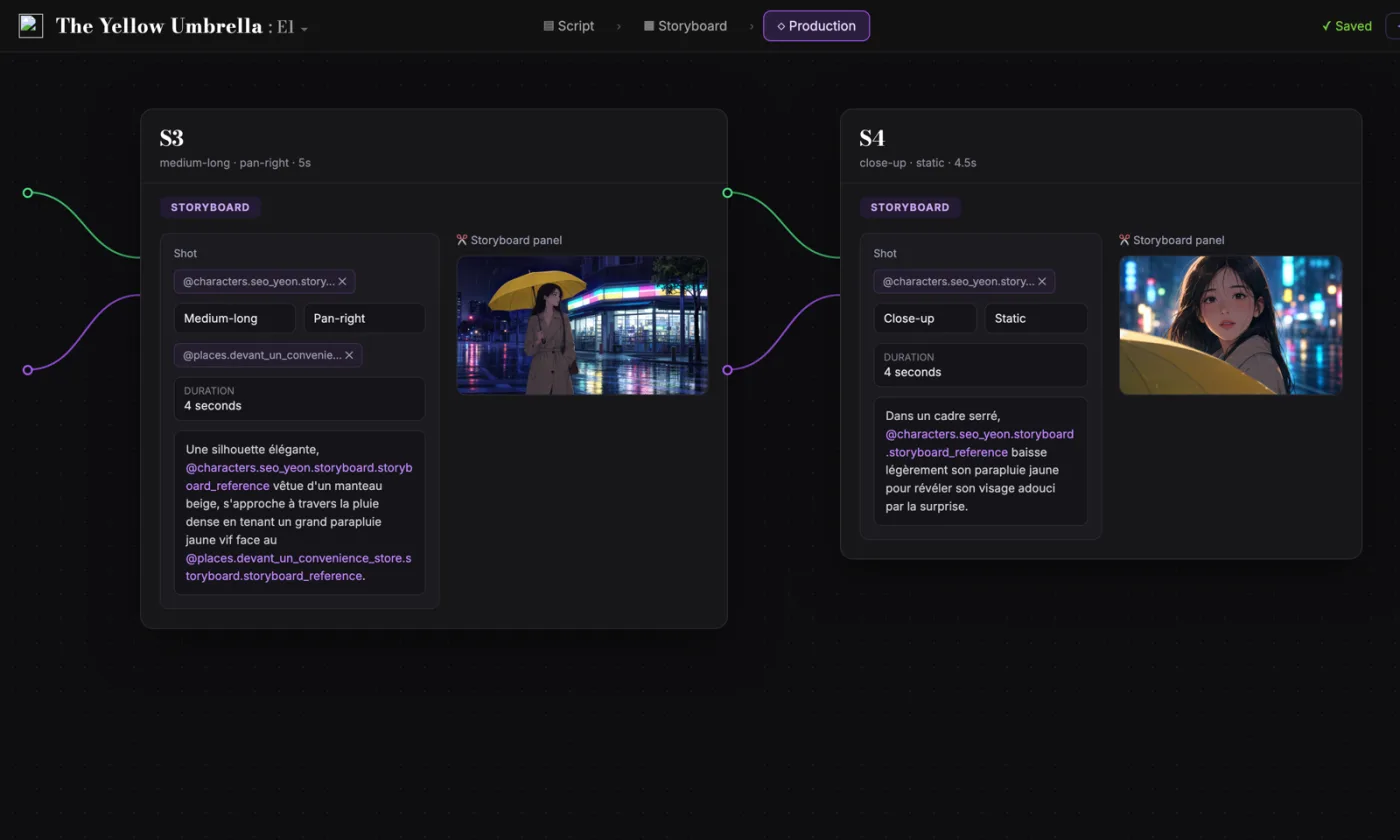
  3. ScreenWeaver production canvas: shots S3 and S4 as connected nodes carrying their storyboard panels and prompts

    03AI production, with finesse

    Footage generation pipelines connected to your screenplay and storyboard. Optimized out of the box, fully editable workflow.

FAQ

The MetaMorph AI Film Award, your questions

How do you win the MetaMorph AI Film Award?
Films are assessed on creativity, storytelling, purposeful AI, human direction, technical execution, impact, innovation, transparency and responsible use. No weights are published. A clear story, visible human choices and an honest statement are the common thread.
How much of the film must use AI?
AI must be involved in at least 50% of the creative or production process. That does not mean 50% of the visible frames. Basic automated functions alone, such as spell-checking or automatic subtitles, do not normally count.
What is the final deadline?
15 May 2027 is the extended deadline on Festhome. Standard is 30 April and late is 8 May. The ceremony is on 15 June 2027 in London. The early deadline was 30 September 2026.
Does the award require TapNow?
No. The rules say there are no limitations on equipment or software. TapNow is a partner, and selected winners receive TapNow credits whose value has not been announced.
Can ScreenWeaver make a film for the award?
Yes. No tool is imposed, and the footage pipelines run on Seedance 2.0 and 2.5. Declare ScreenWeaver and the Seedance version in your submission statement.
What does it cost to enter?
In the fully AI category, €23 early, €29 standard, €35 late and extended, on Festhome. Other sections vary. Fees are not refunded, and withdrawing a film does not normally return them.
Who is on the jury?
The 2026 panel included Cassie Brooksbank, Dave Rolfe, John Rhys-Davies, Rocky Mudaliar, Wesley Ter Haar, Timbaland and Tiger Savage, among others. The 2027 panel is not announced and may vary by category.
What happens to my rights if I submit?
Yes. You keep copyright. By submitting, you give MetaMorph permission to use the title, synopsis, extracts, stills and information to review, promote, screen and announce. Submitting does not transfer ownership.

Seven months. Start with the page.

Write the screenplay free today. Storyboard it, then film it with Seedance.