
MiniMax has released H3-Image, an open-weight image model built on its H3 video model. It generates images from text, from reference images and edits existing ones. MiniMax says it makes a 4K image (4096 × 4096) in under 10 seconds and can work with up to 16 reference images in one request.
The speed will get the headlines. For anyone storyboarding a film, the number that matters is the second one. Sixteen references is enough to give a model every character, the location and the style of a shot at once.
What follows comes from MiniMax's announcement, published on 10 November 2026 (dated 11 November on the page) and read on 12 November, and from the model page on Hugging Face. We have not run the model ourselves yet.
What MiniMax released
According to MiniMax:
- Three jobs in one model: text to image, generation from references, and image editing.
- 4K in under 10 seconds, which MiniMax puts at up to five times the speed of "mainstream alternatives". Its Standard mode is 1.5 to 2 times as fast, and a Highspeed mode 3 to 4 times.
- Up to 16 reference images, with what MiniMax calls state-of-the-art prompt adherence among open-weight models.
- Open weights, like H3 before it, on Hugging Face under a MiniMax community license. The model is also available through the MiniMax API Platform, MiniMax Code and Hailuo AI.
- Price: MiniMax says 50 to 70% of comparable offerings, with 50% off 4K requests during launch week. It does not give a figure per image in the text we read.
The speed and quality claims are MiniMax's own. The announcement does not publish a benchmark table we could check, so treat "5×" as a vendor figure until independent tests come out.
Why 16 references matters for a storyboard

Most consistency problems in AI storyboards come from the same place: the model sees one or two images and has to guess the rest. Put two characters in a kitchen and it has to remember two faces, two outfits, a room and a look. With a handful of references, something gives, usually the second character or the room.
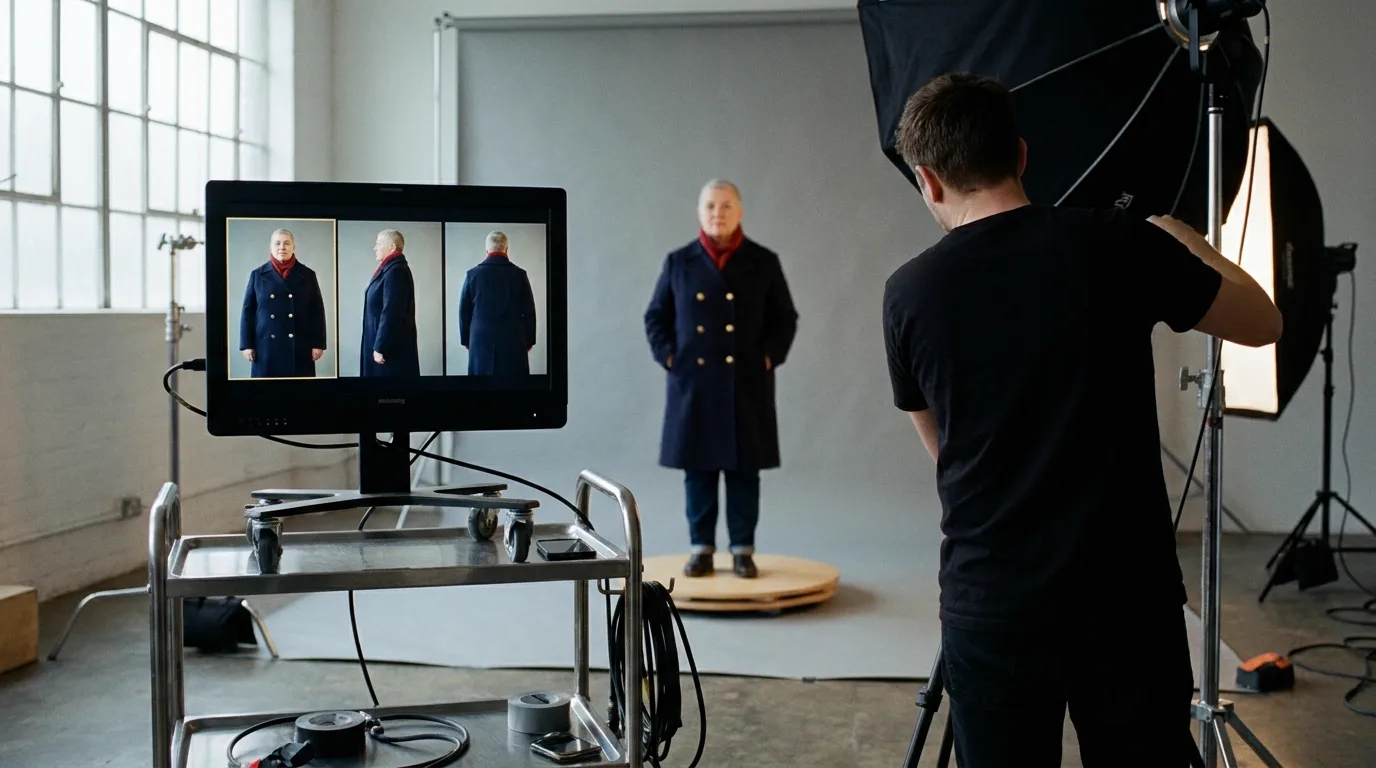
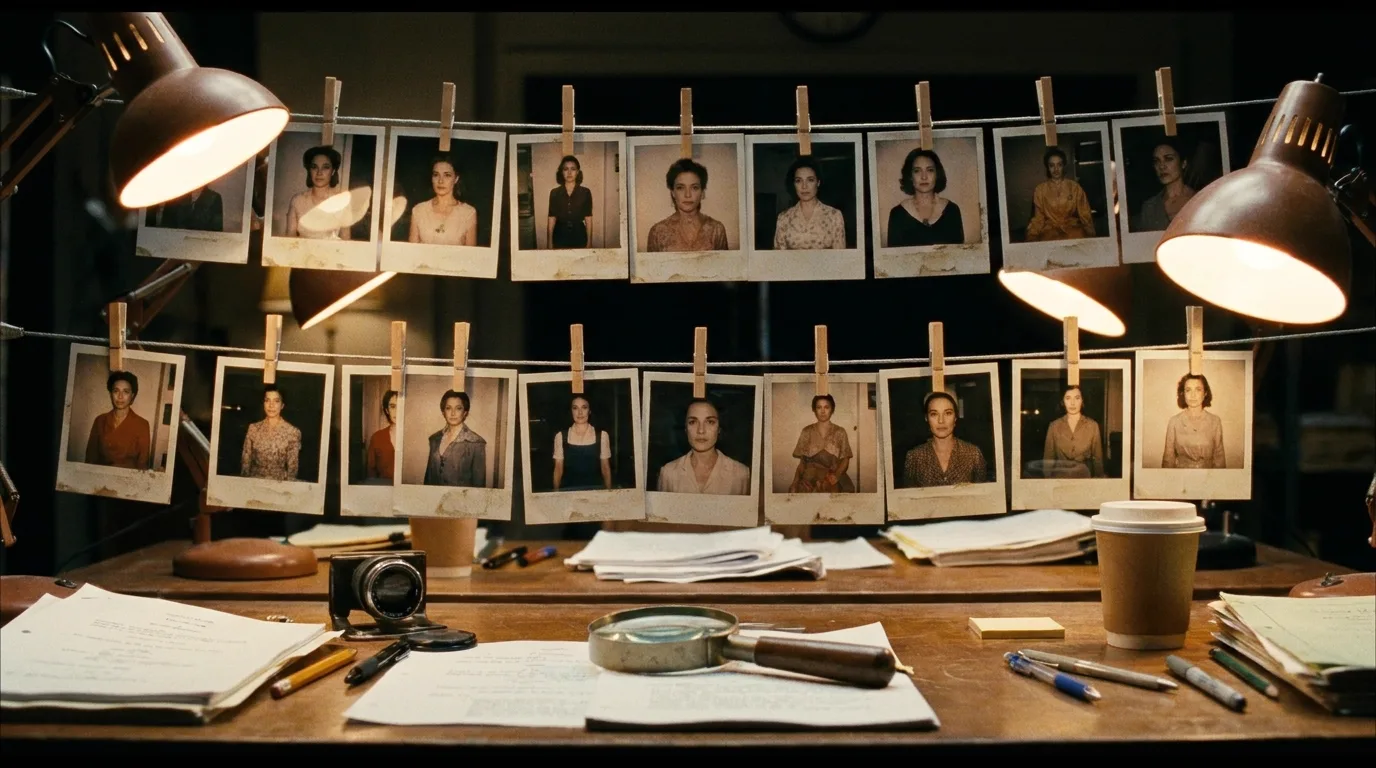
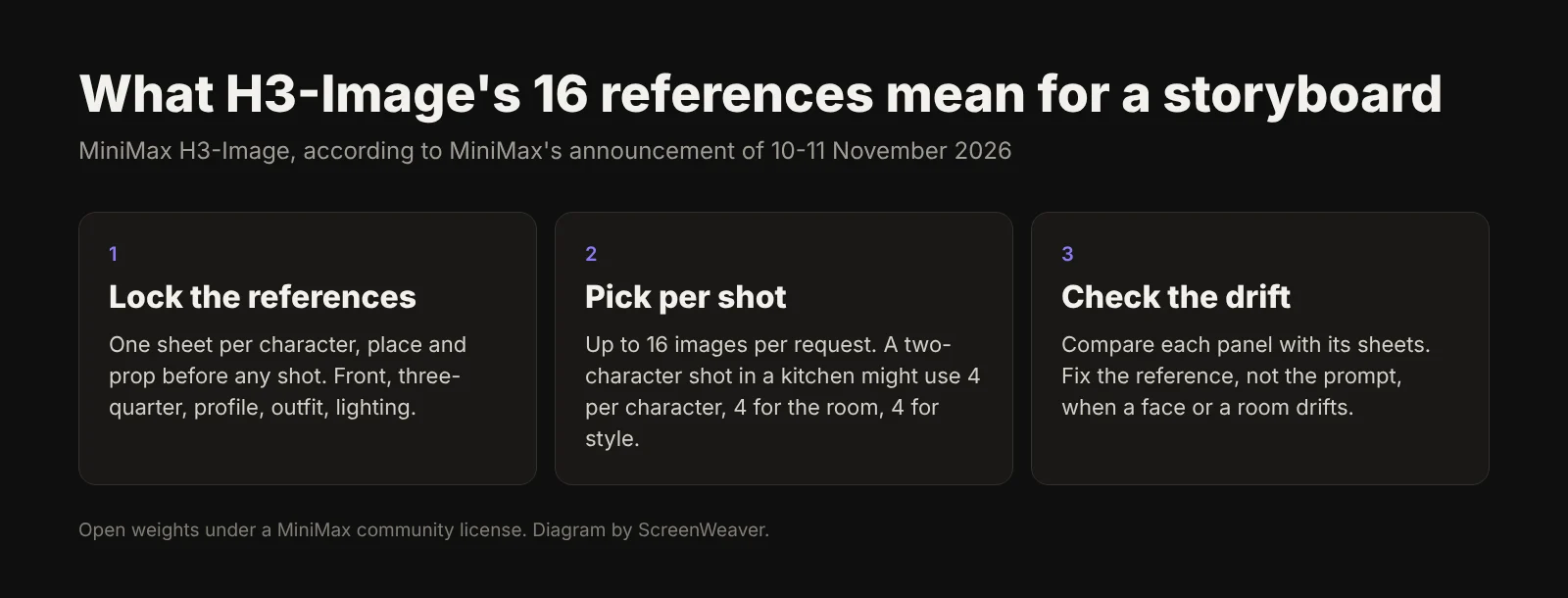
Sixteen slots changes the budget. A two-shot in a kitchen could carry four images per character (front, three-quarter, profile, outfit), four of the room, and a couple for the style. That is the way we already work in ScreenWeaver: every character, place and object is a story element with its own reference sheet, and each shot cites the elements it shows.
Try it free
Try ScreenWeaver for free on your script
It is free. Import your existing project, get a clearer view of your outline, and regain control of your story structure in minutes.
Start FreeWhat I would do this week
- Write your reference sheets first. A model that takes 16 images is only as good as the images you give it. Our guide to keeping characters consistent across a storyboard covers what goes on a sheet.
- Count your references per shot. Two characters plus a location fit comfortably. A crowd scene does not, so decide who gets full references and who stays in the background.
- Test it on your hardest shot, not your easiest. A close-up of two characters in a recurring set will tell you more than a single portrait.
- Read the license before a commercial job. "Open weights" here means a MiniMax community license, not a standard open-source license.
If you are comparing open models, our piece on Pika H3 Flex, a video model post-trained on MiniMax H3, gives the video side of the same family, and fixing character drift in AI video picks up once your panels move.
What we don't know
- Independent quality tests. The speed and adherence claims come from MiniMax.
- How the 16 references are weighted. The announcement does not say whether some images count more than others, or how to tell the model which reference is which.
- The exact license terms for commercial use. Read the community license on Hugging Face before shipping client work.
- The price per image. MiniMax gives a percentage of competitors' prices, not a figure we could quote.
FAQ
What is MiniMax H3-Image? An open-weight image model from MiniMax, built on its H3 video model, released on 10 November 2026. It does text-to-image generation, reference-based generation and image editing, according to MiniMax.
How many reference images does H3-Image accept? Up to 16 reference images per request, according to MiniMax's announcement.
How fast is H3-Image? MiniMax says it generates a 4K image (4096 × 4096) in under 10 seconds, at up to five times the speed of mainstream alternatives. These are MiniMax's own figures.
Is H3-Image open source? Its weights are published on Hugging Face under a MiniMax community license agreement. That is an open-weight release with its own terms, so check them before commercial use.
Where can I use H3-Image without running it myself? Through the MiniMax API Platform, MiniMax Code and Hailuo AI, according to MiniMax.
How do I keep characters consistent with a multi-reference model? Give each character, place and prop a reference sheet before you generate, make every shot cite the sheets it needs, and fix the reference rather than the prompt when something drifts. In ScreenWeaver, story elements carry those sheets and storyboard shots point to the elements they show.
From script to shots
Turn your script into a film, shot by shot
Write the scene, get its storyboard, then generate each shot with consistent characters. You direct every step.
Start your film free