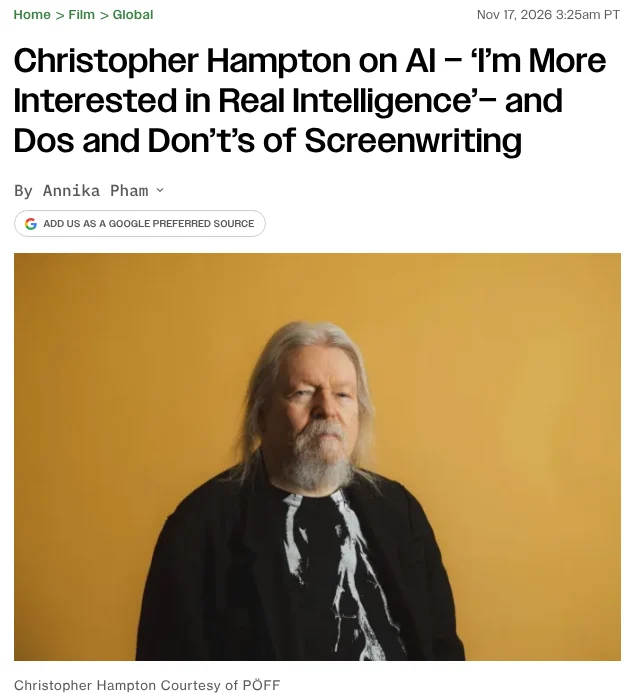
Asked at the Tallinn Black Nights Film Festival whether AI could replace screenwriters, Christopher Hampton, the two-time Oscar winner behind Dangerous Liaisons and The Father, gave a short answer: "I don't think it's gonna happen." For newcomers tempted to write a script with it, his verdict was shorter still: "You're being lazy."
This comes from Annika Pham's report for Variety, published on 17 November and read on 21 November 2026. The masterclass, "From Stage to Screen, The Art of Adaptation", took place at the festival's Industry@Tallinn & Baltic Event. All quotes below are as Variety reported them.
What Hampton said about AI
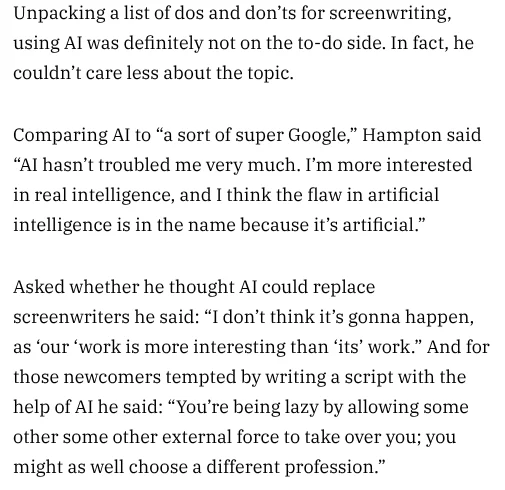
According to Variety, Hampton compared AI to "a sort of super Google" and said it hasn't troubled him much. "I'm more interested in real intelligence, and I think the flaw in artificial intelligence is in the name because it's artificial."
On replacement, he said our work "is more interesting" than its work. And to aspiring writers using AI to write their scripts: "You're being lazy by allowing some other external force to take over you; you might as well choose a different profession."
The rest of the masterclass matters more
Disclosure: ScreenWeaver is a screenwriting and pre-production tool with AI features. A respected writer dismissing AI is not neutral news for us, so weigh our angle accordingly.
The AI lines will travel, but most of the session was about craft, and it is worth reading in full:
- Know what is essential. "One of the most important skills that you can achieve as a screenwriter is to know what you need to say and don't say any more than that." He says the first thing he did on his draft of The Son was cut 20 pages.
- Trust the audience. Studios, he says, ask him to explain things that "are there in the script already that they haven't noticed." The audience "is always more intelligent than people imagine."
- Film is not filmed theatre. It took him about ten years to stop writing films that "smelt like the theatre." From David Lean he learned how to make one scene flow into the next.
- Be patient. A Dangerous Method took 14 years. Embers, with Ralph Fiennes and Viggo Mortensen, took 20 and is lined up for 2027. Writing for film, he said, is "like going into the casino."
If you adapt books, his point about the stage-to-screen gap applies just as well to prose. Our guide on how to adapt a novel into a screenplay starts from the same idea: you translate, you don't transcribe.
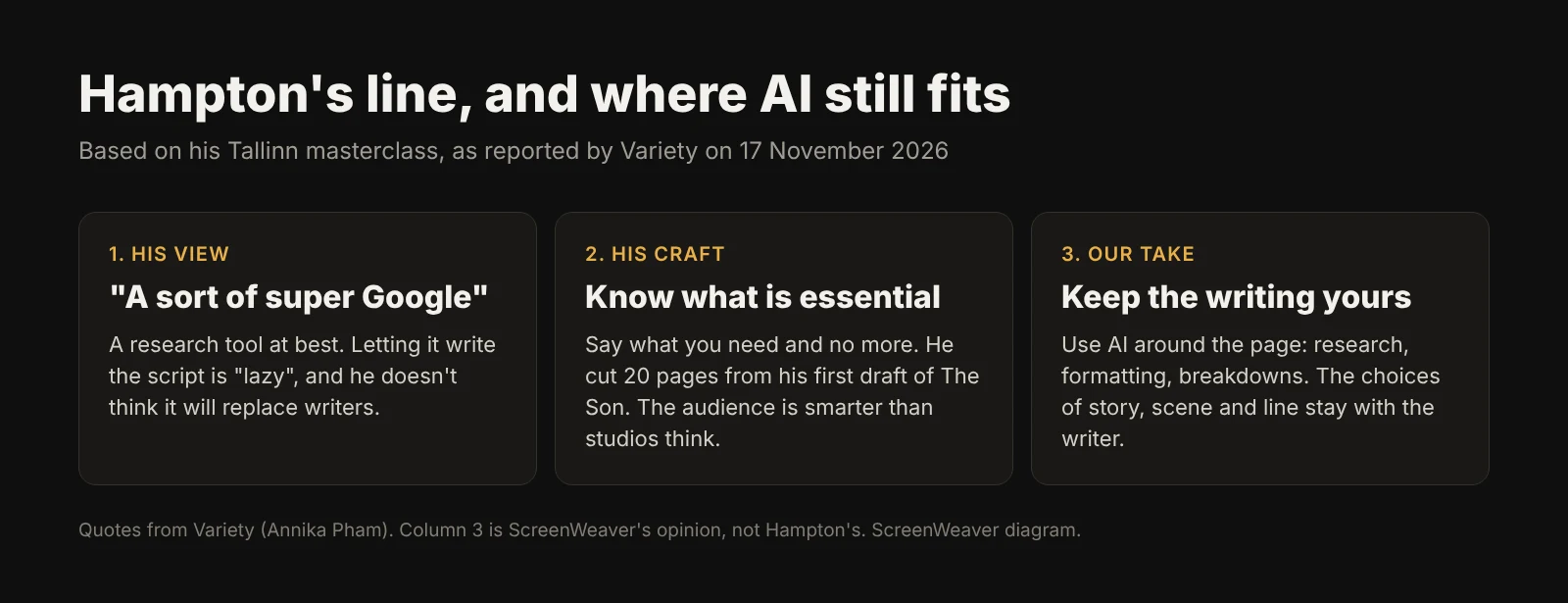
Where we land
Hampton draws the line at the page itself, and we think that line holds. The choices that make a script yours, what the scene is about, what the character doesn't say, which 20 pages go, are exactly the ones he describes as the craft.
His "super Google" is not a bad description of where AI can earn its place, as long as you check what it returns: research, formatting, breaking a script down into scenes, characters and locations, comparing drafts. We made the same case in why algorithmic help will never replace a writer's intuition. If AI writes your dialogue, you skip the part where you learn what you need to say.
And his complaint about notes that ask you to explain what is already on the page is one every writer will recognise. Our guide on how to take notes from producers covers how to answer them without flattening the script.
Try it free
Try ScreenWeaver for free on your script
It is free. Import your existing project, get a clearer view of your outline, and regain control of your story structure in minutes.
Start FreeWhat we don't know
- The full context. We are working from Variety's report, not a recording or transcript of the masterclass.
- Whether he has used AI himself. The report doesn't say whether his view comes from trying the tools.
- How festivals and industry bodies will respond. Nothing in the report points to a policy change.
FAQ
What did Christopher Hampton say about AI?
According to Variety, he compared AI to "a sort of super Google", said it hasn't troubled him much, and said he is "more interested in real intelligence."
Does Christopher Hampton think AI will replace screenwriters?
No. Asked the question at his Tallinn masterclass, he said: "I don't think it's gonna happen", adding that writers' work is more interesting than AI's.
What did he tell new writers about using AI?
That writing a script with AI's help is "being lazy", and that someone who lets an external force take over "might as well choose a different profession."
Where did he say it?
At a masterclass called "From Stage to Screen, The Art of Adaptation" during the Tallinn Black Nights Film Festival's industry event, reported by Variety on 17 November 2026.
What was his main screenwriting advice?
Know what is essential and say no more than that, trust the audience, and accept that projects can take years or decades to reach the screen.
Can a screenwriter use AI without letting it write the script?
Yes. Research, formatting, script breakdowns and draft comparisons don't touch the writing itself. The creative decisions stay with the writer.
From script to shots
Turn your script into a film, shot by shot
Write the scene, get its storyboard, then generate each shot with consistent characters. You direct every step.
Start your film free