
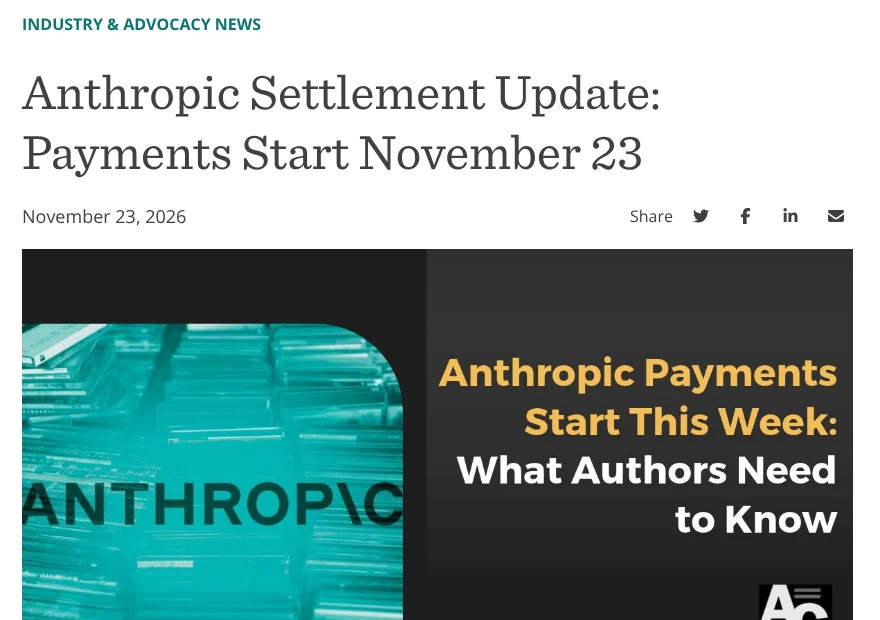
The first checks from Anthropic's $1.5 billion settlement with authors are going out this week. Novelist Courtney Milan says she has already received her share, and the Authors Guild says undisputed claims are being paid in the week of 23 November 2026.
It is the first time a large AI company pays writers, in money that lands in bank accounts, for books it used to build its models. The amounts are modest per book. The precedent is not, and screenwriters should read it closely, because the same question will come for scripts.
This is based on the Authors Guild's payment update, last updated on 23 November 2026, and The Verge's report by Dominic Preston, published on 26 November. We read both on 27 November. We did not see a payment statement ourselves, and the official settlement website refused our automated visit, so the figures below are the Guild's.
Disclosure: ScreenWeaver sells AI tools for writers and filmmakers, including features that call large language models, so we have a stake in how training data is paid for. Read our take with that in mind.
What is being paid, and when
The case is Bartz v. Anthropic, the class action brought by authors whose books were downloaded from pirate libraries and used to train Claude. Anthropic agreed last year to pay $1.5 billion, which The Verge says should work out to around $3,000 per book.
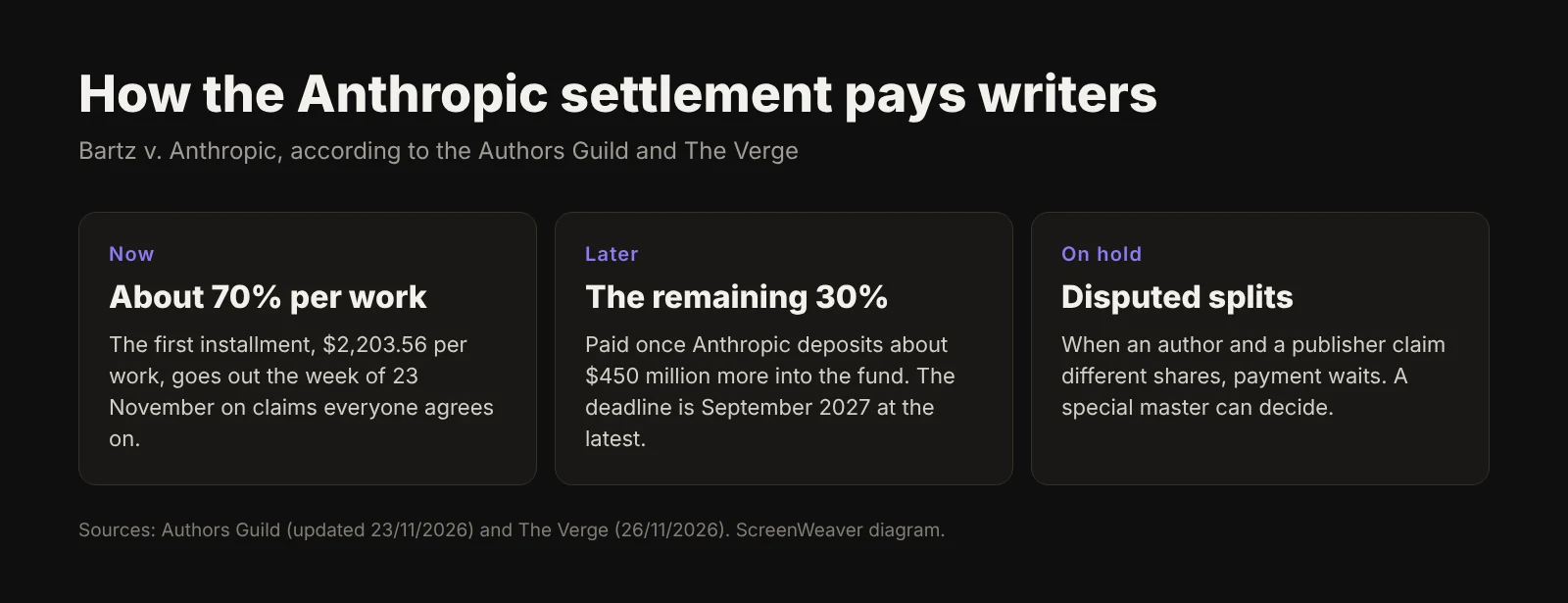
The payment arriving now is not the full amount. According to the Authors Guild, it is an installment of about 70 percent, or $2,203.56 per work, paid only on claims where everyone agrees on the split. Money goes out by the method each claimant chose: ACH, Zelle or check.

The remaining 30 percent depends on Anthropic depositing about $450 million more. The settlement ties that payment to an IPO or a large investment, with September 2027 as the latest date. In its 23 November update, the Guild writes that Anthropic's IPO happened the week before and that it expects the balance "to go out quickly" once the funds arrive.
Why some authors are still waiting
Each book can have several claimants: the author, co-authors and the publisher. When their declared shares don't match, the claim is marked disputed and isn't paid in this first round. The Guild says simple errors, such as a publisher and its own imprint filing separately, should be paid in December. Real disagreements can be settled between the parties, or sent to a court-appointed special master who decides from the contract.
A common case is the out-of-print book where the author believes the rights came back and the publisher still claims half. That detail matters to anyone who signs contracts: the money followed the paperwork, not the person who wrote the words.
What it means for screenwriters
This settlement covers books, not screenplays. A produced script is usually owned by the studio as work made for hire, so a payment like this one would most likely go to the company, not the writer, unless a contract or a guild agreement says otherwise. That is the uncomfortable part.
It is also why training sits next to authorship in the guild debate, as we explained in where the WGA draws the line on AI. And it echoes what we wrote about copyright of AI films: what you can prove you own decides what you can claim.
The settlement shows three things a writer can act on today:
- Ownership records pay. Authors with clean contracts and reverted rights on file are being paid first. The ones arguing about a 50/50 split are waiting.
- Specs and unproduced drafts are yours. Until you sell them, those scripts belong to you, and so does any claim attached to them. Register them and keep dated versions.
- Training is now a line item. A model company has paid per work. Expect the next negotiations, for books, scripts or footage, to start from a price, not from a refusal.
Try it free
Try ScreenWeaver for free on your script
It is free. Import your existing project, get a clearer view of your outline, and regain control of your story structure in minutes.
Start FreeWhat it means for you
- Check every contract for an AI or training clause before you sign an option, a purchase or a staff deal. Ask who gets paid if the script is licensed for training.
- Keep a rights folder per script: registration, contracts, reversion letters. It is the document that settles a dispute in minutes.
- If you also write books, look up your titles on the settlement website and make sure your payment details and tax information are current. The Guild notes the payments are taxable income in the US.
- Read your tool's terms on whether your pages are used to train its models, and switch it off when you can. For ScreenWeaver, see our privacy policy.
What we don't know
- When the remaining 30 percent arrives. The Guild expects it soon after Anthropic's deposit, without a date.
- How many claims are disputed, and how long the special master process will take.
- Whether any screenplays are in the dataset. The class covers books on the case's works list, and no source we read mentions scripts.
- Whether other AI companies will settle on similar terms. Other suits by authors and studios are still running.
FAQ
Has Anthropic started paying authors?
Yes. The first payments from the Bartz v. Anthropic settlement go out in the week of 23 November 2026, according to the Authors Guild, and novelist Courtney Milan says she has received hers, as reported by The Verge.
How much does each book get?
About $3,000 per book in total, according to The Verge. The first installment is about 70 percent, $2,203.56 per work, split between the claimants of that work, according to the Authors Guild.
When is the rest paid?
Once Anthropic deposits about $450 million more into the fund. The settlement links that to an IPO or a large investment, and sets September 2027 as the latest date.
Why haven't some authors been paid?
Their claims are disputed, usually because the author and the publisher declared different shares. Those claims wait until the parties agree or a special master decides.
Does the settlement cover screenplays?
Not as far as we know. It covers books used to train Anthropic's models. No source we read mentions screenplays.
What should screenwriters do now?
Keep clean ownership records for every script, read AI and training clauses in contracts, and check whether the tools you write in train on your pages.
From script to shots
Turn your script into a film, shot by shot
Write the scene, get its storyboard, then generate each shot with consistent characters. You direct every step.
Start your film free