
A showrunner asks you to punch up a scene. You run it through a dialogue generator, tweak a few lines, and hand it back. Nobody asks where the words came from. A year later, the same room is debating whether any writer can use "AI" at all without crossing a line. The room didn’t change. The tools did. So did the guild. The question that used to feel theoretical, Where is the line?, is now the one that decides what you’re allowed to do, what you have to disclose, and what still counts as yours.
This isn’t a question with a single answer. It’s a collision of labor, craft, and policy. The Writers Guild of America has drawn boundaries. Studios have pushed back. Writers are left navigating a space where "using a tool" and "replacing the writer" look different depending on who’s defining the terms. Here’s how that space actually works, where the WGA stands, and how to stay on the right side of the line without giving up tools that make you faster and clearer.
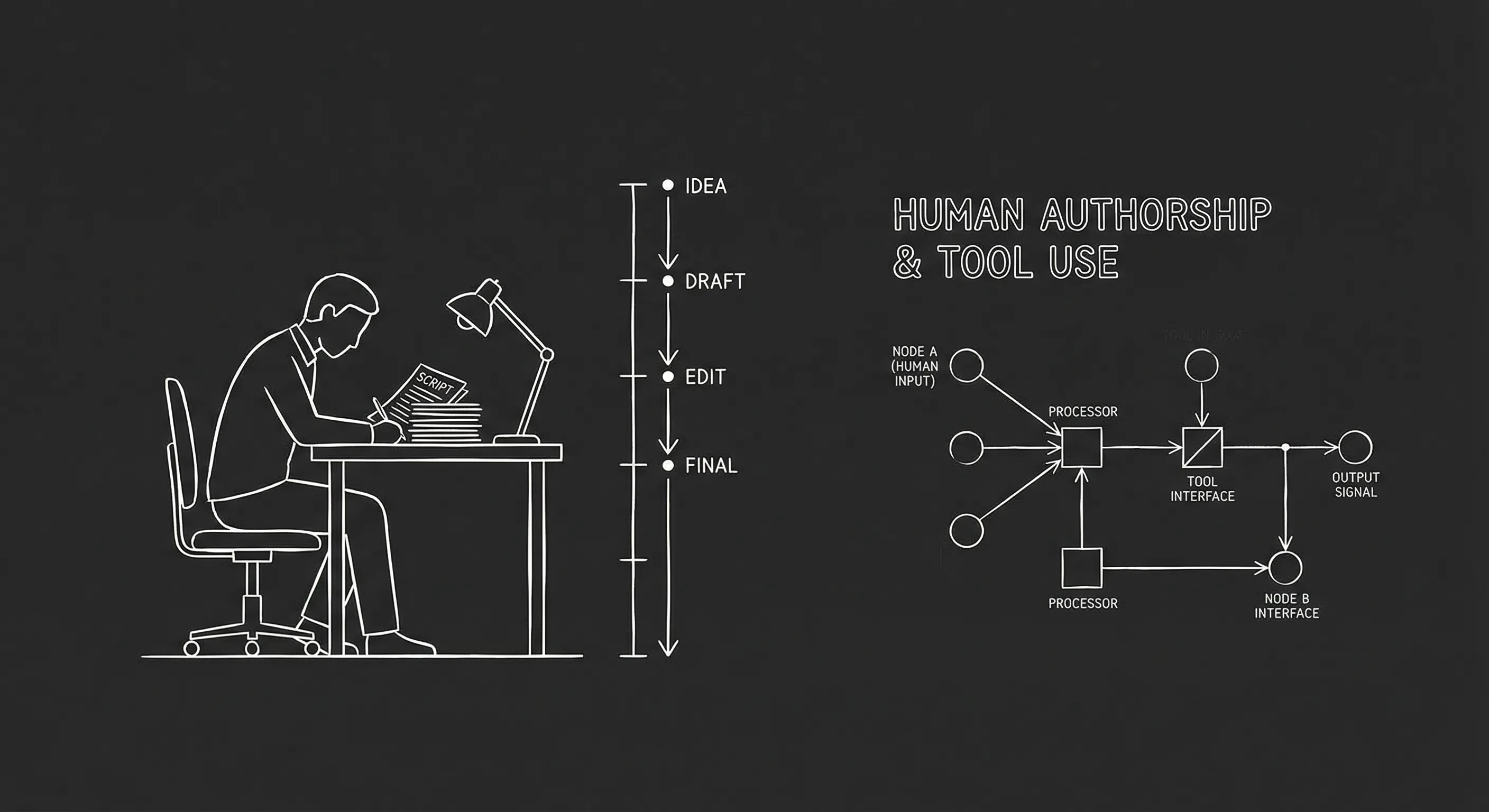
The line isn’t between "technology" and "no technology." It’s between you as the author of the work and something else as the author. The guild’s job is to protect the former. Your job is to know where you stand.
For context on how tools can support structure without replacing you, see our guide on augmented screenwriting. For the legal side of protecting your work, copyright and registration is the baseline before any deal.
Shopping for software mid-guilt spiral? Top AI tools for screenwriters in 2026 labels who generates whole scenes vs who nudges structure, so you can line that up with what the guild still insists you author.
Free tool: use the Beat Sheet Calculator to map these beats to exact page numbers for your script length.
What the WGA Actually Said (And Why It Matters)
The 2023 strike didn’t invent the AI debate. It codified it. After months of negotiation, the WGA secured language that treats AI as a tool that cannot replace the writer, not as a source of literary material to be polished and claimed as original work. The distinction is deliberate. Studios cannot require you to use AI. They cannot use AI-generated material to undercut your fee or credit. And they cannot feed your scripts into a model to train it without agreement. That last point is about ownership and future use as much as current pay.
But the agreement doesn’t say "writers may not use AI." It leaves room for you to use AI as you would any other tool, research, organization, brainstorming, as long as you are the one producing the literary material that gets credited and paid. So the guild has drawn a line around you: your labor, your authorship, your credit. It has not banned the use of assistive technology. That nuance is where most of the confusion lives.
Think about it this way. A thesaurus is a tool. So is a beat sheet template. So is software that suggests alternate phrasings. The guild’s position is that the writer must remain the author of the script. If a studio uses an AI to generate a draft and then hires you to "rewrite" it at a lower rate, that’s the line. If you use an AI to help you brainstorm beats or check continuity, and you write the actual scenes, that’s a different conversation. The former threatens the profession. The latter is tool use.
The Line in Practice: Three Scenarios
Scenario one: The outline request. Your producer sends you a one-pager and says, "Turn this into a beat sheet by Friday." You’re swamped. You paste the one-pager into a model, ask for a 12-beat structure, and get back a generic skeleton. You then rewrite every beat, changing motivations, cutting two subplots, adding a character the one-pager never mentioned. You hand in the beat sheet. It’s 80% your thinking, 20% reworked scaffolding. Did you cross the line? Under the WGA’s framework, the literary material you’re paid for is the beat sheet you delivered. You authored it. You made the creative choices. The tool gave you a starting point; you turned it into a document that reflects your judgment. Most writers and guild reps would say you’re fine. The catch: if you’d submitted the raw model output with a few light edits, you’d be in grayer territory. The line is how much of the creative work is yours.
Scenario two: The dialogue pass. You’re on staff. A script has a scene that’s flat. The showrunner says, "Give me three options for this exchange." You open a dialogue tool, generate a few variants, then rewrite two of them heavily and write the third from scratch, inspired by a line the tool suggested. You turn in three options. The showrunner picks one and asks for a light polish. You do the polish yourself. Who wrote the scene? You did. You selected, rewrote, and polished. The tool was part of your process, like a thesaurus or a brainstorm. But here’s where it gets sticky. If the showrunner or the company has a policy that any use of AI must be disclosed, you need to disclose. If they don’t, you’re still the author of what was shot. Integrity here means knowing your room’s rules and your own comfort level. Some writers will never run dialogue through a generator; others will use it for options and then own the result. Both can be ethical if the final text is yours.
Scenario three: The "AI draft" rewrite. A studio has an AI-generated first draft. They want to hire you for a rewrite at a fee that’s below what they’d pay for an original screenplay. The WGA has said that AI-generated material cannot be used to reduce the compensation or credit due to the writer. So taking that job at a discounted "rewrite" rate, when the "first draft" wasn’t written by a human writer, undermines the guild’s entire fight. The line is clear: that job should be treated as original writing (or at least at a rate that doesn’t use AI to undercut you). Accepting it as a cheap rewrite is on the wrong side of the line. This is the scenario the guild cares about most, not you using a thesaurus, but studios using AI to shrink the pool of paid human work.
Acceptable Use vs. Replacement: A Working Table
| Dimension | On the right side of the line | On the wrong side of the line |
|---|---|---|
| Who is the author? | You write, revise, and approve every line that goes to the show or script. | A model generates substantial dialogue or story beats that you submit with minimal change. |
| Compensation | You’re paid as the writer of the material (story/script fee, credit). | You’re paid a "rewrite" or "polish" rate on AI-generated material that replaced an initial human draft. |
| Disclosure | You know your room’s or company’s policy and follow it. When in doubt, you disclose. | You hide use of AI in a context where the employer or guild expects disclosure. |
| Training | Your scripts are not used to train a model without a clear agreement and compensation. | Your work is fed into a model to generate more "content" without your consent or pay. |
None of this is legal advice. It’s a way to think about where you draw the line so that your practice matches the guild’s principles and your own integrity.
Try it free
Try Screenweaver for free on your script
It is free. Import your existing project, get a clearer view of your outline, and regain control of your story structure in minutes.
Start FreeWhat Beginners Get Wrong (The Trench Warfare)
Treating "AI" as one thing. There’s a big difference between a continuity checker, a beat generator, and a full-scene dialogue engine. Beginners often either refuse everything ("I don’t touch AI") or use everything without reflection ("I just let it write the first pass"). Both are mistakes. The first leaves useful tools on the table; the second blurs authorship. The fix: define what you’re using and for which step. Research and organization? Beats and structure? Actual prose? The closer the tool gets to producing the final words on the page, the more you need to rewrite and own the result, and the more you need to know your employer’s and guild’s expectations.
Assuming the guild banned AI. The WGA did not ban writers from using assistive tools. It negotiated limits on how studios use AI. So if you’re avoiding a beat-sheet generator or a thesaurus-style dialogue helper because you think "the guild forbids it," you’re misreading the deal. The guild forbids studios from requiring AI, from using AI to cut your pay or credit, and from training on your work without agreement. Your personal use is a separate question, governed by your conscience and your room’s policy.
Saying nothing when the room expects disclosure. Some shows and studios have added their own rules: "Disclose any use of AI in the writing process." If you don’t disclose when you’ve used a tool, and they find out later, you’ve broken trust. The fix is simple: ask. At the start of a job or a season, ask the showrunner or the production company whether they have a policy on AI use. If they do, follow it. If they don’t, you still have to live with yourself, so decide in advance what you’re willing to disclose and what you consider "just a tool" like a spell-checker.
Taking "AI rewrite" jobs at cut rate. This is the failure mode the guild was built to prevent. When a producer says, "We have an AI draft; we just need you to clean it up for scale," the ethical move is to push back. The job should be treated as original writing (or at least paid and credited in a way that doesn’t use AI to undercut guild minimums). If you take the job at a rewrite rate, you’re normalizing the practice of using AI to replace the first writer and pay the second less. The fix: know WGA minimums and use them. If the "source material" wasn’t written by a human, don’t accept a discount for it.
Confusing "I used a tool" with "I didn’t write it." You can use a tool and still be the author. The test is: could you defend every creative choice in the room? If the answer is yes, you wrote it. If you’re handing in generated text you didn’t substantially reshape, you didn’t. Own the distinction. It keeps you on the right side of the line and out of the gray zone when someone asks, "Who wrote this?"
Integrity Without Luddism
You don’t have to choose between "no tech" and "anything goes." The line the WGA drew is about who does the writing, not what software is open on your laptop. Use tools that make you faster and clearer, outlines, beat sheets, research, continuity checks. Use them in a way where the final script is unmistakably yours. Disclose when your room or company requires it. Refuse to participate when the job is designed to use AI to pay you less or strip credit. That’s the practice. The rest is detail.
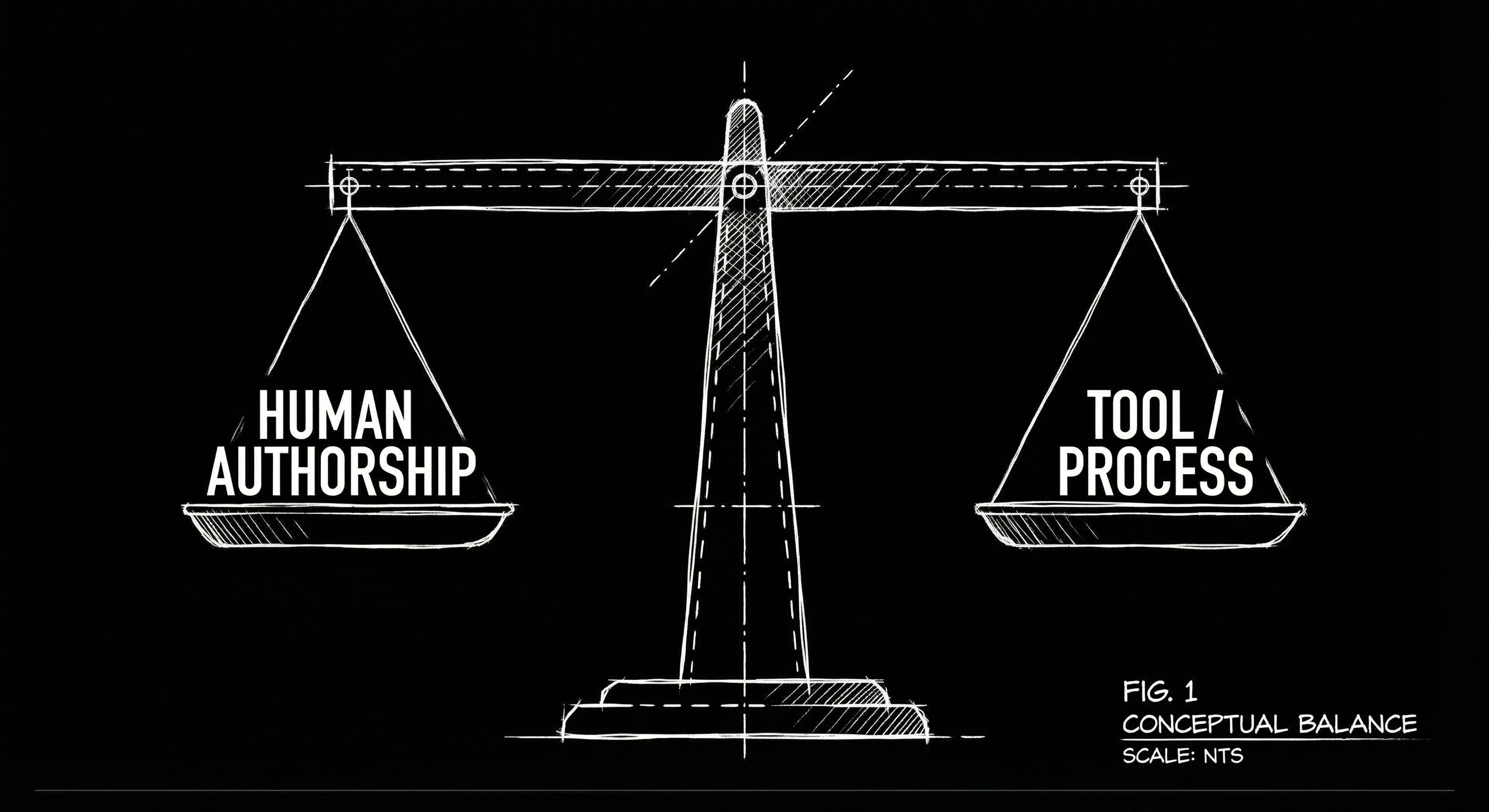
The future of the writers’ room, whether AI replaces assistants or merely augments them, is still being written. For now, the guild has given you a frame: you are the author; the tool is not. Your job is to hold that line in how you work and what deals you take. Do that, and you can use whatever helps you write without stepping over the line.
The line is not "no AI." The line is "no replacement." Protect your authorship, protect your rate, and protect the work of the next writer in the room. The rest is craft.
For a deeper take on how the writers’ room might evolve, see our piece on the future of the writers’ room and the role of assistants. For the legal status of AI-assisted work, copyright and registration and your guild membership are the two pillars.
The WGA’s official resources on the 2024 MBA remain the authoritative source for contract language and guild positions. Use them when a real offer or policy lands.
The Perspective
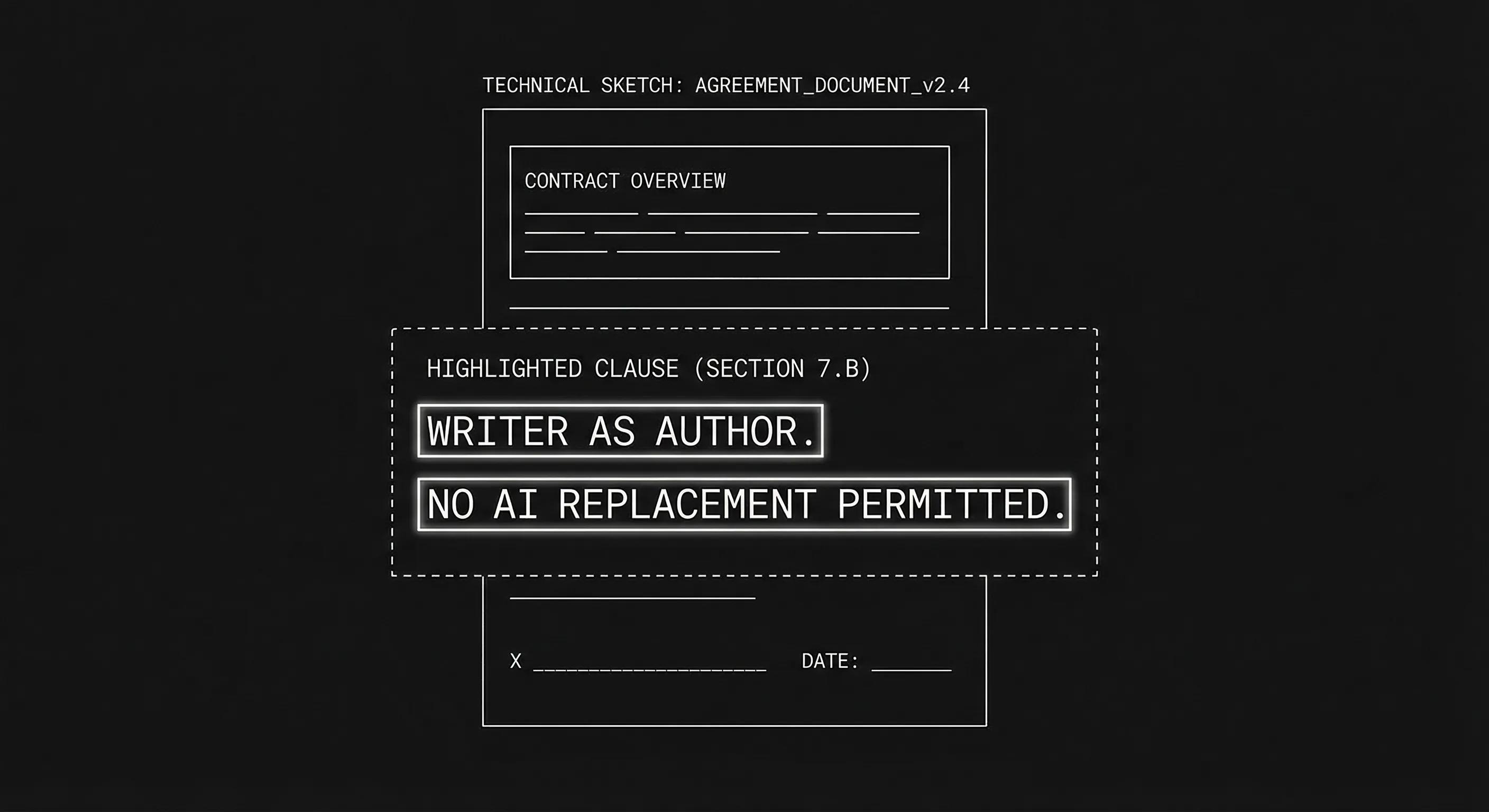
The ethics of AI in screenwriting don’t live in a slogan. They live in the choices you make when you open a tool, when you take a job, and when you sit in the room. The WGA has drawn a line: you are the author; AI cannot replace you; your work cannot be used to train models without agreement. Your job is to work on the right side of that line, to use technology without letting it use you, and to say no when the job is designed to undercut the next writer. Do that, and the line stays clear. The rest is just writing.
Final Step
Build your next script with Screenweaver
Move from ideas to production-ready pages faster with timeline-native writing and AI-assisted story flow.
Try Screenweaver