Free screenplay converter
Screenplay Converter
Every script format, both ways
Convert a screenplay between Final Draft (.fdx), Fountain, PDF, Word, Fade In, Highland, Celtx, WriterDuet, Trelby and plain text. Drop the file, pick the output, download. The conversion runs in your browser: no account, no upload, and the industry layout survives the trip.
- Private: your script never leaves this browser tab.
- Free, no signup, no watermark.
- Industry layout kept: scene headings, cues, dialogue, (MORE) and (CONT'D).
Drop your script here
Final Draft, Fountain, PDF, Word, Fade In, Highland, Celtx, WriterDuet, Trelby or plain text. Any of them converts to any output.
Private by design: the conversion runs in this tab and nothing is uploaded.
How it works
Every file is first read into one neutral model of the script: scene headings, action, character cues, parentheticals, dialogue, transitions, dual dialogue, scene numbers, emphasis and the title page. The chosen format is then written from that model. Formats that store element types (FDX, Fountain, Fade In, Celtx, WriterDuet, Trelby, Word files with screenplay styles) convert exactly. PDF and Word files typed by hand only store positions, so each element is recognized from where it sits on the page, the way a reader would. The PDF is laid out to the industry standard: Courier 12 point, 1.5 inch left margin, dialogue column at 2.5 inches, cues at 3.7 inches, page numbers top right, scene headings kept with what follows them.
Every screenplay format, both ways
Any format in the left column converts to PDF, Final Draft, Fountain, Word or plain text. Apps without a writable format here all open FDX or Fountain.
| Format | Reads | Writes |
|---|---|---|
| Final Draft (.fdx) | ||
| Fountain (.fountain) | ||
| Word (.docx) | ||
| Fade In (.fadein) | Use FDX, which it opens | |
| Highland (.highland) | Use Fountain, which it opens | |
| Celtx (.celtx) | Use FDX, which it opens | |
| WriterDuet (.wdz, .json) | Use FDX, which it opens | |
| Trelby (.trelby) | Use FDX, which it opens | |
| Text (.txt) |
One converter for every screenwriting app
Screenwriters change tools more often than they change drafts. A co-writer works in Final Draft, a producer only opens PDFs, the director reads in Word, and you write in Fountain on a tablet. Every app imports some formats and exports others, and each hop through a generic converter flattens the script into a wall of left-aligned text. This page does the hop properly, in both directions, between all the formats screenwriters actually exchange.
The hard direction is out of PDF. A PDF has no idea what a character cue is; it only knows that some words sit 3.7 inches from the page edge. The converter learns the columns of your document (where the cues, dialogue and parentheticals sit) from the unambiguous lines, then classifies the rest, joins speeches split by (MORE) and (CONT'D), lifts scene numbers out of the margins and rebuilds the title page. The preview can tint every element so you can check the result before you download.
Nothing is sent anywhere. The file is read by the browser tab you have open, converted there, and saved straight to your downloads. That matters for unproduced scripts, and it also means there is no queue, no size cap tied to a paid plan, and no watermark on the result.
Who uses it
- Writers switching apps: move a project from Celtx, Fade In, Trelby or WriterDuet to Final Draft, Highland or ScreenWeaver without retyping a line.
- Writers with only a PDF: get an editable FDX or Fountain file back from an old PDF draft, a contest submission or a script you lost the source of.
- Producers, readers and assistants: turn whatever a writer sends into the PDF or Word file your team works with, on any computer.
Stop fixing margins.Formatting is built in.
ScreenWeaver handles industry-standard formatting and exports to PDF and Final Draft (.fdx). Free, with unlimited pages.
- $0, does not expire
- PDF and Final Draft export
- Mac, Windows, Linux, iPad
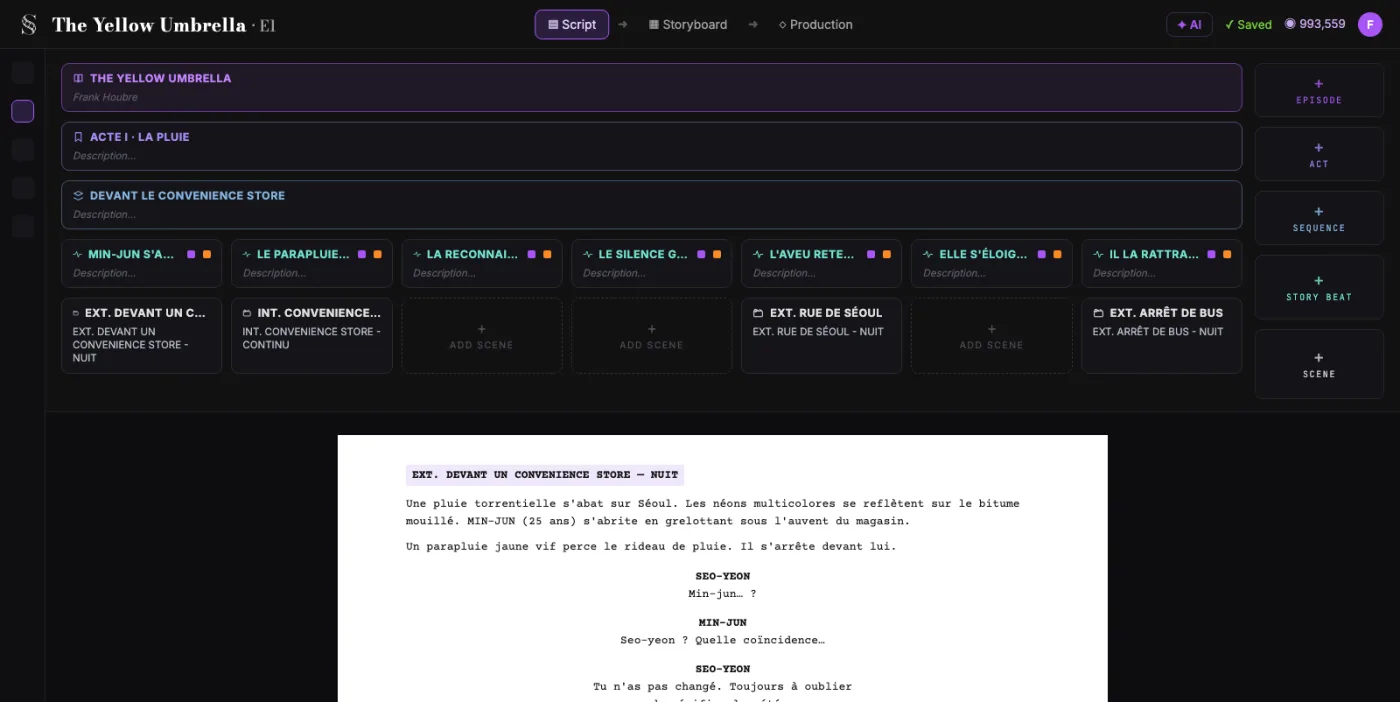
Screenplay Converter: the complete guide
It reads Final Draft, Fountain, PDF, Word, Fade In, Highland, Celtx, WriterDuet, Trelby and plain text files into one neutral model of the script, then writes PDF, Final Draft, Fountain, Word or plain text from it. Typed formats convert exactly; PDF and hand-formatted Word files are recognized from their layout.
For this workflow, the central problem is clear: every screenwriting app reads and writes a different set of formats, and generic converters flatten a script into left-aligned text because they ignore which line is a cue, a speech or a heading. Left unresolved, this creates downstream friction and slower decisions. The practical target is the same screenplay in the format the next person needs, with every element still typed and the industry layout intact.
Limitation to keep in mind: Scanned PDFs need OCR first, revision colors and script notes are not carried over, and Word cannot add (MORE) and (CONT'D) by itself, so final submissions should go out as PDF.
Advanced workflow: Teams keep one editable master (FDX or Fountain), convert it to PDF for readers and Word for notes, then convert the annotated Word file back to FDX, letting the screenplay styles restore every element.
Step-by-Step Workflow
- Drop the file (or paste the text) and check the detected format and the scene, character and page counts.
- Pick the output: PDF to read and submit, FDX for Final Draft and most apps, Fountain for plain text apps, Word for notes.
- Set the options: paper size, title page, scene numbers, (MORE) and (CONT'D).
- Look over the preview with the element view on, then download.
Use Cases By Profile
- Writer: move a project between Celtx, Fade In, Highland, WriterDuet, Final Draft and ScreenWeaver without retyping.
- Producer or reader: turn whatever a writer sends into the PDF or Word file the team works with.
- Writer with only a PDF: rebuild an editable FDX or Fountain file from an old draft.
Common Mistakes To Avoid
- Uploading an unproduced script to a converter site that keeps a copy on its server.
- Running a screenplay through a generic document converter and sending the flattened result.
- Converting a PDF and sending the FDX without checking the recognized elements first.
Professional Best Practices
- Keep one editable master and treat PDF as a delivery format.
- Turn on the element view after converting a PDF: unusual pages show up at a glance.
- Use Fountain as the neutral bridge between two apps that do not read each other's files.
Treat this tool output as a decision support layer, not a replacement for authorship. Great scripts are remembered for specific choices, emotional precision, and clarity of dramatic movement. Tools help by removing noise so your energy can go where it matters: character, conflict, escalation, and payoff. If you review outcomes after each pass and keep an explicit log of accepted changes, your workflow becomes faster and more predictable from draft to draft. That consistency is exactly what professional collaborators value: fewer surprises, clearer rationale, and a script that evolves with intent.
Extended FAQ
Which screenplay formats can I convert?
The converter reads Final Draft (.fdx), Fountain, PDF, Word (.docx), Fade In, Highland, Celtx desktop, WriterDuet exports, Trelby and plain text, and writes PDF, FDX, Fountain, Word and plain text. Apps it does not write directly (Fade In, Highland, Celtx, WriterDuet, Trelby) all open FDX or Fountain.
Is my script uploaded anywhere?
No. The file is read, converted and saved by the browser tab you have open. Nothing is sent to a server.
Is it really free?
Yes: no account, no watermark, no limit on the number of conversions. The converter is part of the free tools from ScreenWeaver, the screenwriting and AI filmmaking app.
How accurate is the conversion from PDF?
For PDFs exported by a screenwriting app it recognizes headings, cues, dialogue, parentheticals and transitions reliably, because it learns the columns of your own document. Unusual layouts can need a few fixes, which the element view in the preview shows before you download. Scanned PDFs need OCR first.
Does it keep dual dialogue, scene numbers and the title page?
Yes, between every format that supports them: dual dialogue is paired in FDX and Fountain and printed side by side in PDF and Word, scene numbers can be kept, renumbered or removed, and the title page is rebuilt in each format.