Free screenplay converter
PDF to FDX Converter
Turn a screenplay PDF back into a Final Draft file
Convert a screenplay PDF into an editable Final Draft .fdx file, free and in your browser. The converter recognizes scene headings, action, character cues, parentheticals, dialogue and transitions from their position on the page, rejoins speeches split by (MORE) and (CONT'D), and keeps your scene numbers and title page.
- Private: your script never leaves this browser tab.
- Free, no signup, no watermark.
- Industry layout kept: scene headings, cues, dialogue, (MORE) and (CONT'D).
Drop your PDF file here
Final Draft, Fountain, PDF, Word, Fade In, Highland, Celtx, WriterDuet, Trelby or plain text. Any of them converts to any output.
Private by design: the conversion runs in this tab and nothing is uploaded.
How it works
A PDF only stores text at positions. The converter reads every line with its exact indent, removes page furniture (page numbers, CONTINUED markers, revision asterisks), lifts scene numbers out of the margins, then learns where this document puts its character cues, dialogue and parentheticals from the lines that cannot be anything else. Each remaining line is classified against those columns, speeches split across pages are rejoined, and the title page is rebuilt from its layout. The result is written as a Final Draft file with every paragraph typed, ready to edit.
Every screenplay format, both ways
Any format in the left column converts to PDF, Final Draft, Fountain, Word or plain text. Apps without a writable format here all open FDX or Fountain.
| Format | Reads | Writes |
|---|---|---|
| Final Draft (.fdx) | ||
| Fountain (.fountain) | ||
| Word (.docx) | ||
| Fade In (.fadein) | Use FDX, which it opens | |
| Highland (.highland) | Use Fountain, which it opens | |
| Celtx (.celtx) | Use FDX, which it opens | |
| WriterDuet (.wdz, .json) | Use FDX, which it opens | |
| Trelby (.trelby) | Use FDX, which it opens | |
| Text (.txt) |
Why converting a PDF to Final Draft is hard, and how this tool does it
You have the PDF of a script but not the source file: an old draft from a dead laptop, a contest copy, a script a collaborator only ever sent as PDF. Retyping 110 pages into Final Draft takes days. Copying and pasting gives you a heap of text where every line is Action. What you need is a PDF to Final Draft converter that understands screenplay layout.
That understanding is the whole job. In a screenplay PDF, a character cue is a short line in capitals around 3.7 inches from the edge, followed by lines in a narrower column. Dialogue is that column. A transition is flush right. This converter measures those positions on your own document instead of assuming fixed values, so it also handles A4 scripts and templates from other apps. Turn on the element view in the preview to check every line before you download.
Limits worth knowing: a scanned PDF has no text to read, so run it through OCR first. Unusual layouts (a cue centered on the page, a heading without INT. or EXT.) may need a few fixes in Final Draft afterwards, which the preview lets you spot in advance.
Who uses it
- Writers who lost the source: rebuild an editable Final Draft file from the only PDF left of an old script.
- Rewrites and adaptations: start a new draft of a script you received as PDF without retyping it.
- Production teams: get typed scene headings and cues into breakdown and scheduling software that imports FDX.
Stop fixing margins.Formatting is built in.
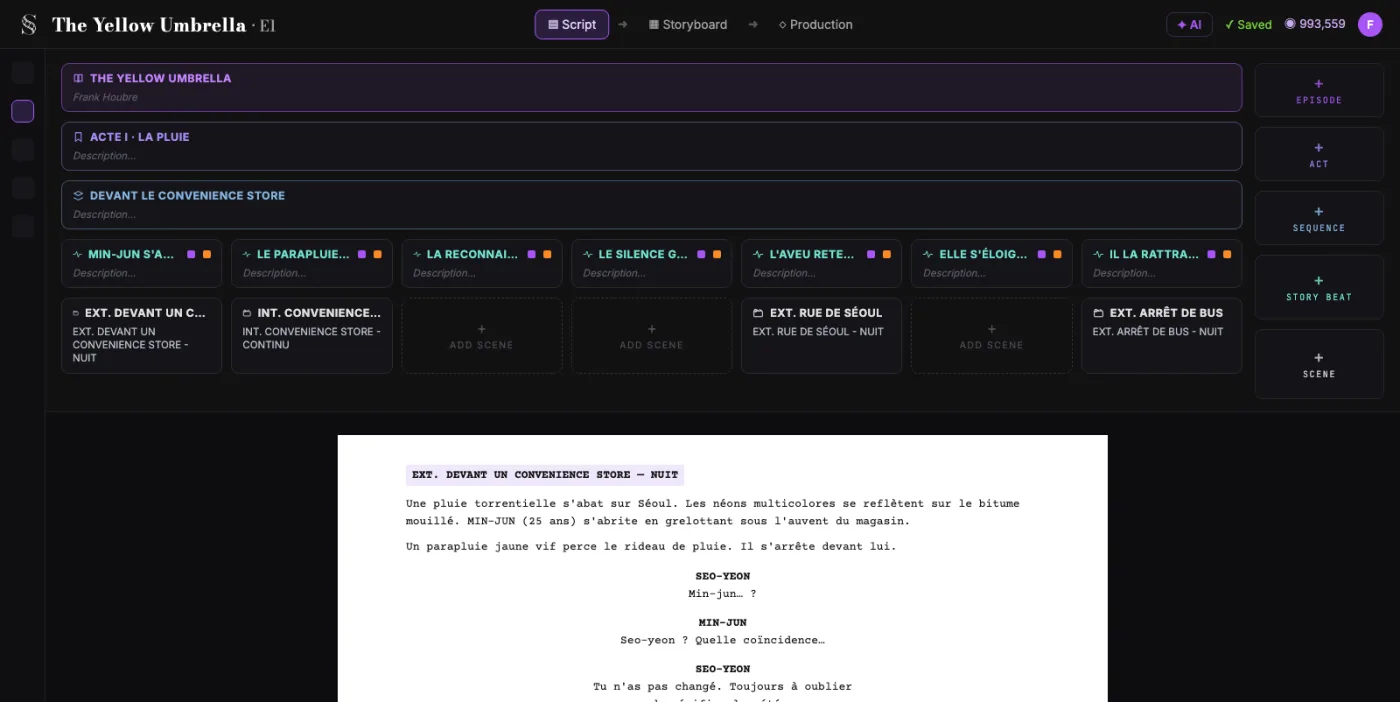
ScreenWeaver handles industry-standard formatting and exports to PDF and Final Draft (.fdx). Free, with unlimited pages.
- $0, does not expire
- PDF and Final Draft export
- Mac, Windows, Linux, iPad
PDF to FDX Converter: the complete guide
It reads every line of the PDF with its position, removes page numbers and CONTINUED markers, lifts scene numbers from the margins, learns the document's cue, dialogue and parenthetical columns, classifies each line, rejoins speeches split by (MORE) and (CONT'D), rebuilds the title page and writes a typed .fdx.
For this workflow, the central problem is clear: a screenplay PDF stores text positions, not elements, so copying it into Final Draft produces a heap of Action paragraphs that take days to retype. Left unresolved, this creates downstream friction and slower decisions. The practical target is an editable Final Draft file with every heading, cue, parenthetical, speech and transition typed, rebuilt from the page layout.
Limitation to keep in mind: Scanned PDFs have no text and need OCR first; bold, italic and underline are not recovered from a PDF; unusual layouts such as centered cues or headings without INT. or EXT. may need a few manual fixes.
Advanced workflow: Script coordinators convert archived PDFs to FDX, check the scene count against the original, then import the files into breakdown and scheduling software that reads Final Draft.
Step-by-Step Workflow
- Drop the PDF and check the detected scene and character counts against the script.
- Turn on the element view and scroll the preview for anything misread.
- Keep or renumber the scene numbers.
- Download the .fdx and open it in Final Draft, Fade In, WriterDuet or ScreenWeaver.
Use Cases By Profile
- Writer: rebuild an editable file from the only PDF left of an old draft.
- Development: start a rewrite from a script received as PDF.
- Production: get typed headings and cues into breakdown software.
Common Mistakes To Avoid
- Copying text out of the PDF and pasting it into Final Draft, which types every line as Action.
- Converting a scanned PDF without running OCR first.
- Skipping the preview check before sending the FDX to a production team.
Professional Best Practices
- Start from the PDF the writing app exported, not a printed and scanned copy.
- If headings are not recognized, check they start with INT., EXT. or a scene number.
- Compare the detected scene count with the last scene number of the PDF.
Treat this tool output as a decision support layer, not a replacement for authorship. Great scripts are remembered for specific choices, emotional precision, and clarity of dramatic movement. Tools help by removing noise so your energy can go where it matters: character, conflict, escalation, and payoff. If you review outcomes after each pass and keep an explicit log of accepted changes, your workflow becomes faster and more predictable from draft to draft. That consistency is exactly what professional collaborators value: fewer surprises, clearer rationale, and a script that evolves with intent.
Extended FAQ
Can you really convert a PDF to Final Draft?
Yes, when the PDF was exported from a screenwriting app or word processor. The converter recognizes each element from its position on the page, the way a reader does, and writes a typed .fdx.
Does it work with scanned PDFs?
No. A scan contains images of pages, not text. Run it through OCR (most PDF readers offer it) and convert the result.
Will Final Draft open the file?
Yes. The .fdx carries Final Draft's standard element settings, so it opens with the usual margins and every paragraph typed. Fade In, WriterDuet, Celtx, Arc Studio and ScreenWeaver open it too.
Is bold and italic text kept?
Not from a PDF: the text is recovered, but styling is not. Formats that store styling (FDX, Fountain, Word) keep it when converted between each other.
Is the PDF uploaded?
No. It is read with pdf.js inside your browser and the FDX is built there.