Free screenplay converter
FDX to Fountain Converter
Final Draft to plain text, nothing lost
Convert a Final Draft .fdx file into Fountain, the plain text screenplay format. Scene headings, cues, dialogue, parentheticals, transitions, dual dialogue, scene numbers, emphasis, outline sections and the title page all come across. Free, in your browser, no upload.
- Private: your script never leaves this browser tab.
- Free, no signup, no watermark.
- Industry layout kept: scene headings, cues, dialogue, (MORE) and (CONT'D).
Drop your FDX file here
Final Draft, Fountain, PDF, Word, Fade In, Highland, Celtx, WriterDuet, Trelby or plain text. Any of them converts to any output.
Private by design: the conversion runs in this tab and nothing is uploaded.
How it works
Every typed paragraph of the .fdx maps to its Fountain element. Bold, italic and underline runs become **, * and _ markers, scene numbers become #12#, the second speech of a dual dialogue gets the ^ marker, Final Draft outline elements become # sections and summaries become = synopses, and forced page breaks become ===. The writer only forces an element (with . ! @ or >) when Fountain's natural rules would read it differently, so the file stays clean and readable.
Every screenplay format, both ways
Any format in the left column converts to PDF, Final Draft, Fountain, Word or plain text. Apps without a writable format here all open FDX or Fountain.
| Format | Reads | Writes |
|---|---|---|
| Final Draft (.fdx) | ||
| Fountain (.fountain) | ||
| Word (.docx) | ||
| Fade In (.fadein) | Use FDX, which it opens | |
| Highland (.highland) | Use Fountain, which it opens | |
| Celtx (.celtx) | Use FDX, which it opens | |
| WriterDuet (.wdz, .json) | Use FDX, which it opens | |
| Trelby (.trelby) | Use FDX, which it opens | |
| Text (.txt) |
Why move a Final Draft script to Fountain
Fountain is plain text with a few conventions, which makes it the most portable screenplay format there is. It opens in Highland, Fade In, Beat, Slugline, WriterSolo and any text editor, it diffs cleanly in Git, and it will still be readable when today's apps are gone. Converting from FDX is the way out of a single vendor.
A good FDX to Fountain conversion keeps more than the words. It keeps forced elements where Final Draft's types disagree with Fountain's guesses, the dual dialogue pairing, the emphasis, and the outline structure. Convert back to FDX later and you get the same script.
The file is read and written by your browser, so the script stays on your computer from start to finish.
Who uses it
- Writers leaving Final Draft: move a whole project to Highland, Beat or a text editor without losing formatting.
- Co-writers on different apps: exchange drafts in a format every app opens.
- Archivists and teachers: keep scripts in a durable, readable plain text format.
Stop fixing margins.Formatting is built in.
ScreenWeaver handles industry-standard formatting and exports to PDF and Final Draft (.fdx). Free, with unlimited pages.
- $0, does not expire
- PDF and Final Draft export
- Mac, Windows, Linux, iPad
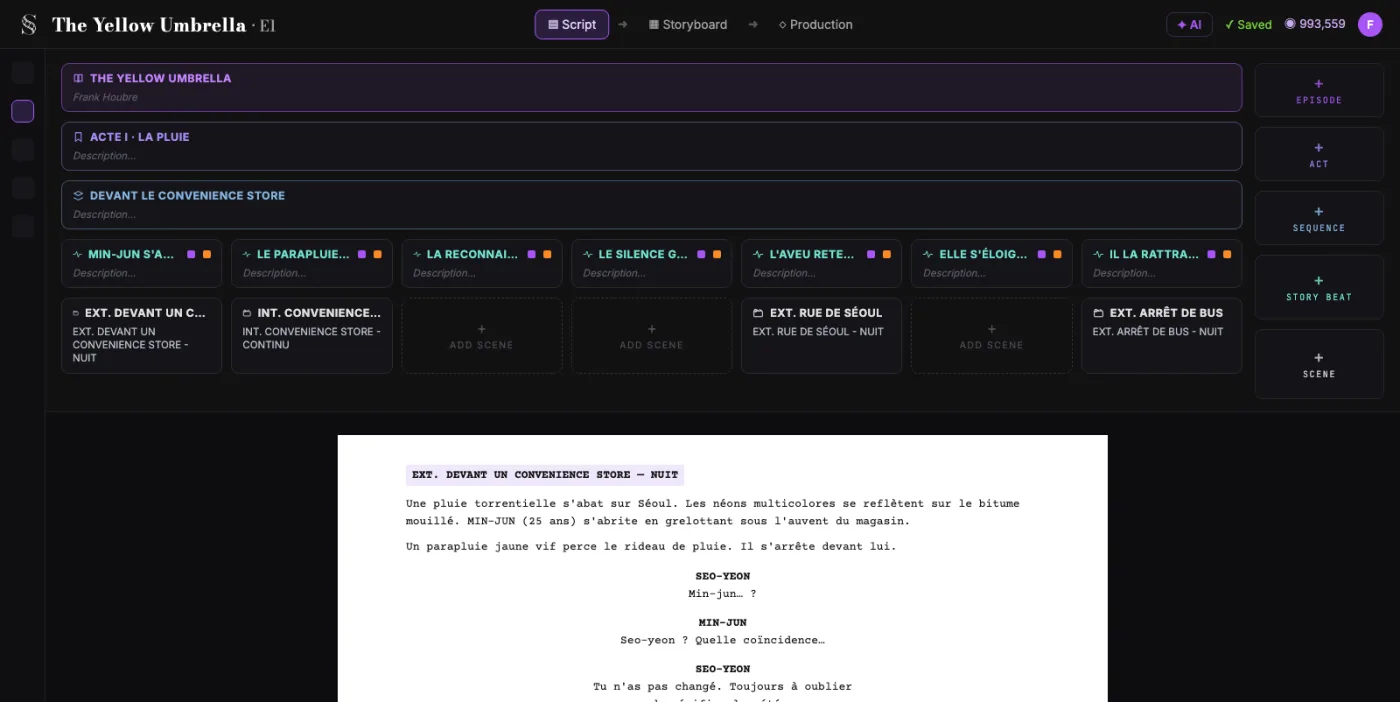
FDX to Fountain Converter: the complete guide
It maps each typed FDX paragraph to its Fountain element, writes style runs as **, * and _ markers, scene numbers as #n#, dual dialogue with ^, outline elements as # sections and summaries as = synopses, and forces elements only when needed.
For this workflow, the central problem is clear: a Final Draft file is tied to Final Draft-compatible apps, and naive exports lose emphasis, dual dialogue and forced elements. Left unresolved, this creates downstream friction and slower decisions. The practical target is a Fountain file that keeps every element, emphasis, scene number, dual dialogue pairing and the outline, and converts back to the same script.
Limitation to keep in mind: Revision marks, script notes attached to text ranges and Final Draft tags (breakdown categories) have no Fountain equivalent.
Advanced workflow: Writers keep Fountain under version control as the master and convert to FDX only when production asks for it, round-tripping without loss.
Step-by-Step Workflow
- Drop the .fdx.
- Check the detected title page and counts.
- Pick Fountain and choose the scene number option.
- Download the .fountain file.
Use Cases By Profile
- Writer: leave Final Draft for Highland, Beat or a text editor.
- Co-writer: share drafts in a format every app opens.
- Archivist: store scripts in a durable plain text format.
Common Mistakes To Avoid
- Exporting plain text from Final Draft and calling it Fountain: the forced elements are missing.
- Losing the dual dialogue pairing in a manual conversion.
- Dropping the title page.
Professional Best Practices
- Open the result in a Fountain app to check that cues with lowercase letters were forced with @.
- Keep sections (#) for structure: they never print but help navigation.
- Convert back to FDX to confirm the round trip.
Treat this tool output as a decision support layer, not a replacement for authorship. Great scripts are remembered for specific choices, emotional precision, and clarity of dramatic movement. Tools help by removing noise so your energy can go where it matters: character, conflict, escalation, and payoff. If you review outcomes after each pass and keep an explicit log of accepted changes, your workflow becomes faster and more predictable from draft to draft. That consistency is exactly what professional collaborators value: fewer surprises, clearer rationale, and a script that evolves with intent.
Extended FAQ
What is kept in the conversion?
Every element, bold, italic and underline, scene numbers, dual dialogue, forced page breaks, outline sections and summaries, and the title page.
Can I convert the Fountain file back to FDX?
Yes, with this converter or any Fountain app, and you get the same script back.
Which apps read Fountain?
Highland, Fade In, Beat, Slugline, WriterSolo, Logline and any text editor.
Do I need Final Draft?
No. The .fdx is read in your browser.
Is the file uploaded?
No. The conversion runs entirely in your browser tab.