Free screenplay converter
FDX to PDF Converter
Open Final Draft files without Final Draft
Turn a Final Draft .fdx file into a correctly formatted screenplay PDF, right in your browser. Drop the file in, check the page preview, download the PDF. No Final Draft license, no signup and no upload: your script never leaves your computer.
- Private: your script never leaves this browser tab.
- Free, no signup, no watermark.
- Industry layout kept: scene headings, cues, dialogue, (MORE) and (CONT'D).
Drop your FDX file here
Final Draft, Fountain, PDF, Word, Fade In, Highland, Celtx, WriterDuet, Trelby or plain text. Any of them converts to any output.
Private by design: the conversion runs in this tab and nothing is uploaded.
How it works
An .fdx file is XML: every paragraph carries a Type (Scene Heading, Action, Character, Parenthetical, Dialogue, Transition, Shot) and its text, split into runs wherever the styling changes. The converter reads those types, the bold, italic and underline runs, scene numbers, forced page breaks, dual dialogue and the title page, then lays the script out on the standard sheet: Courier 12 point, US Letter or A4, 1.5 inch left margin, dialogue at 2.5 inches, cues at 3.7 inches, transitions flush right, page numbers top right from page 2. Speeches that cross a page get (MORE) and (CONT'D), and a scene heading never sits alone at the bottom of a page.
Every screenplay format, both ways
Any format in the left column converts to PDF, Final Draft, Fountain, Word or plain text. Apps without a writable format here all open FDX or Fountain.
| Format | Reads | Writes |
|---|---|---|
| Final Draft (.fdx) | ||
| Fountain (.fountain) | ||
| Word (.docx) | ||
| Fade In (.fadein) | Use FDX, which it opens | |
| Highland (.highland) | Use Fountain, which it opens | |
| Celtx (.celtx) | Use FDX, which it opens | |
| WriterDuet (.wdz, .json) | Use FDX, which it opens | |
| Trelby (.trelby) | Use FDX, which it opens | |
| Text (.txt) |
How to convert an FDX file to PDF without Final Draft
The classic situation: a co-writer, a producer or a contest sends you an .fdx file and you do not own Final Draft. You do not need it to read or share the script. A Final Draft to PDF converter handles the one thing you actually want: a clean, printable PDF that looks the way the writer formatted it. This one is free, with no account and no watermark.
Generic document converters fail at this job in a specific way. FDX stores each line's role in a Type attribute, and the layout (the binding margin, the dialogue column, the cue position) only exists if the converter applies those roles. Tools that treat the file as generic XML or rich text produce a left-aligned wall of Courier that no reader takes seriously. This converter applies the roles, so the PDF reads like one Final Draft would print.
There is also privacy. Most sites that convert Final Draft files online make you upload the script to their server. For an unproduced screenplay that is a real risk, and an unnecessary one: FDX is XML, so your browser can read it locally. This page works as an FDX viewer and as an FDX to PDF export, with nothing leaving your machine.
Who uses it
- Writers who received an .fdx: open a collaborator's Final Draft file, check the formatting and produce a shareable PDF without buying the software.
- Contest and fellowship submitters: most contests want a PDF. Convert your final .fdx and keep the standard layout readers expect.
- Producers and readers: get a printable copy of a draft on any computer, including one where installing screenwriting software is not an option.
Stop fixing margins.Formatting is built in.
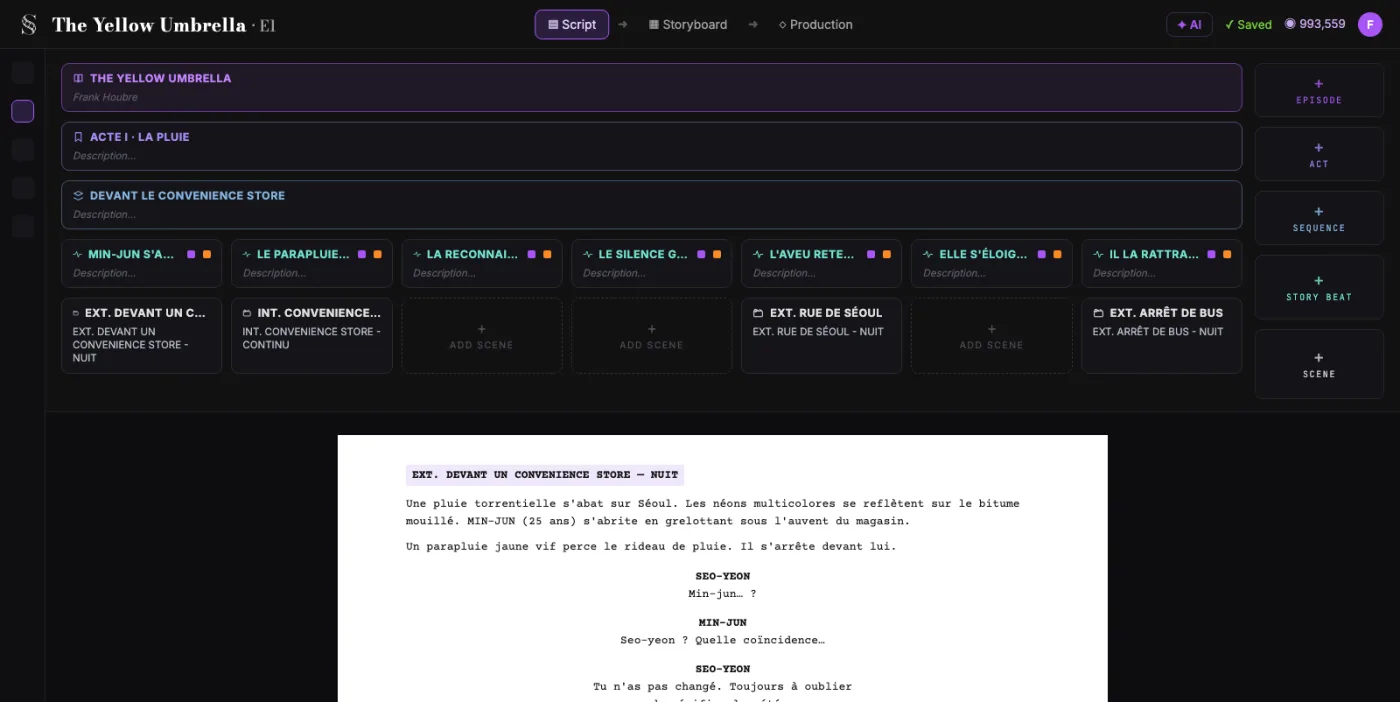
ScreenWeaver handles industry-standard formatting and exports to PDF and Final Draft (.fdx). Free, with unlimited pages.
- $0, does not expire
- PDF and Final Draft export
- Mac, Windows, Linux, iPad
FDX to PDF Converter: the complete guide
It reads the .fdx locally (element types, bold, italic and underline, scene numbers, dual dialogue, page breaks, title page) and lays it out on the industry sheet: Courier 12 point, 1.5 inch left margin, dialogue at 2.5 inches, cues at 3.7 inches, transitions flush right, page numbers top right, (MORE) and (CONT'D) on split speeches.
For this workflow, the central problem is clear: an .fdx file is useless to anyone without Final Draft, and generic converters destroy screenplay formatting because they ignore the element types stored in the XML. Left unresolved, this creates downstream friction and slower decisions. The practical target is a correctly paginated, submission-ready screenplay PDF produced in the browser, with no Final Draft license and no upload.
Limitation to keep in mind: It converts for reading, printing and submission: revision colors, script notes and Final Draft headers or watermarks are not reproduced, and page breaks can differ from Final Draft's by a line or two on some pages.
Advanced workflow: Teams exchanging drafts keep the .fdx as the editable master and cut a reader PDF at each milestone, comparing page counts between versions to catch formatting drift before a submission deadline.
Step-by-Step Workflow
- Drop the .fdx into the converter, or paste its XML if the file came inside an email preview.
- Check the detected title, scenes, characters and page count.
- Choose US Letter or A4, the title page and the scene numbers.
- Look over the page preview and download the PDF.
Use Cases By Profile
- Writer: open a collaborator's Final Draft file and produce a clean, shareable PDF without buying the software.
- Contest entrant: convert the final .fdx to the PDF every major contest asks for, with the standard layout.
- Producer or reader: get a printable copy of a draft on any computer, without the script leaving the browser.
Common Mistakes To Avoid
- Running an .fdx through a generic document converter and sending the left-aligned wall of text it produces.
- Uploading an unproduced script to an unknown conversion site when the browser can read the XML locally.
- Assuming the PDF page count matches Final Draft exactly and copying it into a form without checking.
Professional Best Practices
- Keep the .fdx as the editable master; the PDF is a delivery format.
- Use A4 only when the recipient prints on A4: most contests and US readers expect US Letter.
- If a file refuses to open, check that it really is an .fdx and not a .fdr from Final Draft 7 or earlier.
Treat this tool output as a decision support layer, not a replacement for authorship. Great scripts are remembered for specific choices, emotional precision, and clarity of dramatic movement. Tools help by removing noise so your energy can go where it matters: character, conflict, escalation, and payoff. If you review outcomes after each pass and keep an explicit log of accepted changes, your workflow becomes faster and more predictable from draft to draft. That consistency is exactly what professional collaborators value: fewer surprises, clearer rationale, and a script that evolves with intent.
Extended FAQ
Can I open an FDX file without Final Draft?
Yes. An .fdx file is XML, so this converter reads it in your browser and shows every page in the preview. Download the PDF to read, print or share it, or convert it to Fountain or Word to edit it in another app.
Will the PDF look like Final Draft's?
It uses the same industry layout: Courier 12 point, the standard margins and indents, page numbers top right, (MORE) and (CONT'D) on speeches split across pages. Pagination can differ by a line on some pages, as it does between any two screenwriting apps.
What is an FDX file?
It is Final Draft's native document format. Under the hood it is plain XML: paragraphs tagged with element types like Scene Heading, Character and Dialogue, which is why a converter that respects those tags can rebuild the layout faithfully.
Is my script uploaded?
No. The .fdx is parsed and the PDF is built inside your browser tab. Nothing is sent to a server.
Can I convert an old .fdr file?
No. The .fdr format of Final Draft 7 and earlier is a closed binary format. Open it in a current Final Draft and save it as .fdx, or export a PDF and convert that.