
The email says: "We'd love to hear more about your project. Can you come in Thursday at two?"
Congratulations. Someone read your material - or trusted a referral - and opened a door. Now the anxiety shifts. What do you bring? How long do you talk? Do you read scenes aloud or summarize? What if they hate the third act before you reach the second?
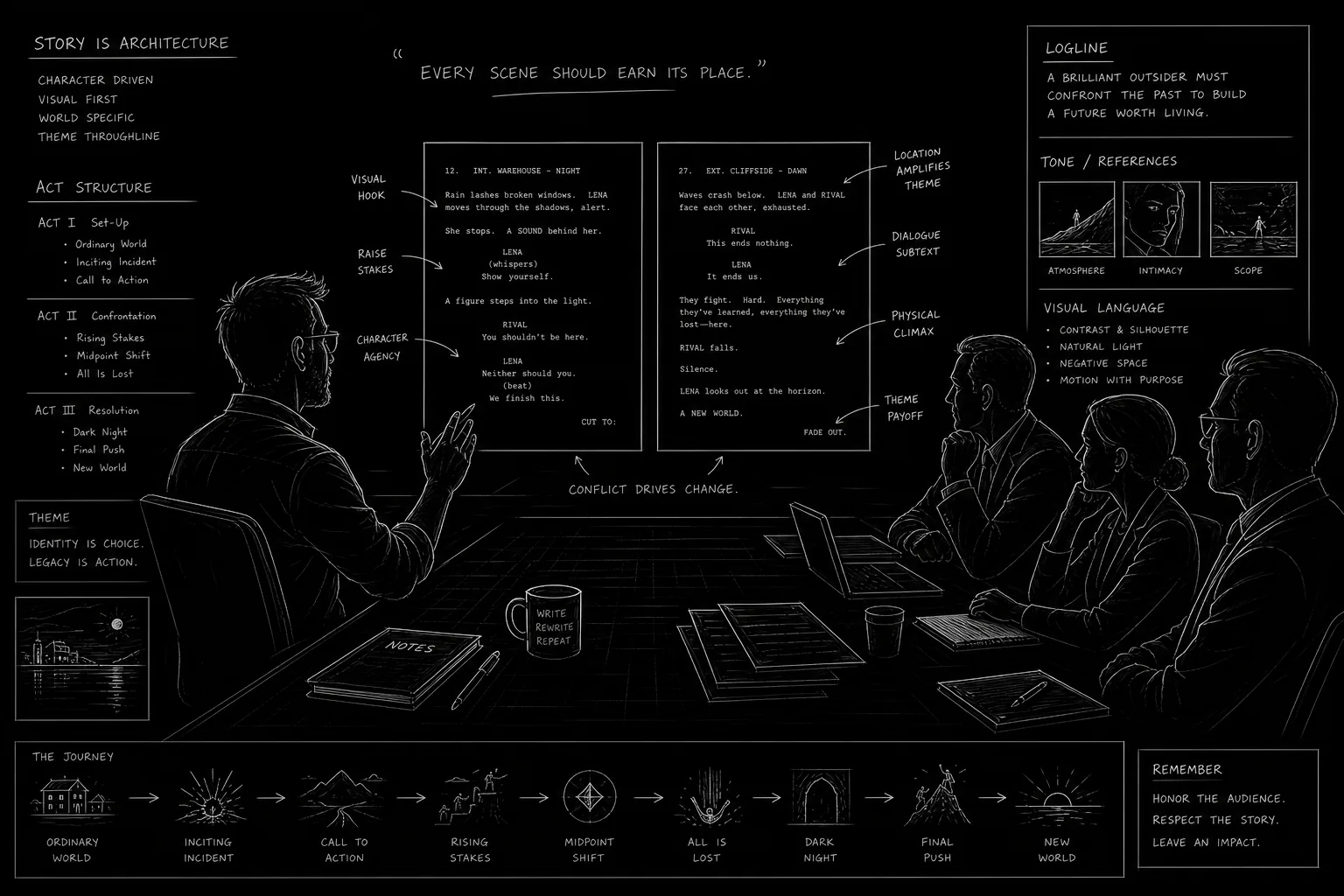
A pitch meeting is not an audition for your personality. It is a structured conversation where you demonstrate that you know your story, understand the market realistically, and can collaborate without collapsing when challenged. This guide covers what to pack, what to say minute by minute, and how to leave the room with a clear next step.
Free tool: use the Logline Workshop to build and pressure-test your logline.
How It Works: Anatomy of a Development Pitch
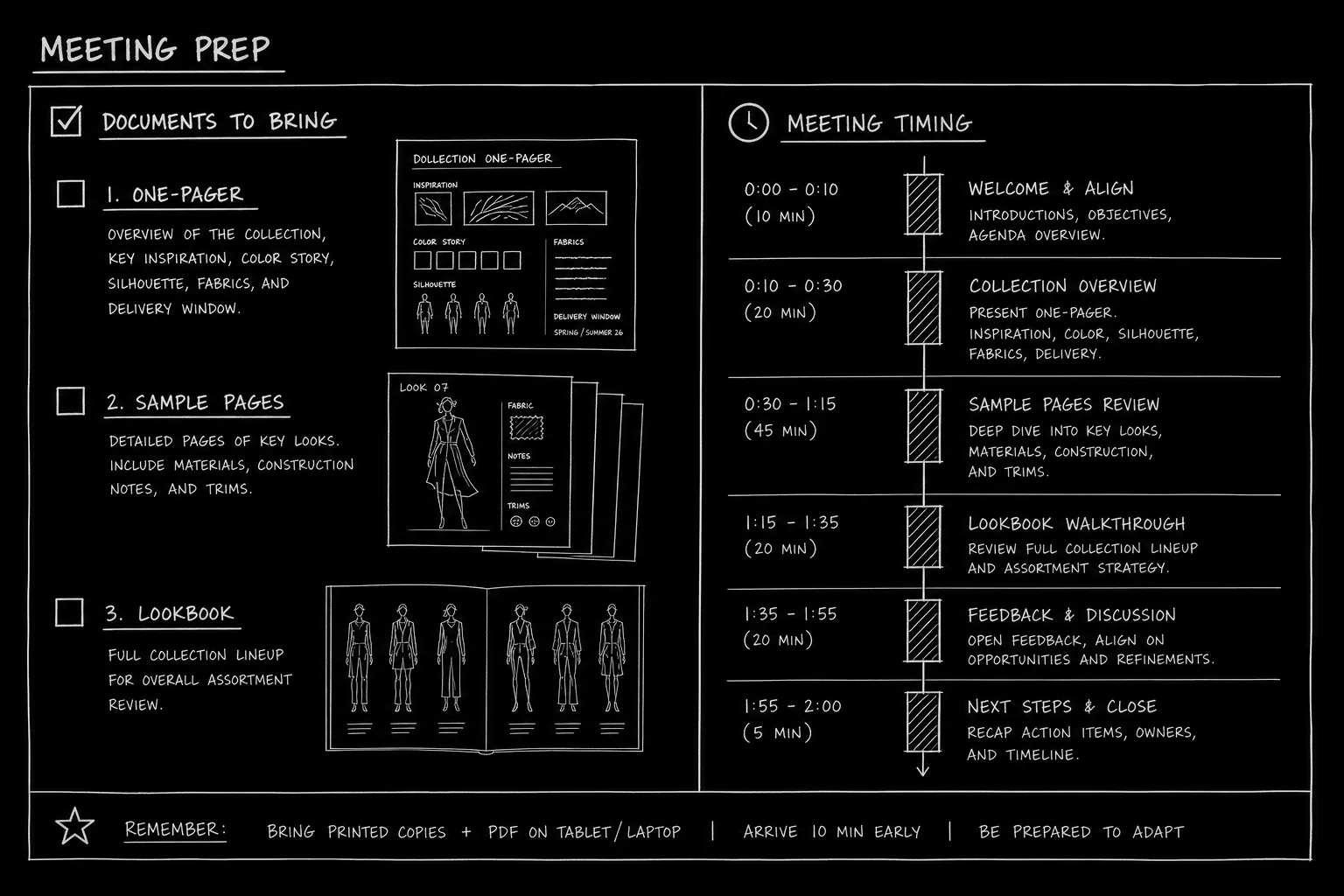
Most pitch meetings run twenty to forty-five minutes. The executive or development team has already done some homework. They may have read your sample pages, your one-pager, or a coverage report from an assistant.
Your job is not to retell the entire plot. Your job is to confirm tone, clarify engine, answer questions, and signal you are a low-risk collaborator.
A standard flow looks like this:
- Small talk (2-3 minutes). Follow their lead. Do not force personal anecdotes.
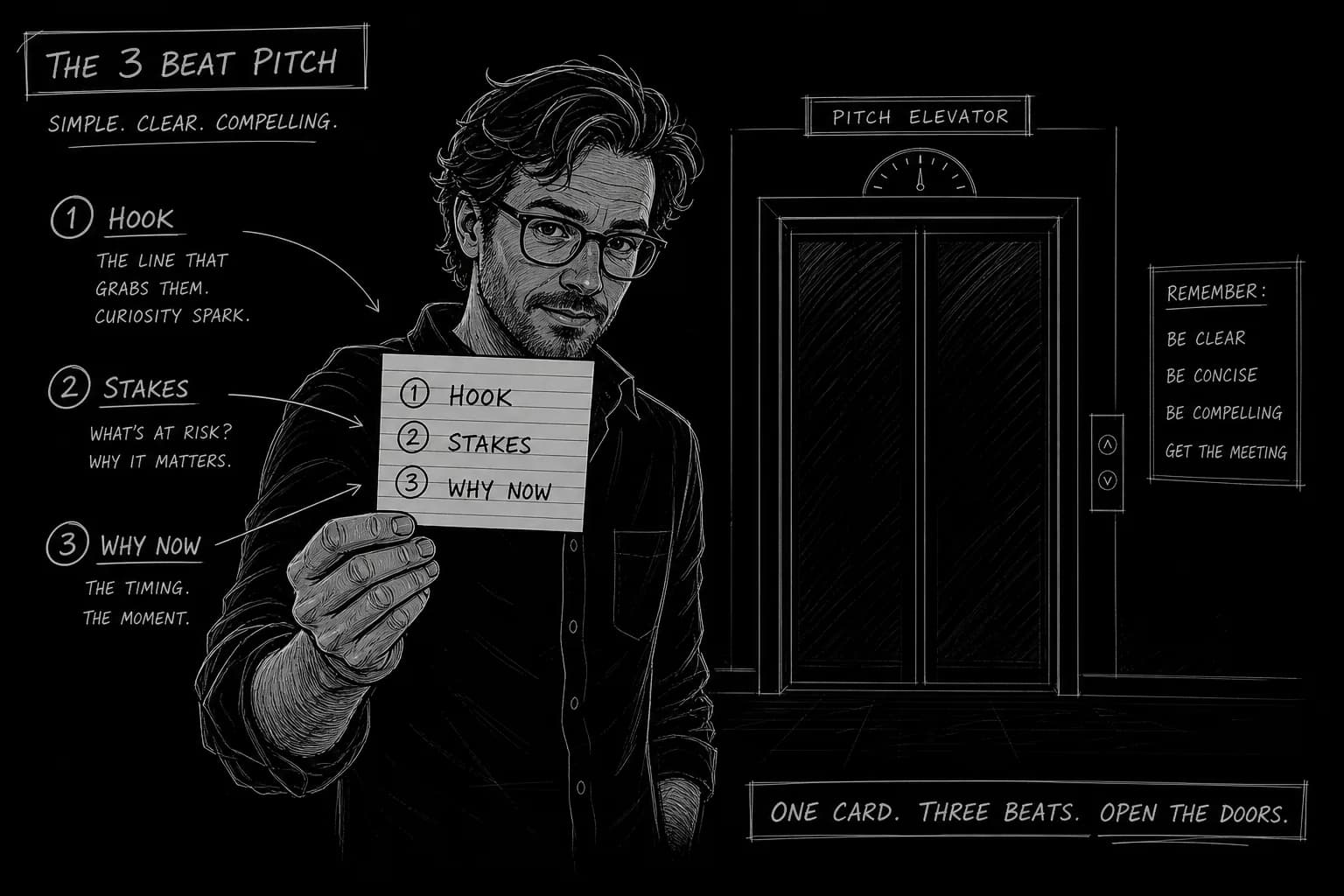
- Your opening (60-90 seconds). Logline plus why you wrote this now.
- Expanded pitch (5-8 minutes). Act breaks for features; season arc for TV. Hit turning points, not every scene.
- Q&A (10-20 minutes). They steer. You listen, then answer concisely.
- Close (2 minutes). Thank them. Confirm what they want next. Ask about timeline.
If you have rehearsed only a monologue, you will struggle in phase four. Prepare for interruption. It is a good sign.
A pitch meeting is a dialogue, not a performance.
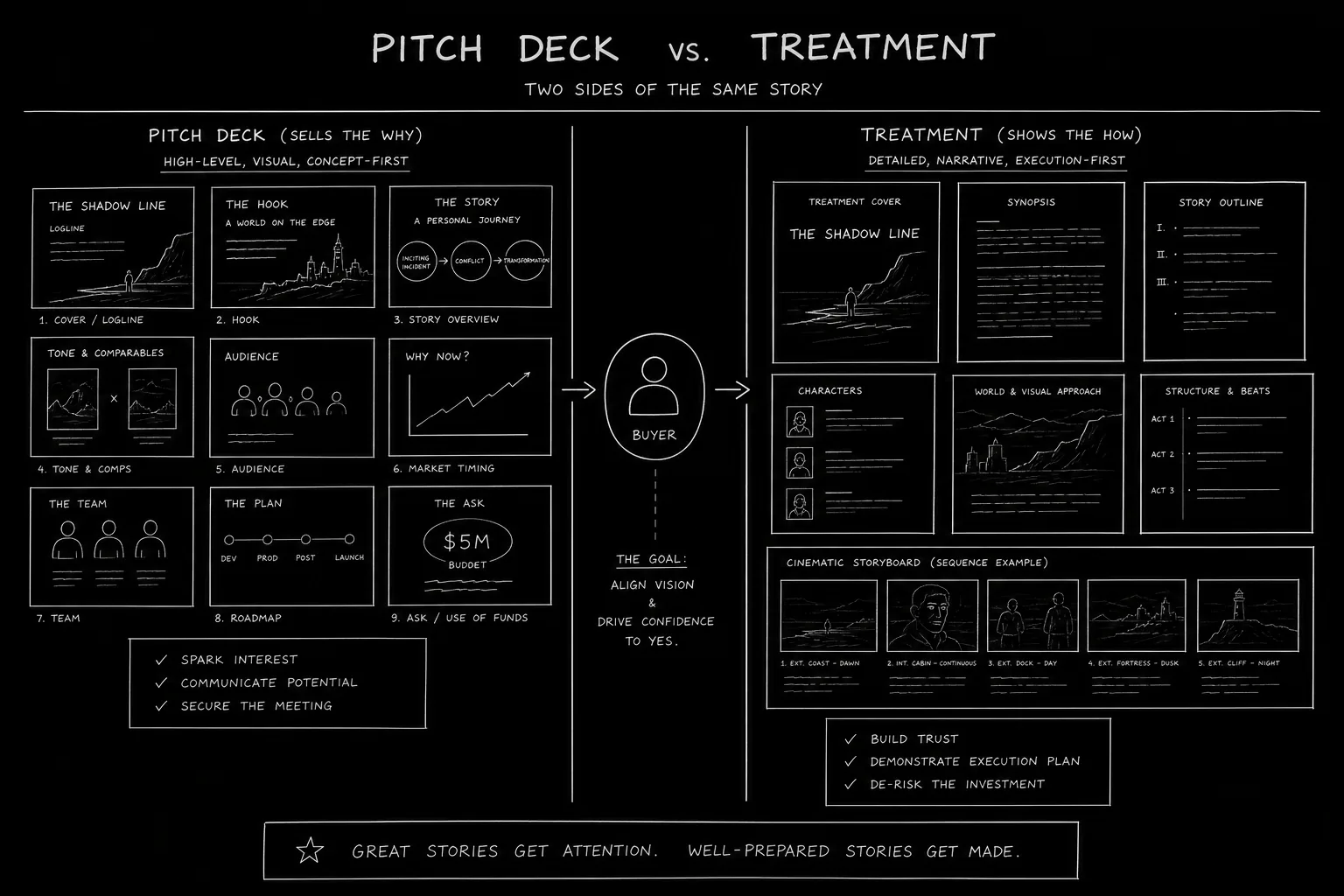
Pair this guide with our 30-second elevator pitch formula for the opening beat, and our one-pager guide for the document they will keep after you leave.
Platform and Use-Case Sections
Feature Film Pitch (Studio or Indie Financier)
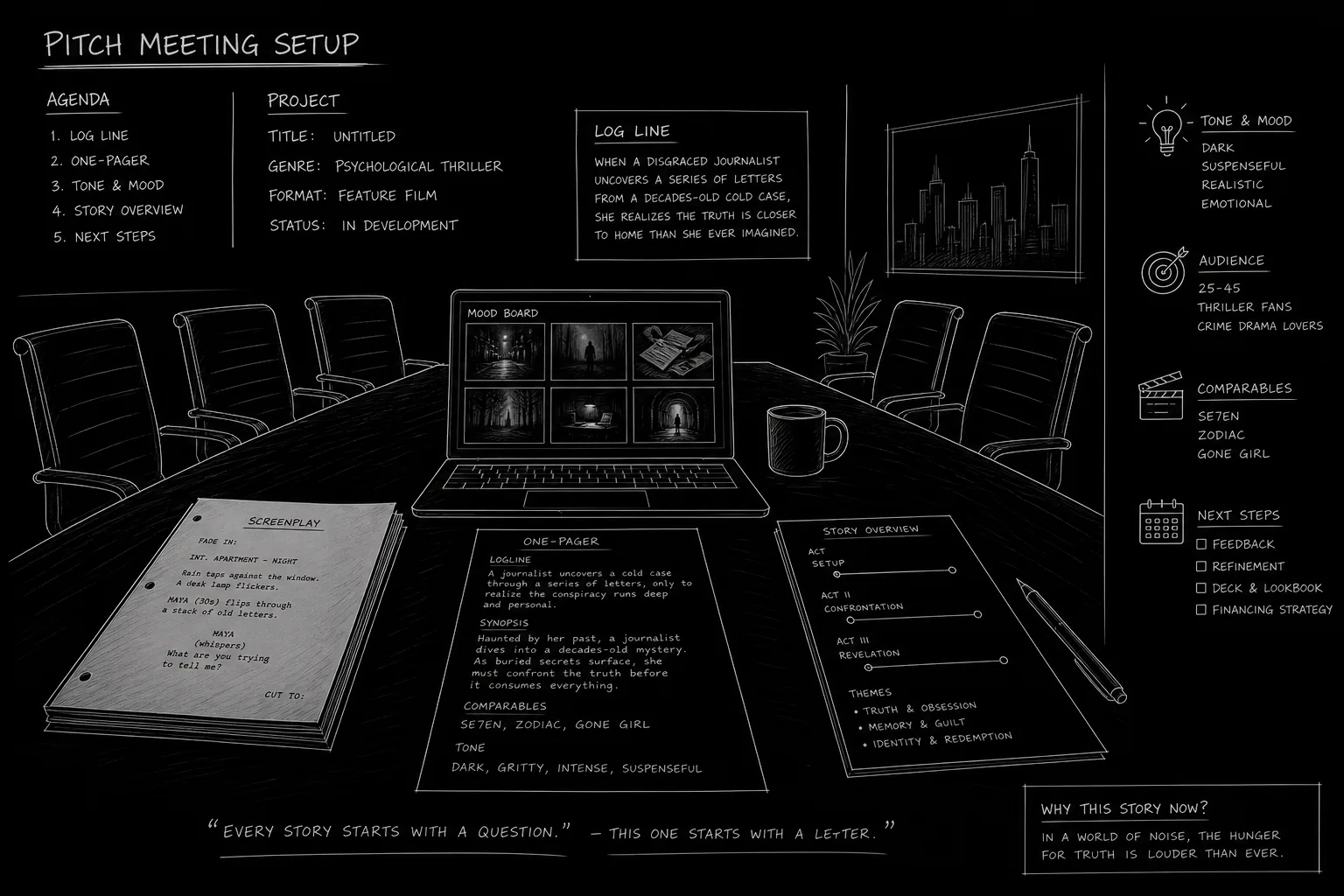
Bring: One-pager, first ten to twenty pages, optional lookbook or concept art for key scenes.
Emphasize: Budget tier (contained vs. epic), casting hooks, comparable titles with real box office or streaming performance, your third-act turn in one sentence.
Avoid: Defending every creative choice preemptively. If they ask why the protagonist is passive in Act One, answer directly. Do not filibuster.
TV Pilot Pitch (Network, Cable, Streaming)
Bring: One-pager, pilot script or detailed pilot outline, series bible pages if requested, sizzle reel script if you have one.
Emphasize: Episode engine, season one arc, character ensemble dynamics, what changes episode to episode vs. season to season.
Avoid: Pitching a movie disguised as a pilot. If the story ends at episode one, it is a feature.
Pitching from Representation (Agent or Manager Present)
Let your rep open. You support. Make eye contact with the buyers, not only your rep. When your rep redirects a question to you, answer in two to four sentences, then stop.
General Meeting (No Specific Project)
They are buying you as a writer. Bring two to three project summaries, each with a logline and status (script complete, outline only, etc.). Lead with the strongest. Ask what kinds of projects their slate needs. A general that goes well often converts to a project pitch later.
Step-by-Step: Preparing for the Room
Step 1 - Confirm the agenda. Reply to the scheduling email with a brief thanks and ask: "Will you want me to walk through the full story, or focus on character and tone?" Clarity prevents mismatched expectations.
Step 2 - Re-read your sample pages. They will ask scene-specific questions. If you wrote the script eight months ago, refresh your memory on page three dialogue you barely remember choosing.
Step 3 - Build a five-minute and a fifteen-minute version. Start with the five-minute path: logline, protagonist, inciting incident, midpoint shift, climax, theme. Expand to fifteen only if they lean in and ask for more.
Step 4 - List ten hard questions. "Why does she not call the police?" "Isn't this too similar to [Comp Title]?" "What's the sequel?" Draft honest answers. Practice without getting defensive.
Step 5 - Pack physical and digital materials. Print two one-pagers (one for you, one for them). USB or shared link as backup. Phone on silent. Water, not coffee that makes you talk too fast.
Step 6 - Rehearse the open out loud. First ninety seconds set the temperature. Record yourself. Cut throat-clearing and apology language.
Step 7 - Plan your close. Decide in advance what you will ask for: "May I send the full script?" or "I'd welcome notes on the pilot outline." Never end with "So... yeah."
[YOUTUBE VIDEO: Mock pitch meeting with split screen showing strong vs. weak responses to executive interruptions.]
Try it free
Try Screenweaver for free on your script
It is free. Import your existing project, get a clearer view of your outline, and regain control of your story structure in minutes.
Start FreeOperational Section: What to Bring (Checklist)
Documents
| Item | When required | Notes |
|---|---|---|
| One-pager | Always | Title, logline, synopsis, characters, comps, contact |
| Sample pages | Almost always | Usually 10-20 pages, best opening |
| Full script | If requested | PDF, standard format, dated |
| Lookbook / deck | Optional | 6-12 images max; see pitch deck template |
| Series bible | TV, if asked | World rules, season arc, character grids |
Personal Readiness
- Know your comps cold. If you say "X meets Y," be ready to explain what you take from each and what you exclude.
- Know your budget band. "Contained thriller, single location, four speaking roles" tells production you think like a professional.
- Bring questions. "What gaps are you trying to fill on the slate?" shows business awareness.
Room Etiquette
Arrive ten minutes early, not thirty. Dress one notch above casual. Do not trash other writers, executives, or notes you received elsewhere. If they offer water, take it. If they check their phone mid-pitch, keep answering the question calmly. It may not be about you.
After the Meeting
Send a thank-you email within twenty-four hours. Attach nothing they did not request. Reference one specific moment from the conversation to prove you were listening. If they asked for the full script, send it the same day.
Outcome Section: Reading the Results
Pitch meetings produce a spectrum of outcomes. Learn to hear what executives actually mean.
"This is really interesting." Without a request for more material, this is polite pass language. Follow up once; move on if silent.
"Send us the full script." Genuine interest. Send promptly. Quality of the script now matters more than your pitch performance.
"We're going to discuss internally." Could be real or soft pass. Ask: "What's your typical timeline for decisions?" Calendar a follow-up.
"It's not quite right for us, but..." Listen for the referral. Thank them. Send the script to the referral only if they offer an introduction.
Notes in the room. If they give creative notes during the meeting, they are engaged. Do not argue. Say: "That's helpful. I'll think about how to address that."
One meeting rarely sells a script. It builds a relationship that sells the next one. Track every meeting. Patterns emerge: which comps land, which act breaks lose people, which questions repeat.
Why It Matters: Old Way vs. New Way
The old way: Writers showed up with a full script, talked for forty minutes without pause, and treated questions as attacks. They brought no comps, no sense of budget, and no follow-up plan. Meetings ended in vague encouragement and months of silence.
The new way: Pitching is packaged. You lead with a rehearsed opening, carry a tight one-pager, know your sample pages intimately, and treat Q&A as collaboration. Visual materials like concept art in pitch decks support tone without replacing the conversation.
The meeting is where your screenplay meets the business. Preparation respects everyone's time and separates hobbyists from professionals.
Final CTA: Walk In Ready
Do not improvise your way through a pitch meeting. Pack the documents. Rehearse the opening. List the hard questions. Plan the close.
The executives have seen hundreds of pitches. Yours will stand out if you are clear, brief, and genuinely curious about what they need - not only what you want to sell.
Schedule the rehearsal. Print the one-pager. Then walk into the room knowing that the story you wrote deserves a pitch as sharp as its best scene.
Final Step
Build your next script with Screenweaver
Move from ideas to production-ready pages faster with timeline-native writing and AI-assisted story flow.
Try Screenweaver