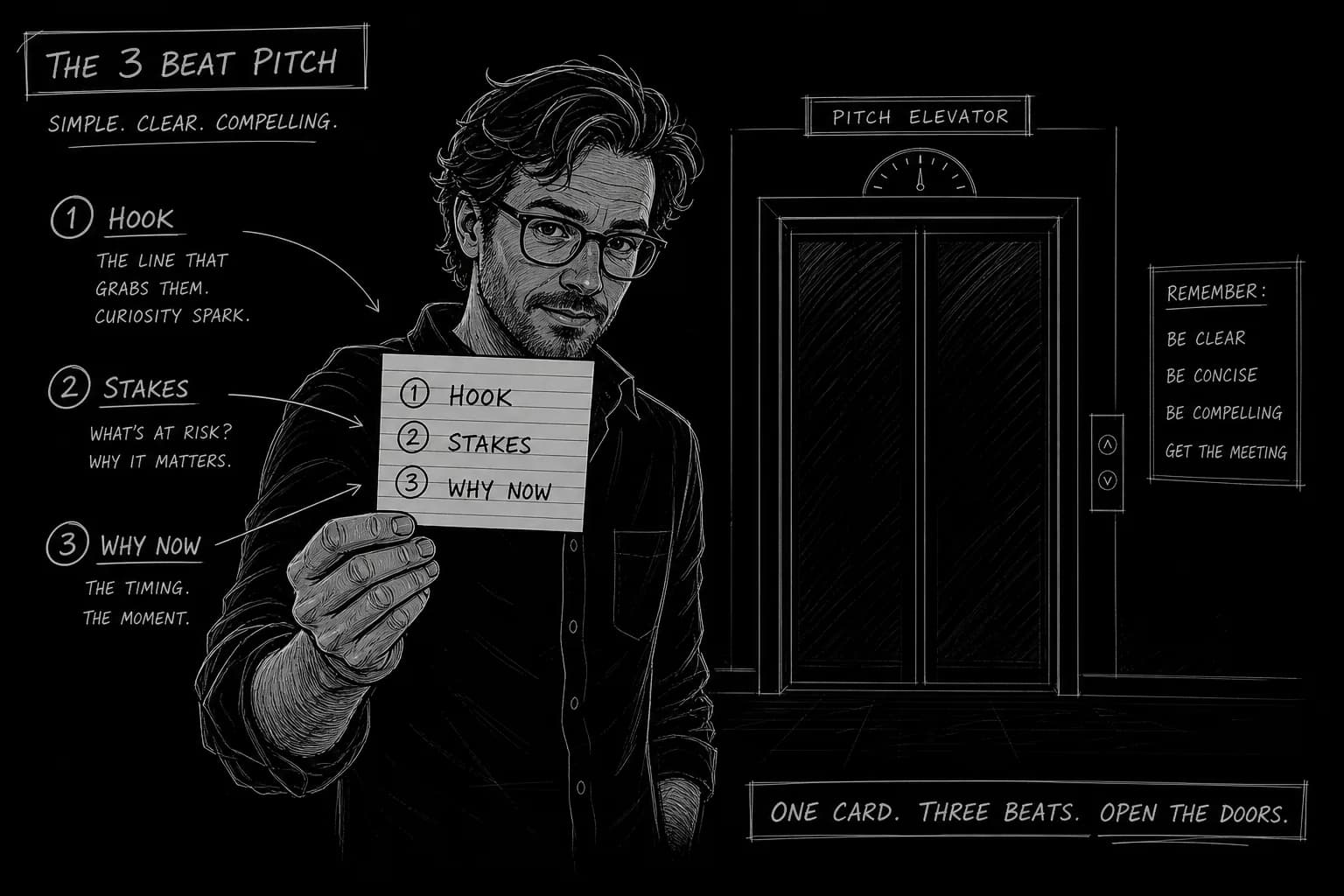

You step into the elevator. The door closes. The person beside you is a development executive, a producer, or a showrunner you have admired from afar. They ask what you are working on. You have thirty seconds before the doors open again.
Most screenwriters freeze. They ramble about theme. They apologize for the premise. They bury the hook under backstory. The executive nods politely, steps out, and forgets you before lunch.
A tight elevator pitch is not a miniature treatment. It is a precision tool: enough to spark curiosity, not enough to exhaust patience. This guide gives you a repeatable formula, platform-specific variations, and a step-by-step rehearsal path so your next chance encounter becomes a real meeting request.
Free tool: use the Logline Workshop to build and pressure-test your logline.
How It Works: The Three-Beat Formula
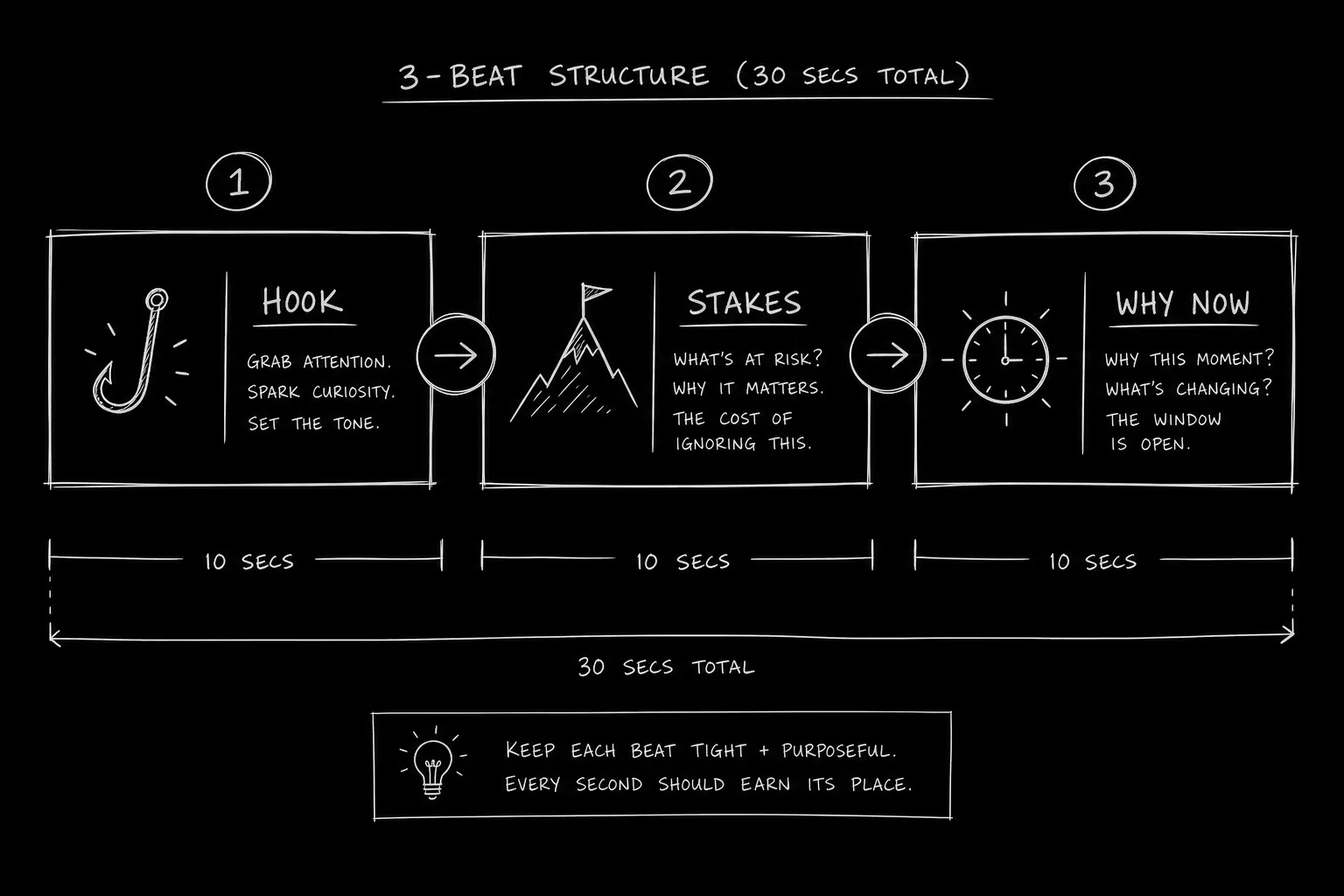
Every effective thirty-second pitch contains three beats, each roughly ten seconds when spoken at a natural pace.
Beat 1 - The Hook. One sentence that names genre, protagonist, and the unusual situation. No preamble. No "So there's this guy who..."
Beat 2 - The Stakes. What the protagonist stands to lose or gain. Make it personal and specific, not abstract.
Beat 3 - The Why Now. What makes this story urgent, timely, or commercially alive. This is where you connect to audience appetite without sounding like a market report.
The formula is deceptively simple. The discipline is in what you leave out. If you cannot say it in three sentences, you do not yet know your story well enough to pitch it.
An elevator pitch answers one question: "Why should I keep listening?"
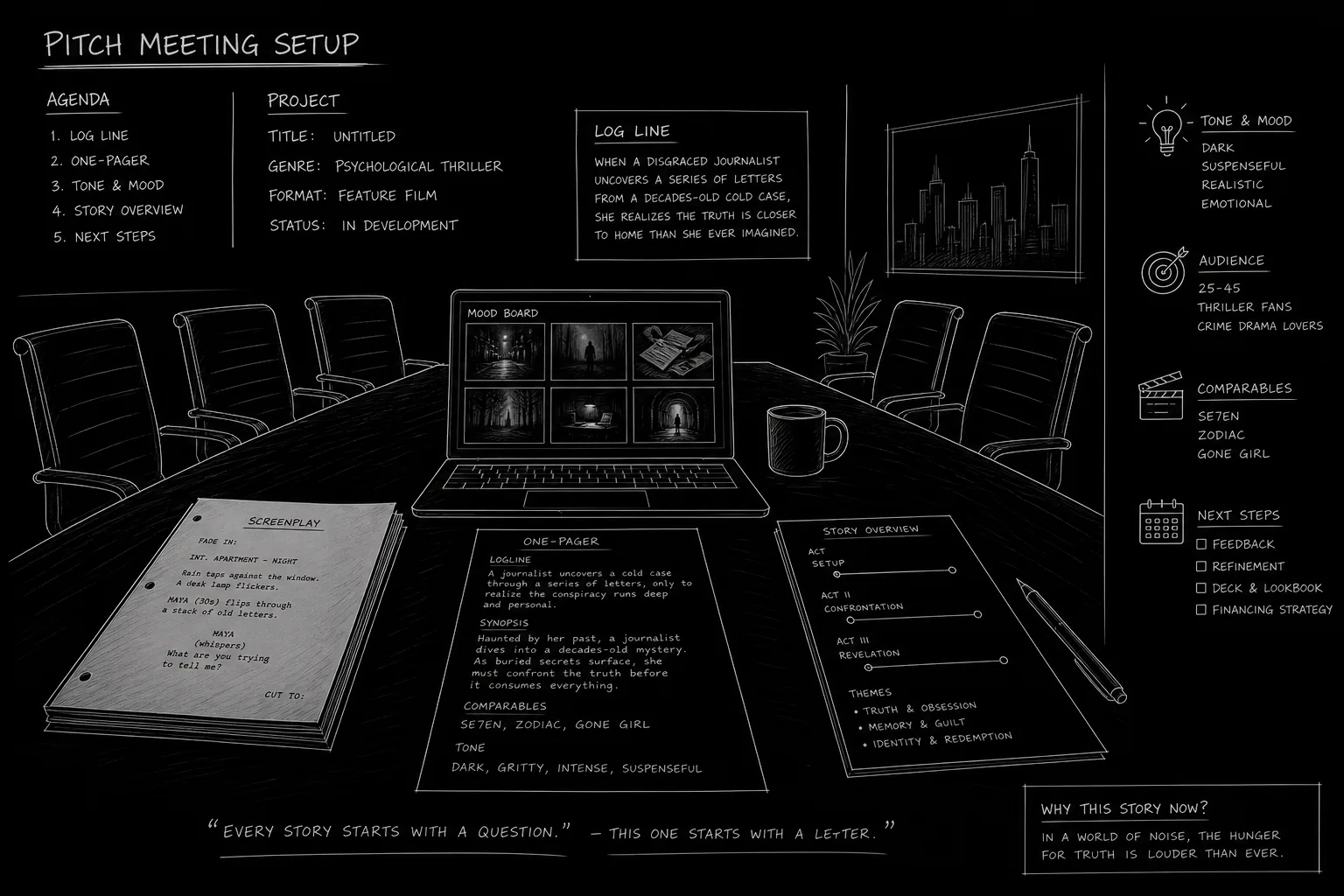
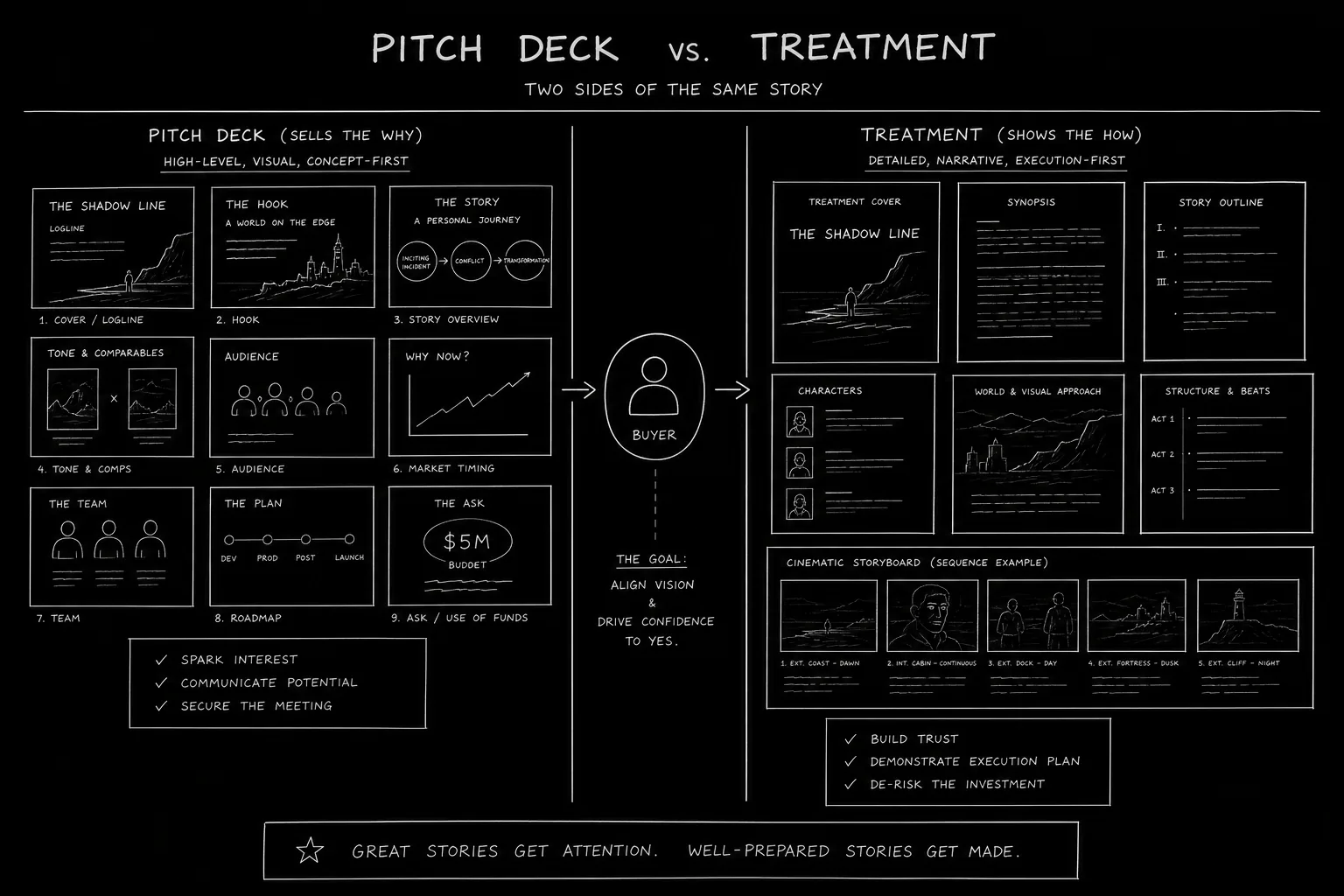
For longer-form selling documents, see our guide on writing a sizzle reel script. For the one-page version executives actually read in meetings, see how to write a one-pager.
Platform and Use-Case Variations
Film Pitch (Theatrical or Streaming Feature)
Lead with character and conflict. Executives greenlight people first, plots second.
Example structure: "A disgraced forensic accountant must prove her own innocence when she discovers the embezzlement she was hired to expose leads to her former mentor - and the only witness is a teenager who trusts no one over thirty."
Film pitches benefit from a single vivid image. Think poster, not plot summary.
TV Pilot Pitch
Name the series engine: what happens every week, or what unspools across the season.
Example structure: "Every episode, a grief counselor who can hear the last thoughts of the dead must solve one final mystery for each client before they cross over - but this season, one voice won't stop calling her by a name she buried twenty years ago."
TV pitches need a repeatable premise. If episode two sounds impossible to generate from your logline, revise the pitch before you enter the elevator.
Documentary or Limited Series
Lead with access, revelation, or stakes at societal scale, then narrow to a human face.
Example structure: "Three whistleblowers inside the same corporation documented the cover-up on their phones for two years. Our series follows what happens when the footage goes public - and one of them is still employed there."
General Networking (Festivals, Mixers, Writing Groups)
Soften the commercial beat. Lead with passion and specificity. End with an invitation, not a hard close.
Example structure: "I'm writing a contained thriller set entirely in a jury deliberation room where one juror realizes the defendant is her missing brother. It's about the stories we tell ourselves to survive guilt. I'd love your reaction to the premise."
Step-by-Step: Building Your Pitch
Step 1 - Write the logline first. Before you touch the elevator pitch, draft a one- or two-sentence logline. Strip adjectives. Name the protagonist, the goal, and the obstacle. If the logline fails, the pitch will fail louder.
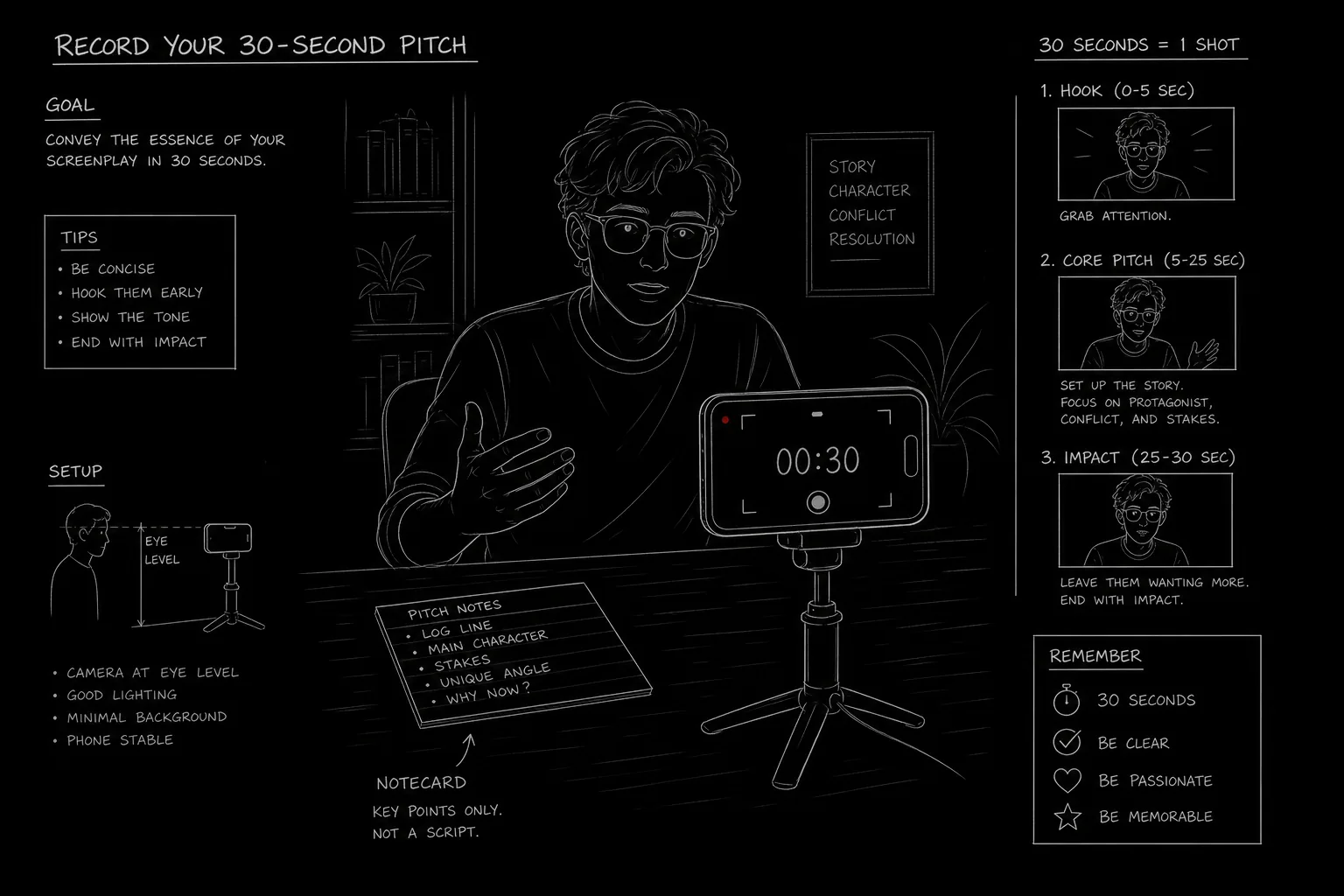
Step 2 - Identify your single image. What is the moment an executive would put on a sizzle reel? A woman tearing up a photograph in a jury room. A diver reaching a submerged vault. Write that image on a notecard. It anchors your memory under pressure.
Step 3 - Draft Beat 1 (Hook). Read it aloud. Count seconds. If it exceeds twelve seconds, cut a clause. Remove character backstory. Remove world-building unless the world is the hook (sci-fi, historical).
Step 4 - Draft Beat 2 (Stakes). Ask: what does the protagonist lose if they fail? Make it emotional and concrete. "She loses custody" beats "her world falls apart."
Step 5 - Draft Beat 3 (Why Now). Connect to cultural moment, genre hunger, or your unique access. "Post-#MeToo boardroom thrillers are having a moment" is weak. "This is a boardroom thriller where the whistleblower and the CEO are the same person - told in real time across one shareholder call" is strong.
Step 6 - Run the stopwatch. Record yourself on your phone. Thirty seconds, hard stop. Listen for filler words, uptalk, and defensive qualifiers ("It's kind of like..."). Delete them.
Step 7 - Prepare the follow-up. The pitch opens the door; the next sentence walks through it. Have one line ready: "I have a one-pager and the first ten pages if you'd like to read." Never leave the executive wondering what step two is.
[YOUTUBE VIDEO: Side-by-side comparison of a rambling two-minute pitch versus a tight thirty-second version, with on-screen beat labels.]
Try it free
Try Screenweaver for free on your script
It is free. Import your existing project, get a clearer view of your outline, and regain control of your story structure in minutes.
Start FreeOperational Section: Requirements and Meeting Details
What to Have Ready Before You Pitch
- One-pager (title, logline, brief synopsis, character list, tone comps, your contact). Format guidance lives in our pitch deck template article.
- First ten pages of the script, polished. Not the whole draft unless asked.
- Two comparable titles ("X meets Y") that are recent, real, and accurate. Avoid comps that flatter your ambition but mislead about tone.
Pitch Environments
| Setting | Time you really have | Adjust |
|---|---|---|
| Literal elevator | 20-40 seconds | Three beats only |
| Festival mixer | 45-90 seconds | Three beats + one follow-up question |
| Scheduled general meeting | 2-5 minutes | Three beats + brief expansion on theme |
| Video call intro | 60 seconds | Three beats; offer to send materials |
What Executives Listen For
They are not buying the plot in thirty seconds. They are buying clarity, confidence, and a reason to request pages. Mumbling, over-explaining, and apologizing signal risk. Clean delivery signals you can survive a writers' room.
Legal and Professional Boundaries
Do not pitch unreleased ideas you do not own. If you are under NDA on a project, do not pitch it in public hallways. If the executive passes, thank them and move on. Burning a bridge over one elevator ride has a long half-life in a small industry.
Outcome Section: What a Strong Pitch Gets You
A successful elevator pitch rarely ends with a deal on the spot. That is not the goal. The realistic outcomes, ranked by frequency:
- "Send me the one-pager." The most common win. Treat this as a warm lead, not a brush-off. Follow up within forty-eight hours.
- "Tell me more about the character." You hooked them. Expand with one additional sentence, then offer pages.
- "This isn't for us, but try [Name]." A referral is a win. Send a thank-you email the same day.
- Silence and a business card. Accept it. Follow up once. Do not stalk.
The pitch is a filter, not a lottery ticket. You will deliver it hundreds of times across a career. The writers who advance treat each delivery as rehearsal for the next one.
Track outcomes in a simple spreadsheet: who, where, date, response, follow-up date. Professionalism compounds.
Why It Matters: The Old Way vs. the New Way
The old way: Screenwriters relied on accidental encounters at parties, memorized a paragraph-long synopsis, and hoped the executive's eyes did not glaze over. Pitches sounded like book reports. Writers conflated complexity with intelligence.
The new way: Short-form pitching is a designed skill. You build the three beats from your logline, test them aloud, and pair them with a one-pager and sample pages ready to send. Tools like concept art in pitch decks extend the pitch beyond words, but the verbal core stays brutally short.
The industry did not get busier. Attention got scarcer. A thirty-second pitch respects that reality and signals you understand how development actually works.
Thirty seconds is not a limitation. It is a constraint that forces you to know what your story is about - which is the same clarity that makes the screenplay better.
Final CTA: Nail It Before You Need It
Do not wait for the elevator. Write your three beats today. Record yourself tonight. Cut until it fits thirty seconds with room to breathe.
Your next pitch is not a test of talent. It is a test of preparation. Build the formula once, adapt it per project, and carry it the way you carry a pen - ready when the door closes and someone finally asks what you write.
Open your script. Find the hook. Set the stakes. Answer why now. Then say it out loud before the coffee gets cold.
Final Step
Build your next script with Screenweaver
Move from ideas to production-ready pages faster with timeline-native writing and AI-assisted story flow.
Try Screenweaver