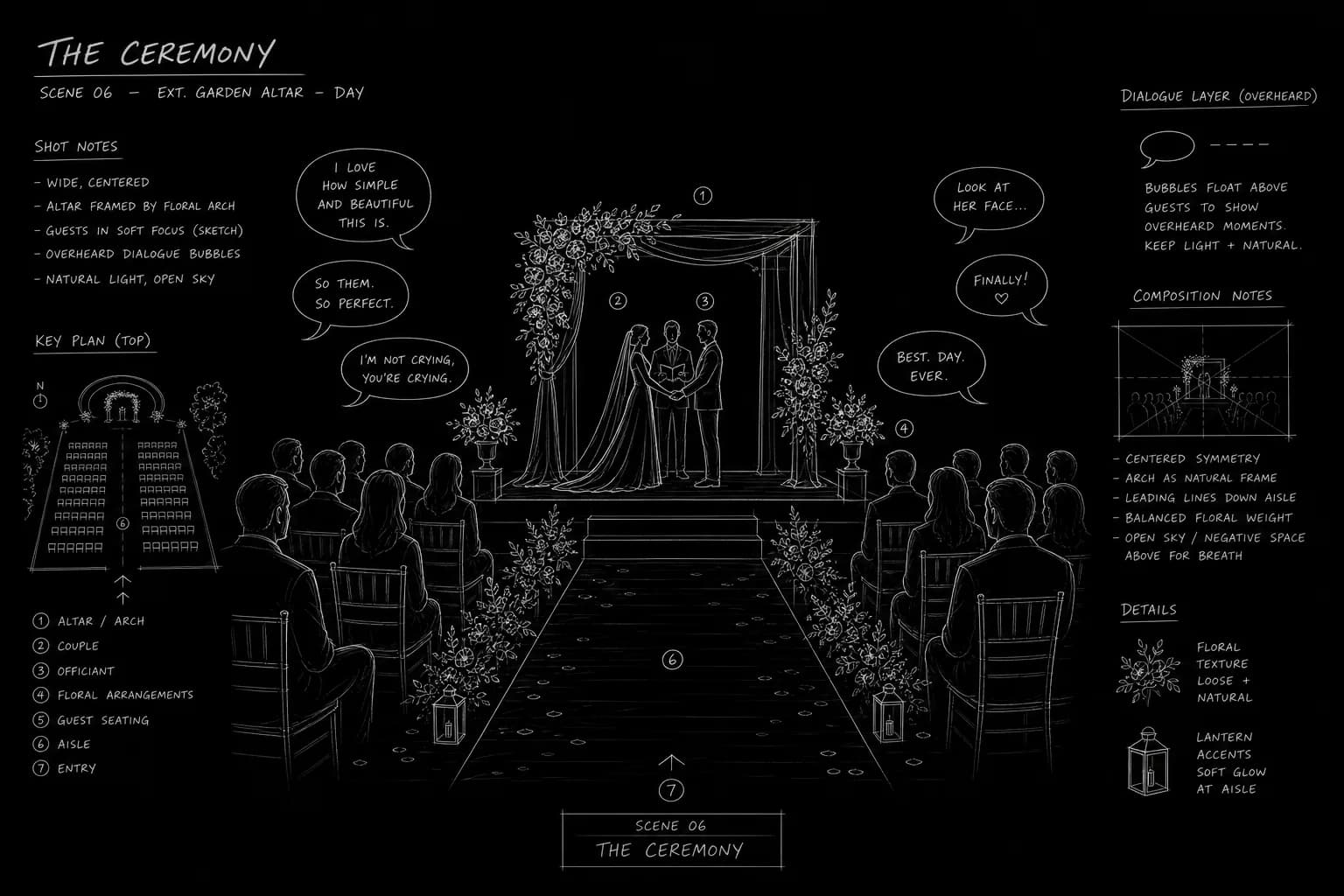
Wedding scenes are dangerous. White dresses, slow-motion petals, a swell of strings, and a speech that "really says something." The reader has seen it a hundred times before the page leaves their hand. That does not mean you should avoid weddings. Ceremonies are social pressure cookers: public vows, private doubts, families performing unity while old wounds twitch under the collar.
A strong wedding scene screenplay uses the ritual as structure, then subverts what the ritual promises. The format stays familiar. The drama does not.
The wedding is never about the wedding. It is about what two people are willing to say in front of everyone who will remember.
Free tool: use the Script Time Calculator to estimate your runtime from your script text or word count.
How to Start: Decide What the Scene Is Really Doing
Before you write "EXT. CHURCH - DAY," answer three questions:
- Whose scene is this? Bride, groom, parent, ex, best friend, objector in the back row?
- What changes by the last kiss or the last exit? Commitment, betrayal, exposure, escape?
- What is the opposite of cliché here? Not "no flowers." Opposite means a specific surprise rooted in character.
Weddings work when the ceremony forces a truth that could not appear anywhere else in the story. If your scene could happen at a dinner table, it is not earning the tuxedos.
Platform and Use-Case Sections
Romantic Comedy: Public Stakes, Private Panic
Rom-com weddings often hinge on the wrong person in the aisle or the right person arriving late. Format for readability: cluster group reactions into short blocks, keep vows tight, save the joke for after a sincere line so the sincerity lands first.
Use dual dialogue formatting sparingly during the ceremony itself. Overlapping voices read chaotic on the page unless you intend chaos. Save overlapping for the reception kitchen, not the altar unless the story demands interruption.
Drama and Ensemble Pieces: The Wedding as Crossroads
Ensemble dramas use weddings to collide subplots. The sister who cannot toast without spilling. The father who signs the check but not the blessing. Format with clear POV anchors: start on your protagonist's sensory details (hands, ring, breath), cut to antagonist reaction, return to protagonist decision.
If you need simultaneous action in two parts of the venue, consider intercutting parallel action between ceremony and parking lot, not one bloated action paragraph.
Thriller and Horror: Ritual as Trap
Thriller weddings are contracts with witnesses. The scene may look romantic while the trap springs. Keep descriptions concrete. One telling detail beats five generic decorations. Sound matters: applause covering a whisper, a ring box click that is too loud.
Horror can weaponize tradition: vows repeated wrong, a receiving line that will not end, toasts that turn accusatory. Format pauses as white space. Let dread breathe between short dialogue lines.
Step-by-Step: Building the Ceremony Beat by Beat
Step 1: Open with a character-specific image. Not "beautiful venue." Try "Maya fixes her own veil because her mother is already crying and useless."
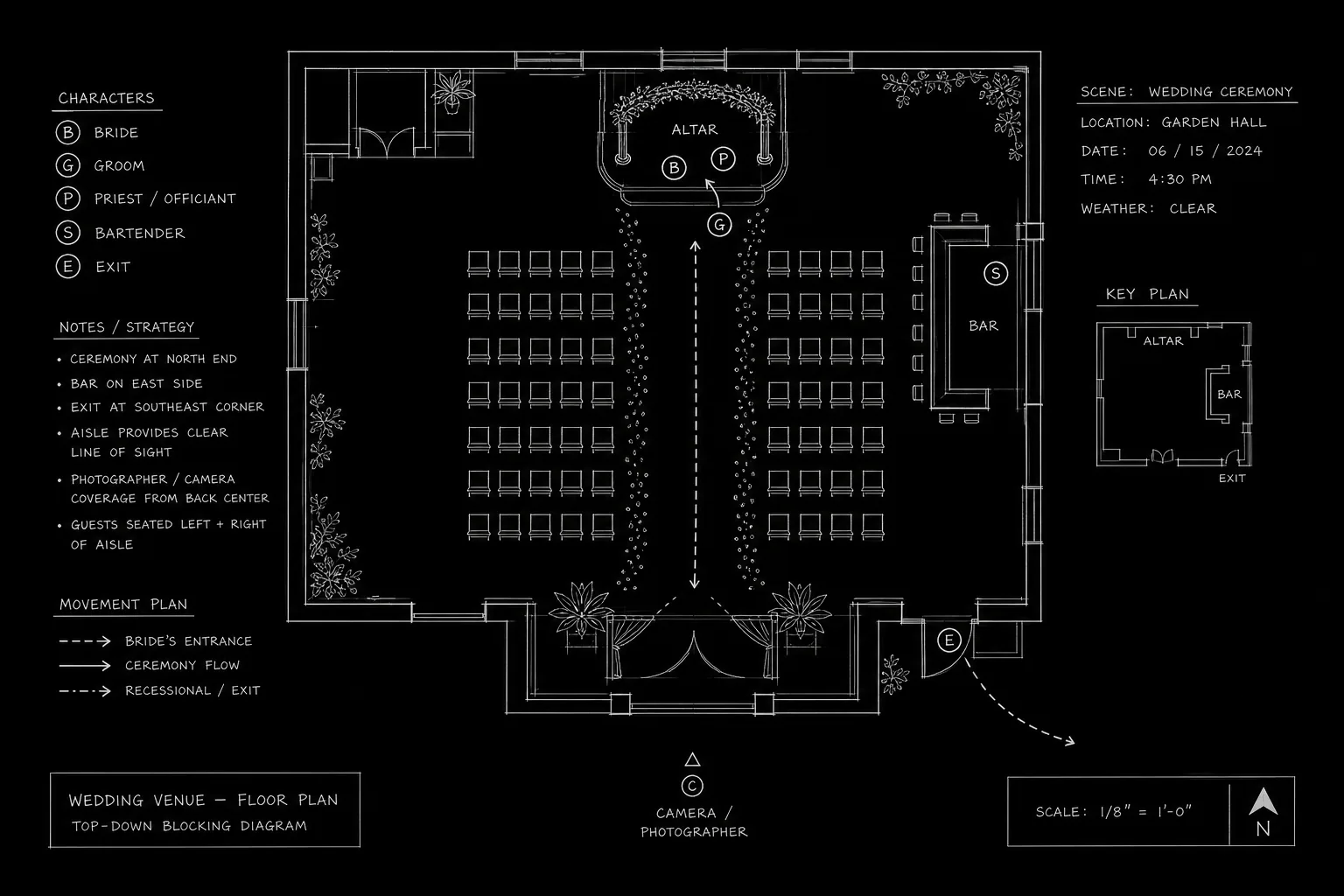
Step 2: Establish the social map in one pass. Who stands where. Who is missing. Who should not be here but is. Readers need the chessboard before the moves.
Step 3: Write the officiant lean. Officiant lines can be brief stage directions: (OFFICIANT) Standard vows. Only write full officiant dialogue if a line subverts meaning.
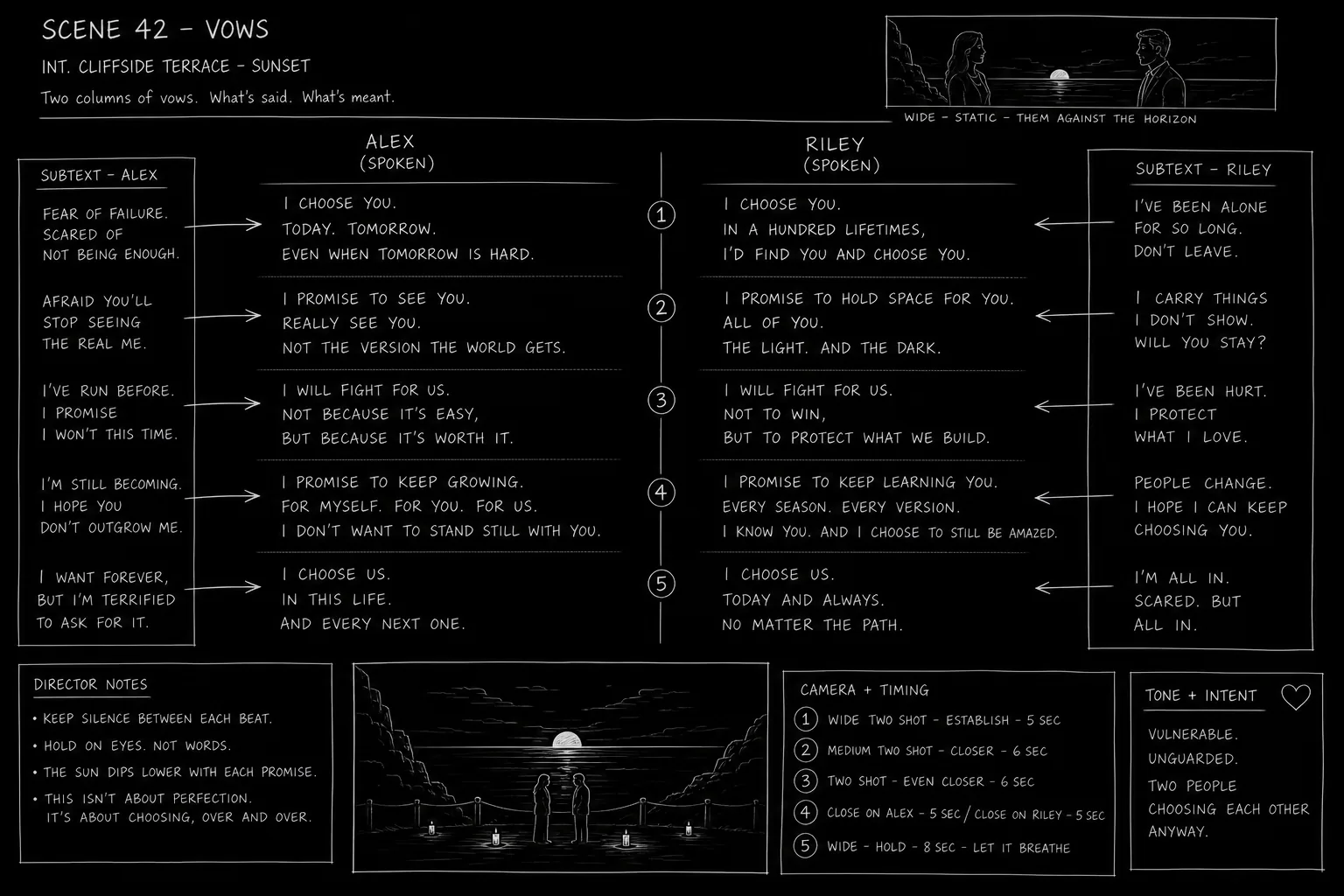
Step 4: Land the vow exchange as character test. Each vow should sound like this person, not a greeting card. If they agree to generic language, that is character information too.
Step 5: Insert the turn. Objection, revelation, glance, phone buzz, missing ring, wrong name, unexpected guest. The turn should connect to act-one setup. Chekhov's bouquet, not random shock.
Step 6: Close on aftermath image. Not confetti unless confetti means something. A held hand, a released hand, a parent alone at an empty table.
Try it free
Try Screenweaver for free on your script
It is free. Import your existing project, get a clearer view of your outline, and regain control of your story structure in minutes.
Start FreeOperational Section: Formatting Requirements and Ceremony Details
Scene headings. Split ceremony and reception if tone shifts. INT. CHAPEL - DAY then later INT. RECEPTION HALL - NIGHT gives readers a natural act break.
Crowd control on the page. You do not need every guest named. Use roles: BRIDE'S FATHER, GROOM'S SISTER, UNCLE WHO DRINKS. Name only characters who speak or whose reaction steers plot.
Stage directions without directing actors. Write behavior, not performance notes. "Tomas smiles for the photographer. His jaw stays tight." not "Tomas acts happy."
Music and ritual sounds. Note key sonic beats once: processional start, kiss cue, glass clink. For broader sound craft, see describing sound effects in a screenplay.
Legal and cultural specificity. If vows include cultural ritual, one precise action line beats three paragraphs of explanation. Trust the reader. Trust production research.
Page budget. Wedding scenes balloon. Aim for one to three pages for the ceremony unless the ceremony is the climax. Trim decorative business. Keep turning points.
| Cliché trap | Craft fix |
|---|---|
| Generic "perfect day" description | One specific wrong detail early |
| Long toast recap of entire plot | Toast that reveals new information |
| Comic relief character only jokes | Give them a stake in the outcome |
| Sudden objector with no setup | Plant objection motive two scenes earlier |
Outcome and Results: What Readers and Audiences Should Feel
A wedding scene succeeds when the audience forgets the genre baggage and watches people under pressure. Outcomes you can measure on the page:
- Clear emotional shift. Someone is more committed, more trapped, or more exposed than before.
- Memorable line that is not a quote from another movie. Test: would this line sound odd in a different story? Good.
- Visual final image that summarizes theme. Lonely cake cut. Two glasses untouched. A dance floor with one person leaving.
After drafting, run the scene in a table read. Wedding dialogue that "sounds written" will flatten in the room. Rewrite until actors can say it like speech.
Why It Matters: Old Way vs New Way
The old way: Writers used weddings as aesthetic wallpaper. Beautiful description stood in for conflict. Speeches explained theme. Readers skimmed to the reception punchline.
The new way: Writers treat the ceremony as a pressure scene with a clock. Public words, private stakes, visual grammar that reveals character. The wedding feels inevitable and surprising at once.
That shift mirrors broader spec script discipline: suggest the emotional experience, do not micromanage the cinematographer. Your job is to make the reader see the right problem at the altar, not to choreograph every pan across petals.
Relatable Scenario: The Toast That Turns the Room
Picture a reception where the best friend rises with a glass. The old way writes three minutes of biography recap: how they met, the road trip, the ex who is thankfully not here. The room listens politely and the reader checks page count.
The new way gives the toast one new fact that changes how we read the marriage. "I drove her to the clinic the morning after his bachelor party in Montreal. She told me she still wanted the wedding. I believed her. I am not sure I do now." Same glass, same smile, different stakes. Format the toast in short paragraphs so the reader feels pauses. Land a reaction line from the groom, the bride, or a parent without turning the moment into a group speech contest.
This is how wedding scenes escape cliché: not by avoiding tradition, but by making tradition carry information the story needs.
Final CTA and Conclusion
If your wedding scene feels familiar, do not add more decorations. Add a sharper secret. Cut one speech. Give one silent character a decisive action. Make the vows cost something.
Take your current wedding pages and highlight every line that could appear in a stock photo caption. Replace those lines with behavior only your characters would choose. Then format the scene so the reader always knows whose heart is on the line.
Write the wedding as a turning point, not a postcard. The reader will thank you. The audience will remember the aisle, not the Pinterest board.
Final Step
Build your next script with Screenweaver
Move from ideas to production-ready pages faster with timeline-native writing and AI-assisted story flow.
Try Screenweaver