
Enemies-to-lovers is the romance arc readers claim they are tired of and still finish every time - when it is earned. The failure mode is familiar: two characters hate each other because the plot needs friction, then kiss in Act Three because the plot needs a beat. No pivot scene. No credible vulnerability. No cost to the shift. The audience feels manipulated, not moved.
This article maps the screenplay beats that turn professional rivalry, ideological clash, or personal grudge into romantic tension that feels inevitable instead of imported from a trope checklist.
Free tool: use the Beat Sheet Calculator to map these beats to exact page numbers for your script length.
How It Works: From Antagonism to Attraction
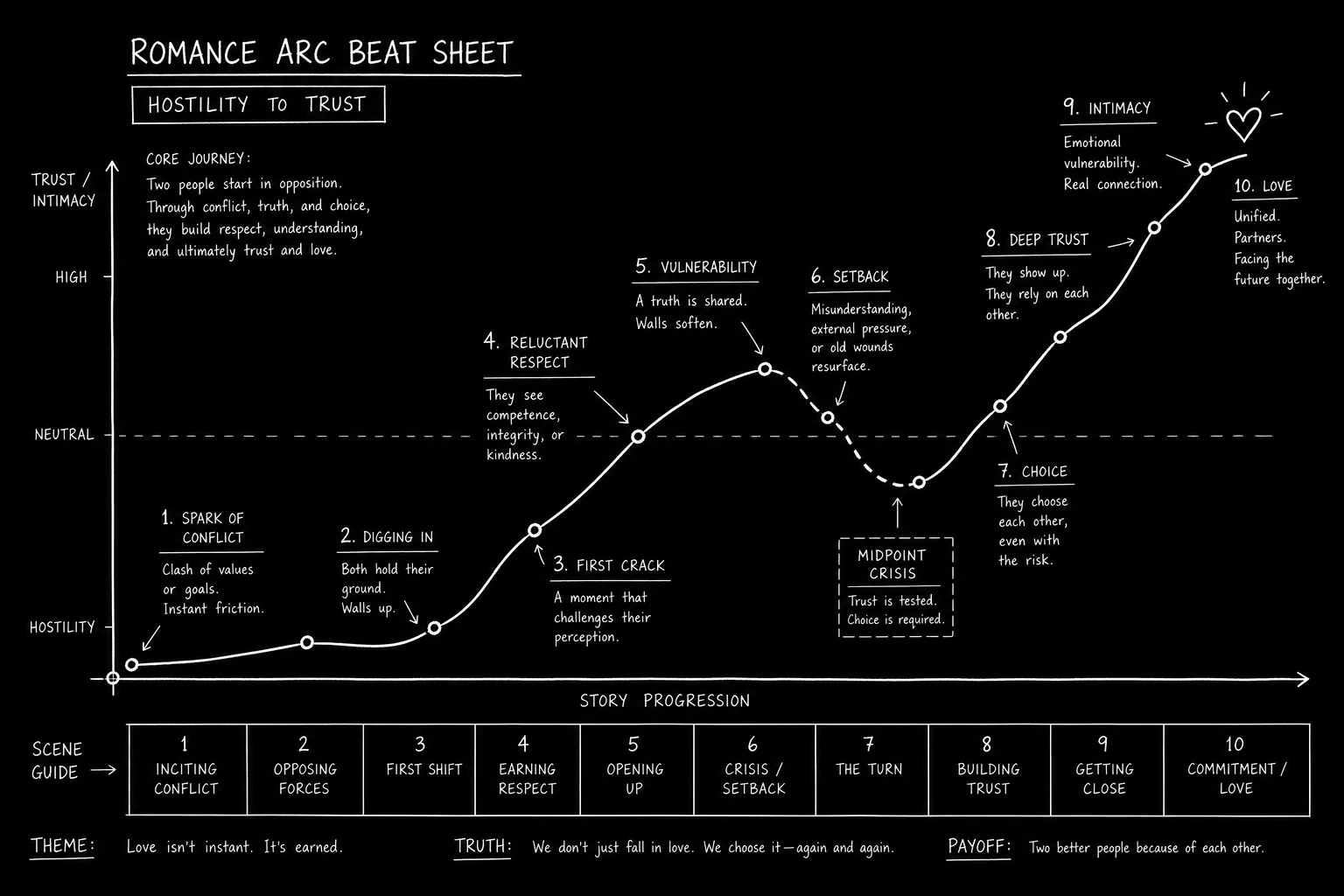
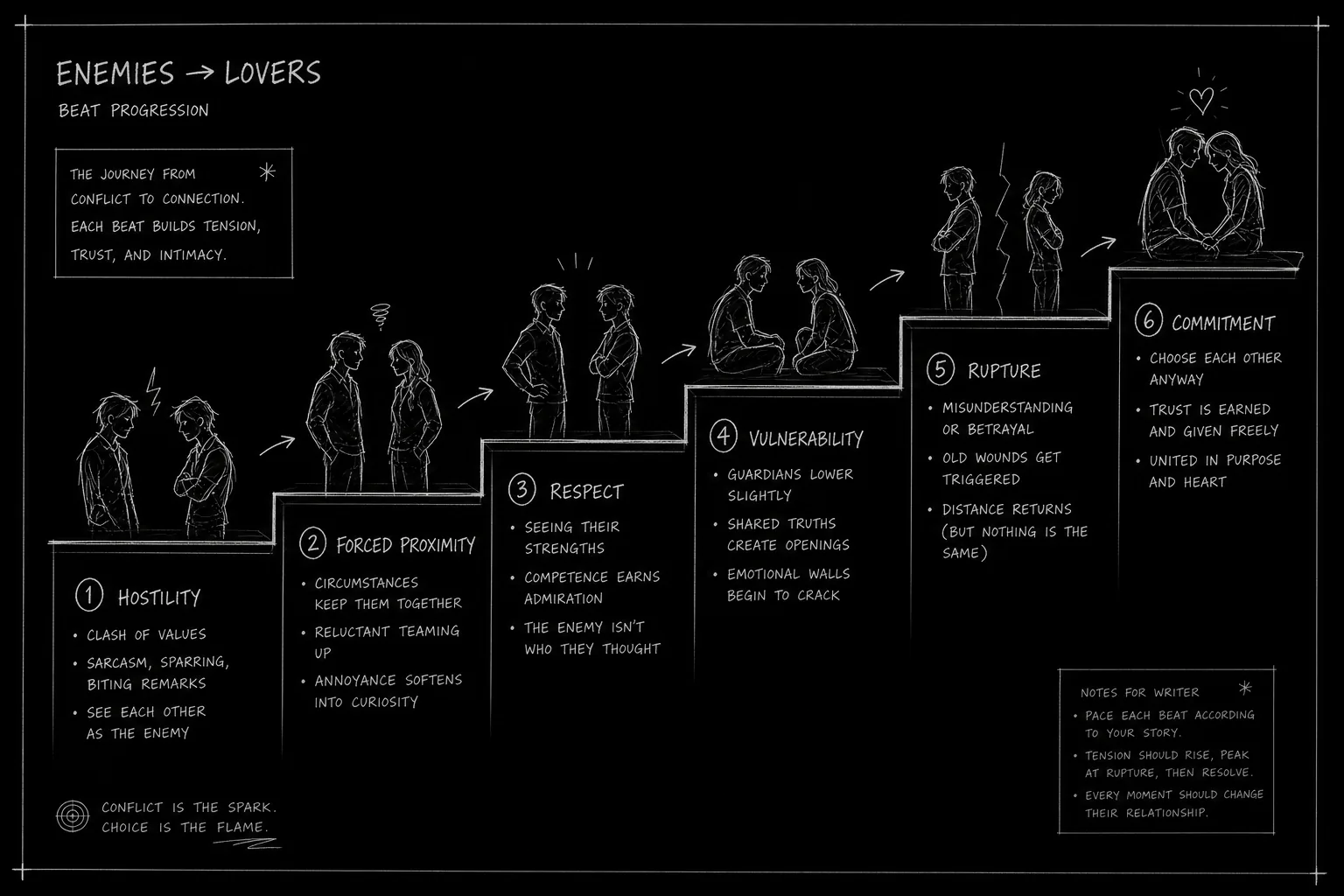
Enemies-to-lovers is not a single reversal. It is a staircase of micro-shifts. Each step recontextualizes what the characters thought they knew about the other. Early scenes establish legitimate conflict: competing goals, wounded pride, incompatible values. Middle scenes introduce forced proximity and shared stakes that make cooperation necessary before affection is safe. Late scenes trade hostility for honesty, usually one vulnerable confession at a time, never both at once until the final turn.
The arc works when hatred was never cosmetic. If they could swap positions in Act One without changing the story, the romance has no foundation. Ground enmity in story logic first. For argument craft that stays sharp without repetition, see writing argument scenes without repetitive dialogue.
Platform and Use-Case Sections
Feature Romance and Romantic Comedy
Features need a visible midpoint shift: the moment attraction becomes undeniable to the audience but deniable to the characters. Often this is a private victory, one saves the other, one tells the truth the other needed, and the saved party hates that gratitude feels like warmth.
One-Hour Drama
Serialized enemies-to-lovers can span a season. Plant season-long obstacle pairs: every time trust builds, external pressure reactivates the original wound. Subtext carries the arc; see writing seduction scenes with subtext for charged scenes that are not yet confessions.
Streaming Limited Series
Binge structure rewards delayed payoff. Give viewers a near-miss beat per episode: almost confession, interrupted touch, shared secret that cannot be unshared. The kiss lands harder when the audience has catalogued every almost.
YA and Commercial Fiction Adaptations
Younger-skewing arcs need clear consent and agency on the page. Enemies-to-lovers is not bullying-to-romance. Rewrite any beat where cruelty reads as chemistry unless the script explicitly frames it as toxic and addressed.
The Trench Warfare Section: What Beginners Get Wrong
Banter without stakes. Witty insults with no professional or personal consequence feel like sitcom filler. Fix: attach a dollar figure, reputation risk, or moral line to every barb.
Attraction too early. If they flirt in Act One, enmity was theater. Delay warmth until after the respect beat.
Forgiving the unforgivable off-screen. Betrayals that vanish between scenes destroy trust in the arc. Show the cost of forgiveness in behavior, not a montage.
Making only one party wrong. One-sided villains produce wish fulfillment, not romance. Both need defensible wounds.
Skipping the rupture because the kiss is pretty. Rain does not equal conflict resolution. Write the fight that makes reunion costly.
Step-by-Step: Beat Map From Cold Open to Commitment
Step 1 - Establish legitimate enmity (Pages 1-15)
Write the origin of conflict in present tense action, not backstory monologue. Both characters must have a defensible position.
Step 2 - Force proximity with a shared goal (Pages 15-35)
They need each other to win something neither can win alone. Cooperation is tactical, not emotional.
Step 3 - Insert the respect beat (Midpoint)
One demonstrates competence or integrity the other did not expect. No flirtation yet. Just recalibration.
Step 4 - Private vulnerability, public armor (Pages 35-55)
One character reveals fear, loss, or shame in a scene with no audience. The other witnesses and does not weaponize it. That restraint is the first love note.
Step 5 - External threat reframes the enemy (Pages 55-75)
A third force threatens both. Fighting side by side rewrites the emotional ledger. Grudging trust becomes protective instinct.
Step 6 - The rupture (All Is Lost)
Misunderstanding or old wound resurfaces. They retreat to hostility because vulnerability felt dangerous. This beat must callback Act One logic, not invent a new problem.
Step 7 - Earned confession and choice (Climax)
Resolution is mutual. Each gives up something: pride, career advantage, moral certainty. The kiss is a decision, not a reward.
[YOUTUBE VIDEO: Beat-by-beat breakdown of a film or series enemies-to-lovers arc, mapping each micro-shift to a specific scene function and flagging where weak versions skip the respect beat.]
Try it free
Try Screenweaver for free on your script
It is free. Import your existing project, get a clearer view of your outline, and regain control of your story structure in minutes.
Start FreeOperational Requirements: Scene-Level Craft Rules
Dialogue: Early scenes need barbed brevity. Late scenes need pauses. If late scenes still sound like Act One insult comedy, the arc has not turned.
Physical staging: Enemies touch late. When they do, make it purposeful: passing a weapon, steadying an injury, removing a thread. Each touch category escalates.
Supporting cast: Friends and allies must challenge the romance. "You hated them yesterday" is a useful dramatic mirror.
Rating and market: Romantic heat level must match platform expectations. A network procedural and a premium cable drama use the same beat map with different intimacy ceilings.
| Beat | Audience Should Feel | Common Mistake |
|---|---|---|
| Enmity | Both sides valid | One-dimensional villainy |
| Proximity | Irritation + need | Instant banter chemistry |
| Respect | Surprise | Immediate flirtation |
| Vulnerability | Tenderness under protest | Full confession too early |
| Rupture | Earned pain | Random third-act lie |
| Commitment | Relief + cost | Kiss without sacrifice |
Track character status shifts visually. Our guide on before-and-after scenes without dialogue helps you stage the turn in behavior, not speeches.
Outcome: What Readers and Viewers Experience When Beats Land
Earned enemies-to-lovers delivers a double payoff: romantic satisfaction and thematic resolution. The characters do not just end up together; they become versions of themselves that could not exist without the other's challenge. Readers describe the arc as "inevitable in hindsight," which is the highest compliment for this structure.
On the business side, a well-beatmapped romance survives coverage. Development executives can pitch the arc in one sentence because the pivot scenes are identifiable on the page.
Why It Matters: Trope Delivery vs Dramatic Engineering
The old way: Slap "enemies-to-lovers" in the logline, write snarky banter, schedule a rain-soaked kiss. Chemistry is assumed. Conflict is performative.
The new way: Engineer respect before desire, vulnerability before trust, rupture before reunion. Banter is armor that cracks on a schedule the story earns.
Trope language sells decks. Beat engineering sells scripts. The difference is whether the audience remembers the kiss or only the premise.
Conclusion
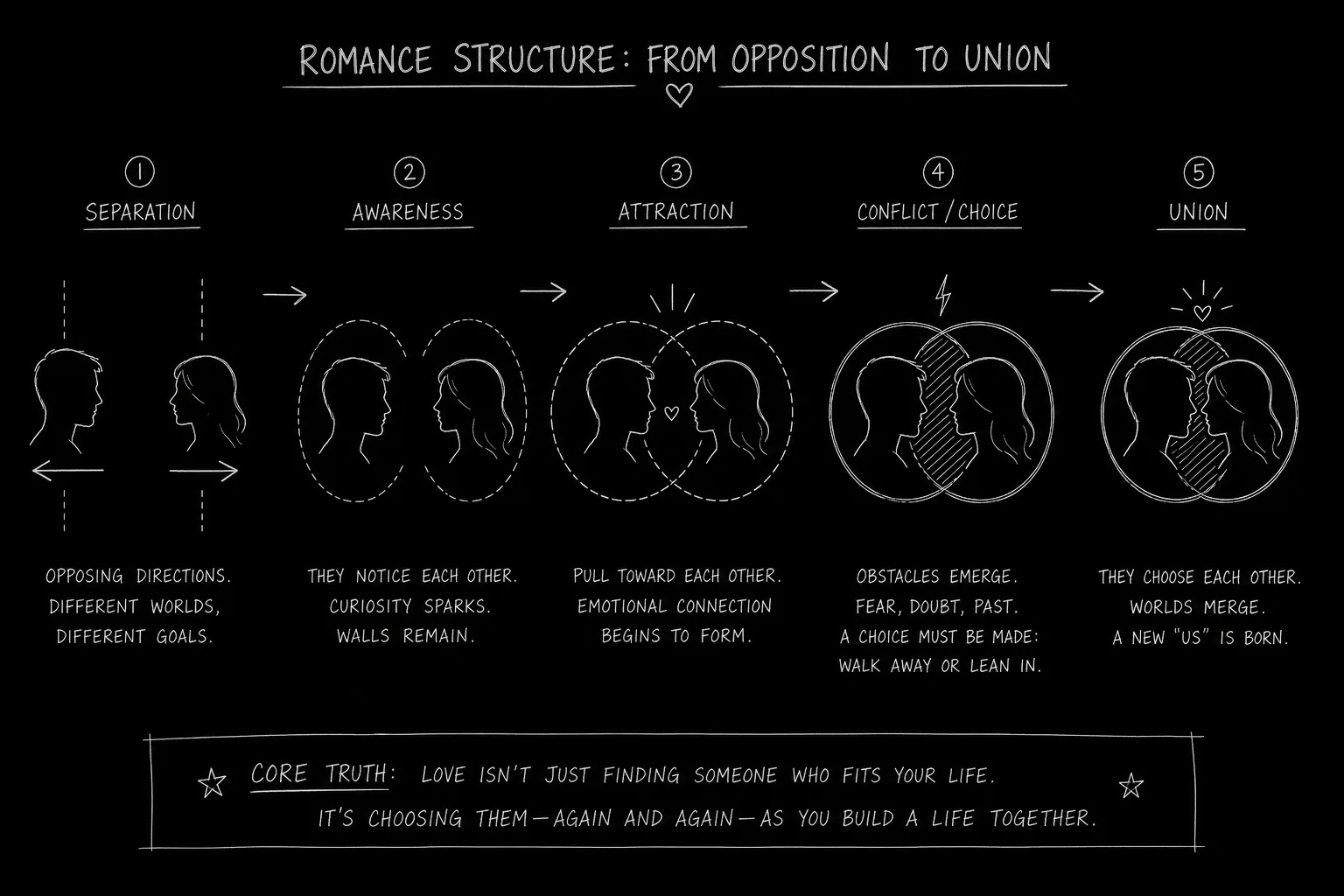
Enemies-to-lovers lives or dies on the respect beat and the rupture beat. Skip respect and the kiss feels horny but hollow. Skip rupture and the ending feels unopposed. Map the staircase, write legitimate enmity, and make cooperation costly before you make attraction obvious.
When you draft the vulnerability scenes, pair this guide with writing dialogue subtext vs exposition so confessions reveal character instead of explaining the theme. Your next pass is simple: label every scene with where the characters are on the staircase. If two consecutive scenes occupy the same step, add a turn or cut one.
Consider a public vs private axis across the arc. Enemies perform hostility in public longer than they feel it in private. A hallway argument might still be sharp while a late-night repair scene shows one character leaving coffee without comment. The audience tracks the gap between performance and truth. That gap is where romance lives before anyone admits it.
For writers adapting existing IP, check whether the source material's enemies period is long enough to support a feature or needs compression. A 400-page novel can hate for chapters; a 100-page script cannot without losing the middle. Choose the two hostility scenes that best define the feud and cut the rest. Quality of enmity beats quantity every time.
Final Step
Build your next script with Screenweaver
Move from ideas to production-ready pages faster with timeline-native writing and AI-assisted story flow.
Try Screenweaver