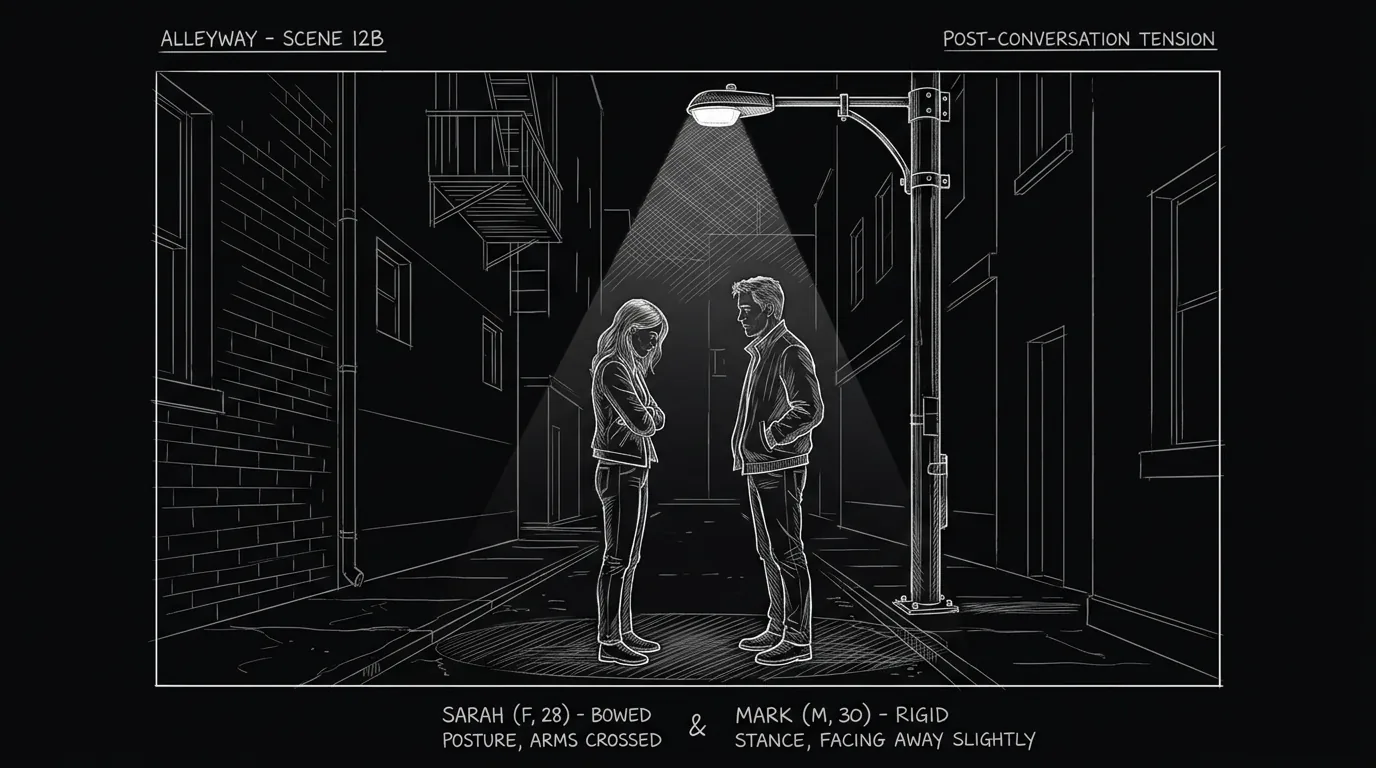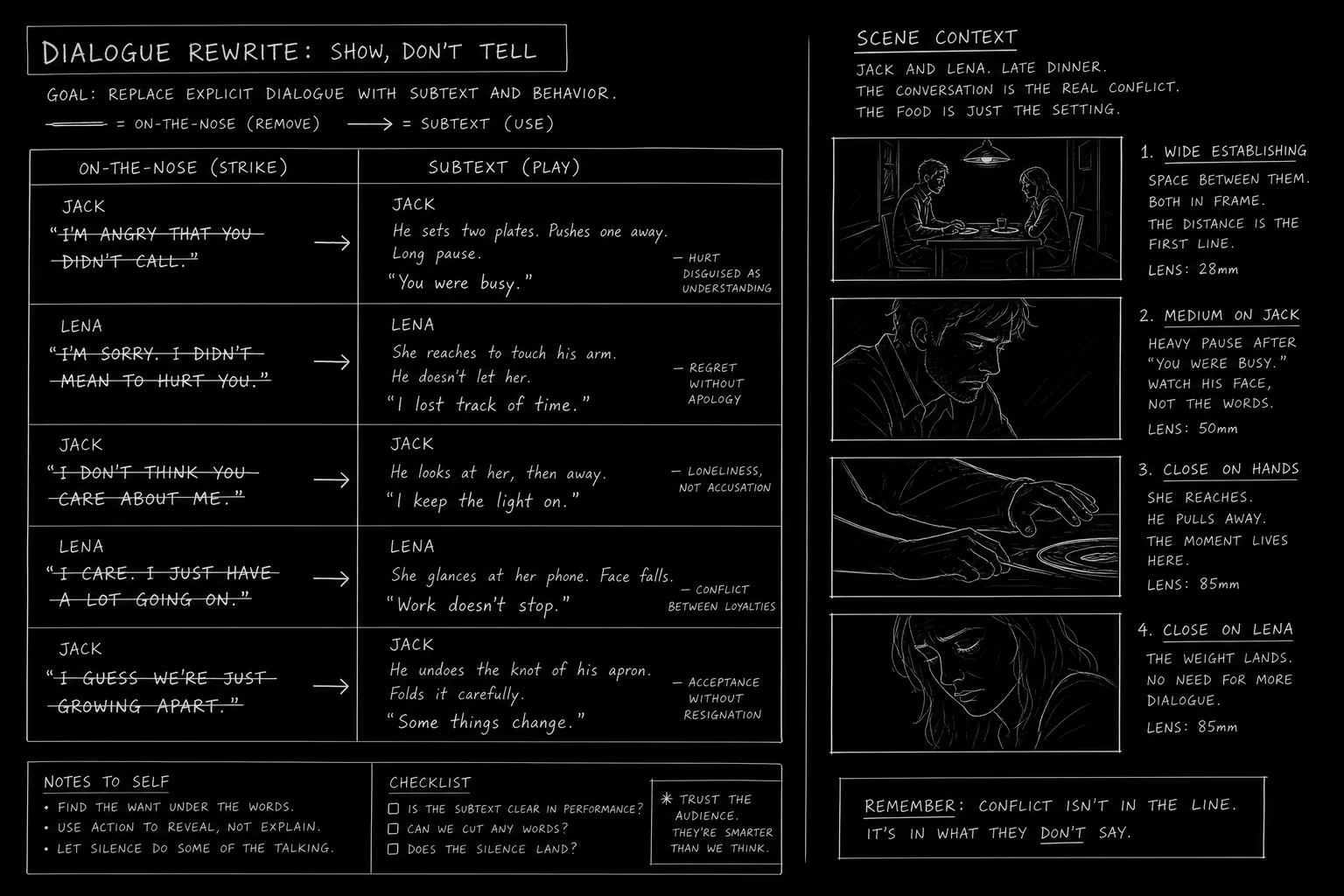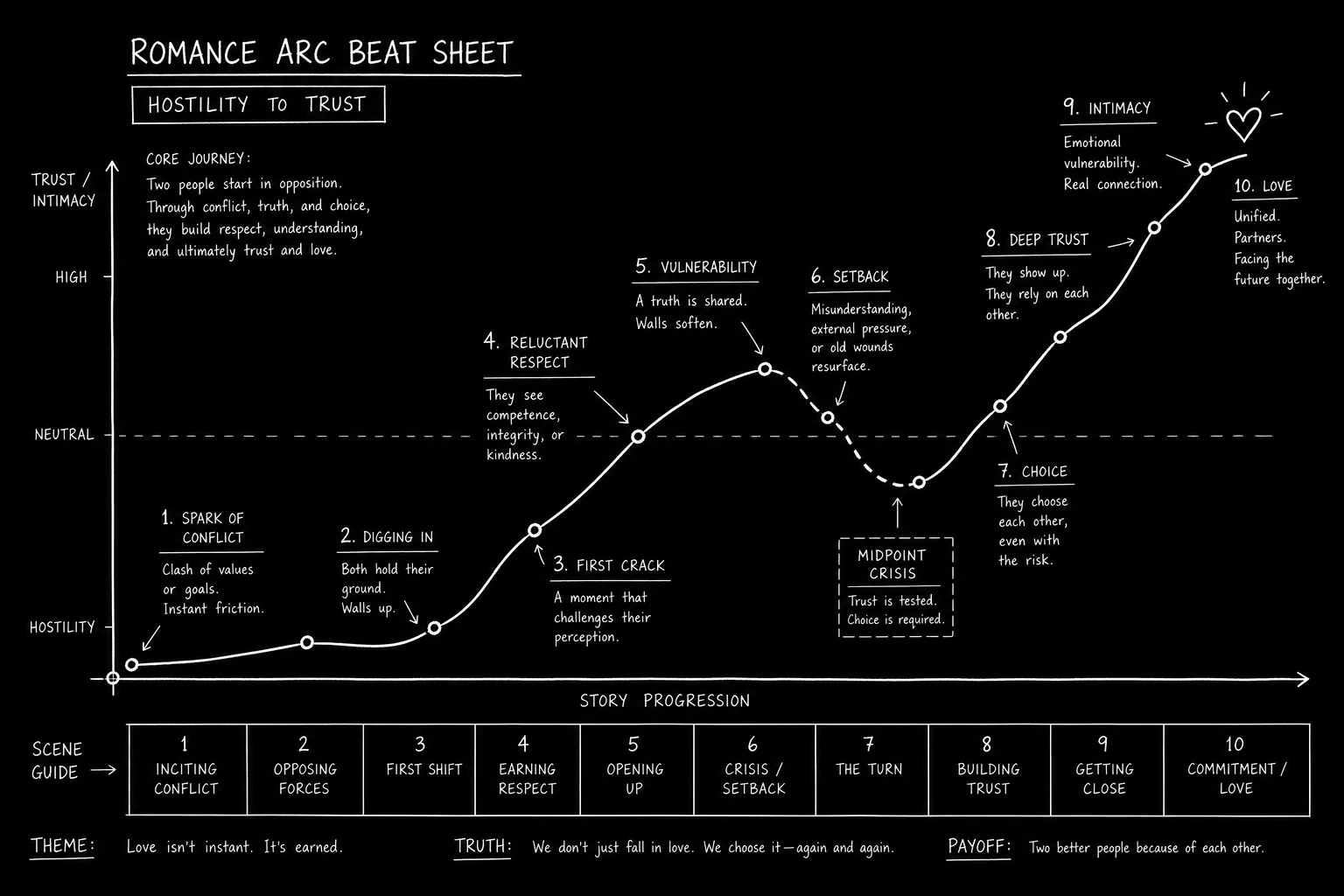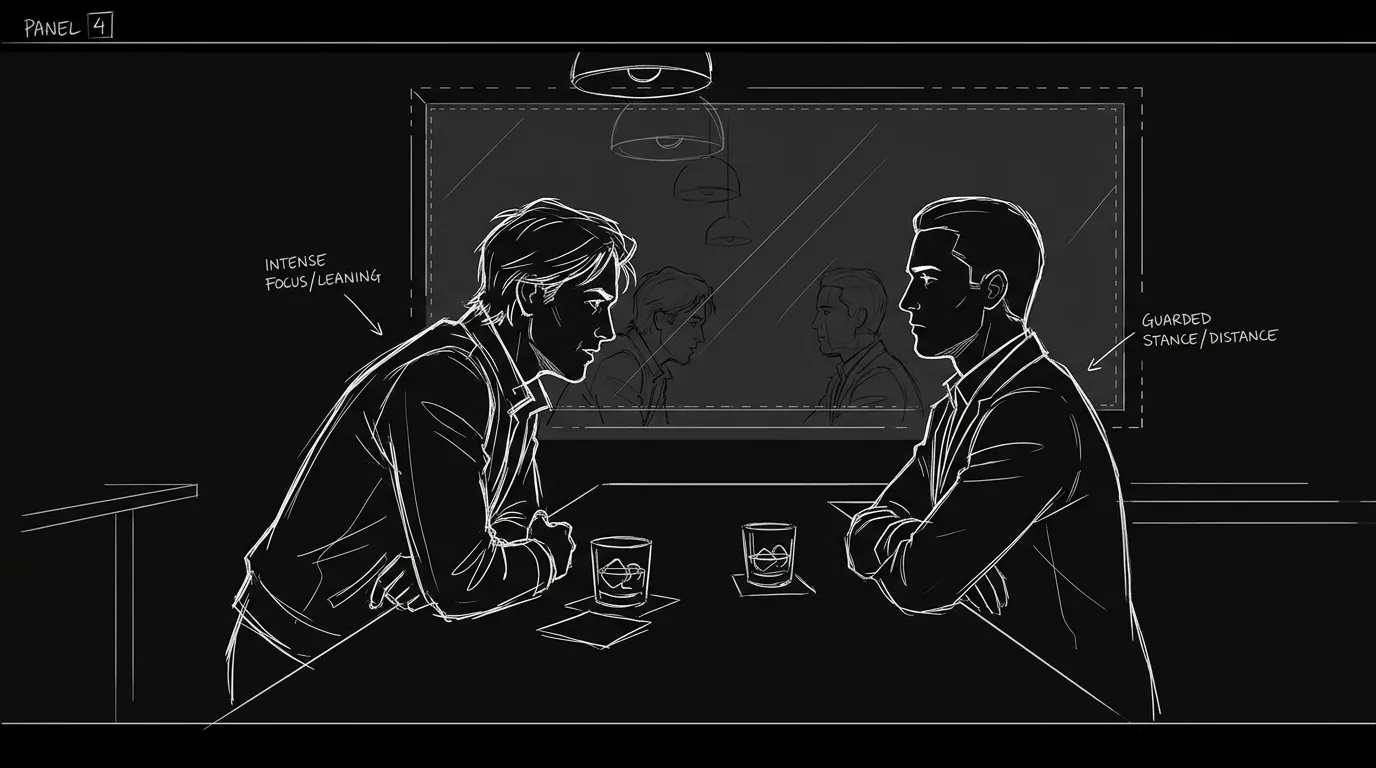

Seduction scenes fail when they say exactly what they mean.
That sounds simple. It is not.
Most weak seduction writing swings between two bad extremes: explicit dialogue that kills tension, or vague "chemistry" language that feels ornamental and empty. In both cases, the reader senses the writer pushing attraction instead of letting attraction emerge through behavior, stakes, and risk.
A strong seduction scene is not about sexy lines.
It is about strategic ambiguity.
Two people want something, but not always the same thing. Desire intersects with power, fear, status, timing, secrecy, and self-protection. The scene works when spoken text and true intent diverge, and that divergence is legible without becoming obvious.
Here is why that matters: seduction in narrative is rarely only about romance or sex. It can be about access, leverage, validation, escape, revenge, information, belonging, or control. If you write only surface attraction, you lose half the scene.
Why Seduction Scenes Feel Cringe or Generic
Weak scenes usually fail because writers treat seduction as content instead of interaction dynamics.
They over-rely on body description and underwrite objective conflict. They use clichéd dialogue ("I've been waiting for this") without character-specific voice. They confuse consent clarity with tension loss and end up either ethically muddy or dramatically flat.
Another frequent issue is symmetrical intent. Both characters want the same thing at the same speed, so there is no dramatic friction.
Think about it this way: if your seduction scene could be transplanted into ten other scripts unchanged, you have atmosphere, not character.
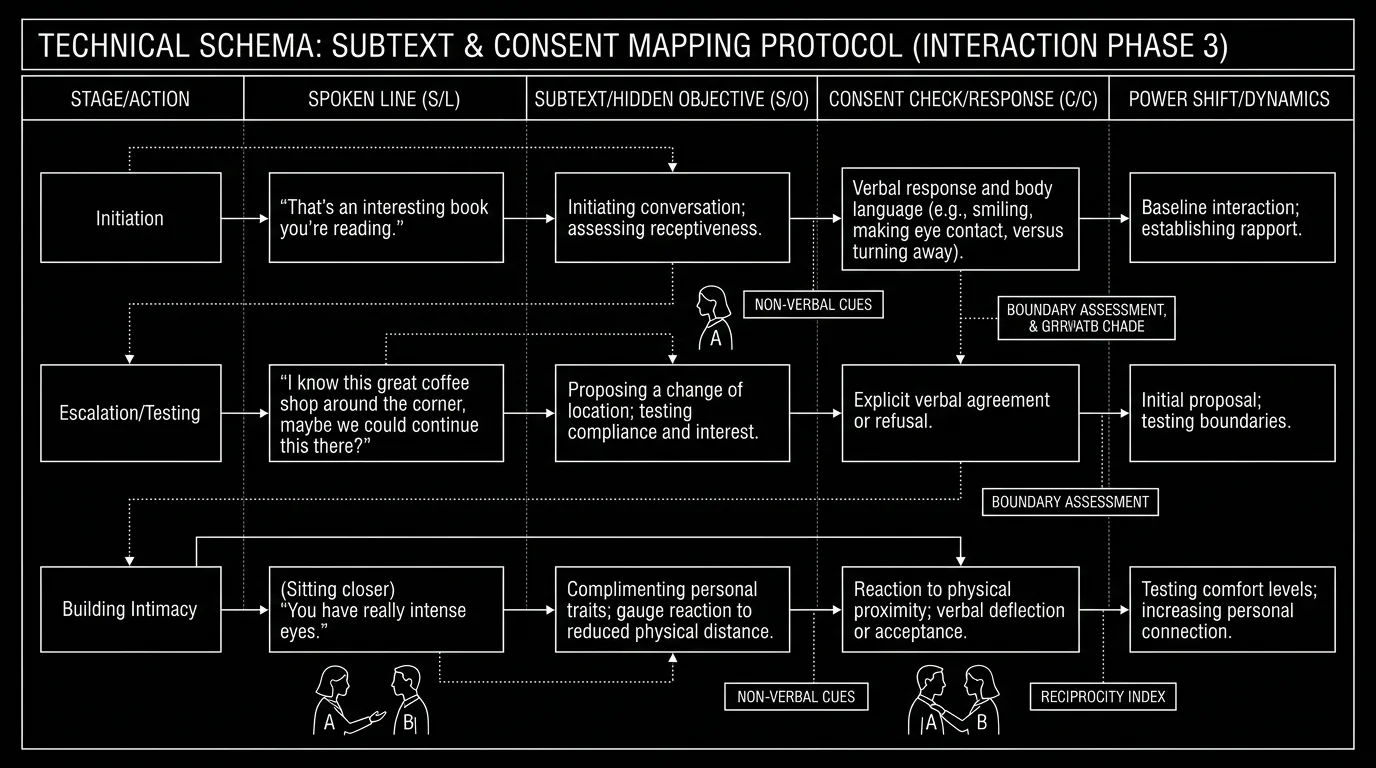
Subtext in seduction is the gap between what is offered and what is actually being negotiated.
The Core Model: Objective, Signal, Test, Boundary, Shift
A high-functioning seduction scene runs on five beats.
Objective: each character enters wanting something concrete.
Signal: one initiates contact through coded language or behavior.
Test: the other probes intent, sincerity, and risk.
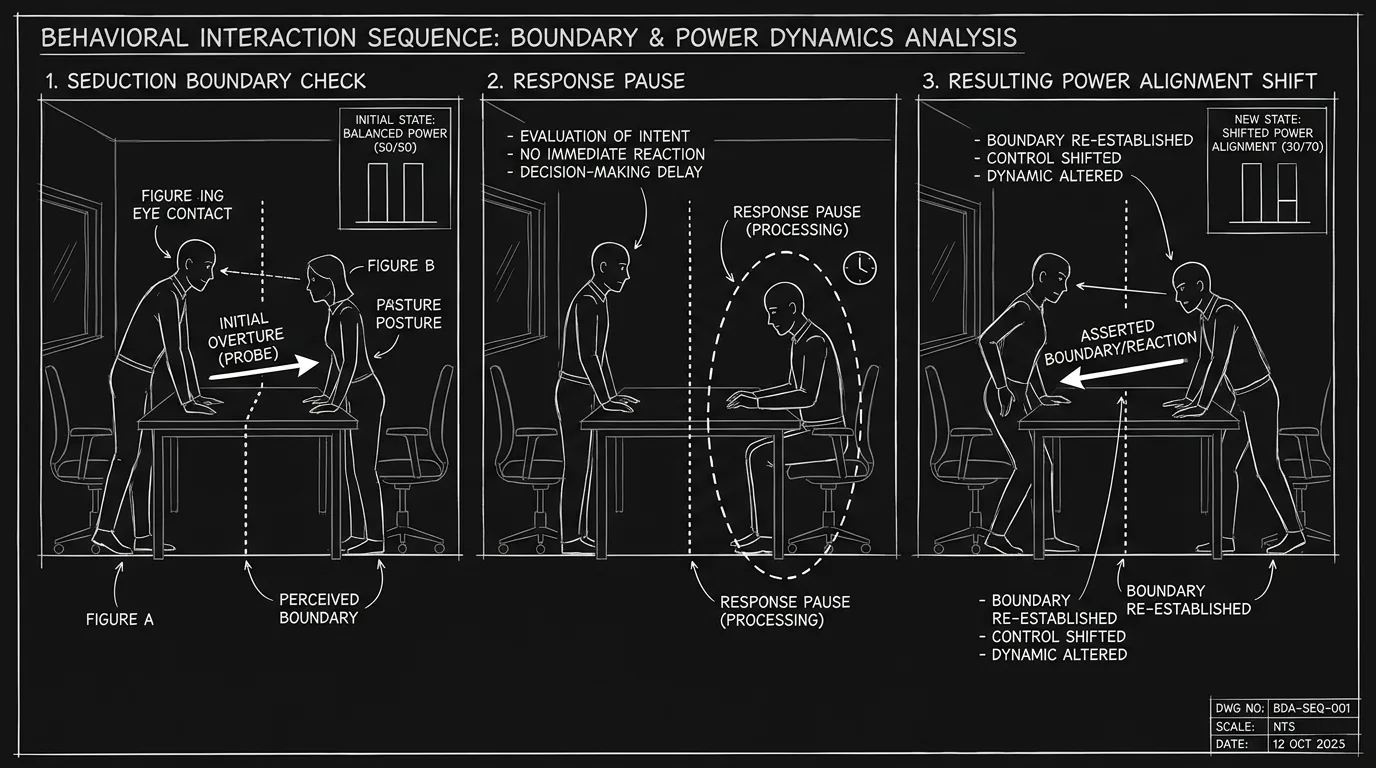
Boundary: consent, limit, or condition is set or challenged.
Shift: power and expectation change by scene end.
Without Test, seduction feels shallow.
Without Boundary, seduction feels unsafe or unearned.
Without Shift, seduction feels decorative.
Scenario One: Seduction as Information Extraction in a Thriller
Beginner version: operative flirts, target flirts back, private meeting secured.
Functional, but thin.
A stronger version layers conflicting objectives. Operative wants access to encrypted device. Target wants emotional validation and proof of discretion. Each line tests not just attraction but operational risk tolerance.
The best lines do double work:
surface invitation,
subsurface credential test.
Now the scene carries both sensual and tactical tension.
Scenario Two: Romantic Drama Seduction with Emotional Mismatch
In romantic dramas, scenes often become confession-heavy too early.
Stronger approach: desire appears before emotional certainty.
One character uses humor to lower stakes; the other uses precision questions to slow momentum. A hand touch lingers, then stops. A sentence trails off. A boundary is acknowledged and respected. This produces trust and tension.
Restraint creates heat when objective conflict is clear.
Scenario Three: Workplace Seduction Under Institutional Risk
These scenes are often mishandled as either harmless flirtation or predatory shorthand.
To write them well, define power conditions explicitly. Role hierarchy, policy constraints, reputational stakes, and consent clarity all matter. Subtext here may involve career calculation, fear of retaliation, or mutual caution.
When written responsibly, the scene can be intense without glamorizing coercion.
Step-by-Step Workflow for Writing Seduction with Subtext
Step 1: Define Dual Objectives
Before dialogue, write one desire objective and one non-desire objective for each character.
Example:
Character A desires intimacy, needs intel.
Character B desires control, needs reassurance.
Dual objectives prevent one-note writing.
Step 2: Establish Power Baseline
Who has social, emotional, informational, or institutional power at scene start?
Subtext depends on this baseline.
Without it, "power shift" is guesswork.
Step 3: Write Signal Language, Not Explicit Declaration
Use offers, invitations, jokes, deflections, and curiosity prompts that can be read two ways.
Avoid immediate literal declarations unless your character would truly speak that directly.
Step 4: Insert Consent-Linked Test Beat
Seduction scenes need consent clarity without killing tension.
Use explicit or implicit check moments:
pause-and-wait,
"is this okay?",
step-back opportunity,
boundary naming.
Consent beats increase trust and can intensify subtext.
Step 5: Add One Misread or Mismatch Beat
Seduction becomes dynamic when one signal is misread or strategically misunderstood.
This can reveal fear, pride, or hidden agenda and force recalibration.
Step 6: Design Boundary Language in Character Voice
Boundary setting should sound like the person speaking.
Some are direct.
Some are playful but firm.
Some are procedural.
Some are emotionally transparent.
Voice-accurate boundaries prevent cliché.
Step 7: End on Changed Terms
What changed by scene end?
Access granted or denied.
Trust increased or fractured.
Risk accepted or deferred.
This new term should affect the next scene.
Table: Surface Seduction vs Subtext-Rich Seduction
| Dimension | Surface Version | Subtext-Rich Version |
|---|---|---|
| Dialogue | Literal attraction statements | Dual-meaning signals and tests |
| Character intent | Single desire axis | Desire plus strategic objective |
| Consent | Implicit and unclear | Clear, integrated boundary beats |
| Power dynamics | Static | Measurable shifts |
| Conflict | Minimal friction | Mismatch, misread, recalibration |
| Plot impact | Mood scene | Terms change for next action |
The Trench Warfare Section: What Beginners Get Wrong (and How to Fix It)
This is where seduction scenes usually improve fast.
Mistake one: writing "sexy" instead of writing intention.
Fix by defining objective per line.
Mistake two: over-describing bodies, under-describing decisions.
Fix by prioritizing behavior that changes leverage.
Mistake three: no consent architecture.
Fix with clear boundary checks and response beats.
Mistake four: generic flirt dialogue.
Fix with character-specific voice and context-specific stakes.
Mistake five: no subtext gap.
Fix by ensuring spoken line and true aim differ.
Mistake six: symmetrical pace.
Fix with unequal readiness and asymmetrical risk appetite.
Mistake seven: no external stakes.
Fix by linking scene to social, institutional, or plot consequences.
Mistake eight: instant escalation without test.
Fix with signal-test rhythm before physical progression.
Mistake nine: power dynamic ignored.
Fix by mapping baseline power and end-state shift.
Mistake ten: seduction as filler between plot scenes.
Fix by requiring outcome that changes next decision.
Mistake eleven: all dialogue, no environment leverage.
Fix using spatial choices (distance, exits, witnesses, noise).
Mistake twelve: no aftermath.
Fix by showing changed behavior in next scene.
Mistake thirteen: manipulative objective hidden from audience unfairly.
Fix with fair cues that support re-interpretation later.
Mistake fourteen: melodramatic emotional reveal too soon.
Fix with phased disclosure.
Mistake fifteen: boundary violation framed as passion.
Fix by preserving agency and consequence.
Mistake sixteen: tone mismatch with genre.
Fix by calibrating language to thriller, drama, comedy, etc.
Mistake seventeen: one-note confidence archetypes.
Fix by adding vulnerability or insecurity texture.
Mistake eighteen: no witness pressure in public scenes.
Fix by tracking who can see what and when.
Mistake nineteen: no strategic silence.
Fix by writing purposeful pauses and reaction beats.
Mistake twenty: no thematic connection.
Fix by tying seduction conflict to central story question.
The most compelling seduction scenes are negotiations where attraction is real, risk is real, and meaning is never only one thing.
Body Image: Seduction Subtext Matrix
Practical 45-Minute Rewrite Drill
Take your current seduction scene and run this pass.
First ten minutes: write each character's dual objectives in the margin.
Next ten minutes: label each line as signal, test, boundary, or reveal.
Next ten minutes: add one consent check and one misread beat.
Next ten minutes: cut generic flirt lines and replace with voice-specific subtext.
Final five minutes: define changed terms that affect next scene.
This pass usually turns chemistry blur into dramatic architecture.
Advanced Calibration: Desire, Power, and Narrative Ethics
Seduction scenes carry ethical weight because attraction and power are often unequal in context. Good writing does not sterilize tension, but it does clarify agency, choice, and consequence.
Another advanced move is delayed interpretation. Let the audience feel attraction now and understand full strategic intent one or two scenes later through fair clues.
This creates rewatch value without deception fatigue.
For external script-study references, the Writers Guild Foundation Library is useful and should be treated as nofollow in publishing workflows.
As discussed in our guide on [how to write a first kiss scene without cringe], restraint and aftermath behavior are stronger than ornamental romance language.
If seduction drives confession pressure, our framework in [how to write a confession scene in a thriller] helps structure reveal timing.
And when desire conflict turns into overt showdown, the principles in [how to write a final confrontation scene that feels earned] support escalation.
Try it free
Try Screenweaver for free on your script
It is free. Import your existing project, get a clearer view of your outline, and regain control of your story structure in minutes.
Start FreeBody Image: Boundary and Power Shift Sequence
YouTube Placeholder
[YOUTUBE VIDEO: A rewrite workshop transforming a literal seduction scene into a subtext-driven sequence with clear consent, tactical intent, and plot consequence.]
Extra Deep Dive: Writing Subtext Through Topic Selection
A highly effective way to write seduction without cliché is to avoid talking about attraction directly.
Instead, choose conversation topics that function as subtext vessels.
Good subtext topics have three qualities:
they allow plausible conversation,
they carry symbolic relevance,
they can be redirected quickly.
Examples include:
travel routes,
favorite music interpretations,
risk preferences,
work frustrations,
childhood rituals,
food choices,
sleep habits,
timing and routine.
None of these are "seduction lines" on paper.
All of them can reveal intimacy potential, compatibility pressure, and vulnerability appetite when written with intent.
Scenario Layer: Seduction in a High-Surveillance Environment
Suppose two characters are in a casino bar under camera coverage.
They cannot speak plainly.
Surface dialogue is about card strategy.
Subtext dialogue is about trust, betrayal tolerance, and whether one will risk exposure for the other.
A line like "You fold too early" can carry emotional and tactical meaning simultaneously.
This is the power of coded topic design.
Writing Contradictory Signals Without Confusion
Seduction often includes contradictory behavior:
approach then retreat,
joke then seriousness,
invitation then boundary.
These contradictions create tension if they are motivated.
To keep clarity, tie each contradiction to one pressure source:
fear of rejection,
institutional risk,
unresolved betrayal,
self-protection habit.
When contradiction has motive, readers feel complexity, not inconsistency.
Practical Subtext Annotation Pass
After drafting, annotate each key line with two labels:
literal function,
subtext function.
If a line has only literal function in a seduction scene, consider cutting or rewriting.
If every line has identical subtext function (all invitation, all defense), add tactical variation.
This pass quickly increases subtext density.
Micro-Exercise: Build Seduction in Five Exchanges
Try this short drill:
Exchange 1: neutral topic with mild signal.
Exchange 2: test question that can be answered safely or vulnerably.
Exchange 3: response that reveals controlled risk.
Exchange 4: boundary check with explicit agency.
Exchange 5: changed term that sets next-scene stakes.
If you can execute this in voice-accurate dialogue, your longer seduction scenes will improve fast.
Extended Craft Layer: Writing Desire Under Unequal Power
Many seduction scenes happen inside unequal systems:
workplace hierarchy,
mentor-protege dynamic,
legal custody conflict,
financial dependency,
fame imbalance.
If you ignore these systems, scenes can read irresponsible or implausible.
You do not need to turn every scene into policy dialogue, but you should make power conditions legible and consequential.
A useful rule:
the greater the structural imbalance, the clearer the consent and boundary beats must be.
This does not reduce tension. It refines it.
Agency-Forward Writing Pattern
To preserve agency, ensure both characters make active choices on-page.
Choice can be verbal, physical, or strategic:
ask,
decline,
pause,
redirect,
propose condition.
Scenes where only one character acts and the other merely absorbs often lose depth quickly.
Designing Aftermath to Prevent "Scene Isolation"
Seduction scenes are often written as isolated mood spikes.
Prevent this by defining one immediate aftermath effect in the next scene:
access granted,
trust altered,
jealous third-party response,
mission risk increased,
self-perception shifted.
Without this bridge, subtext feels theatrical rather than structural.
Compression Rule for Overwritten Seduction
If your scene feels overlong, apply this rule:
keep one line per beat that changes terms,
cut repeated invitations,
replace descriptive repetition with one strong reaction beat.
Seduction scenes usually improve with tighter language and clearer turning points.
Final Integrity Check
Before locking the scene, ask:
Are both characters' objectives identifiable?
Is consent legible and respected?
Does dialogue carry double meaning?
Does power shift by scene end?
Does next-scene behavior prove this moment mattered?
If yes, you are writing subtext-driven seduction rather than decorative flirtation.
Micro-Exercise: Rewrite One Literal Line Three Ways
Take one literal line from your draft, for example:
"I want you to come with me."
Rewrite it three subtext-rich ways:
Version A as invitation with plausible deniability.
Version B as challenge with boundary respect.
Version C as strategic test disguised as casual suggestion.
Then choose the version that best matches your character's objective and voice.
This small exercise trains subtext instinct quickly and helps avoid generic seduction dialogue.
Additional Scenario Bank: Three Common Seduction Setups and Fixes
Setup A: Exes Reconnecting at a Professional Event
Weak version: immediate flirt banter with nostalgia references.
Stronger version: one ex asks process-oriented questions about current life while avoiding emotional keywords. The other uses humor to test whether old wounds are still active. A boundary line appears when one proposes private continuation and the other reframes timing.
Why it works: history is present, but current stakes and limits control momentum.
Setup B: Two Rivals Forced to Collaborate Overnight
Weak version: rivalry vanishes instantly once attraction appears.
Stronger version: rivalry remains operational. Seduction emerges through competence admiration and risk-sharing behavior, not instant personality reversal. One character tests whether attraction compromises strategic judgment; the other tests whether respect can survive disagreement.
Why it works: desire and conflict coexist rather than cancel each other.
Setup C: Socially Risky Attraction in Small Community
Weak version: characters ignore social consequences.
Stronger version: characters account for visibility, rumor velocity, and relational collateral damage. A scene may end with delayed action choice because timing is itself a boundary.
Why it works: social ecosystem remains believable, which increases tension.
Practical Revision Grid for Seduction Scenes
Use this quick grid after your first draft:
Intent clarity: can you state each character's hidden objective in one sentence?
Subtext density: do at least half of key lines carry dual meaning?
Boundary integrity: is consent legible at each escalation point?
Power movement: can you identify where leverage shifts?
Aftermath link: does next scene show changed terms?
If two or more answers are no, the scene likely needs structural rewrite before line polish.
Ending Perspective: Seduction Scenes Are About Terms, Not Temperature
If your seduction scene feels generic, do not add bolder lines.
Add clearer stakes and sharper subtext.
Who wants what.
Who risks what.
Who checks boundaries.
Who changes terms.
When those vectors are clear, attraction becomes dramatically meaningful.
And your scene stops being decorative heat.
It becomes what great seduction writing always is: a negotiation where desire and power rewrite each other in real time.
Final Step
Build your next script with Screenweaver
Move from ideas to production-ready pages faster with timeline-native writing and AI-assisted story flow.
Try Screenweaver