
The chief of police steps to the microphone. Forty cameras rise. Your protagonist sits in the third row, knowing the statement about to be read is a lie - and that the only person who can prove it is standing at the podium.
Press conference scenes appear in political thrillers, legal dramas, whistleblower films, and disaster movies. They promise high stakes and public performance. They often deliver flat exposition instead.
The difference is not budget. It is structure. A press conference is a arena scene: multiple agendas, public masks, a clock, and consequences that land in real time. This guide shows how to write and format one that grips readers the way a courtroom climax should.
Free tool: use the Beat Sheet Calculator to map these beats to exact page numbers for your script length.
How It Works: The Press Conference as Set Piece
Treat the press conference as a contained set piece with:
- A public objective - What the institution wants the room to believe
- A private truth - What your protagonist knows
- Interruption potential - Questions, evidence, violence, walkouts
- Witnesses - Reporters, cameras, livestreams that cannot be un-said
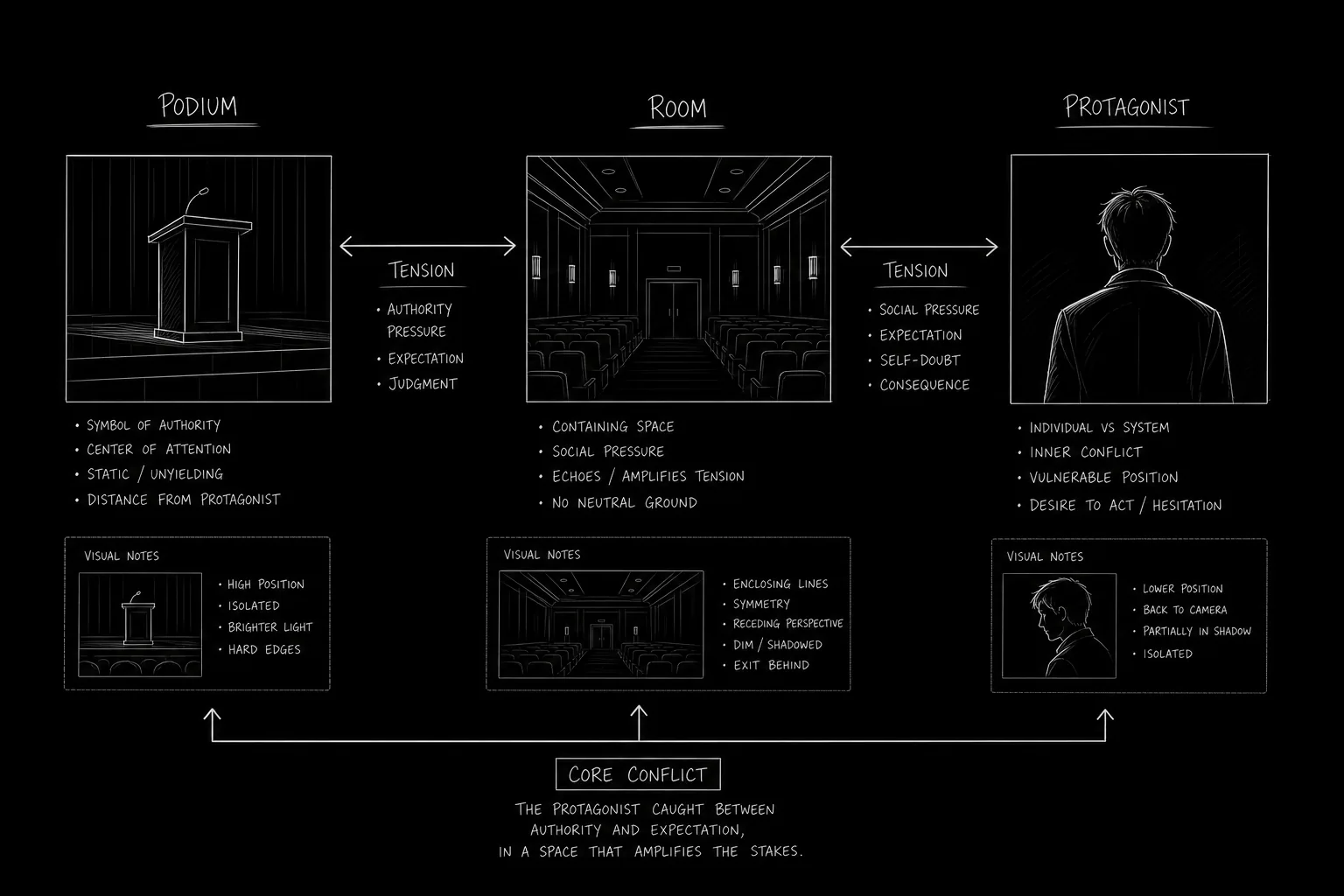
The scene works when three channels run at once:
- Podium channel - Prepared statement, deflections, reveals
- Room channel - Reporters, reactions, side conversations
- Protagonist channel - Internal goal, whether to act or stay silent
A press conference is theater with legal and career consequences.
For courtroom speech craft, see writing the big speech in courtroom dramas. For public humiliation beats, see writing public humiliation scenes. For interrogation power dynamics that mirror Q&A aggression, see interrogation scene power dynamics.
Platform and Use-Case Sections
Political Thriller
Engine: Leaks, denials, document drops. The podium is a battlefield.
Key beat: A reporter asks the one question the institution rehearsed against - and still fails.
Legal / Crime Drama
Engine: Case updates, plea announcements, victim family statements.
Key beat: Evidence shown to press before detectives were ready. Chain of custody drama.
Corporate Scandal
Engine: CEO apology, stock ticker in background, shareholder distrust.
Key beat: Protagonist whistleblower in audience, deciding whether to stand.
Disaster / Emergency Response
Engine: Official reassurance vs. visible contradiction (smoke on horizon, conflicting numbers).
Key beat: Casualty count revision live on air.
Character-Driven Indie Drama
Engine: Small local press room. Stakes personal, not global.
Key beat: One question from a friend that destroys a relationship publicly.
Step-by-Step: Building the Scene
Step 1 - Define the institution's goal. What message must leave the room? Write the prepared statement in full, even if only fragments appear on screen.
Step 2 - Define the protagonist's goal. Expose, survive, rescue someone, escape notice. One verb.
Step 3 - Map the reporters. Name three to five with distinct outlets and angles. Sports reporter accidentally asking a sharp question is gold.
Step 4 - Open on texture before dialogue. Strobes, sound checks, aides whispering, empty chair before official arrives. Tension is pre-loaded.
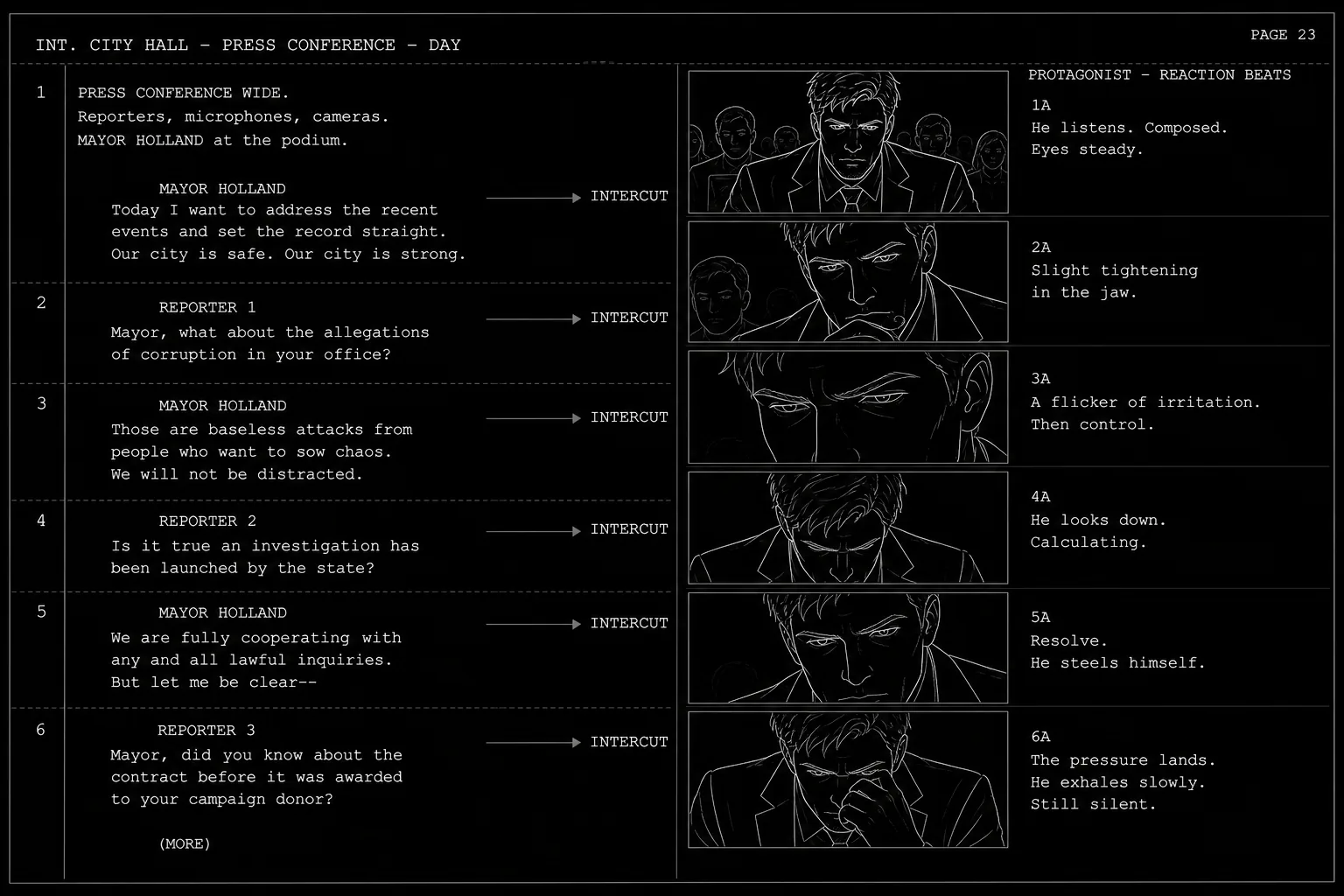
Step 5 - Run the statement in beats. Do not dump two pages of monologue. Break every four lines with reaction shots, camera cues, or a raised hand.
Step 6 - Plant the turning question. A reporter asks. The official deflects. A follow-up lands. Or your protagonist stands.
Step 7 - End on irreversible public consequence. A walkout. A live arrest. A document projected on screen. The story cannot return to pre-conference normal.
[YOUTUBE VIDEO: Press conference scene breakdown showing podium, room, and protagonist channels edited in rhythm with script annotations.]
Operational Section: Formatting and Production Details
Scene Heading and Setup
INT. CITY HALL PRESS ROOM - DAY

Packed. CAMERAS on tripods. LOCAL and NATIONAL press.
A podium with six microphones. AIDE arranges water glasses.
Speaker Labels
| Role | Label example |
|---|---|
| Official | POLICE CHIEF or MAYOR HAYES |
| Reporter | REPORTER 1, REPORTER - GLOBE, SARAH (REPORTER) |
| Aide | PRESS SECRETARY |
| Protagonist | Character name when speaking |
Questions and Cross-Talk
Format reporter questions as dialogue blocks. Indicate overlapping chaos sparingly:
REPORTER 2
You knew about the leak last Tuesday. Why say nothing?

PRESS SECRETARY
We'll take one more question.

REPORTER 3
That's not an answer.
Visual and Audio Cues
STROBES pop.LIVE FEED graphic in corner.(Note for production.)MURMURS rise.Phones tilt for vertical stream.
Length
Effective press conference scenes in specs run one and a half to three pages. Longer only if multiple reversals earn the space.
Budget Reality
One location. Many extras. Sound design carries scale. Write intimacy (faces, hands on mics) when budget is tight.
Sample Sequence: The Walk-Back
Use this rhythm as a template. Adjust genre, but keep the turns.
INT. FEDERAL BUILDING PRESS ROOM - DAY

Fifty REPORTERS. CAMERAS. The INSPECTOR GENERAL approaches the mic.

INSPECTOR GENERAL
This morning we received credible evidence of fraud
within the relief program. An arrest is imminent.

REPORTER - TRIBUNE
Can you name the official under investigation?

INSPECTOR GENERAL
Not at this time.

REPORTER - TRIBUNE
Sources say it's Deputy Director Hale. Yes or no?

Silence. Aides exchange glances.

INSPECTOR GENERAL
No further questions.

REPORTER 4
You opened with "imminent." Either you have a name or you don't.

MURMURS. Phones rise higher.

In the third row, LENA slips a flash drive into her pocket.
She stands. Every camera swings.

LENA
I have the ledger. Right here.

The room detonates.
Three channels active: podium deflection, room aggression, protagonist action. The scene ends on public irreversibility.
Pacing the Q&A Wave
Strong press conferences rise in waves, not straight lines. Wave one: prepared statement. Wave two: polite questions. Wave three: teeth. Wave four: your turn or catastrophe. Map waves on a beat sheet before you draft dialogue so the scene accelerates instead of flattening.
Try it free
Try Screenweaver for free on your script
It is free. Import your existing project, get a clearer view of your outline, and regain control of your story structure in minutes.
Start FreeOutcome Section: What the Scene Must Deliver
Plot movement. New fact public, new lie exposed, new mission for protagonist.
Character revelation. Who cracks under questions? Who performs calm?
Spectacle of democracy or institution. Audience feels the weight of public narrative.
Failure modes:
- Official reads three pages; no interruptions
- All reporters sound identical
- Protagonist passive observer only
- Scene repeats information from prior scenes
Success test: Could this scene be replaced by a TV news clip watched at home? If yes, you have not used the room. Put your protagonist in physical jeopardy or moral choice in the space.
Why It Matters: Old Way vs. New Way
The old way: Press conferences were exposition dumps. Officials lectured. Reporters clapped. Protagonists watched TV summaries later.
The new way: Writers choreograph public set pieces with the precision of action sequences. Livestreams, phone vertical video, and social clip cycles mean the press room extends onto the internet before the scene ends. Format for multi-channel consequence.
Audiences understand spin. They crave scenes where spin fails in public. Give them the failure with structure, not speech volume.
The best press conference scenes linger because they change what the public record says. Someone lied on camera. Someone told a partial truth that cannot be walked back. Write with that permanence in mind and your room will feel as dangerous as any alley chase.
Final CTA: Put Your Protagonist in the Room
Do not write the press conference from the podium alone. Write it from the room. Give reporters teeth. Give your hero a goal that cannot wait until the car ride home.
Open the scene on strobes and silence. Close it on something the cameras already captured.
The microphone is live. The lie is ready. Write the question that burns it down.
Final Step
Build your next script with Screenweaver
Move from ideas to production-ready pages faster with timeline-native writing and AI-assisted story flow.
Try Screenweaver