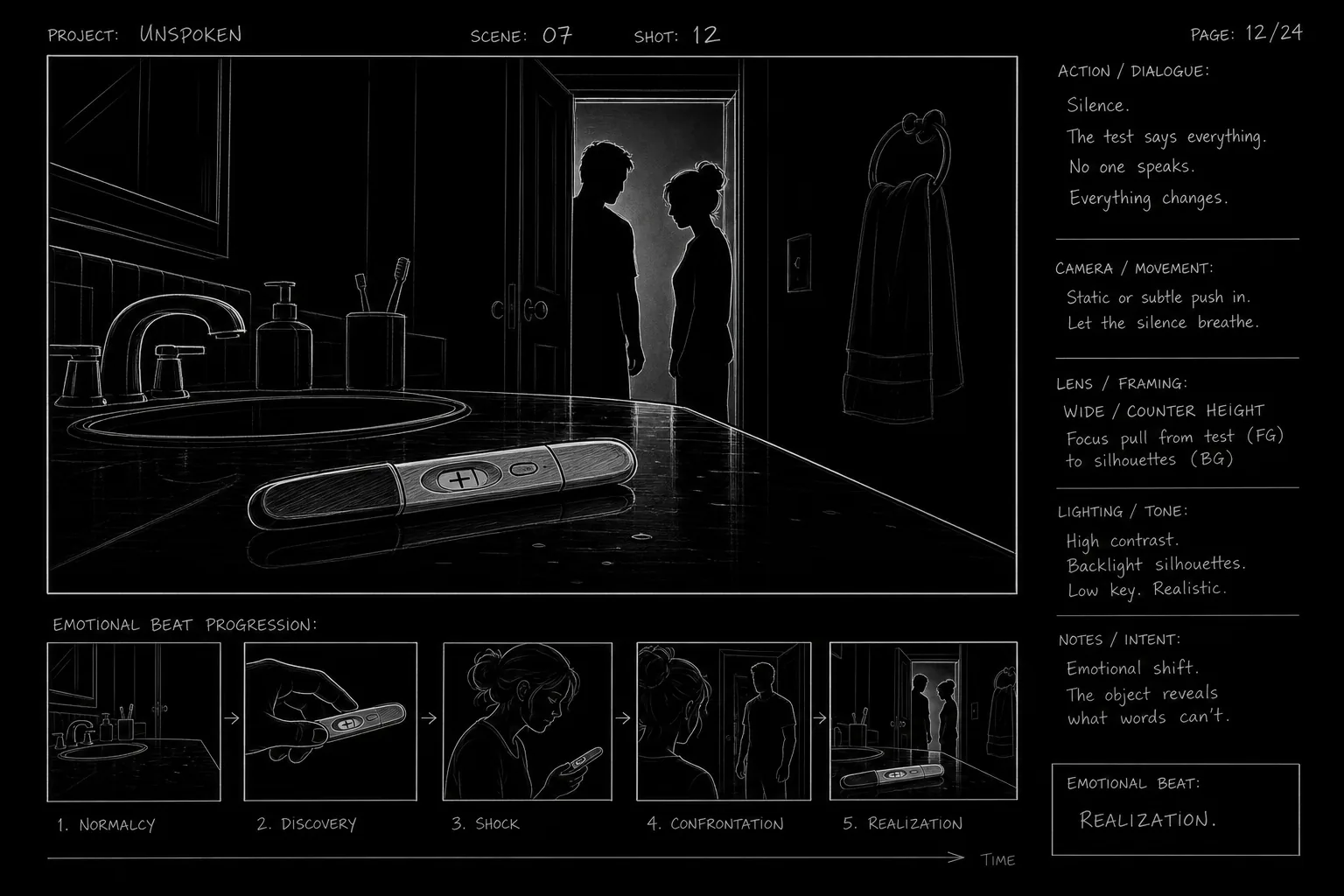

She stares at the stick. Two lines. He reads her face before he sees the plastic. Neither speaks the word pregnant for a full minute - because in this story, the word is not news. It is a threat, a miracle, a lawsuit, or a door they swore they would not open again.
Pregnancy reveal scenes are staples of drama, comedy, thriller, and family saga. They fail when treated as automatic applause beats - hugging, swelling score, end of scene. Real reveals carry history, stakes, and silence.
This guide covers how to structure a pregnancy reveal for character truth, how to format medical and domestic details on the page, and when restraint outperforms exposition.
How It Works: The Reveal Is Never Only Medical
A pregnancy reveal is a status change scene. Someone learns or admits that a life is underway. The drama comes from what that fact does to relationships and plans already in motion.
Four common reveal engines:
- Joy under threat - Wanted pregnancy, dangerous circumstances
- Unwanted surprise - Plans collapse, identity shifts
- Strategic disclosure - Reveal as weapon, bargain, or alibi
- Ambiguous or loss-adjacent - Positive test after loss, IVF exhaustion, ectopic risk foreshadowed (handle with care)
The scene needs a before state and after state for at least one character. Without that arc, you have announcement, not story.
The test is prop. The reaction is plot.
For hospital tension scenes that may follow complications, see writing hospital waiting room scenes. For silence and nonverbal beats, see writing silence in screenplays. For before/after status changes without dialogue, see before and after scenes.
Platform and Use-Case Sections
Domestic Drama / Marriage Story
Engine: Trust, timing, careers deferred. Reveal in kitchen, bathroom, car after appointment.
Technique: Small space. Objects carry weight - test, ultrasound printout, voicemail from clinic.
Workplace Drama / Legal Thriller
Engine: Pregnancy complicates case, custody, cover-up, or statute timeline.
Technique: Reveal intersects professional stakes. "I can't fly to the deposition next month."
Teen / Family Series
Engine: Secrecy, parental discovery, economic fear.
Technique: Avoid lecture dialogue. Parents react from character flaw, not morality pamphlet.
Sci-Fi / Horror
Engine: Impossible pregnancy, accelerated gestation, parasite twist, fertility experiment.
Technique: Clarify rules early. Audience buys emotion before biology breaks.
Comedy (Underplayed)
Engine: Timing subversion, wrong person finds test, absurd misread.
Technique: Same structure as drama. Earn heart under jokes.
Step-by-Step: Building the Reveal Scene
Step 1 - Know who knows what before the scene. Only one person aware? Both suspecting? Doctor call incoming? Map information.
Step 2 - Choose the reveal vector. Home test, clinic call, ultrasound image, character vomiting then admitting, third party disclosure. Each has different intimacy.
Step 3 - Write the before beat. Routine action undercut by discovery. Making coffee. Packing for tour. Preparing speech.
Step 4 - Stage the object or information. Test on counter. Envelope marked radiology. Phone on speaker. Do not hide the mechanics.
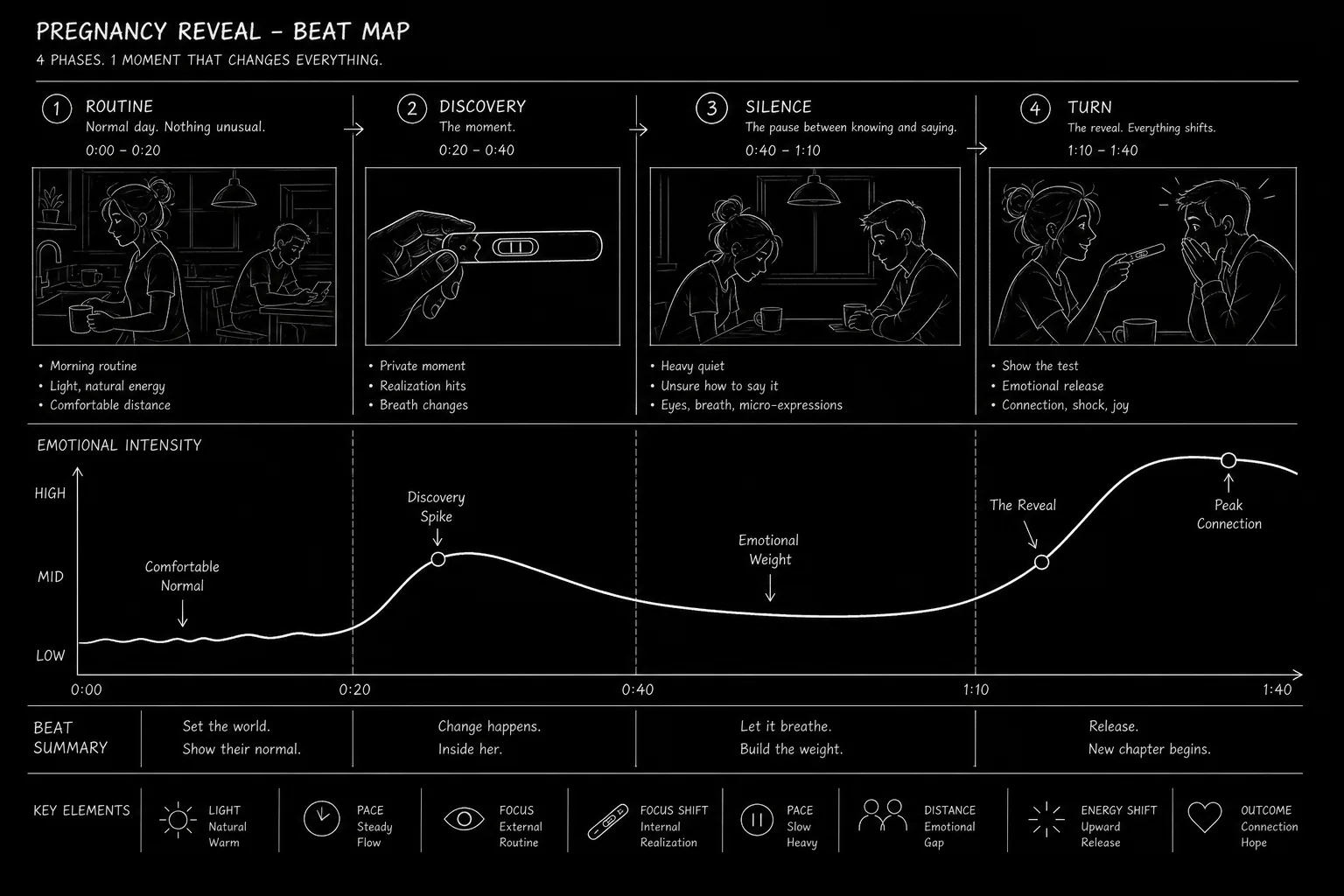
Step 5 - Delay the word. Let looks, breath, and gesture carry first wave. Dialogue arrives after silence earns it.
Step 6 - Land the relationship turn. One character steps closer; one retreats. Agreement or fracture. The scene ends on decision or unresolved tension, not on hug unless hug is complicated.
Step 7 - Track consequences in next scenes. Appointment, secrecy, lie told to third party. Reveal is inciting incident for a branch, not a button on the old story.
[YOUTUBE VIDEO: Pregnancy reveal scenes compared across drama, comedy, and thriller tones with beat maps for silence and dialogue placement.]
Operational Section: Formatting, Sensitivity, and Details
Formatting the Test or Medical Beat
INT. BATHROOM - EARLY MORNING

LEO enters. The pregnancy test sits on the sink rim,
cap beside it. Two pink lines, unmistakable.

He picks it up. Sets it down like it might detonate.
Name brands only if story-relevant or comic. Otherwise generic description.
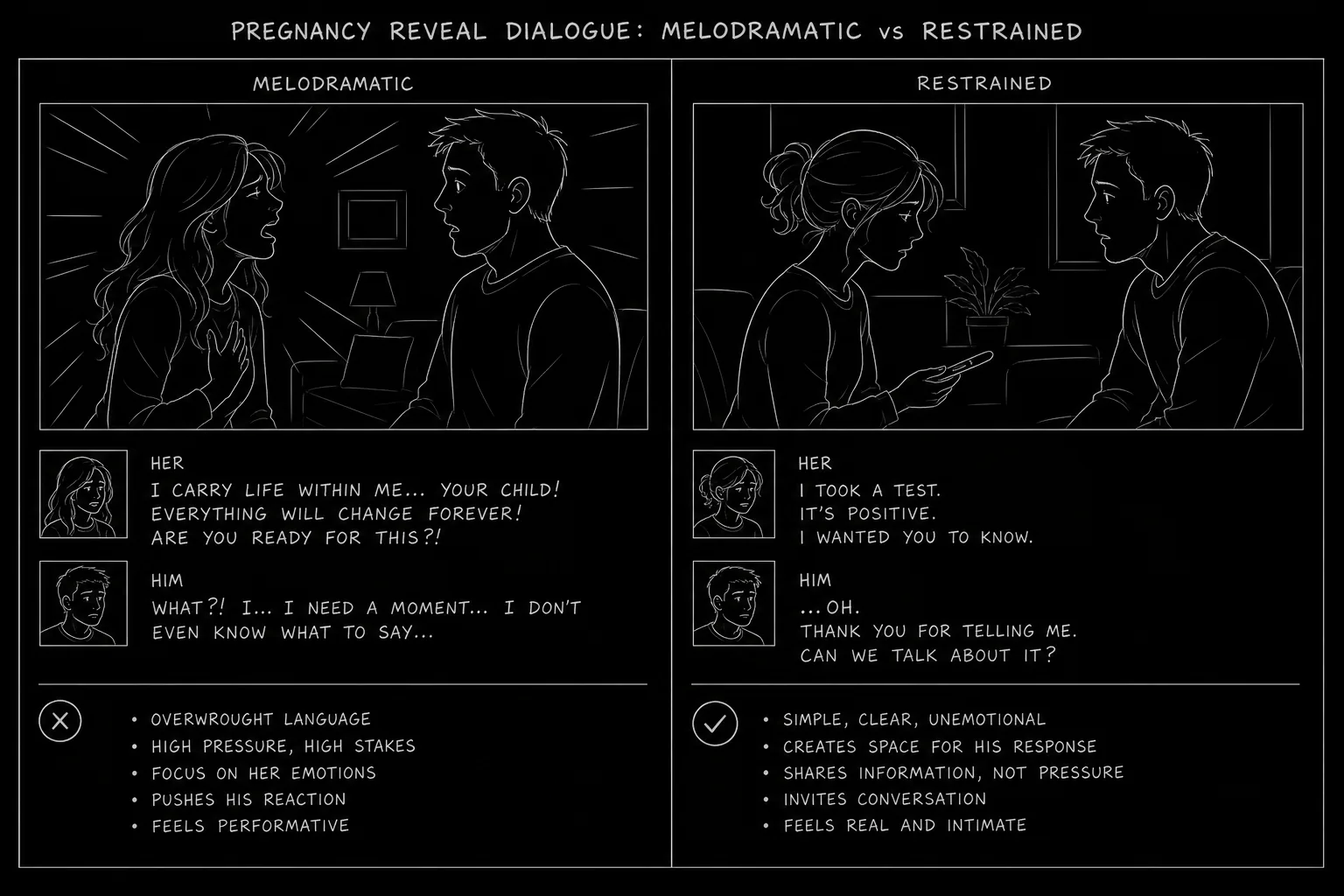
Dialogue Discipline
Avoid on-the-nose:
- Weak:
I'm pregnant and everything changes. - Strong:
The clinic called. I didn't pick up.(Audience infers; character deflects.)
Time and Trimester Clarity
If timeline matters to plot, state gestational age once clearly - through dialogue, super, or action (Ultrasound printout: 12 weeks).
Sensitivity Notes
- Pregnancy loss, infertility, and termination adjacent stories deserve research and specificity. Avoid miracle cure tropes.
- Do not use pregnancy only as twist without character interiority.
- Consider who in your writers' room voices experience.
Legal / Thriller Plotting
Paternity, inheritance, citizenship, witness protection - pregnancy reveal may trigger procedural scenes. Follow with concrete next action, not only shock.
Sample Scene: The Negative Space Reveal
INT. APARTMENT - NIGHT

Dinner cooling on the table. ELLA stares at her plate.
MARCUS checks his watch.

MARCUS
You're not eating.

ELLA
I saw the appointment on your calendar.

MARCUS
The follow-up. I can reschedule.

ELLA
Don't.

She slides an envelope across the table. Ultrasound printout
visible through the thin paper window.

MARCUS
How far along?

ELLA
Ten weeks. I found out the day you took the Singapore offer.

He closes his eyes. Not joy. Inventory.

MARCUS
You should have told me before I signed.

ELLA
You should have told me you were signing.

Neither touches the food. The reveal is not the lines.
It's who retreats first. Marcus stands. Picks up his keys.

MARCUS
I need air.

ELLA
That's becoming your answer to everything.

Door closes. Ella alone with the printout and the cooling meal.
The scene ends on fracture, not celebration. The audience knows the next act must address custody of truth, not nursery paint.
Variant Beats by Genre
Thriller: Reveal pairs with deadline. "Due date lands the same week the trial starts."
Comedy: Wrong test, wrong person, right emotion. Still give characters a turn, not only a gag.
Ensemble TV: Reveal in B-story with ripple to A-story. Another character overhears partial information - plant misunderstanding for episode engine.
Try it free
Try Screenweaver for free on your script
It is free. Import your existing project, get a clearer view of your outline, and regain control of your story structure in minutes.
Start FreeOutcome Section: What the Scene Should Achieve
Character truth. We believe these two people in this room.
Plot branch. New goal, secret, or obstacle appears.
Emotional residue. Audience carries feeling into next scene.
Failure modes:
- Instant celebration without complication
- Both characters articulate theme in dialogue
- Test discovery by accident with no prior story pressure
- Reveal undone next episode without consequence (TV cheat)
Success test: describe protagonist's goal before scene and after scene in one sentence each. If the sentence changed, the reveal worked.
Why It Matters: Old Way vs. New Way
The old way: Pregnancy reveal was a genre checkbox. Positive test, tears, montage, done. Women served as plot devices. Medical details fuzzy.
The new way: Drama treats reproduction as lived experience with economic, medical, and relational specificity. Writers use silence and nonverbal beats before dialogue. Scenes connect to before/after status architecture across the script.
Audiences are savvy. They have seen the stick a hundred times. They have not seen your characters hold it.
Write the people, not the prop. The stick only starts the scene.
Final CTA: Write the Silence First
Open your reveal scene. Write everything that happens before anyone says pregnant. Stage the object. Let the room contract.
Then write one line that changes the relationship - not explains the theme.
The audience knows what two lines mean. Your job is to show what they cost.
Write the reveal. Make it irreversible. Move the story forward on the next page.
Final Step
Build your next script with Screenweaver
Move from ideas to production-ready pages faster with timeline-native writing and AI-assisted story flow.
Try Screenweaver