
Writing the "Big Speech": Courtroom Dramas
The room goes quiet. Counsel stands. The jury watches. One person has the floor, and for the next few minutes everything hangs on what they say and how they say it.
That’s the promise of the courtroom drama. It’s also where a lot of scripts collapse.
Writers treat the closing argument or the key cross-examination like a TED talk. They load it with theme, rhetoric, and moral weight. They forget that in a real trial, and in a good courtroom movie, the speech doesn’t exist in a vacuum. It’s the payoff of evidence, strategy, and character. If you haven’t earned it, the big moment feels like a sermon dropped from the sky.
Here’s how to write the big speech so it lands like a verdict, not a lecture.
The Speech Is Never the Climax
This is the first thing to internalize.
The climax of a courtroom drama is not the speech. It’s the verdict. Or the moment the verdict becomes inevitable. Or the moment a key witness breaks, or evidence is excluded, or the lawyer chooses not to give the speech at all.
The speech is the engine that drives toward that climax. It’s the last push. It doesn’t replace the need for stakes, structure, and setup.
Think about it this way: if you could cut the closing argument and the story would still make sense, you’ve written a detour. If the speech is the only place where the themes finally “click,” you’ve hidden your thesis in a monologue instead of baking it into the plot.
The best courtroom speeches feel inevitable because the story has been building to them for ninety minutes. The worst feel like the writer finally remembered what the movie was supposed to be about.
So before you type a single line of the big address, ask: what has the jury (and the audience) already seen and heard that this speech will reframe? What evidence, what testimony, what character beat does the speech crystallize? If you can’t list three concrete payoffs, the speech isn’t ready.
What the Courtroom Actually Is
A trial is a ritual. There are rules. There are roles. There’s a rhythm: opening statements, case-in-chief, cross, rebuttal, closing. If you ignore that rhythm, you might still write something entertaining, but it won’t feel like a courtroom.
You don’t need a law degree. You need enough research to avoid howlers (objections that make no sense, procedures that don’t exist, verdicts that couldn’t happen in that court) and enough respect for the form to use it.
A few basics that shape how you write:
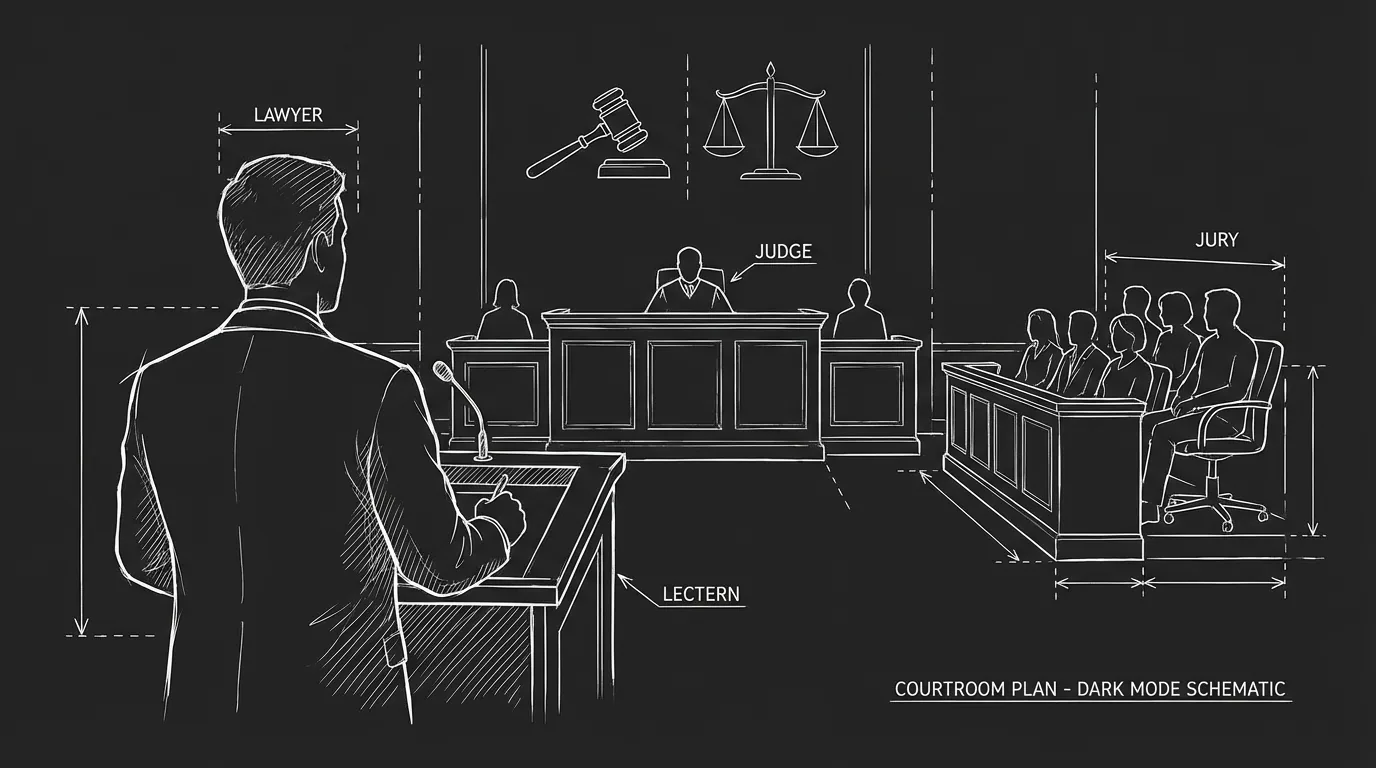
The burden of proof. In a criminal trial, the prosecution must prove guilt beyond a reasonable doubt. The defense doesn’t have to prove innocence; it has to create doubt. That asymmetry drives strategy. Your prosecutor’s speech has to close the gaps. Your defense speech has to open them.
The jury. They’re not experts. They’re ordinary people who’ve been sitting there for days or weeks. They’re tired. They’re confused. They want to go home. A great closing argument doesn’t show off. It simplifies. It tells a story they can hold in their hands.
The judge. They control the room. They can sustain or overrule. They can cut a lawyer off, warn them, hold them in contempt. If your script never lets the judge matter, you’ve flattened the world.
The record. Everything is on the record. Lawyers can’t just say whatever they want. They’re limited by what was entered into evidence, what witnesses said, what was objected to and sustained. Your big speech has to feel like it’s working within those constraints, referencing exhibits, quoting testimony, building from what the jury has already seen.
Once you treat the courtroom as a system with rules, your speeches stop floating. They become moves inside a game.
Scenario 1: The Writer Who Leads With the Speech
Jesse has a killer idea for a closing argument. They’ve written it first. It’s passionate, poetic, full of rhetorical questions and parallel structure. It’s the heart of the movie.
Then they try to build the trial around it.
They retrofit scenes: a witness who says the right thing so the lawyer can quote them later; evidence that exists only to be referenced in the closing. The plot becomes a delivery system for the speech instead of the speech being the culmination of the plot.
When they send the script out, readers say the trial feels contrived. The speech itself might be good on the page, but it has nothing to land on. The jury might as well be mannequins.
The fix is to reverse the order.
Start with the verdict you want (or the moment of decision). Then ask: what would have to be true in this courtroom for that verdict to feel earned? What evidence? What testimony? What surprises? Build the trial first. Let the closing argument emerge as the synthesis of everything we’ve seen, the story the lawyer tells the jury to make sense of it all.
The speech should feel like the only possible conclusion. Not the only possible scripted moment.
Scenario 2: The Speech That Explains the Theme
Maria’s script is about corruption in a small town. The trial is the crucible. Her defense attorney is noble, overmatched, and finally gets to “say what the movie is about” in the closing argument.
She writes a beautiful speech. Justice. Truth. The little guy. She’s proud of it.
In feedback, someone says: “We already knew that. Why are we being told again?”
She’s committed the classic error: using the speech to state the theme instead of proving it through the mechanics of the case.
The jury (and the audience) should have been living the theme through the evidence and the witnesses. The closing argument’s job is to name what they’ve already felt, to sharpen it, not to introduce it. If the theme isn’t clear until the speech, you’ve under-written the trial. If the speech just repeats what we already know, you’ve over-written the speech.
The test: could you cut the last two minutes of the closing and still have the audience know what the movie believes? If yes, those two minutes are redundant. Trim them or replace them with something that only the lawyer could say after this specific trial.
The Anatomy of a Closing Argument (That Works on Screen)
Real closing arguments can be long, dry, and procedural. Screenplay closings are compressed and shaped. You’re not transcribing a real trial; you’re giving us the feel of one while keeping the story moving.
A useful skeleton:
Hook. One line or image that grabs the jury, and the audience. Often a question, a stark contrast, or a single fact that reframes everything. Not “Ladies and gentlemen, today we have seen…” Something that forces attention.
Narrative. The lawyer tells the story of the case. Not a list of evidence. A story: cause and effect, motive and opportunity, what we know and what we can infer. The jury thinks in stories. So does the audience. Structure the speech as a mini-movie: setup, complication, resolution.
Evidence callbacks. The speech doesn’t introduce new facts. It reminds the jury of what they’ve already seen. “Remember when the witness said…” “Look at Exhibit 12 again.” “You heard the defendant’s own words.” Each callback should feel like a brick being laid. By the end, the wall is obvious.
The ask. What does the lawyer want? Acquittal. Guilty. A specific finding. The speech should build to a clear request. Not vague “do the right thing” but “find my client not guilty” or “hold this man accountable.” Clarity of ask = clarity of stakes.
The button. The last line. Often short. Often visual or emotional rather than logical. It’s what we’re left with when the lawyer sits down. It should land like a period, not a comma.
You don’t have to label these sections in the script. But if you draft with this shape in mind, the speech will feel like an argument instead of a rant.
| Element | Purpose | Pitfall to avoid |
|---|---|---|
| Hook | Lock attention, set frame | Generic “Ladies and gentlemen…” |
| Narrative | Give jury a story to believe | Listing evidence instead of weaving it |
| Evidence callbacks | Ground speech in the trial | Introducing new facts (not allowed) |
| The ask | Make the verdict feel like a choice | Vague moralizing |
| Button | Leave a lasting impression | Over-explaining or trailing off |
Try it free
Try Screenweaver for free on your script
It is free. Import your existing project, get a clearer view of your outline, and regain control of your story structure in minutes.
Start FreeGranular Workflow: Building the Speech From the Trial Out
Step 1: List every piece of evidence and testimony that will matter to the verdict. Bullet points are fine here, this is your cheat sheet. What did the jury see? What did they hear? What was contested?
Step 2: Decide the verdict (or the moment of decision). Is the defendant guilty or not? Does the plaintiff win? Does the lawyer lose despite the speech? The speech serves that outcome. It doesn’t create it out of nowhere.
Step 3: Write the speech in plain language first. No flourishes. Just: “Here’s what happened. Here’s what the evidence shows. Here’s what I’m asking you to do.” If that version doesn’t feel persuasive, the fancy version won’t save it.
Step 4: Add the callbacks. Go through your evidence list. Which three to five moments does the lawyer have to reference? Weave them into the plain-language draft. The jury should feel like they’re remembering, not learning.
Step 5: Layer in voice. Now you can add rhythm, repetition, rhetorical questions, a metaphor or two. But only where it amplifies the logic. If a line is pretty but doesn’t advance the argument, cut it.
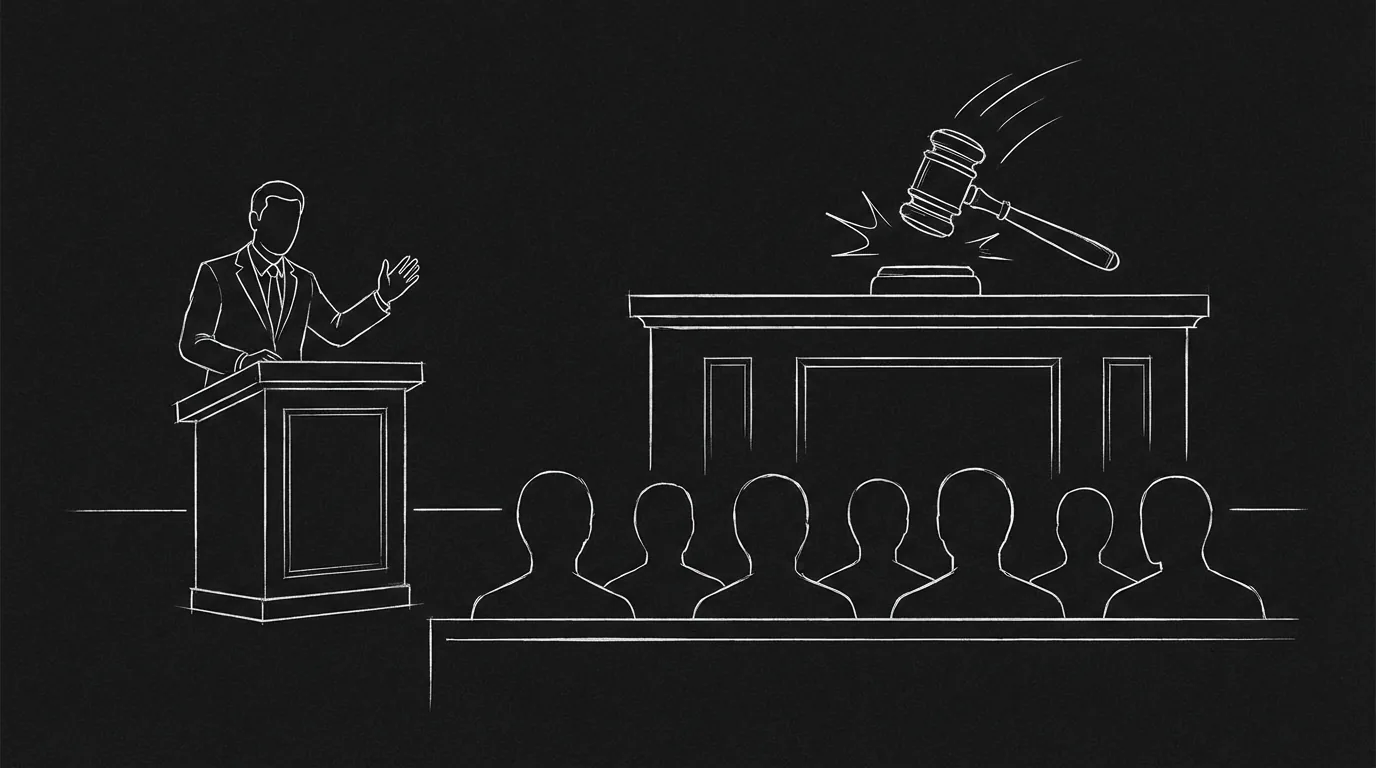
Step 6: Write the reaction. The speech isn’t over when the lawyer stops talking. How does the jury react? The judge? The client? The other side? One beat of silence. One juror’s face. One gavel. Give the speech a consequence in the room.
Cross-Examination: The Other Kind of “Speech”
Courtroom drama isn’t only closings. The most electric moments often come in cross-examination: short questions, long pauses, the witness cornered.
Cross is a kind of speech too, a controlled attack in the form of questions. The lawyer has a goal: expose a lie, establish a fact, destroy credibility. Each question is a step. The “speech” is the cumulative effect.
On the page, cross can be brutal to write. You’re balancing:
- Legal plausibility (you can’t ask leading questions in the same way on direct).
- Pacing (short questions, short answers, or the rhythm breaks).
- Revelation (the audience learns something at the same time as the jury).
A simple discipline: before you write the cross, write the destination. What is the last thing the witness says before they break, or before the lawyer turns to the jury with a look that says “See?”? Work backward from that line. Each question should push one step closer.
And remember: the lawyer’s power in cross isn’t just what they ask. It’s when they stop. The question they don’t ask. The pause that hangs. Use action lines to show the weight of silence. The speech isn’t always the words. Sometimes it’s the beat after.
Trench Warfare: What Beginners Get Wrong
Mistake 1: The speech does the work the plot didn’t.
If the case has been muddy or underwhelming, a great closing won’t fix it. The speech can clarify. It can’t substitute. Fix the trial first. Make the evidence memorable. Make the witnesses vivid. Then the speech has something to crystallize.
Mistake 2: The lawyer is a megaphone for the writer.
When the closing argument sounds like the writer’s personal manifesto, we feel the hand of the author. The lawyer should sound like a lawyer, someone who’s been in this case for months, who knows the record cold, who’s making an argument, not delivering a sermon. Give them a strategy. Give them a flaw. Give them a moment of doubt. Let the theme emerge from the character’s choices, not from a speech that could be given by anyone.
Mistake 3: No opposition.
The other side exists. They object. They have their own narrative. If the prosecution’s closing is the only voice we hear, the trial feels one-sided. Even if we’re meant to side with the defense, let the prosecution have a strong, coherent closing too. The best courtroom dramas let both sides be good at their jobs. Victory (or defeat) means more when the other side was formidable.
Mistake 4: The verdict is an afterthought.
You’ve spent pages on the speech. The lawyer sits down. We cut to the jury deliberating for thirty seconds, then the verdict. That’s a letdown. The verdict is the climax. Give it space. Show the wait. Show the room. Show the moment the foreperson stands. Show the lawyer’s face. If you’ve written the speech well, the verdict is where we feel its effect. Don’t rush it.
Mistake 5: Legalese as dialogue.
Real trials are full of “Your Honor,” “objection,” “sustained,” “approach the bench.” A little goes a long way on screen. Too much and the scene becomes a documentary. Use procedure to add texture, a sustained objection that forces the lawyer to pivot, a warning from the judge, but keep the actual dialogue accessible. The audience should understand the stakes, not the rulebook.
How This Connects to Structure and Stakes
Courtroom dramas are still three-act stories. The trial has a shape: opening, case-in-chief, cross, closing, verdict. Your script has a shape too. The inciting incident might be taking the case. The midpoint might be a key piece of evidence or a witness who changes everything. The all-is-lost might be a ruling that seems to doom the side we care about. The speech is part of the climb to the climax, often the last big push before the verdict.
If you want to go deeper on how to place a climactic beat in the overall script, our guide on [Mastering the Midpoint: How to Raise Stakes Without Breaking Your Plot] applies: the midpoint of the trial (a surprise ruling, a witness breaking) should raise the stakes so that the closing argument has more to do. And for structuring the emotional arc of your lawyer character, [Character Arcs 101: Positive, Negative, and Flat Arcs] is a useful companion, the speech can be the moment the lawyer’s arc pays off: the coward who finally stands, the showboat who finally shuts up and serves the client.
One External Reference
Real closing arguments are a rich resource. Many high-profile trials have transcripts or video available. The American Bar Association’s resources on trial practice and bar associations often publish articles on effective closings, structure, do’s and don’ts, how lawyers actually prepare. You’re not copying real speeches; you’re borrowing the logic of persuasion so your fictional speech feels grounded.
The Takeaway: The Speech Serves the Verdict
The big speech in a courtroom drama is not the movie. It’s the weapon the movie uses to reach the verdict.
Write the trial first. Plant the evidence. Build the witnesses. Give the lawyer a strategy and a flaw. Let the theme live in the choices and the evidence, not only in the oration. Then write the closing argument as the synthesis, the story the lawyer tells to make the jury see what we’ve already seen.
When the speech ends, we should feel we’ve arrived somewhere. Not because the lawyer was eloquent, but because the case demanded this conclusion, and the speech was the final, necessary step to get there.
Give the verdict its moment. Give the other side a real voice. Give the jury and the audience something to remember. Do that, and the big speech stops being a set piece and becomes the spine of the film.
Article complete. Should I proceed to the next topic: The "Training Montage" in 2026: Cliché or Classic??
Final Step
Build your next script with Screenweaver
Move from ideas to production-ready pages faster with timeline-native writing and AI-assisted story flow.
Try Screenweaver