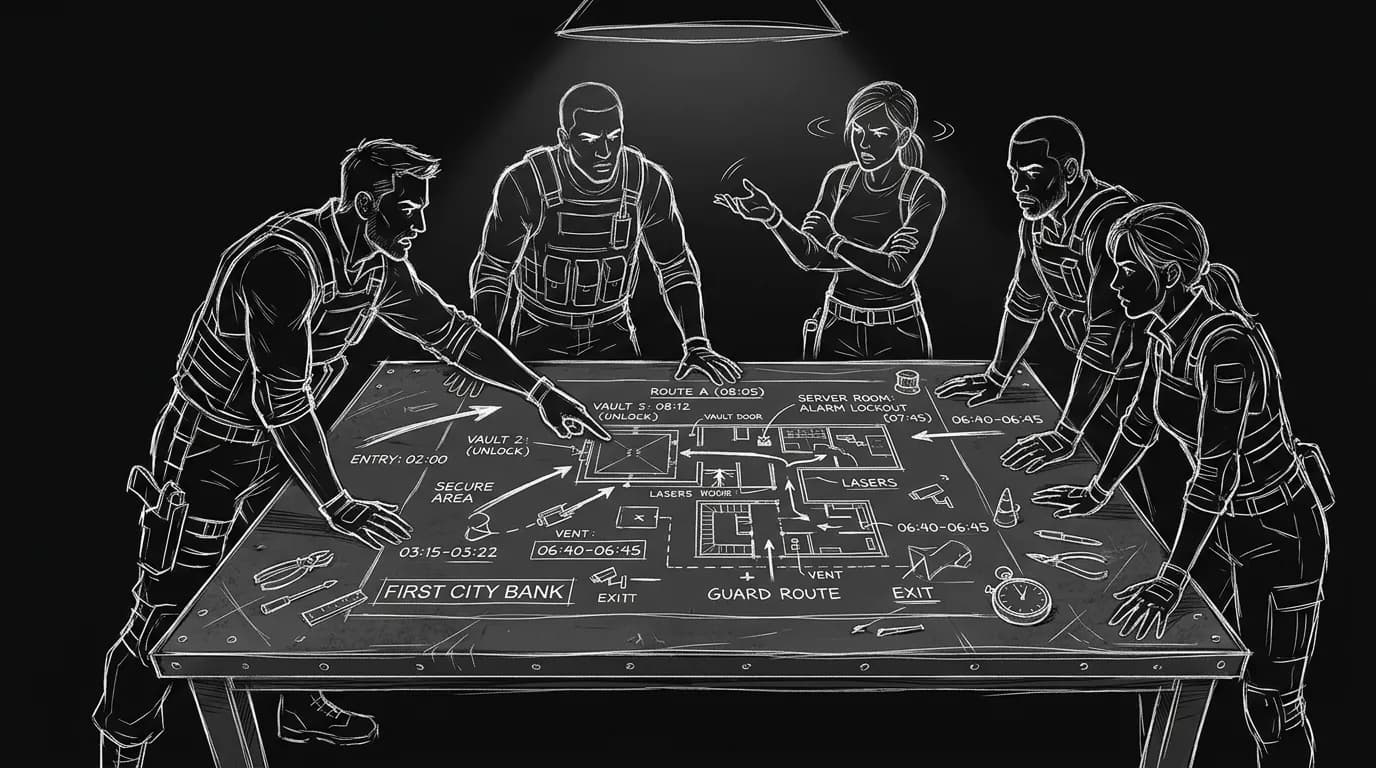

Heist planning scenes should be electric.
You have a target. A clock. A crew with mismatched motives. A system designed to resist intrusion. A plan that looks brilliant until one detail snaps and everyone realizes they are already too committed to stop.
And yet many scripts turn this into a lecture.
One character stands in front of a board and explains everything in perfect sequence while the rest of the team nods. The audience receives information, yes, but tension leaks out of the scene line by line. By the time the heist begins, the movie feels like it already happened in PowerPoint.
That is the exposure dump trap.
A great heist planning scene does not explain operation design.
It dramatizes operation design.
Here is why that matters: in heist stories, planning is conflict. Every plan choice reveals hierarchy, trust, competence, ego, desperation, and hidden agendas. If the planning scene has no friction, your heist will feel pre-solved. If it has friction without clarity, your heist will feel confusing. The art is balancing legibility and volatility.
Free tool: use the Script Time Calculator to estimate your runtime from page count.
Why Heist Planning Scenes Become Boring
Most flat planning scenes fail for one core reason: they deliver information without forcing decisions.
Writers think clarity means one uninterrupted explanation. But audiences do not engage with data by default. They engage with contested choices under risk.
Another common issue is fake complexity. Writers pile on jargon, maps, acronyms, and logistics details to appear sophisticated. This often creates cognitive fatigue instead of suspense.
Then there is the opposite problem: oversimplification. The plan sounds easy, so the heist has no dread.
Think about it this way: if your planning scene could be replaced by a narrator saying "they plan the job," you have underwritten it. If it feels like reading an operations manual, you have overwritten it.
The planning scene should make the audience understand enough to worry, not so much that they stop feeling uncertainty.
The Core Model: Goal, Constraint, Disagreement, Revision, Commitment
Strong heist planning scenes follow a functional progression.
Goal defines what success actually means.
Constraint defines why this is hard now.
Disagreement reveals conflicting methods, priorities, and risk tolerances.
Revision transforms abstract plan into adaptive strategy.
Commitment is the moment where characters cross the line from discussing to doing.
If you skip Disagreement, planning is sterile.
If you skip Revision, planning is static.
If you skip Commitment, planning has no narrative weight.
Scenario One: The "Mastermind Monologue" Failure
Beginner version: mastermind explains the entire operation in one long speech, complete with timing, routes, personnel roles, contingency plans, and emotional stakes.
It sounds impressive.
It plays dead.
A better version breaks explanation into conflict beats.
Mastermind outlines initial approach.
Specialist challenges one assumption.
Driver rejects timing window as unrealistic.
Inside contact reveals late-breaking security update.
Plan mutates under pressure.
Now information arrives through contested agency, not monologue.
Scenario Two: The Crew Assembly Scene with Zero Tactical Meaning
Many scripts treat planning scenes as personality showcase only. Fun banter, role introductions, style, swagger. Entertaining for a minute, then hollow.
Personality matters, but planning must expose capability and liability in operational terms.
Who improvises well?
Who cannot handle changing instructions?
Who is brilliant but untrustworthy?
Who has leverage over whom?
When banter reveals tactical reality, scene becomes useful and vivid.
Scenario Three: The Over-Explained Plan That Kills Heist Tension
Some writers fear audience confusion and explain every move upfront. Then the heist execution has no discovery value.
A stronger approach is selective disclosure.
Make audience understand mission objective, key constraints, and critical dependencies.
Hold back one or two elements that can be revealed in execution for momentum.
This keeps comprehension high while preserving suspense.
Step-by-Step Workflow for Writing a Planning Scene That Moves
Step 1: Define Mission in One Sentence
Before writing any board diagram dialogue, define mission with precision:
who takes what,
from where,
by when,
at what acceptable cost.
If this sentence is vague, every subsequent detail will drift.
Step 2: Establish Three Non-Negotiable Constraints
Great heists are shaped by constraints, not cool ideas.
Pick three hard constraints:
time window,
access barrier,
human variable.
Now every plan proposal must survive those constraints.
Step 3: Assign Risk Philosophy to Each Key Character
Not everyone on a crew views risk the same way.
One prefers precision.
One prefers speed.
One prefers redundancy.
One prefers improvisation.
Encode this into dialogue and choices. Risk philosophy conflict generates scene energy.
Step 4: Turn Exposition into Questions and Challenges
Whenever one character explains a step, another should test it.
"What if door two is staffed?"
"What if signal drops?"
"What if patrol shifts early?"
Challenge-response rhythm keeps the scene active and clarifies plan through stress-testing.
Step 5: Use Visual Anchors Without Over-Directing
Map, tablet, blueprint, model, floor plan, schedule printout, live camera feed. These tools help audience orientation.
Use them selectively.
Do not drown scene in object choreography.
A few clear anchors are enough.
Step 6: Write One Plan Failure Inside the Planning Scene
Before execution, force a micro-failure.
Simulation reveals timing gap.
Code brute-force test fails.
Inside source retracts access promise.
This failure requires revision and proves stakes are real.
Step 7: End on Irreversible Commitment
Scene should end when crew can no longer pretend this is hypothetical.
Cash advance paid.
Fake badges activated.
Phones destroyed.
Alibi calls scheduled.
Vehicle moved to staging point.
This commitment beat turns planning into plot propulsion.
Table: Exposition Dump Planning vs Dramatic Planning
| Dimension | Exposition Dump Version | Dramatic Planning Version |
|---|---|---|
| Information delivery | Single long explanation | Distributed through challenge-response |
| Character role | Passive listeners | Active testers and veto players |
| Tension source | "Will plan work?" only | Internal disagreement + external constraints |
| Clarity | Overloaded or vague | Selective and functional |
| Adaptation | None, fixed plan | Revision under pressure |
| Scene ending | "Any questions?" | Irreversible operational commitment |
The Trench Warfare Section: What Beginners Get Wrong (and How to Fix It)
This is where planning scenes usually improve quickly.
Mistake one: plan speech with no interruptions.
Fix by inserting challenge beats every few lines and forcing tactical response.
Mistake two: unclear objective.
Crew debates methods before mission is defined. Fix by anchoring scene with precise win condition first.
Mistake three: too many steps narrated.
Writers explain every micro-action. Fix by emphasizing only high-risk dependencies.
Mistake four: no internal conflict.
Everyone agrees too easily. Fix by assigning risk philosophies and conflicting incentives.
Mistake five: cartoon specialist intros.
Each crew member enters with gimmick but no operational role. Fix by tying personality to tactical contribution and failure mode.
Mistake six: no contingency thinking.
Plan assumes perfect world. Fix by introducing at least one branch decision.
Mistake seven: jargon fog.
Too much technical language reduces clarity. Fix by using plain speech around key technical anchors.
Mistake eight: no trust tension.
Past betrayals and side deals ignored. Fix by embedding trust checks in planning decisions.
Mistake nine: no timeline pressure.
Scene feels timeless. Fix with hard clock and deadline consequences.
Mistake ten: static location usage.
Boardroom style with no dynamic movement. Fix with physical interactions that alter control of information.
Mistake eleven: no stakes for failure.
Crew says "this is risky" but costs are vague. Fix with explicit consequence ladder.
Mistake twelve: plan appears flawless.
Perfect plans kill suspense. Fix by demonstrating known weak point before execution.
Mistake thirteen: one-note tone.
All scene is serious or all scene is banter. Fix with tonal modulation: tension, brief release, renewed pressure.
Mistake fourteen: no outside pressure intrusion.
Scene insulated from world. Fix with one external development mid-plan.
Mistake fifteen: no emotional agenda.
Characters discuss only logistics. Fix by linking plan choices to personal motives and fears.
Mistake sixteen: audience cannot track geography.
Fix by adding one concise orientation beat and consistent location labels.
Mistake seventeen: overusing "this is impossible."
Fake resistance without specifics. Fix with concrete obstacles and measurable feasibility.
Mistake eighteen: no escalation within scene.
Plan starts and ends same complexity level. Fix by increasing cost or reducing options as scene progresses.
Mistake nineteen: no commitment threshold.
Scene ends before point-of-no-return. Fix by adding irreversible prep action.
Mistake twenty: execution ignores planning seeds.
Heist scene forgets planning setup. Fix by ensuring planned dependencies reappear under stress.
A planning scene earns excitement when strategy is contested, revised, and paid for before the first door opens.
Try it free
Try Screenweaver for free on your script
It is free. Import your existing project, get a clearer view of your outline, and regain control of your story structure in minutes.
Start FreeBody Image: Heist Planning Conflict Grid

Practical 55-Minute Rewrite Drill
Take your current planning scene and run this pass.
First ten minutes: mark every line that only explains without pressure. Cut or convert.
Next ten minutes: define one challenge beat for each key plan phase.
Next ten minutes: add one internal disagreement that forces plan revision.
Next ten minutes: insert one external pressure update that narrows options.
Next ten minutes: rewrite ending to include irreversible commitment act.
Final five minutes: verify that audience understands objective and fears failure.
This process usually transforms static explanation into active strategy drama.
Advanced Calibration: What to Hide, What to Reveal
A major craft decision in heist planning is information choreography.
Reveal too little and execution is confusing.
Reveal too much and execution is predictable.
A useful rule: reveal objectives, constraints, and mission-critical dependencies. Hide one tactical wrinkle that can surface during execution to generate surprise without cheating.
Another advanced strategy is viewpoint-bounded planning. If your POV character does not know the whole plan, the audience should not either. This can create suspense while preserving fairness if essential stakes remain clear.
For external script study, the Writers Guild Foundation Library is useful and should be treated as a nofollow external reference in publishing setup.
As discussed in our guide on [how to write a hostage negotiation scene], dialogue-heavy tension works best when every line changes leverage rather than repeats intent.
If your planning scene includes trust fractures, our framework in [how to write a betrayal reveal scene] helps stage hidden agendas and credibility collapse.
And when planning culminates in showdown dynamics, the approach in [how to write a final confrontation scene that feels earned] supports escalation into payoff.
Body Image: Planning-to-Execution Dependency Map

YouTube Placeholder
[YOUTUBE VIDEO: A scene workshop rebuilding a flat heist planning monologue into a conflict-driven planning sequence with clear constraints and point-of-no-return ending.]
Extra Deep Dive: Writing Plan Clarity Without Killing Surprise
One of the hardest balancing acts in heist writing is informational calibration.
Writers usually fall into one of two extremes.
Extreme one: explain almost nothing and rely on fast editing during execution. Result: audience confusion, not suspense.
Extreme two: explain every beat in planning. Result: execution becomes confirmation, not discovery.
The solution is layered clarity.
Layer one is strategic clarity.
Audience understands mission objective, primary obstacle, and why timing matters.
Layer two is operational clarity.
Audience understands role responsibilities and one or two key dependencies.
Layer three is withheld tactical detail.
Audience does not know one implementation wrinkle that can be revealed later for momentum.
This structure keeps execution readable while preserving narrative lift.
Another useful technique is "if-then branching dialogue."
Instead of listing linear steps, characters discuss decision branches:
if camera loop fails, then fallback route B.
if vault delay exceeds window, then abort or split.
if insider misses signal, then proceed blind or postpone.
Branching dialogue does two things at once: it delivers information and dramatizes risk philosophy differences.
You can also improve engagement by assigning ownership language.
When each role owner explains only their segment and is challenged by others, exposition becomes interpersonal conflict. Ownership naturally prevents one-character lecture mode.
Example rhythm:
Hacker owns access window.
Driver challenges timing realism.
Inside source revises staff movement assumptions.
Mastermind reframes objective around updated limits.
Now planning reads as collaborative friction.
Scenario Layering: Plan as Trust Audit
Heist planning is not only about logistics. It is a trust audit under deadline.
Who insists on full transparency?
Who withholds side information "for focus"?
Who asks no questions because they already know more than they should?
You can surface this without explicit accusations.
A single reaction to a contingency can reveal hidden knowledge.
A too-fast answer to a technical question can imply prior access.
A refusal to discuss extraction path can signal side deal.
These micro-signals create anticipation before betrayal is proven.
Practical Compression Pass for Bloated Planning Scenes
If your planning scene runs long, apply a compression pass:
Keep one line that states objective.
Keep one line per critical constraint.
Keep one disagreement exchange per major plan phase.
Keep one revision beat.
Keep one commitment beat.
Cut redundant confirmations and duplicate concerns.
This often reduces page count while increasing velocity.
Building Rewatch Value
Great heist planning scenes reward second viewing.
To create this, plant subtle but fair cues:
minor wording that foreshadows hidden motive,
casual mention of overlooked asset,
body-language mismatch during specific contingency,
timing line that later becomes crucial.
These cues should not scream "twist incoming." They should feel natural first pass and meaningful in hindsight.
When done well, the audience feels respected: surprised in the moment, satisfied afterward.
Micro-Exercise: Convert Explanation into Conflict in 12 Lines
If you need a fast training drill, take any 12-line planning passage from your draft.
Line 1 states the objective.
Line 2 states the first hard constraint.
Line 3 challenges feasibility.
Line 4 defends with a concrete dependency.
Line 5 introduces a new risk variable.
Line 6 forces role ownership.
Line 7 reveals hidden assumption.
Line 8 rejects assumption and proposes revision.
Line 9 tests revised plan against clock.
Line 10 introduces personal agenda pressure.
Line 11 commits to final branch.
Line 12 executes point-of-no-return action.
This drill retrains scene instinct away from "explain then proceed" and toward "contest then commit." Run it before major rewrites and your planning pages usually sharpen quickly.
Ending Perspective: Planning Scenes Should Feel Like Controlled Disaster
If your heist planning scene feels like exposition, do not add more jargon.
Add more decisions under pressure.
Make strategy fight with ego.
Make logistics fight with time.
Make trust fight with necessity.
Make every solved problem create a new vulnerability.
That is how planning scenes become cinematic: not by explaining a perfect plan, but by showing intelligent people argue, adapt, and commit to an imperfect plan because waiting is more dangerous than moving.
Write that tension, and your heist starts before the heist.
Final Step
Build your next script with Screenweaver
Move from ideas to production-ready pages faster with timeline-native writing and AI-assisted story flow.
Try Screenweaver