
Nightmare sequences are easy to write.
That is exactly why most of them are bad.
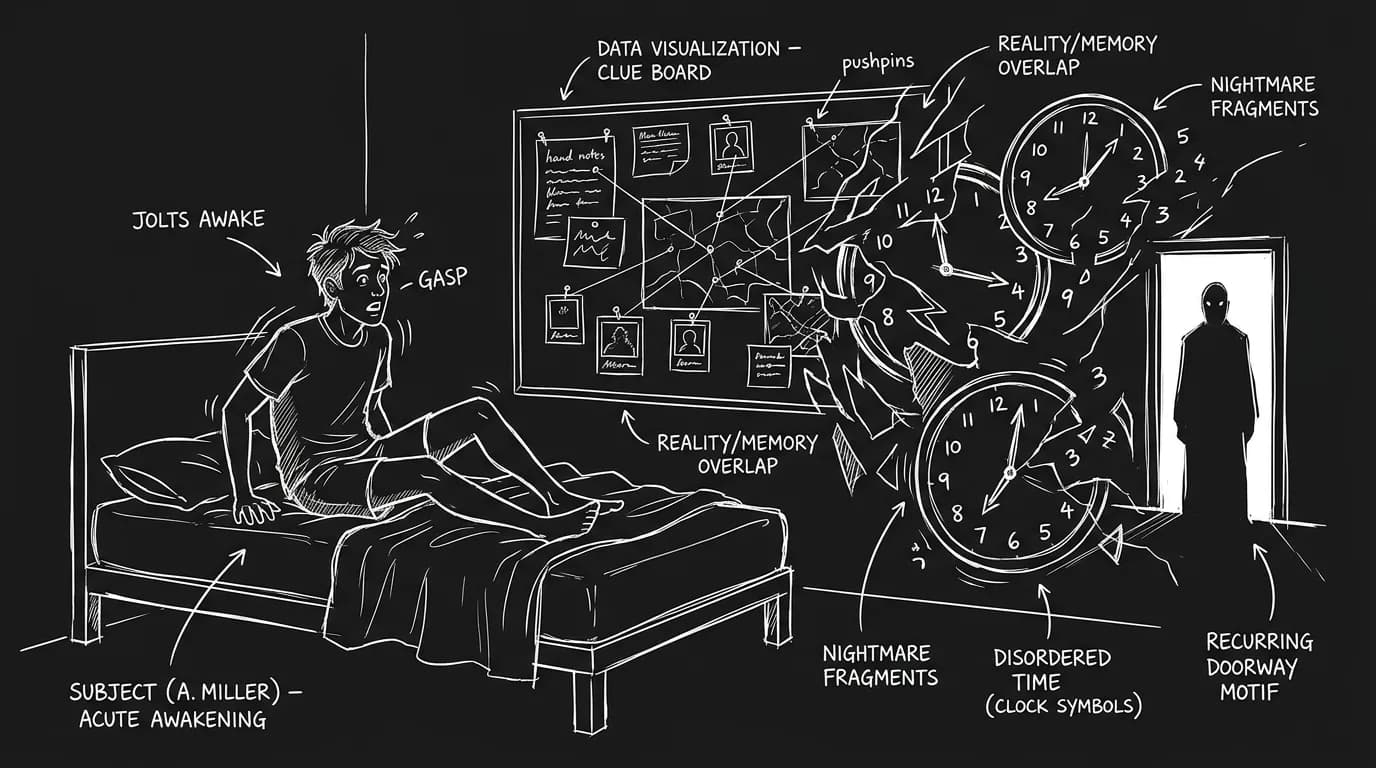
A writer wants intensity, symbolism, and psychological depth, so they drop in a dream: distorted hallway, dead relative appears, protagonist runs but cannot move, wake-up gasp, cut to morning.
You have seen this scene a hundred times.
Usually it does not matter.
That is the real issue. Not style. Not imagery. Function.
A nightmare sequence in a serious script must do narrative work. It should alter interpretation, decision-making, risk perception, or behavior. If the story can continue unchanged after removing the nightmare, the sequence is decorative.
In thrillers, horror, psychological drama, and even character-driven crime stories, nightmares can be strategic tools. They can surface suppressed pattern recognition, reveal thematic pressure, expose self-deception, or trigger actions that change the plot trajectory.
Here is why that matters: dreams are not evidence, but they can expose how a character processes evidence. That distinction is where sophisticated writing lives.
Why Nightmare Sequences Feel Cliche
Most weak nightmare scenes fail in predictable ways.
They repeat generic dream visuals with no story-specific logic. They over-explain symbolism in dialogue right after wake-up. They use nightmares as jump-scare devices rather than character engines. Or they stack surreal images without emotional progression.
Another common issue is tonal detachment. The nightmare feels like a different movie for two pages, then the script returns to normal with no residue. Readers feel manipulated.
Think about it this way: nightmare scenes are narrative debt. If you borrow attention for surrealism, you must repay it with consequence.
A nightmare that does not change what the character does next is usually a music video, not a scene.
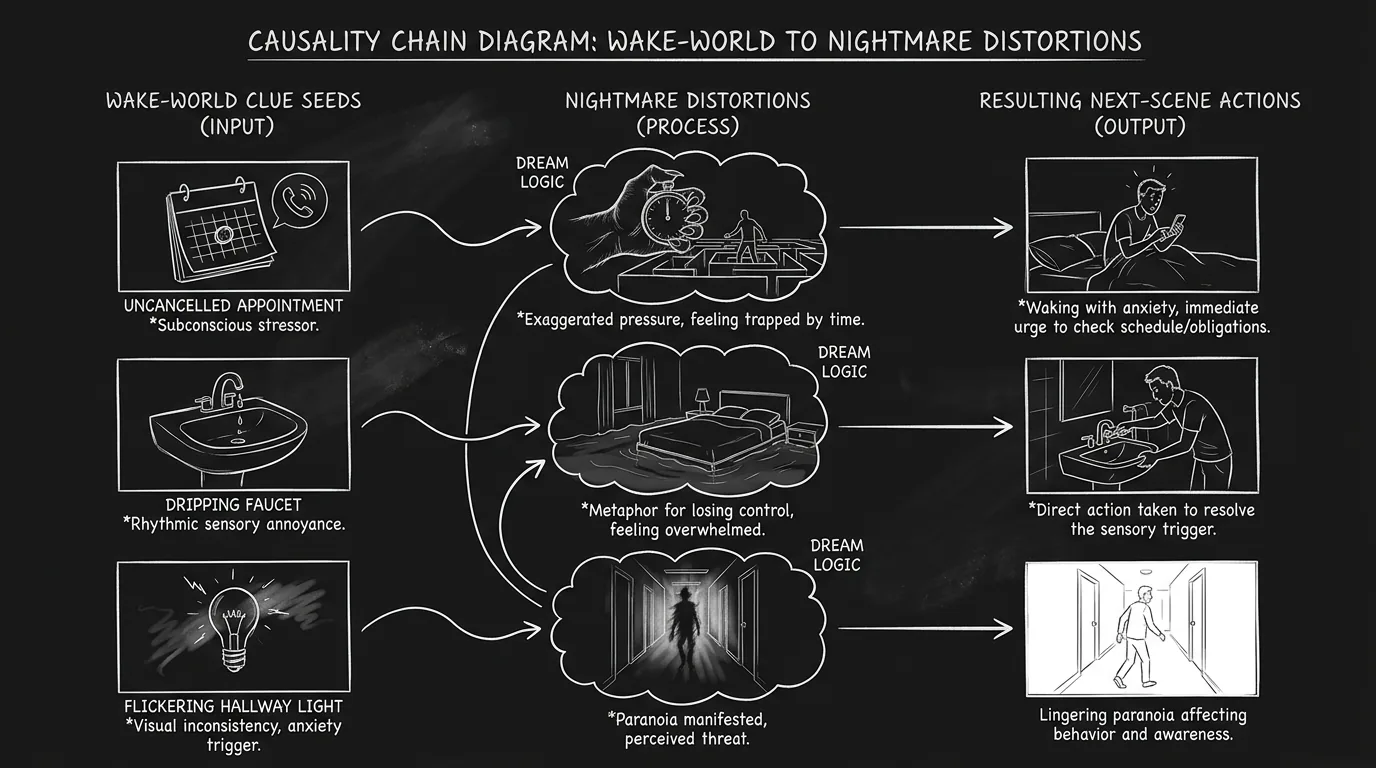
The Core Model: Seed, Distort, Reveal, Translate, Act
A plot-relevant nightmare sequence follows a functional chain.
Seed: real-world inputs are planted before sleep.
Distort: dream recombines those inputs under fear logic.
Reveal: dream highlights a pressure point the waking mind avoided.
Translate: character interprets, misinterprets, or weaponizes the dream insight.
Act: behavior changes in the next sequence.
If you skip Seed, the dream feels random.
If you skip Translate, the dream feels abstract.
If you skip Act, the dream feels pointless.
Scenario One: The Detective Nightmare That Repeats Known Facts
Beginner version: detective dreams about the crime scene exactly as seen before, wakes up sweating, says "I cannot stop thinking about this case."
Nothing new.
A stronger version uses distortion to expose overlooked linkage. The detective dreams of the victim's watch ticking backward while hearing a voicemail timestamp. The dream itself is not literal truth, but it forces the detective to recheck timeline assumptions, leading to discovery of manipulated metadata.
Now the nightmare did plot work.
Scenario Two: The Trauma Nightmare That Becomes Exposition Dump
Another common failure appears in character dramas and thrillers with backstory trauma. Character has nightmare, then explains trauma in long monologue to a side character.
This can feel mechanical.
A better approach lets nightmare trigger specific avoidance or compulsion behavior first. Maybe character refuses elevator access route and takes longer path, missing a key meeting. Maybe they over-control a routine task. Maybe they delete a message they should keep.
Backstory can come later.
Behavior first, explanation second.
Scenario Three: The Horror Nightmare That Steals Energy from Main Threat
In horror scripts, nightmare sequences can accidentally undercut core threat by flooding page with surreal imagery unrelated to monster logic.
If nightmares are disconnected from the film's threat architecture, they become tonal clutter.
To fix this, bind dream symbols to actual threat mechanics. If the creature hunts through sound, dream distortion should involve auditory dread patterns. If the threat is inherited guilt, nightmare should stress lineage cues and relational rupture, not random body-horror collage.
Dream language should rhyme with story logic.
Step-by-Step Workflow for Writing Nightmare Sequences with Plot Consequence
Step 1: Define Nightmare Function in One Sentence
Before drafting imagery, write: "This nightmare causes the character to ______ in the next scene."
If you cannot complete this clearly, postpone the sequence.
Step 2: Plant Three Wake-World Seeds
Within scenes before sleep, plant three concrete inputs:
object cue,
phrase cue,
sensory cue.
These seeds give the dream credible origin and improve reader trust.
Step 3: Build Distortion Rules
Do not write random surrealism.
Choose distortion logic:
time distortion,
scale distortion,
identity substitution,
spatial recursion,
causal reversal.
Use one or two rules consistently inside the sequence.
Step 4: Limit Symbol Set
Too many symbols dilute meaning.
Pick two primary symbols and one secondary texture. Repetition of limited symbols increases psychological force and interpretability.
Step 5: Write Emotional Progression, Not Image Parade
Dreams still need beats.
Entry unease.
Recognition.
Escalation.
Threshold terror or paralysis.
Abrupt break or unresolved drift into waking.
Without progression, sequence feels like disconnected visual snippets.
Step 6: Stage Wake Transition with Residue
Wake-up should not erase dream state instantly.
Add residue:
disorientation,
misplaced object check,
somatic carryover,
wrong name spoken,
immediate action impulse.
Residue bridges dream and plot.
Step 7: Translate Dream into Decision Under Uncertainty
Character should not treat dream as prophecy by default.
They should translate uncertainty into decision: verify clue, avoid location, confront memory, mistrust ally, accelerate plan, or hide instability.
The story moves because of interpretation, not because dream is magically true.
Table: Decorative Nightmare vs Plot-Critical Nightmare
| Dimension | Decorative Version | Plot-Critical Version |
|---|---|---|
| Setup | No prior seed | Clear wake-world seed inputs |
| Imagery | Generic surreal fragments | Symbol set tied to story pressure |
| Function | Mood and jump scare only | Decision catalyst for next action |
| Wake transition | Immediate reset | Residue affects behavior |
| Meaning | Over-explained in dialogue | Inferred through action and verification |
| Narrative impact | Removable without damage | Removing breaks causal chain |
The Trench Warfare Section: What Beginners Get Wrong (and Exact Fixes)
This is where most nightmare writing gets repaired.
Mistake one: using nightmares as shortcut for "character is troubled."
Fix by replacing generic distress imagery with character-specific fear logic tied to current stakes.
Mistake two: no causal bridge to next scene.
Fix by writing one explicit post-nightmare decision that alters objective, route, or relationship.
Mistake three: cliché imagery stack.
Mirrors, endless hallway, bloody hands, faceless crowd, wake-up gasp. Fix by deriving imagery from prior concrete scene details.
Mistake four: overt symbolism lecture.
Character explains exact meaning of dream immediately. Fix by keeping interpretation partial and contested.
Mistake five: dream tone mismatch.
Nightmare feels like different genre. Fix by aligning sensory and thematic language with film's established grammar.
Mistake six: random timeline placement.
Nightmare appears where pacing is already overloaded. Fix by placing sequence at decision hinge where internal pressure needs externalization.
Mistake seven: too long.
Dream consumes pages without new leverage. Fix by cutting to high-signal beats and preserving rhythm.
Mistake eight: no uncertainty.
Dream is clearly true or clearly meaningless. Fix by writing ambiguous but actionable insight.
Mistake nine: wake reset.
Character wakes and instantly banters. Fix with residue beat and behavioral lag.
Mistake ten: repetitive recurring nightmare with no evolution.
Fix by evolving dream motifs as character knowledge changes.
Mistake eleven: dream reveals information impossible for character to know with no framework.
Fix by limiting reveal to recombinations of known or inferred inputs unless supernatural rules are established.
Mistake twelve: no supporting-character reaction consequences.
Fix by showing how others interpret post-nightmare behavior: concern, distrust, exploitation.
Mistake thirteen: over-formatting gimmicks.
Excess caps, fragmented typography, and stylized spacing overwhelm readability. Fix with selective formatting and clear action lines.
Mistake fourteen: one-note fear.
Only terror, no shame, grief, anger, longing, or guilt. Fix by mixing emotional vectors relevant to arc.
Mistake fifteen: dream used to retcon plot.
Fix by ensuring nightmare amplifies existing threads rather than solving structural problems retroactively.
Mistake sixteen: no sensory hierarchy.
Everything is equally intense. Fix by escalating one sensory channel at a time.
Mistake seventeen: no character agency.
Character only suffers dream. Fix by giving waking choice that reflects interpretation.
Mistake eighteen: symbolic incoherence across multiple dreams.
Fix with motif bible: same symbols, evolving meanings.
Mistake nineteen: false profundity language.
Dream lines become abstract poetry detached from voice. Fix with concise, character-anchored imagery.
Mistake twenty: forgetting plot clock.
Dream detour ignores urgency timeline. Fix by linking wake action to active clock pressure.
Nightmare sequences earn their place when they expose what the character knows but refuses to know while awake.
Try it free
Try Screenweaver for free on your script
It is free. Import your existing project, get a clearer view of your outline, and regain control of your story structure in minutes.
Start FreeBody Image: Nightmare Causality Chain
Practical 55-Minute Rewrite Drill
Take your existing nightmare scene and run this focused pass.
First ten minutes: list all dream images and mark which ones come from prior wake-world seeds. Cut unseeded noise.
Next ten minutes: define one distortion rule and remove imagery that violates it.
Next ten minutes: rewrite wake-up transition with two residue beats.
Next ten minutes: add one concrete decision in following scene caused by dream interpretation.
Next ten minutes: trim explanatory dialogue and shift meaning delivery to behavior.
Final five minutes: test removability. If deleting nightmare does not break causal flow, revise until it does.
This drill converts ornamental dream writing into narrative mechanism.
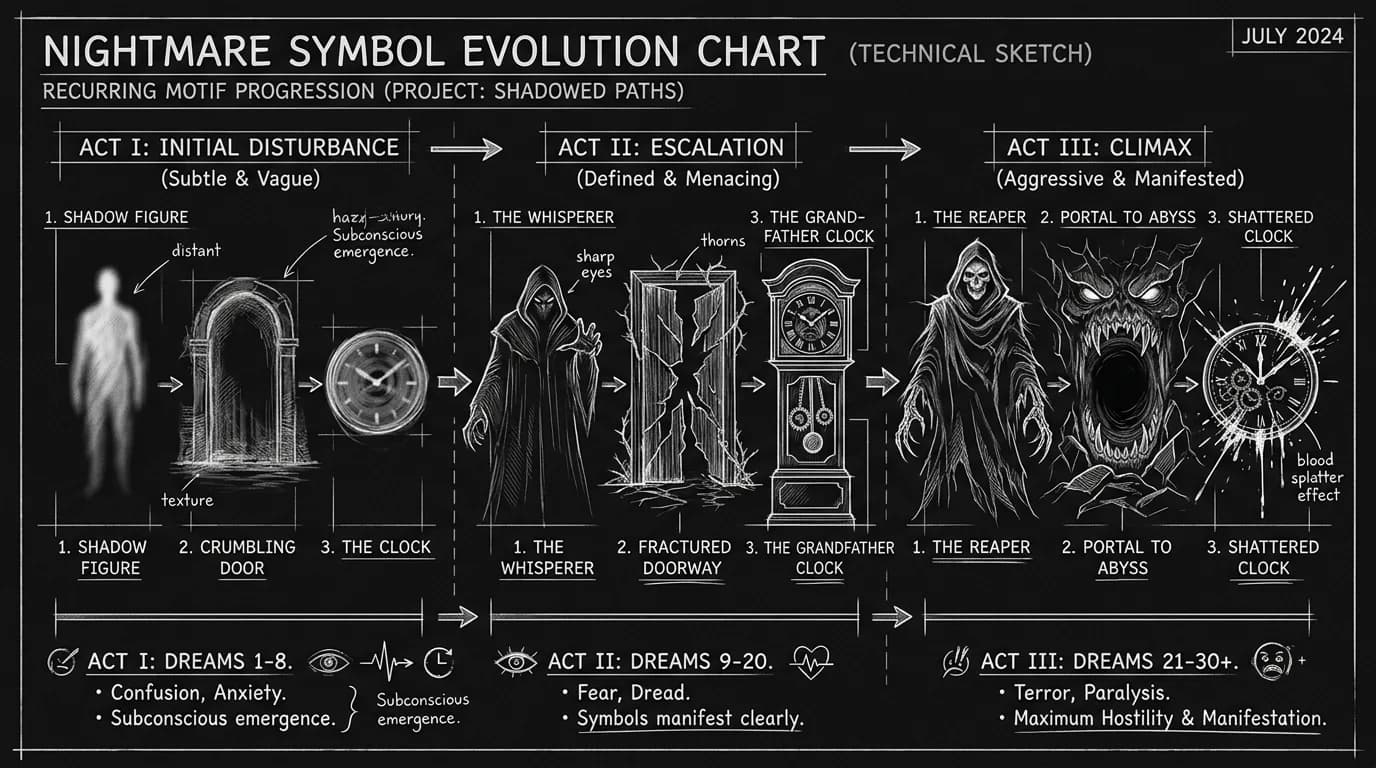
Advanced Calibration: Recurring Nightmares Across a Script
Recurring nightmares can be powerful when designed as progressive diagnostics rather than repeated jump scares.
Each recurrence should update based on new knowledge, guilt, or threat proximity. Symbol remains but context shifts. Sound remains but source changes. One missing face becomes identifiable. One locked door becomes open at wrong moment. This progression mirrors character confrontation arc.
A recurring nightmare system should track:
what repeats,
what mutates,
what resolves,
what remains unresolved by ending.
Use this as an internal map to avoid repetitive sequences.
For external produced-script references, the Writers Guild Foundation Library is useful and should be treated as a nofollow external link in publishing workflows.
As discussed in our guide on [how to write a panic attack scene on the page], embodied sensory progression is critical when depicting internal overload states.
If nightmare content points toward hidden betrayal, the framework in [how to write a betrayal reveal scene] helps translate internal suspicion into external strategy.
And when nightmare interpretation drives endgame decisions, our article on [how to write a final confrontation scene that feels earned] supports payoff design.
Body Image: Recurring Motif Evolution Map
YouTube Placeholder
[YOUTUBE VIDEO: A script workshop transforming a cliché nightmare montage into a causal, plot-driving sequence with wake-world seeds and actionable aftermath.]
Extra Deep Dive: Writing Nightmare Logic for Different Thriller Subgenres
One reason nightmare scenes feel repetitive is that writers use the same dream language across every thriller type.
But subgenre changes fear architecture.
In procedural crime thrillers, nightmares often revolve around evidence anxiety, moral contamination, and timeline collapse. The dream should push investigative interpretation, not supernatural dread.
In conspiracy thrillers, nightmare logic often emphasizes paranoia patterning: trusted faces swapping identities, communication channels failing, maps changing while observed. Here the function is to intensify uncertainty around reality filters.
In psychological thrillers, nightmares can expose unreliable self-narrative. Distortion should challenge memory confidence and self-trust, but still connect to concrete waking decisions.
In survival thrillers, nightmares should stress bodily vulnerability and tactical mistakes replayed under altered physics. They can motivate corrective behavior and training adaptation.
In supernatural thrillers, nightmares may legitimately carry external signal. Even then, discipline matters. If dreams become all-purpose prophecy machines, tension dies because causality feels rigged.
A practical way to keep subgenre alignment is to write a "nightmare function statement" per script:
What does dreaming do in this world that waking cannot do as efficiently?
If answer is vague ("it is creepy"), redesign.
Another high-value technique is nightmare viewpoint control.
Who experiences the dream matters, but so does narrative distance.
Close subjective mode lets readers feel sensory distortion directly through fragmented action and focal details.
Slightly distanced mode can work when the goal is interpretive uncertainty.
Switching mode mid-sequence can be effective if motivated by threshold breach, but random switching harms readability.
Keep point-of-view discipline.
Now consider sound-writing on the page.
Dream scenes often overuse visual symbols and underuse auditory motifs, even though sound is a major fear trigger. Repeated tone, misheard phrase, distant mechanical rhythm, delayed echo of known voice: these can connect nightmares to plot clues elegantly when seeded before sleep.
You can also use language contamination as a subtle signal. Words spoken by one waking character appear in dream dialogue from another figure. This can expose hidden associations or suspicions without explicit explanation.
The key is moderation. One or two contaminated phrases are intriguing. Ten become heavy-handed.
Scenario Layering: A Concrete Before-and-After Design
Imagine a political thriller where the protagonist suspects internal leak in their own agency.
Weak version:
Nightmare of faceless men chasing protagonist through endless corridor.
Wake-up.
"I cannot trust anyone."
No new action.
Stronger version:
Before sleep, protagonist reviews redacted memo with one unusual typo and hears a colleague repeat a phrase: "keep channels clean."
Dream distortion recombines this: in the dream, every office door has the same typo; intercom repeats "keep channels clean" in protagonist's own voice; security badge opens wrong rooms.
Wake residue: protagonist checks badge logs instead of proceeding to scheduled briefing.
Action consequence: discovers access pattern mismatch that confirms leak is internal to clearance ring.
Now nightmare sequence carries investigative function, not just mood.
Practical Editing Pass for Dream Clarity
After drafting, run a clarity pass with four tests.
Symbol trace test: can each major symbol be traced to a prior seed?
Causality test: does the nightmare alter subsequent objective or tactic?
Voice test: does dream language still sound like this script, not generic elevated prose?
Compression test: if scene is reduced by 25 percent, does impact improve?
Most nightmare scenes benefit from compression. Intensity usually rises when you cut ornamental transitions and keep high-value beats.
Finally, calibrate ambiguity level to audience contract. If your thriller has taught viewers that clues are solvable, keep dream clues partially decodable. If your thriller prioritizes existential uncertainty, let interpretation remain unstable but maintain emotional causality.
Ambiguity should create tension, not confusion.
Ending Perspective: Dreams Should Disturb the Plot, Not Pause It
If your nightmare sequence feels cliche, the fix is not stranger imagery.
The fix is stronger causality.
Seed the material.
Distort with purpose.
Translate under uncertainty.
Force a decision.
Carry residue forward.
When you write nightmares this way, they stop being decorative psychology.
They become structural pressure events that expose denial, redirect choices, and sharpen thematic conflict.
That is what audiences remember: not the jump cut, not the wake-up gasp, but the unsettling moment when a dream makes the character act differently and the plot takes a darker, smarter turn because of it.
Final Step
Build your next script with Screenweaver
Move from ideas to production-ready pages faster with timeline-native writing and AI-assisted story flow.
Try Screenweaver