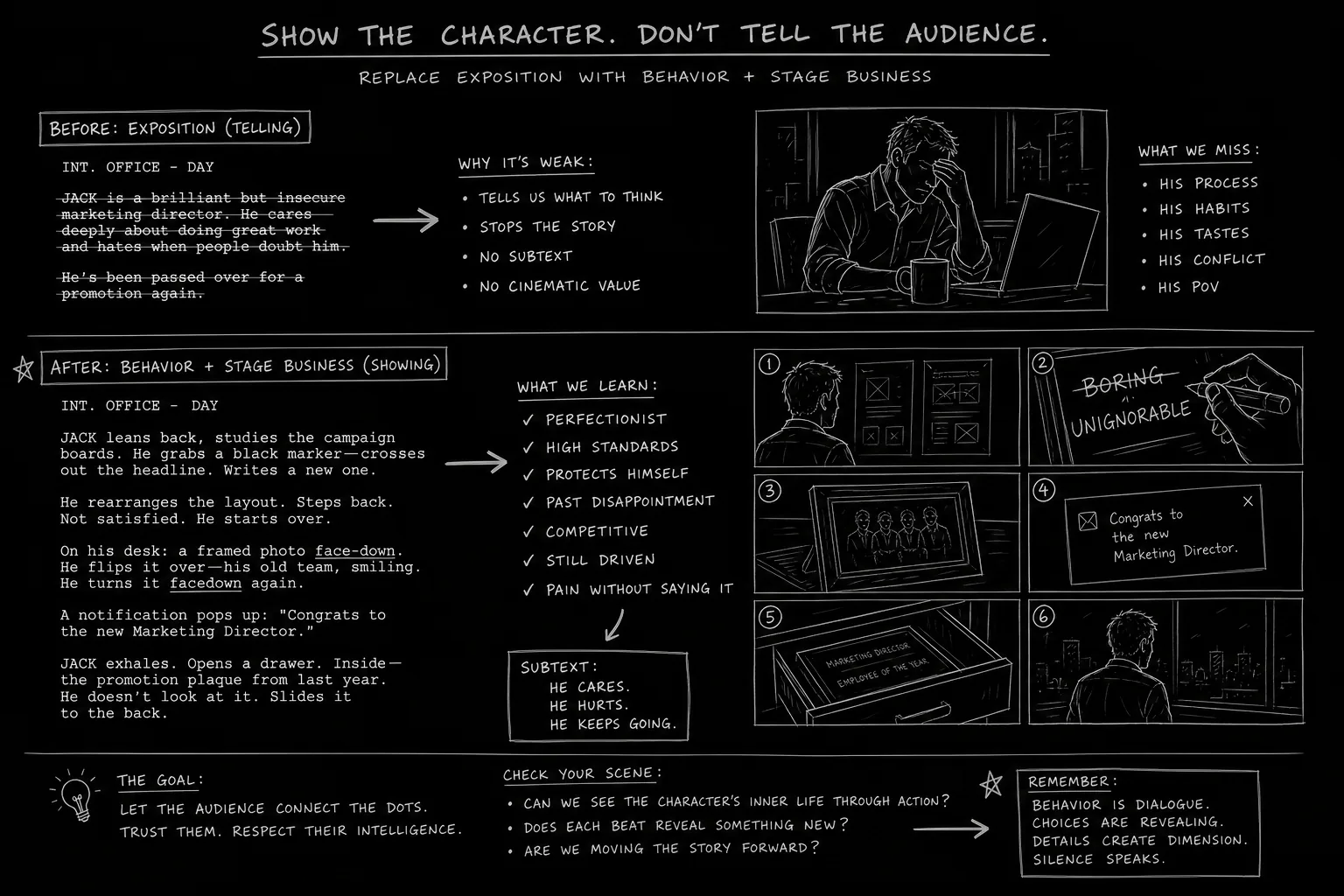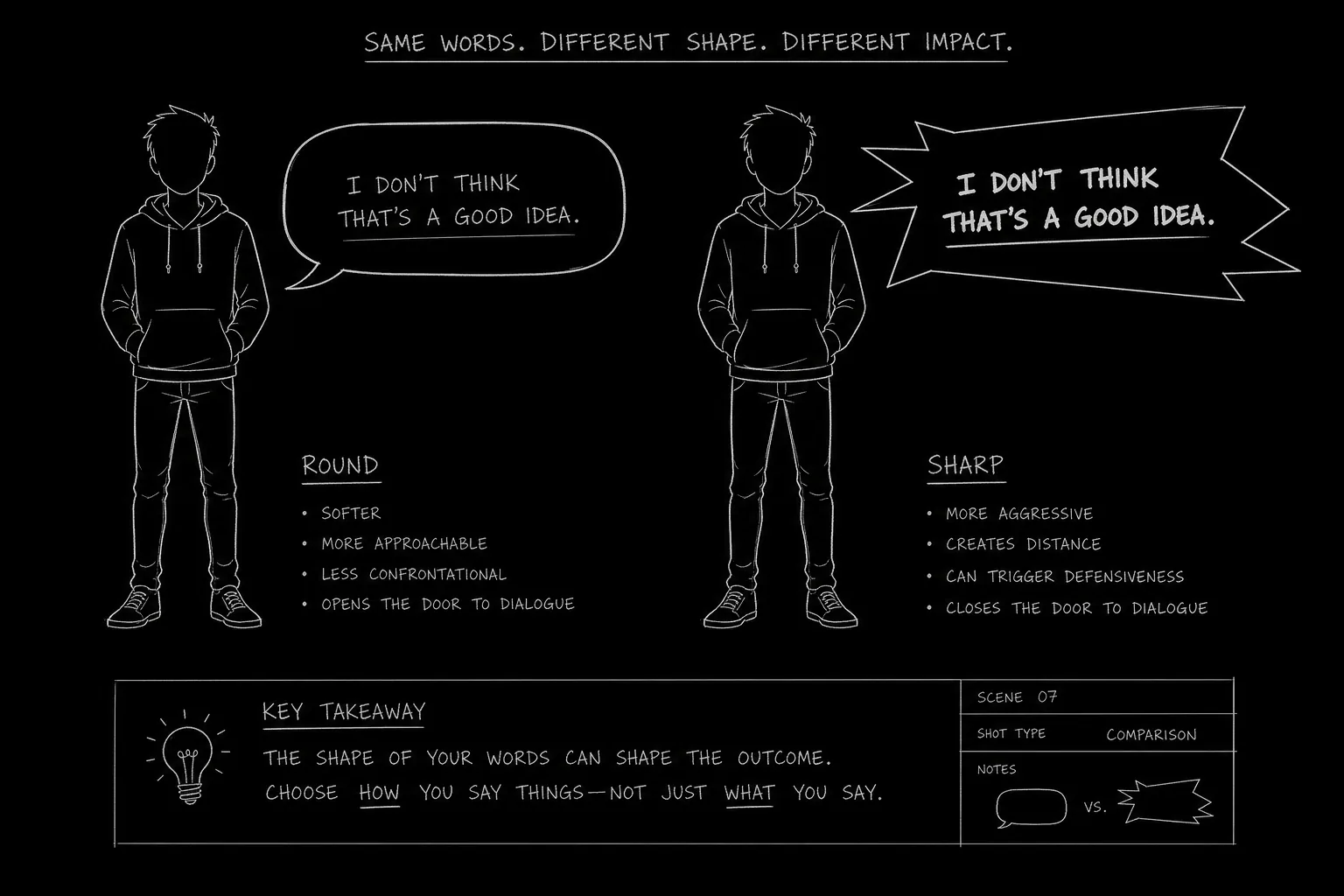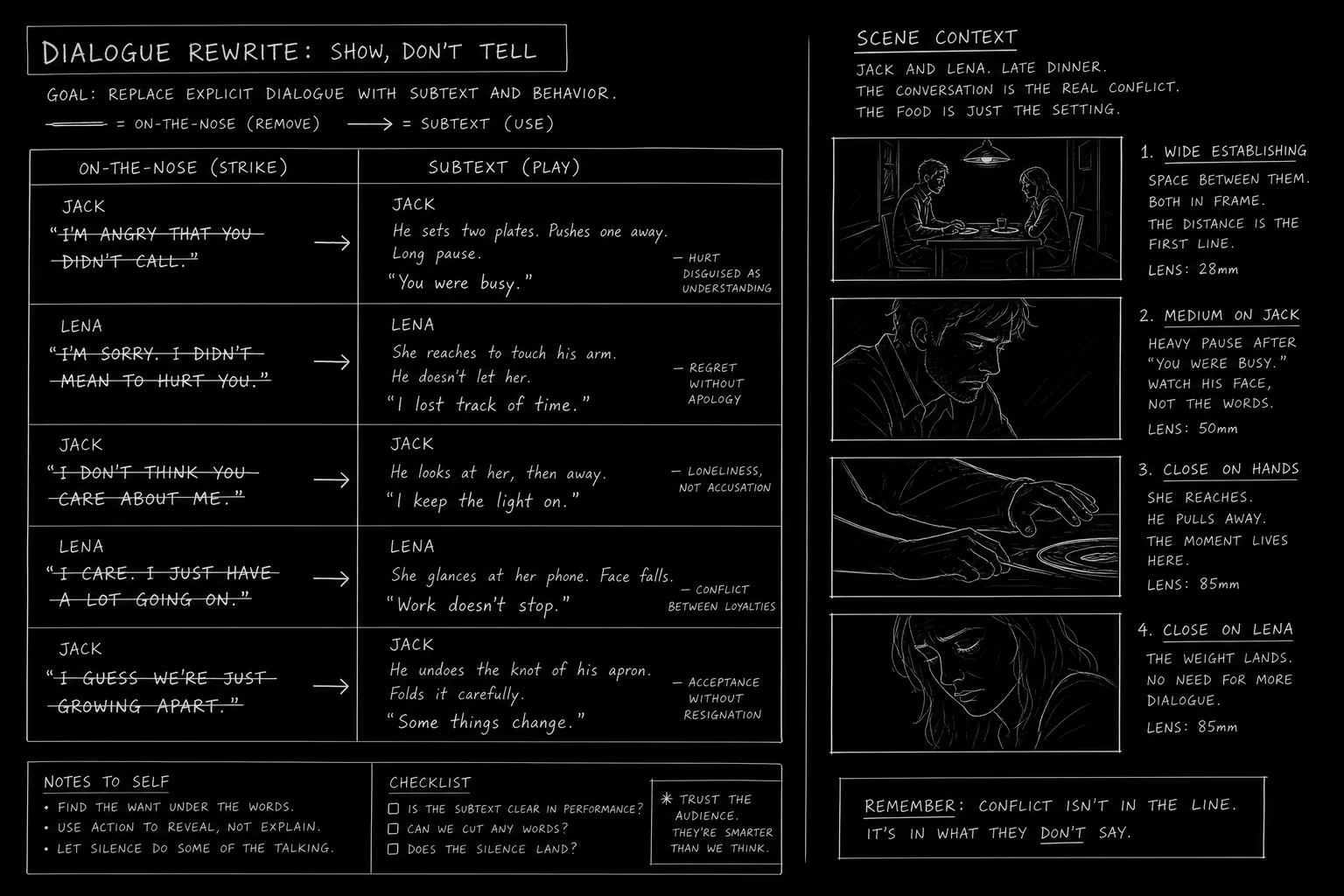

On-the-nose dialogue says exactly what the character means, exactly when they mean it, in the vocabulary of a therapy worksheet. It is efficient and deadly. Audiences feel spoken at, not spoken with. Readers skim. Actors flatten because there is no gap to play.
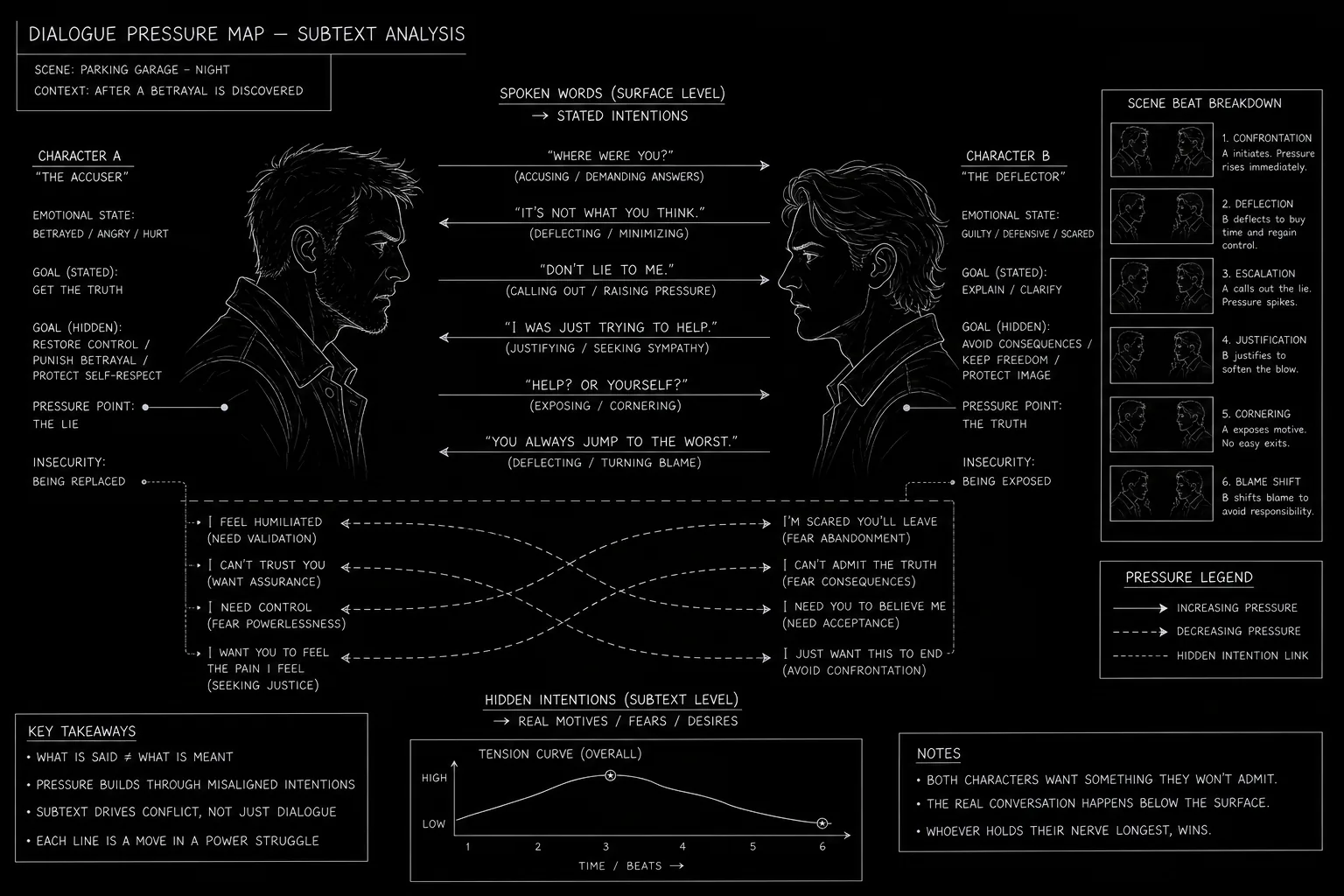
A subtext rewrite pass does not make characters vague. It restores pressure: what they want to say vs what they dare say given power, shame, timing, and who is listening.
How It Works: Gap Between Text and Subtext
Subtext lives in the distance between line and intention. Characters pursue goals with words that protect face, test loyalty, buy time, or misdirect. On-the-nose lines collapse that distance to zero.
The pass targets three failure modes:
- Theme delivery: "This is about family." Characters do not announce theme; they fight about keys, money, or silence.
- Emotion labeling: "I am scared." Fear shows in topic shifts, jokes, aggression, or over-precision.
- Plot exposition: "As you know, we met at the lake in 2019." Replace with conflict that forces partial reveal.
Start after structure and clarity passes. Subtext on a broken scene is lipstick. Use screenplay revision passes ordering if you have not.
Platform and Use-Case Sections
Drama and Prestige
Prestige audiences tolerate silence and indirection. Subtext is default grammar. On-the-nose reads as condescending.
Comedy
Comedy needs on-the-nose sometimes as punchline weapon, then subtext elsewhere for relationship truth. The straight man can be literal; the wound cannot.
Thriller and Noir
Genre thrives on coded speech. Cross-train with subtext in film noir and argument scenes without repetition.
YA and Commercial
Younger markets still need subtext, but clarity windows are wider. Teens can dodge, not speak in riddles for ten pages.
Relatable Scenario: The Villain Monologue
Your antagonist explains the entire plan while the hero listens. The audience checks out because the hero already knew half of it. Rewrite as interrogation with misdirection: the villain answers questions that sound like boasts but hide the real move. The hero (and audience) receives information under conflict pressure, not lecture mode.
Relatable Scenario: The Breakup
"I love you but I can't do this anymore" is honest and flat. Rewrite around logistics that hurt: returning a key, canceling a shared subscription, choosing who keeps the dog walking app account. Love lives in what they fight over while pretending it is practical.
The Trench Warfare Section: Subtext Mistakes
Obscurity masquerading as depth. If nobody can follow the scene, that is not subtext; it is fog.
Identical subtext voices. Everyone speaks in coded epigrams. Differentiate syntax per character.
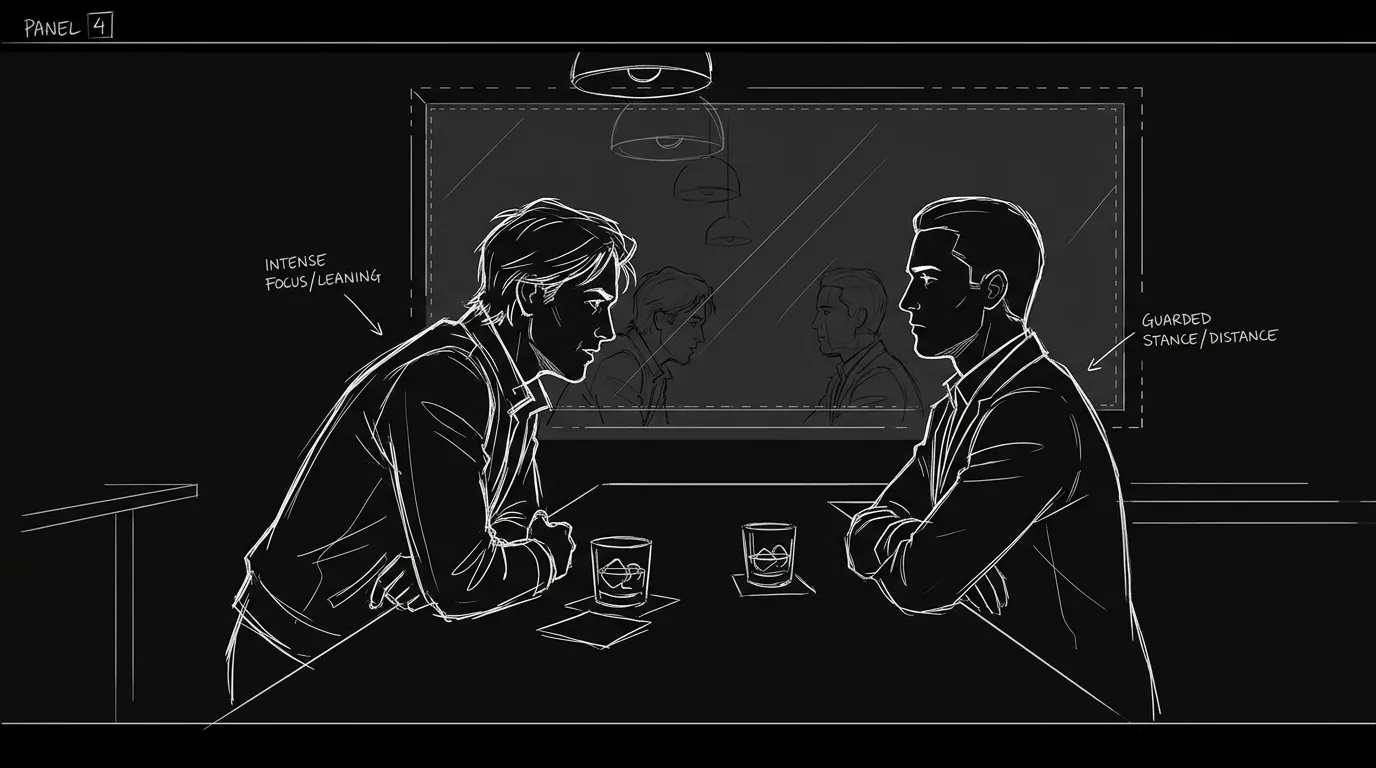
Subtext without behavior. Lines say one thing while bodies stay neutral. Actors need contradiction.
Over-correction. Removing all clarity. One orientation line per scene is allowed.
Theme speeches in the last five pages. Replace with a choice that costs something visible.
Step-by-Step: The Subtext Rewrite Pass
Step 1 - Mark lines that state theme, feeling, or backstory directly
Highlight in pink. Do not fix yet. Count them. If a scene has more than two, the scene is lecturing.
Step 2 - Write each speaker's secret objective for the scene
One sentence per character: what they need emotionally or practically by scene end.
Step 3 - Rewrite lines to pursue objective indirectly
Ask: what would this person say to avoid losing status? To probe without confessing? To win without admitting they care?
Step 4 - Add behavior that contradicts speech
Smiling while threatening. Offering help while refusing closeness. Behavior makes subtext legible without explanation.
Step 5 - Cut duplicate beats
On-the-nose often repeats the same information in dialogue and action. Keep the better version.
Step 6 - Read aloud with a friend
If every line sounds like the same essay voice, differentiate syntax per character. See distinct voices blind read.
Step 7 - Spot-check trailer lines
One or two quotable direct lines per script are fine. More than that and the piece feels like a speech draft.
[YOUTUBE VIDEO: Actor workshop reading the same scene twice, first on-the-nose draft then subtext rewrite, discussing playable gaps and camera-friendly reactions.]
Try it free
Try Screenweaver for free on your script
It is free. Import your existing project, get a clearer view of your outline, and regain control of your story structure in minutes.
Start FreeOperational Requirements: When Direct Speech Is Allowed
High stakes clarity: Medical consent, legal warning, military command may need direct speech. Earn plain talk with context.
First-time information: Audiences need facts once. Subtext is not hiding basic orientation past reasonable delay.
Character voice: Some characters speak plainly as trait. Contrast them with subtext-heavy scene partners.
Translation and accessibility: Subtext must not become incomprehensible. Behavior and context carry meaning for global audiences.
| On-the-Nose Example | Subtext Rewrite Angle |
|---|---|
| "I never got over you." | "You still use that cologne." |
| "The company is evil." | "They promoted me for staying quiet." |
| "I'm the hero here." | "Tell them whose name is on the lease." |
| "This reminds me of my dad." | He straightens a tool belt that isn't his. |
Outcome: Dialogue Actors Fight to Book
Subtext-rich scenes generate auditions where performers show range in a single page. Readers describe dialogue as "elevated but clear," the commercial-art sweet spot.
Plot clarity improves because information arrives through conflict, not briefing. Scenes shorten when speeches become sparring.
Why It Matters: Explanation vs Dramatization
The old way: Characters explain feelings, theme, and backstory because the writer fears misunderstanding.
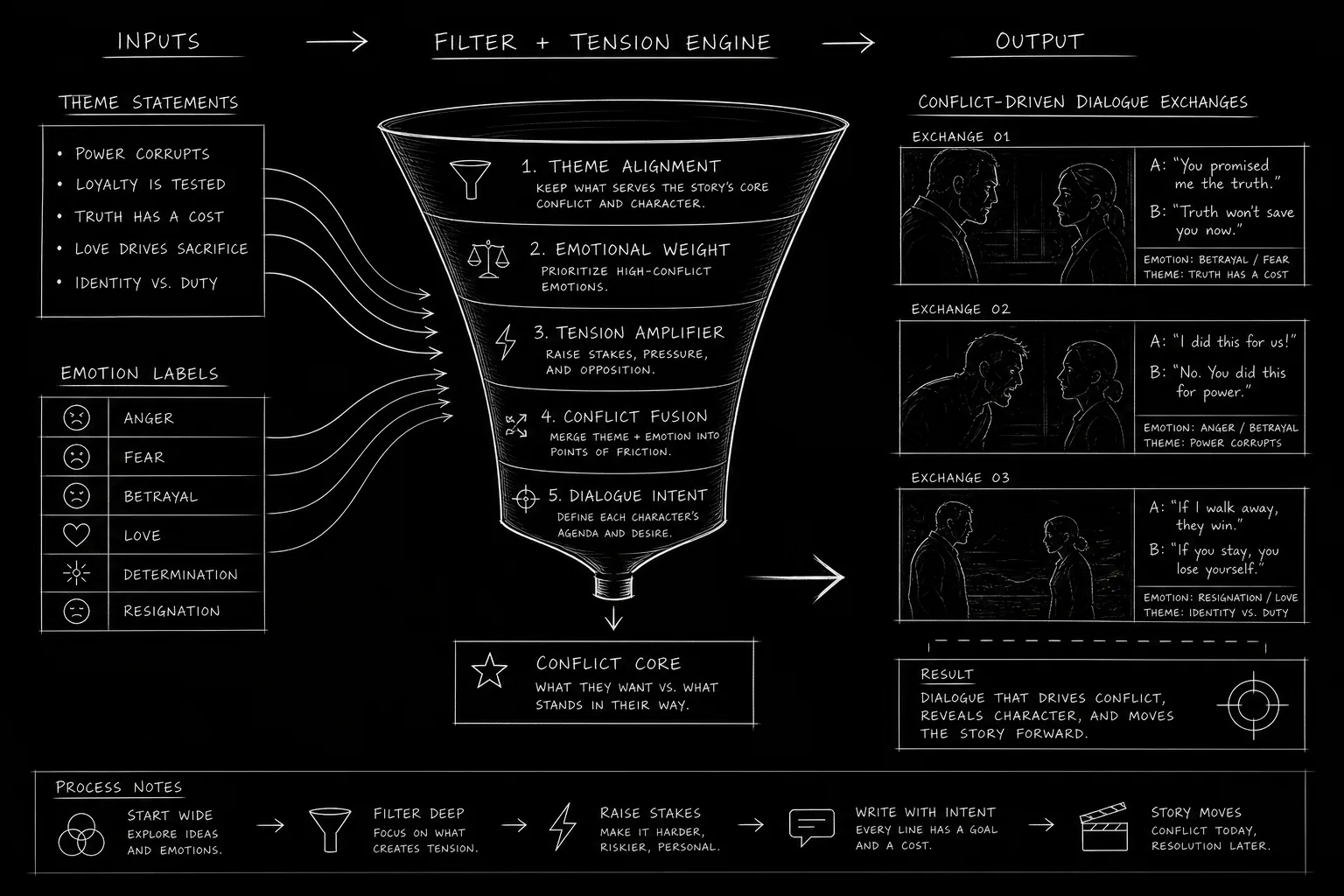
The new way: Characters pursue objectives under social risk; audience infers meaning from gap, behavior, and consequence.
Explanation is control. Subtext is trust in the audience and in actors.
Conclusion
On-the-nose dialogue is a draft problem with a draft solution. Mark direct theme and feeling lines, define secret objectives, rewrite for indirect pursuit, let behavior contradict speech. Keep one or two blunt lines if they earn trailer power; cut the rest.
Run this pass on arguments, reconciliations, and villain monologues first. Then pair with show don't tell action lines pass so dialogue and behavior stop repeating each other. The best scripts make readers lean in. Subtext is that lean.
Try the question test on each rewritten line: could the character answer a different question than the one asked and still move their goal forward? If yes, you are probably in subtext territory. If every line answers exactly what was asked with perfect honesty, you are still on the nose.
Subtext and Genre Dialogue: A Practical Balance
Horror characters can name fear when the naming makes them vulnerable to mockery from another character. Legal dramas can state facts when cross-examining. The subtext pass is not anti-clarity. It is anti-redundancy. Ask whether the line tells us something the scene already showed. If yes, cut or indirect. If no, keep.
Romantic comedy often uses direct confession as the climax beat after ninety minutes of dodge. Earn the direct line by making it the first time the character stops performing. The pass removes premature honesty, not all honesty. Save the direct line for the moment the character has run out of dodges.
Read subtext scenes with a non-writer friend. If they understand the scene but cannot quote a theme sentence afterward, the pass worked. If they are confused, you cut clarity instead of redundancy. Adjust. Subtext is a communication skill, not a hiding skill. The audience should feel more, not understand less.
Keep a save list of one or two direct lines per script that must stay blunt for character or genre reasons. Protect them from the pass. Subtext is the default, not a religion. The art is knowing which moment earns plain speech.
Final Step
Build your next script with Screenweaver
Move from ideas to production-ready pages faster with timeline-native writing and AI-assisted story flow.
Try Screenweaver