
Dinner party scenes are traps.
Not because they are inherently boring. Because they look easy and punish lazy writing.
Everyone is seated. Everyone is talking. Social etiquette creates natural constraints. In theory, this is perfect drama territory. In practice, many scripts produce the same dead version: polite banter, one awkward joke, one sudden outburst, cut to aftermath.
You can feel the missed opportunity.
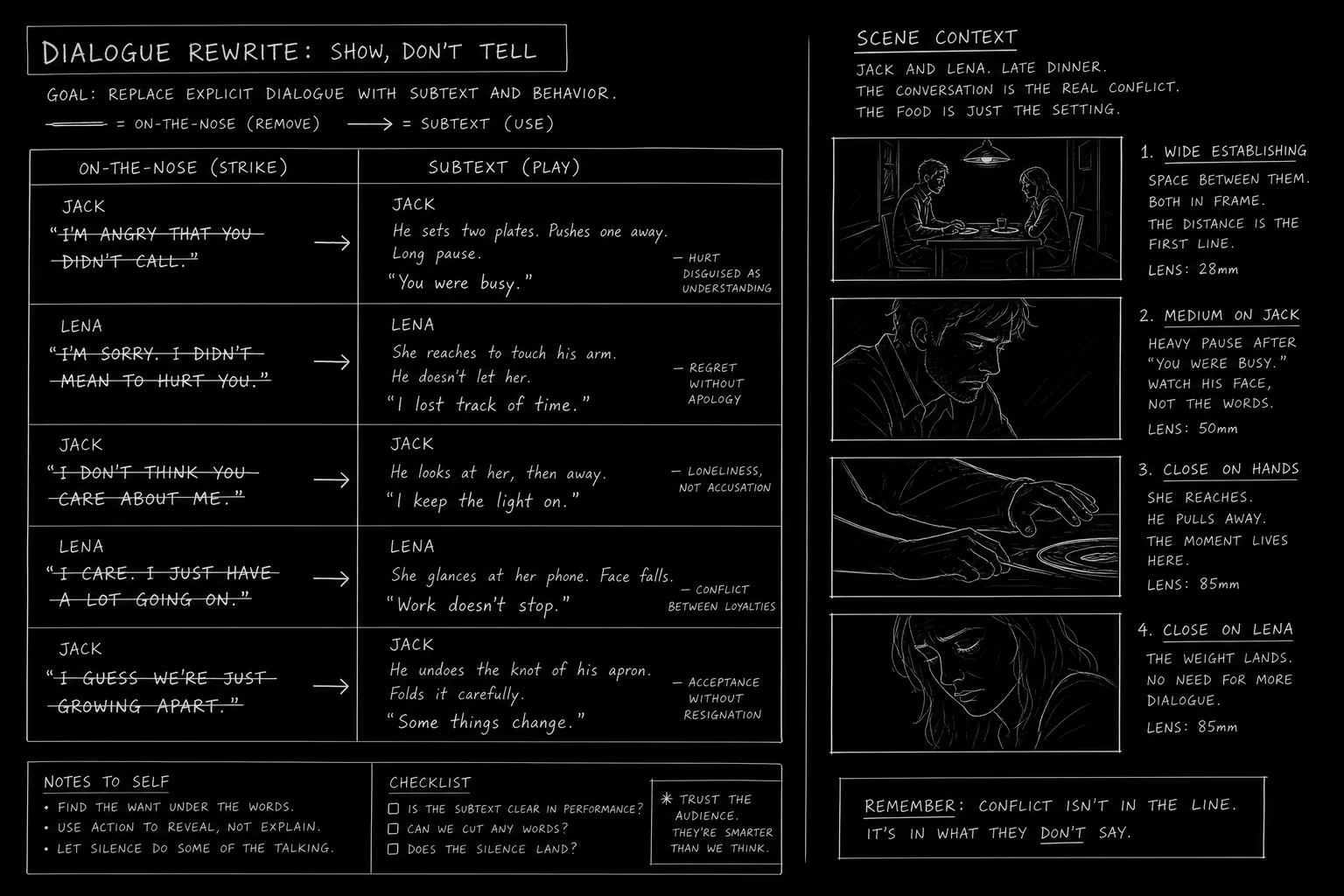
A strong dinner party scene with hidden conflict is not about who shouts first. It is about who controls the room while pretending nothing is wrong. It is about tactical civility. Knife-edge politeness. Tiny status moves that reveal alliances, fear, and long-term strategy.
Here is why that matters: dinner tables force proximity and ritual. People cannot just walk out without consequence. They must perform social coherence while emotional and political pressure rises. That contradiction is story gold.
If you write it as conversation, it drifts.
If you write it as controlled social warfare, it hums.
Why Dinner Party Scenes Become Generic
Most weak scenes fail because writers mistake hidden conflict for delayed conflict.
They keep everything neutral for too long, then trigger a loud reveal. But "hidden" does not mean "absent." Conflict must be active from line one, just encoded in subtext, seating behavior, topic selection, interruption patterns, and who is allowed to define reality.
Another common issue is ensemble blur. Six characters speak but sound interchangeable. Without distinct conflict tactics, the scene feels crowded and flat.
Then there is tempo monotony. Everyone speaks in medium-length lines, same tone, same rhythm. No pressure waves.
Think about it this way: if your dinner scene could happen at any generic gathering without changing one line, you are writing event texture, not dramatic structure.
Hidden conflict is not silence. It is intention masked as manners.
The Core Model: Surface Topic, Subsurface Agenda, Trigger Pivot, Social Fallout
A functional hidden-conflict dinner scene runs on layered channels.
Surface topic is what people are ostensibly discussing.
Subsurface agenda is what each person is actually trying to achieve.
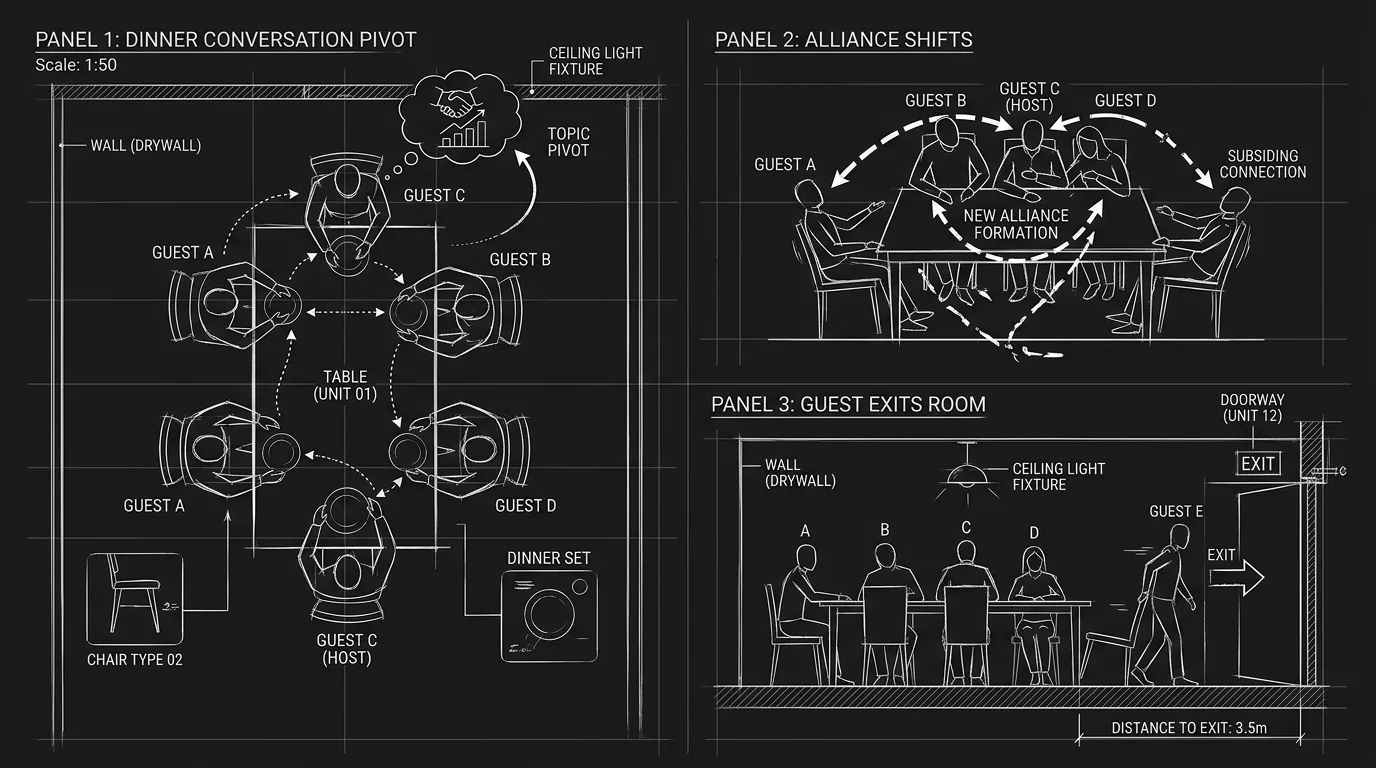
Trigger pivot is the moment a line, object, or interruption exposes the underlying battle.
Social fallout is how room hierarchy and alliances shift after that exposure.
Without Subsurface agenda, the scene becomes chatter.
Without Trigger pivot, the scene feels static.
Without Social fallout, it feels inconsequential.
Scenario One: The Family Dinner with Inheritance Tension
Beginner version: siblings exchange passive-aggressive remarks, one sibling explodes about money, scene ends.
Predictable.
A stronger version encodes conflict through hosting mechanics.
Who is seated at head of table?
Who pours wine for whom?
Who gets served first?
Who introduces sensitive topic under cover of "practical planning"?
Maybe the inheritance issue is never named directly at first. Instead, one sibling repeatedly references "responsibility," another references "sacrifice," a third references "what Mom would have wanted." Language becomes proxy battlefield.
When legal paperwork appears mid-dessert, the room reorders.
Now your scene has arc.
Scenario Two: The Professional Dinner with Hidden Deal-Making
Corporate or political dinner scenes often fail because they become pure exposition transfer.
A stronger version treats table talk as negotiation arena.
One guest is evaluating loyalty, another testing discretion, another trying to bait an admission, another protecting reputation. Topics like schools, travel, and market conditions carry coded meaning.
If one character publicly "misunderstands" a coded remark on purpose, they can force revelation without overt confrontation.
That is high-level scene craft.
Scenario Three: The Friendship Dinner with Romantic Triangulation
Many scripts write these scenes as jealousy fireworks. Someone drinks too much, blurts truth, chaos.
This can work in broad comedy, but often reads shallow in drama.
Try escalation by conversational triangulation.
Two people exchange shared-memory references that exclude a third.
A third redirects topic to future plans.
A fourth person makes an innocuous toast that lands like accusation.
Conflict escalates while everyone remains "civil." This is often more painful and more compelling than direct yelling.
Step-by-Step Workflow for Writing Hidden-Conflict Dinner Scenes
Step 1: Define Room Power Map Before Dialogue
List participants and answer:
who has formal authority,
who has social authority,
who has informational leverage,
who has emotional leverage.
These are not always the same person.
This map should drive seating, speaking order, and interruption rights.
Step 2: Assign One Private Agenda Per Character
No passengers.
Each relevant character needs a scene objective beyond "eat dinner."
Secure promise.
Protect secret.
Test loyalty.
Humiliate rival subtly.
Repair relationship without admitting fault.
Private agendas produce meaningful subtext.
Step 3: Choose the Surface Topic Strategically
Surface topic should plausibly host subtext pressure.
Travel plans,
school choices,
health routines,
work updates,
wedding logistics,
real estate,
charity events.
Pick one that mirrors core conflict axis.
Step 4: Build Pressure Through Micro-Tactics
Hidden conflict appears in micro-moves:
interrupted anecdotes,
name usage shifts,
selective eye contact,
inside jokes,
delayed responses,
performative compliments.
Write these precisely and sparsely.
Step 5: Insert Trigger Object or Line
A hidden-conflict scene needs a pivot mechanism.
Photo appears.
Message notification is seen.
Wrong name is used.
Toast wording misfires.
Bill arrives unexpectedly.
Document is passed.
One trigger, well-placed, can transform scene.
Step 6: Escalate Without Immediate Explosion
After pivot, do not always jump to shouting.
Escalate through coded lines first.
Forced jokes.
Tighter politeness.
Public agreement hiding private threat.
Then choose whether overt rupture is earned.
Step 7: End with Status Reallocation
The room should not end in same hierarchy.
Someone loses narrative control.
Someone gains alliance.
Someone is exposed.
Someone leaves with leverage.
Status shift is the real payoff.
Table: Flat Dinner Scene vs Hidden-Conflict Dinner Scene
| Dimension | Flat Version | Hidden-Conflict Version |
|---|---|---|
| Dialogue level | Literal conversation only | Surface talk plus strategic subtext |
| Character goals | Undefined or shared | Distinct private agendas |
| Tension growth | Sudden outburst only | Micro-escalation with pivot trigger |
| Ensemble function | Voices blur together | Role-specific tactics and power |
| Environment use | Decorative table setting | Seating and service as leverage tools |
| Outcome | Emotional noise | Clear status and alliance shift |
The Trench Warfare Section: What Beginners Get Wrong (and How to Fix It)
This is the practical fix zone.
Mistake one: starting neutral and waiting too long.
Fix by planting agenda signals in first page of scene.
Mistake two: everyone speaks at equal volume and confidence.
Fix by encoding hierarchy through interruption rights and response timing.
Mistake three: hidden conflict mistaken for no conflict.
Fix by writing tactical intention into each key line.
Mistake four: overlong small talk.
Fix by trimming literal chat and retaining only lines that shift leverage or test boundaries.
Mistake five: exposition via toast.
Fix by keeping toasts short and loaded, not explanatory monologues.
Mistake six: no trigger pivot.
Fix by introducing one object/line event that forces reinterpretation.
Mistake seven: instant screaming climax.
Fix by escalating through coded pressure before overt rupture.
Mistake eight: all guests are spectators.
Fix by giving each major participant a tactical role.
Mistake nine: no sensory pressure writing.
Fix with selective details: cutlery sounds, serving pauses, spilled wine, temperature discomfort, delayed courses.
Mistake ten: identical voices.
Fix by assigning different rhetorical styles: irony, precision, anecdote, moral framing, strategic silence.
Mistake eleven: no social consequence fear.
Fix by making reputation stakes visible: children present, clients present, elder present, media-adjacent witness.
Mistake twelve: pivot has no aftermath.
Fix by writing immediate alliance shift or boundary statement.
Mistake thirteen: too many hidden topics.
Fix by centering one primary conflict axis and one secondary echo.
Mistake fourteen: clumsy symbolism.
Fix by using one or two meaningful objects, not a symbolic buffet.
Mistake fifteen: no exit strategy tension.
Fix by deciding who can leave and what leaving signals.
Mistake sixteen: overuse of sarcasm.
Fix by varying tactics so sarcasm is not the only subtext tool.
Mistake seventeen: unresolved scene inertia.
Fix by ending on a clear shift in power, trust, or plan.
Mistake eighteen: humor disconnected from conflict.
Fix by making jokes tactical, defensive, or aggressive in context.
Mistake nineteen: no thematic link.
Fix by aligning surface topic with story's moral pressure.
Mistake twenty: forgetting next-scene consequences.
Fix by scripting immediate behavioral fallout in following beat.
The best dinner party scenes feel polite on the surface and dangerous underneath, like porcelain over live current.
Try it free
Try Screenweaver for free on your script
It is free. Import your existing project, get a clearer view of your outline, and regain control of your story structure in minutes.
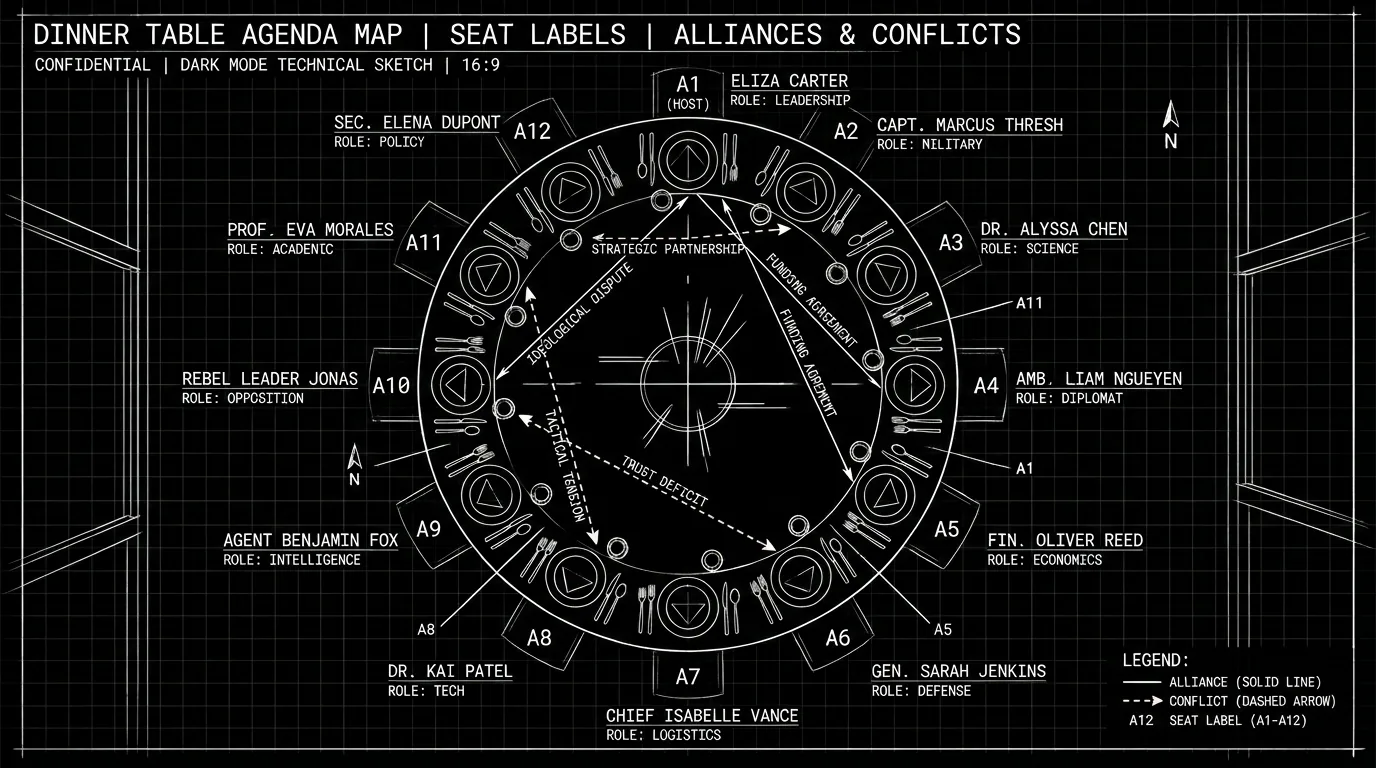
Start FreeBody Image: Dinner Table Agenda Map
Practical 50-Minute Rewrite Drill
Take your current dinner party scene and run this pass.
First ten minutes: write one private objective for each major character in margin notes.
Next ten minutes: cut lines that do not serve any objective.
Next ten minutes: add one trigger pivot object or line.
Next ten minutes: revise post-pivot dialogue to escalate coded pressure before rupture.
Final ten minutes: rewrite ending to lock in status reallocation and next-scene consequence.
This usually upgrades a social scene from "conversation" to "strategic encounter."
Advanced Calibration: Managing Ensemble Clarity Without Simplifying Conflict
Large dinner scenes can become unreadable if too many threads fire at once.
Use rotational focus.
Anchor each mini-beat around one primary dyad while secondary reactions are briefly noted. Then rotate focal dyad. This keeps ensemble complexity manageable and cinematic.
Another high-value technique is topic handoff control. Who redirects conversation, and when, is a power move. Track handoff ownership as carefully as dialogue content.
You can also modulate pressure through service rhythm: appetizers for setup, main course for pivot, dessert for fallout. This gives scene temporal structure without obvious mechanical beats.
For external script references, the Writers Guild Foundation Library is useful and should be treated as a nofollow source in publishing workflow.
As discussed in our guide on [how to write a reunion scene after years apart], asymmetrical emotional tempo is often the difference between sentiment and drama.
If hidden conflict turns into direct truth release, our framework in [how to write a confession scene in a thriller] helps structure disclosure and verification.
And when table pressure explodes into overt conflict, the principles in [how to write a final confrontation scene that feels earned] support escalation and payoff.
Body Image: Pivot-to-Fallout Sequence
YouTube Placeholder
[YOUTUBE VIDEO: A scene lab converting a flat dinner party conversation into a hidden-conflict sequence with agenda mapping, trigger pivot, and status-shift ending.]
Extra Deep Dive: Dialogue Compression and Subtext Density
Dinner party scenes often bloat because writers try to represent "real conversation length."
Realism is not raw duration. Realism is selective pressure.
A high-performing rewrite technique is dialogue compression.
Take any exchange and ask: can this line do two jobs?
If a line only advances literal topic, it is probably expendable.
If a line advances topic and signals status, fear, jealousy, or alliance, keep it.
This is subtext density: more dramatic information per line.
You can build subtext density with four tools.
First, strategic pronoun use.
Switching from names to "we" or "they" can quietly redraw social boundaries.
Second, reference ownership.
Who claims a shared memory first can signal narrative control over the past.
Third, selective politeness.
Overly formal language between familiar people often indicates active conflict management.
Fourth, omission.
Not answering the core question while answering adjacent detail can be a stronger attack than open insult.
Another important craft move is rhythm staggering.
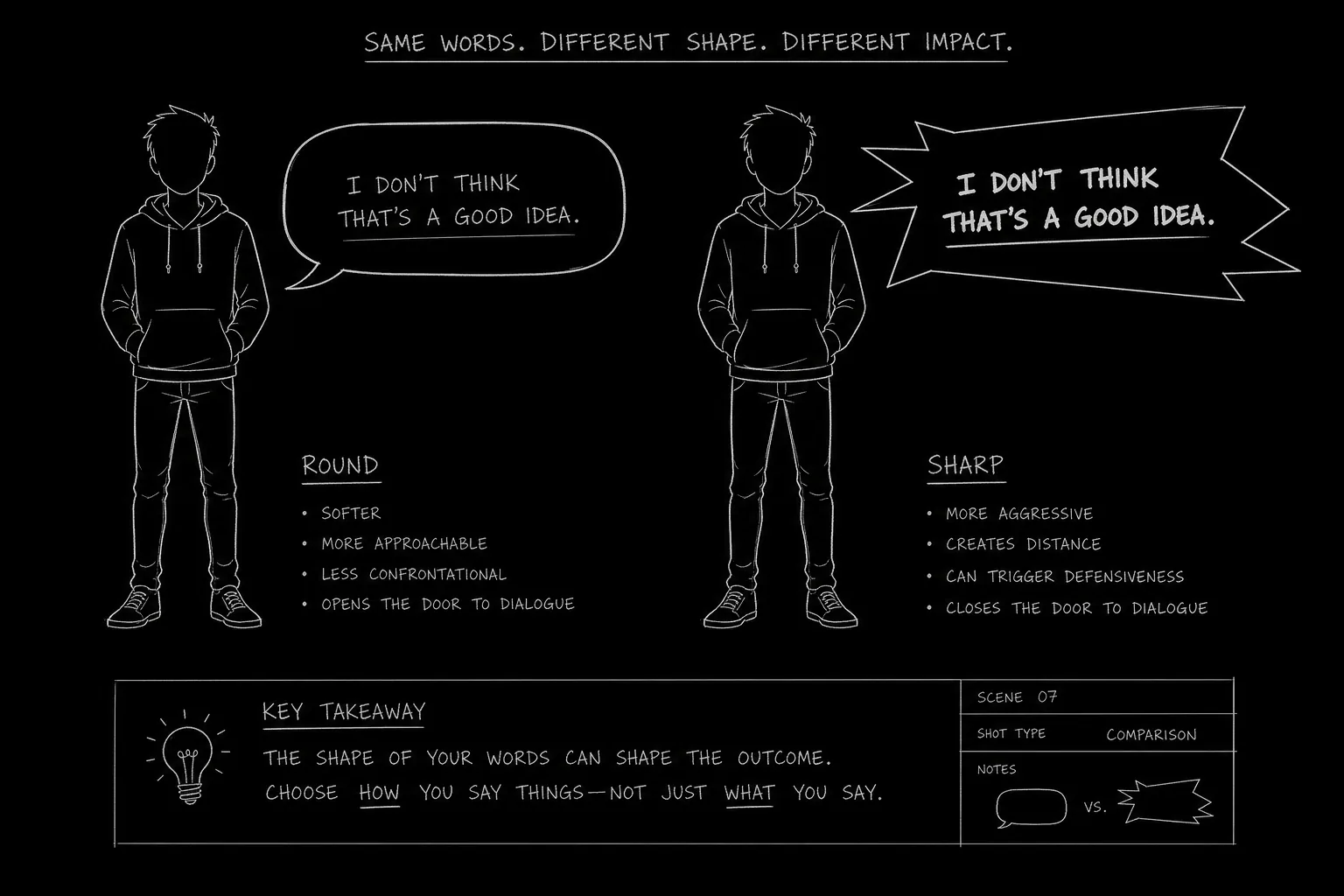
Do not let every speaker deliver similarly sized lines. Use short cuts, medium probes, and occasional longer social performances. Rhythm variation helps readers track changing control.
Scenario Layer: The Weaponized Compliment
One of the most useful hidden-conflict tactics is the weaponized compliment.
Surface line sounds kind.
Subtext line imposes hierarchy.
Example dynamic:
"I admire how fearless you are about changing jobs so often."
Depending on context, this can mean admiration, accusation, or class-coded contempt.
When writing these lines, anchor reaction beats carefully. A micro-pause, fork set-down, or redirected eye contact can confirm interpretation without explicit argument.
Micro-Exercise: Build a Pressure Ladder in 10 Beats
If your scene feels flat, run this 10-beat ladder:
Beat 1: neutral opening line with latent agenda.
Beat 2: mild probe disguised as curiosity.
Beat 3: deflective response.
Beat 4: second probe with sharper edge.
Beat 5: ally intervention to diffuse.
Beat 6: trigger pivot line/object appears.
Beat 7: coded accusation under politeness.
Beat 8: failed joke or failed toast.
Beat 9: boundary statement or exposed lie.
Beat 10: status-shift exit/decision.
This ladder gives you escalation architecture without forcing immediate shouting.
Managing Multiple Hidden Conflicts in One Scene
Ensemble dinner scenes may carry more than one conflict axis:
financial,
romantic,
professional,
familial.
Do not activate all axes equally at once.
Prioritize one primary axis and let secondary axes echo through reaction lines and side exchanges. If every axis peaks simultaneously, clarity collapses.
A simple drafting tool helps: mark each beat with one axis tag. If tags become random, reorganize.
When axis control is clear, complexity feels intentional instead of chaotic.
Extended Craft Layer: Table Geometry as Narrative Pressure
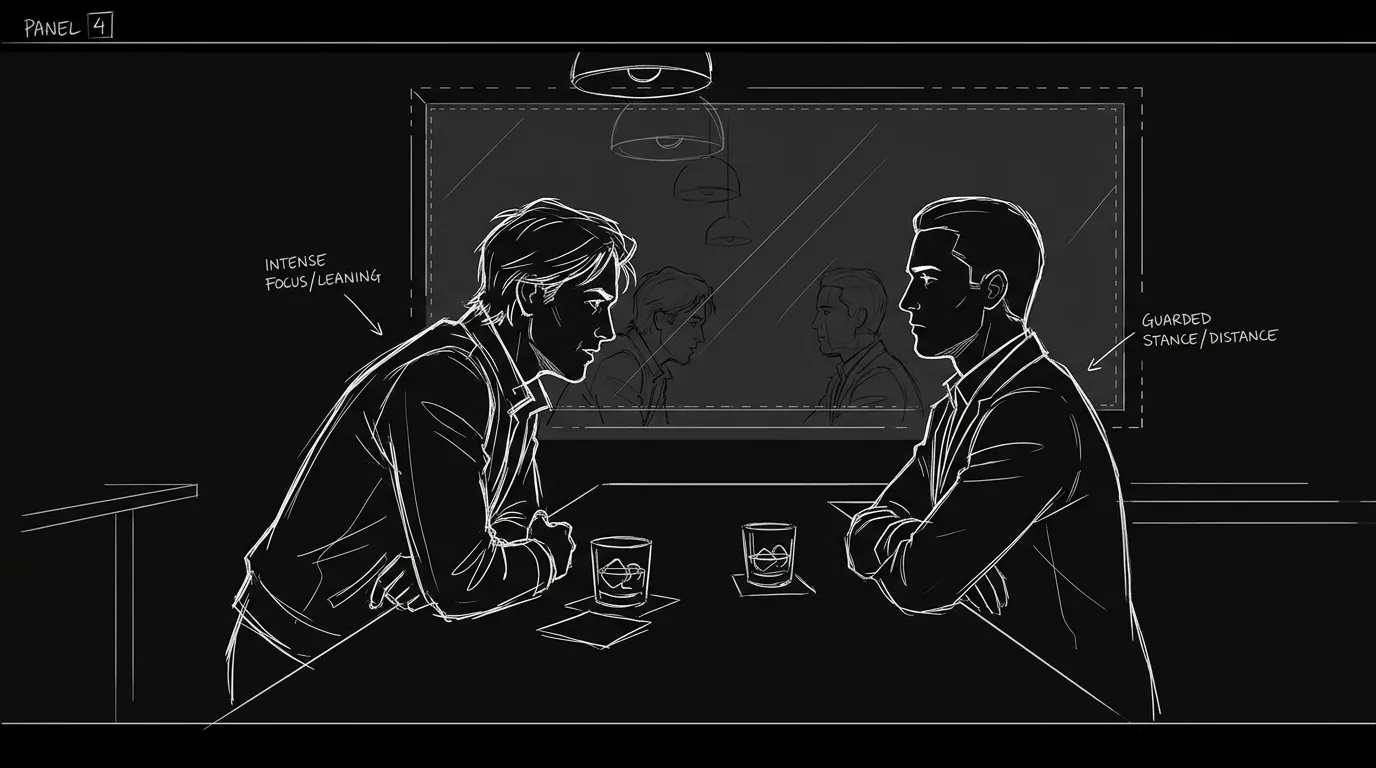
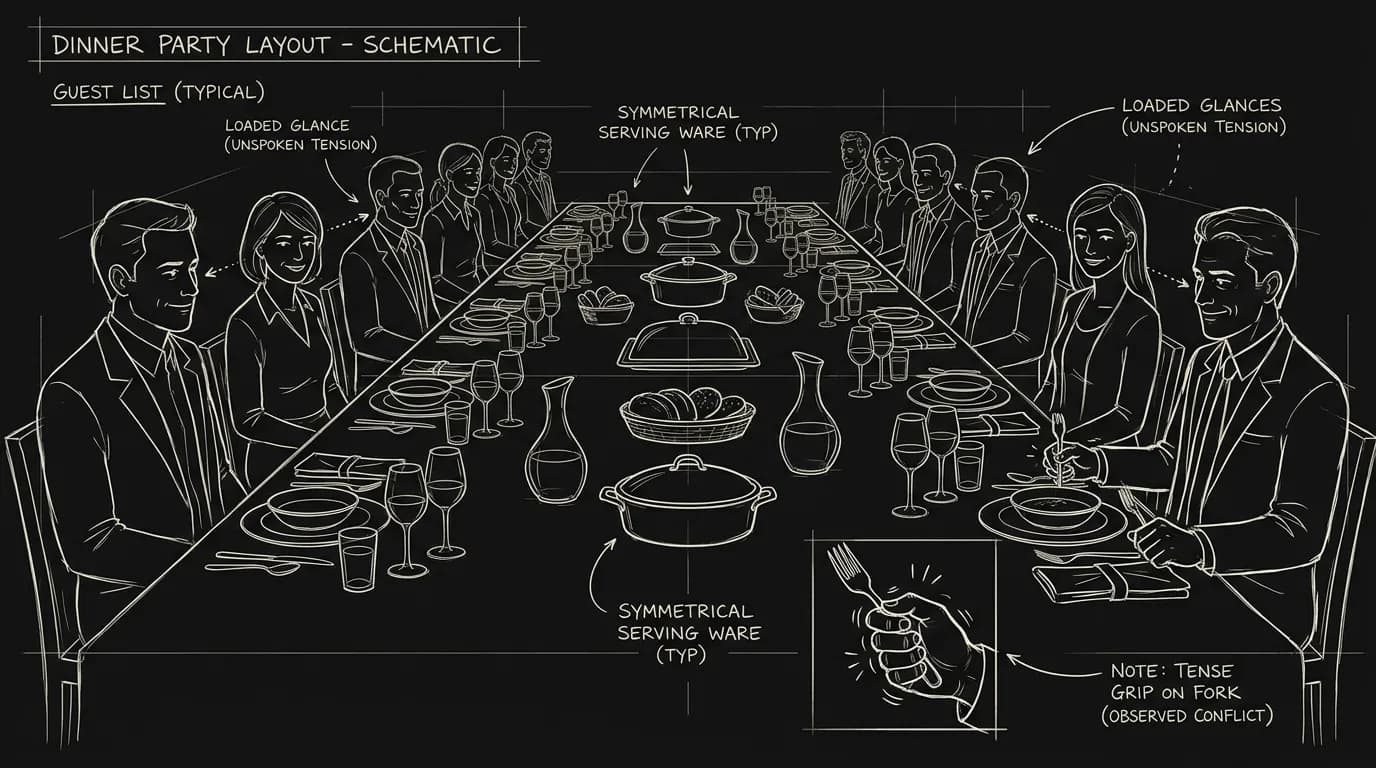
Writers often describe what characters say but ignore where they are positioned. In dinner scenes, geometry is story.
Who has direct line of sight to whom.
Who must speak across someone else.
Who can whisper without being seen.
Who sits near exits.
Who controls serving flow.
Table geometry determines conversational reach and interruption power.
Round tables distribute visibility differently than long tables. Long tables intensify factional lanes and symbolic hierarchy. Sideboard service can create temporary private corridors. Open kitchen layouts allow overheard fragments that alter alliance logic.
When you intentionally design geometry, hidden conflict becomes easier to stage without over-dialoguing.
Practical Geometry Pass
After drafting, sketch a simple top-down seat map.
Then mark:
primary conflict vectors,
alliance adjacency,
isolation seats,
witness lines.
If crucial conflict partners cannot realistically engage, reposition or use movement beats.
Then audit movement permissions. Who is socially allowed to stand, serve, refill drinks, or clear dishes? These roles can be used tactically to gather information or reset pressure.
Timing Design with Course Changes
Course transitions are excellent structural hinges.
Arrival drinks can establish masks.
Main course can introduce topic pressure.
Dessert can host trigger pivot.
Post-dessert cleanup can create private pair collisions.
You do not need to show every course. You can still use course logic to sequence escalation.
Writing the Quietest Character as Pressure Instrument
In many ensembles, one character speaks little. Beginners sometimes underuse them.
A quiet character can become the strongest pressure instrument if they choose one precise line at the pivot. Because they have conserved social bandwidth, that line lands harder.
You can design this intentionally:
early observation beats,
minimal contributions,
one late intervention that reframes room dynamics.
This technique increases ensemble depth and prevents talkative characters from monopolizing narrative force.
When to Let the Scene Break Open
Not every hidden-conflict dinner scene should stay hidden to the end.
Decide early whether your payoff is:
contained reallocation (conflict remains coded),
controlled disclosure (one truth surfaces),
full rupture (social facade collapses).
Choose one mode based on plot needs. Indecisive hybrid endings often feel mushy.
If you choose rupture, make sure it changes practical next steps. Otherwise it becomes noise.
If you choose containment, ensure readers can still see power shifted clearly.
Ending Perspective: Dinner Scenes Are Wars Fought with Napkins
If your dinner party scene feels cliche, do not add louder dialogue first.
Add clearer agendas.
Add sharper social pressure.
Add one pivot that forces masks to crack.
Then end with a changed room.
Because that is the point. A hidden-conflict dinner scene should leave the table physically intact and the relationships structurally altered.
When you write it that way, the audience does not remember what was served.
They remember who won the room, who lost face, and who silently decided what happens next.
Final Step
Build your next script with Screenweaver
Move from ideas to production-ready pages faster with timeline-native writing and AI-assisted story flow.
Try Screenweaver