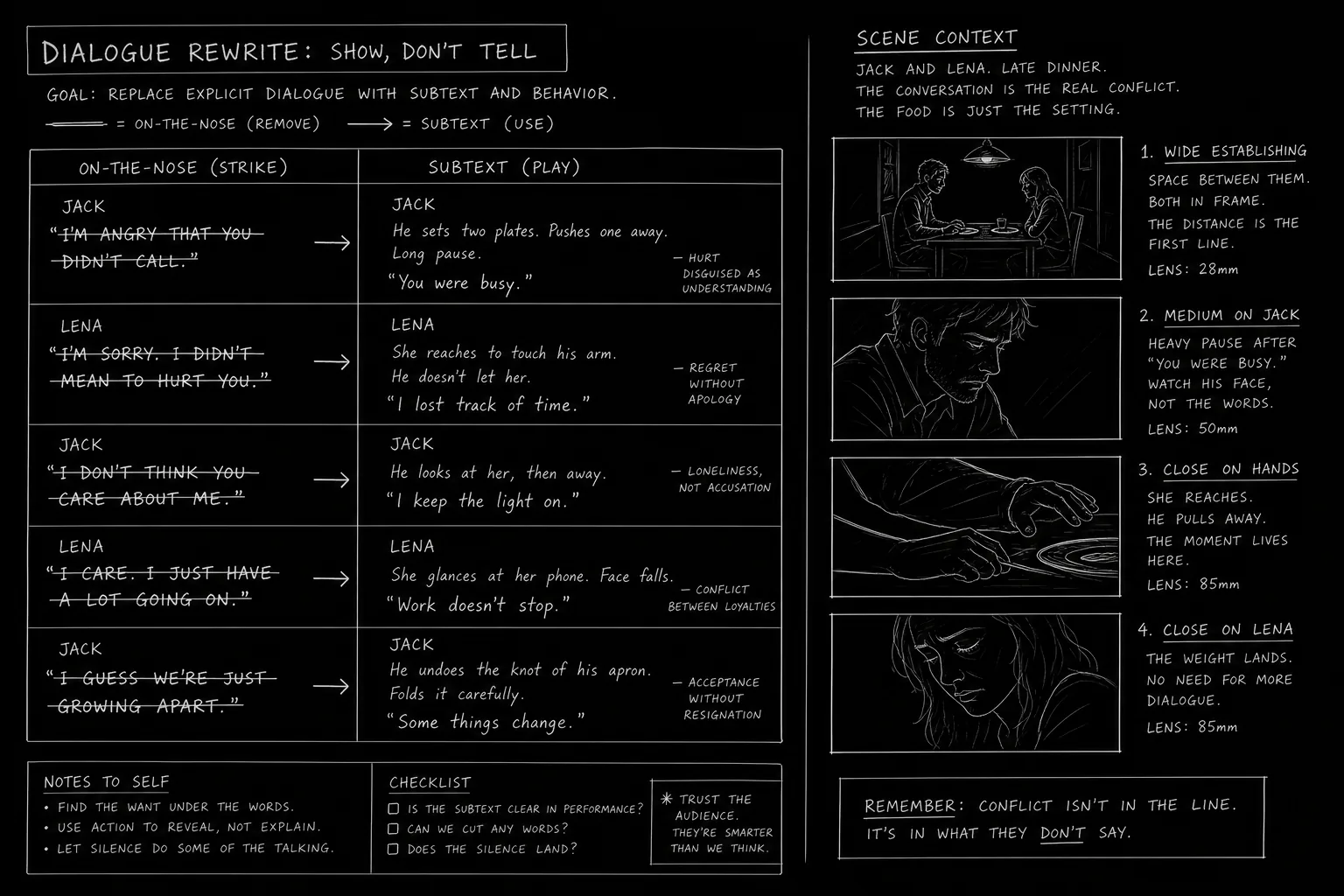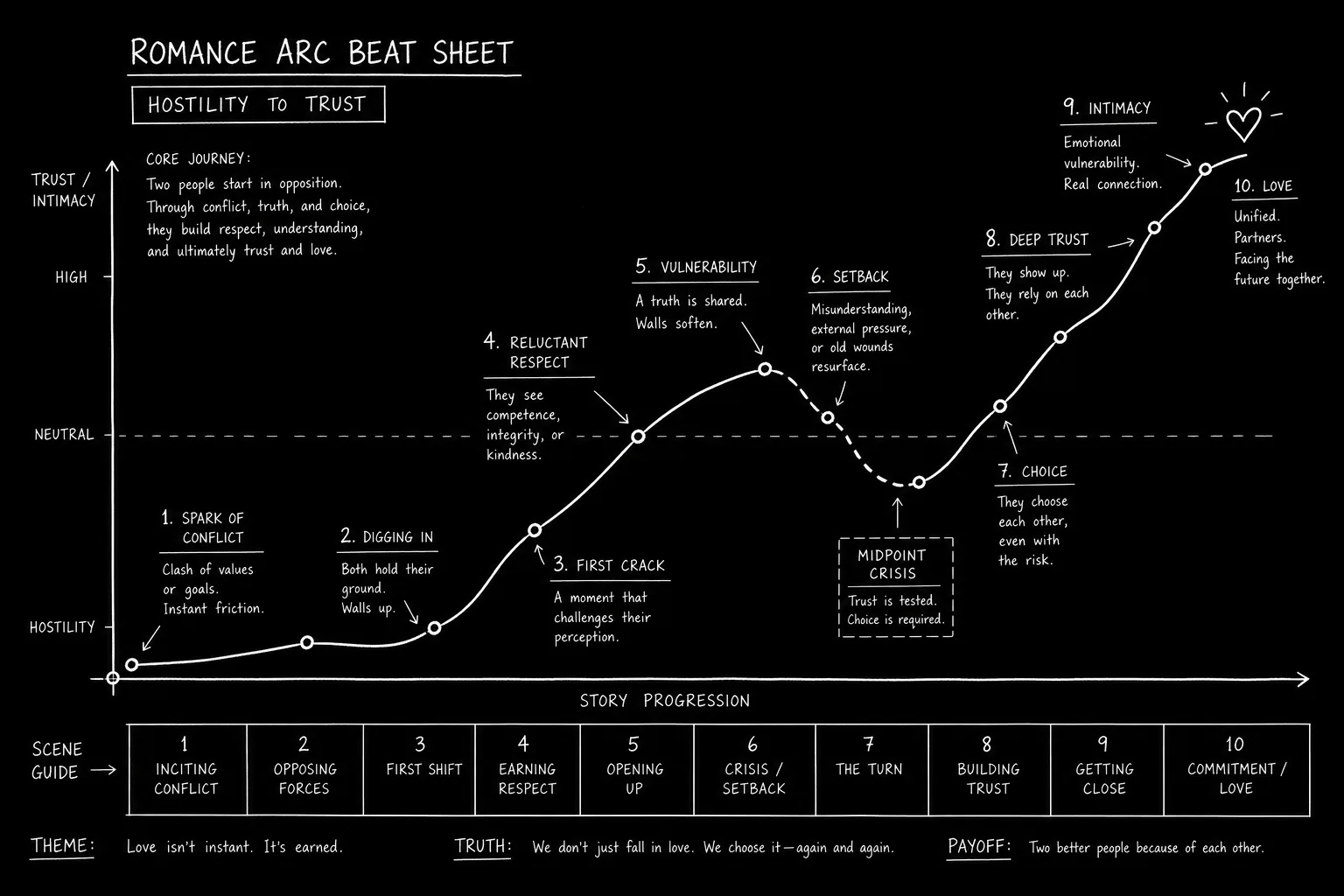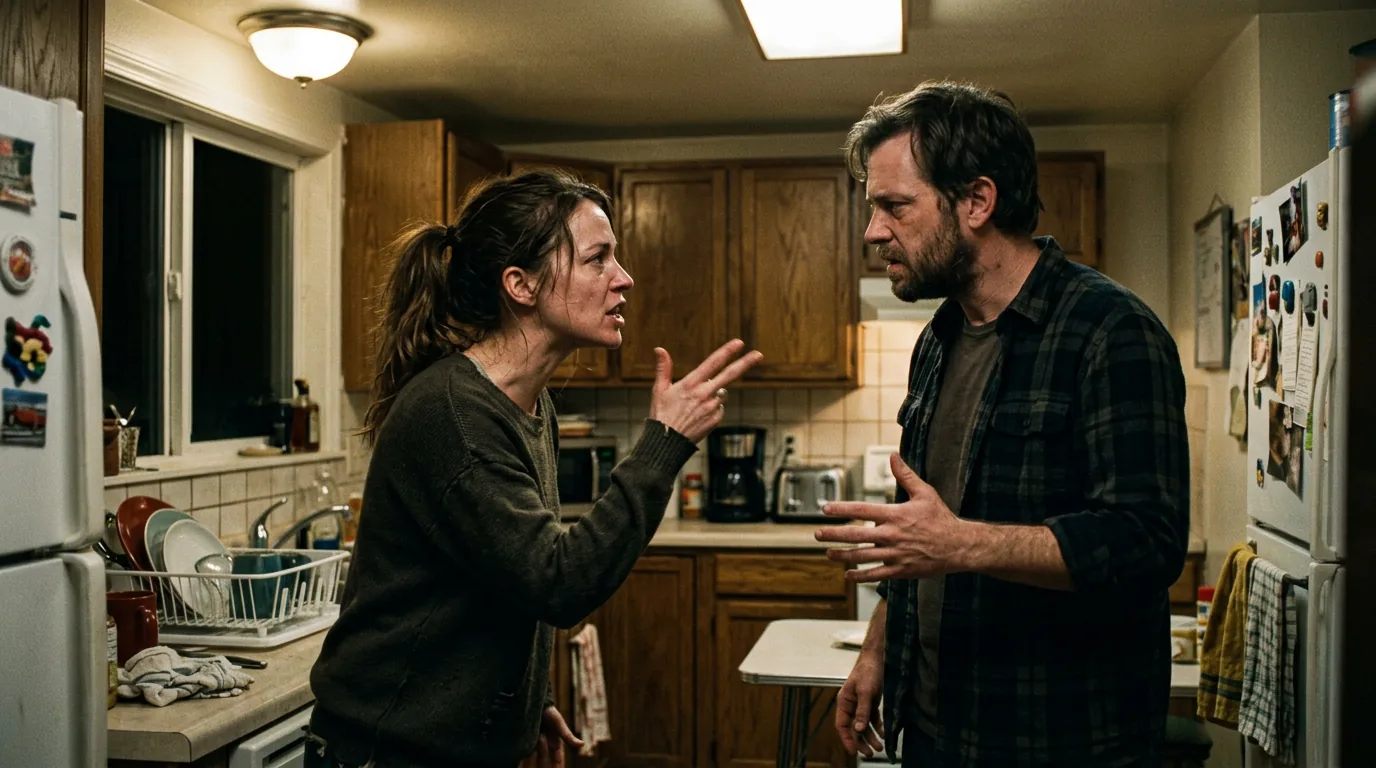

Two characters yell the same point three different ways.
Page after page.
Nothing changes.
That is not an argument scene. That is a loop.
Great argument scenes feel dangerous because every line shifts leverage, exposes vulnerability, or changes the tactical landscape. Bad argument scenes feel exhausting because characters keep repeating claims without new pressure.
Most beginners think argument intensity comes from volume, profanity, and interruption frequency. It does not. Intensity comes from progression.
Here’s why that matters: readers tolerate heat only when heat produces movement. If your argument scene repeats beats, even strong dialogue lines start feeling thin.
Think about it this way: an argument scene is a negotiation under emotional duress. If positions do not evolve, the scene stalls no matter how sharp the insults are.
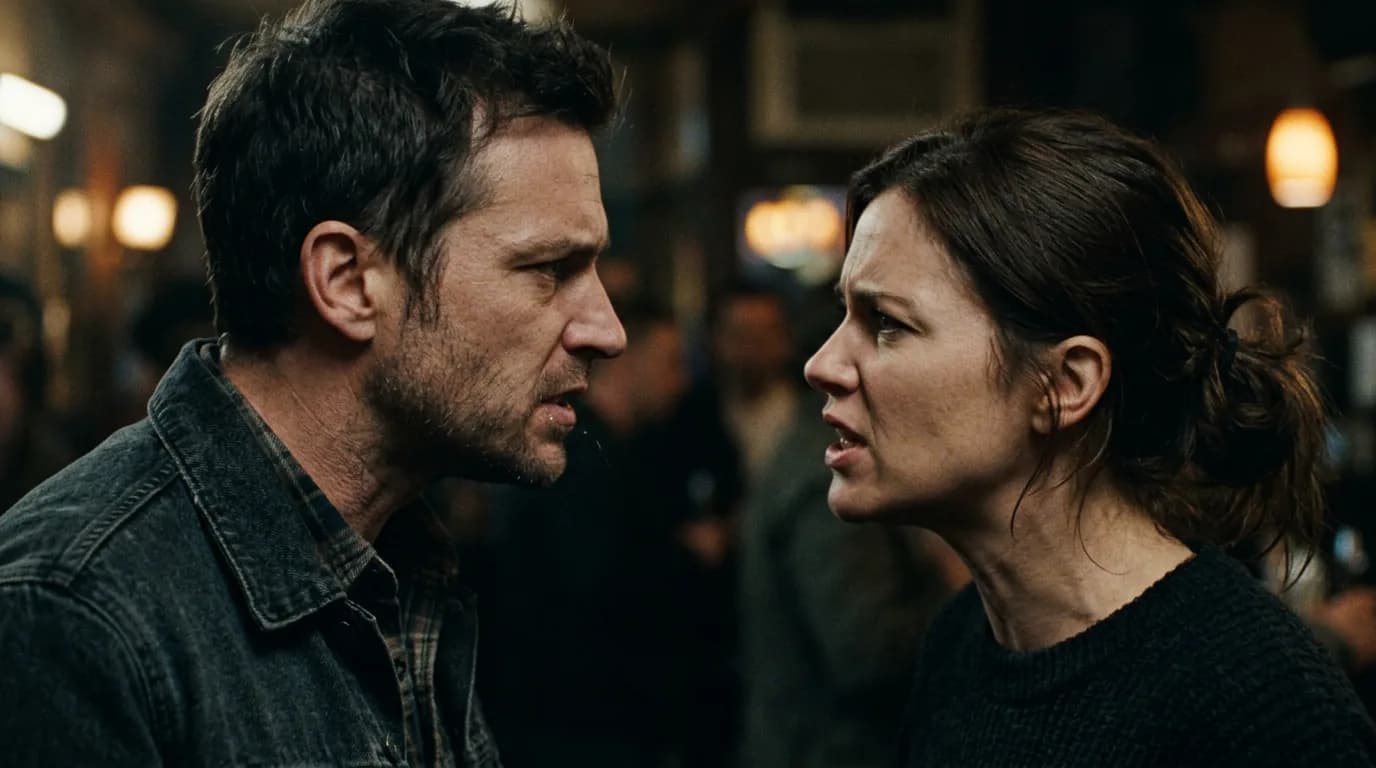
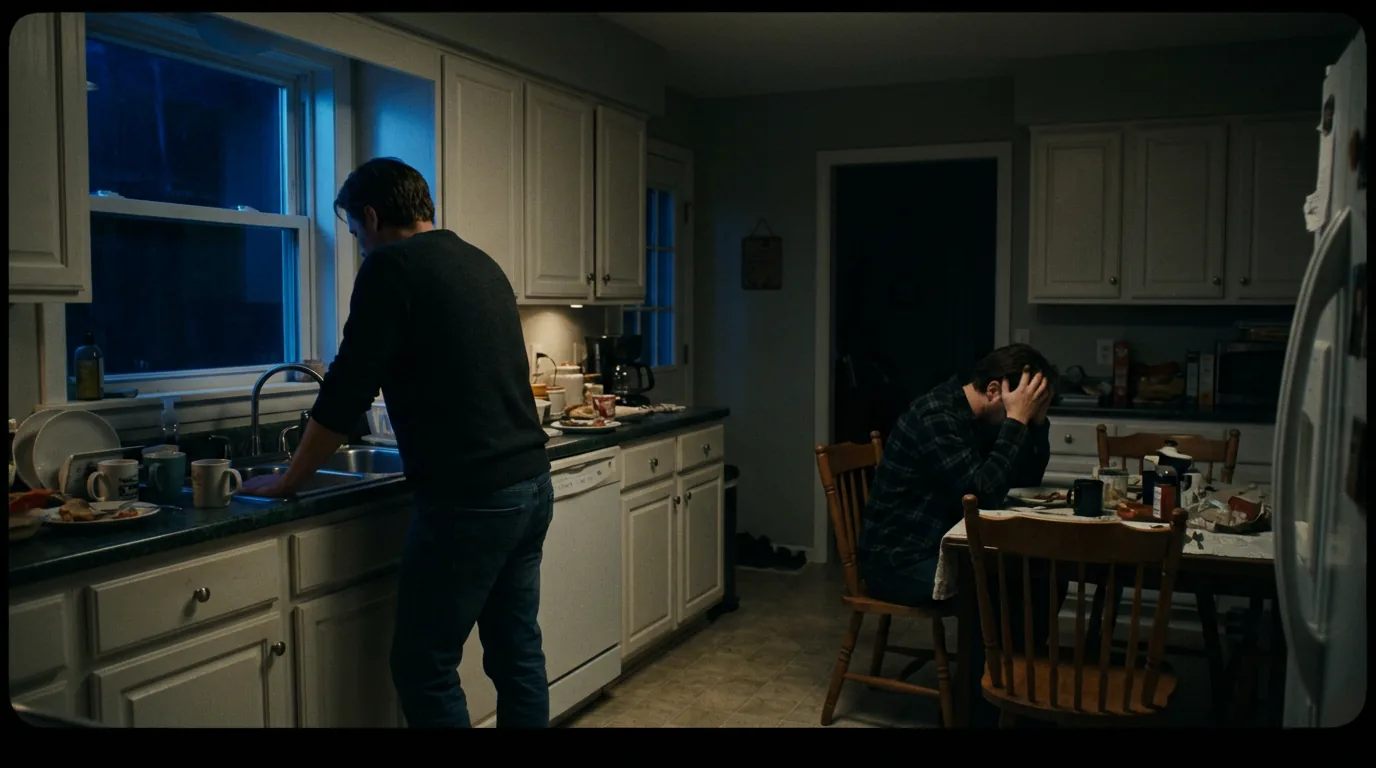
Cinematic workflow frames
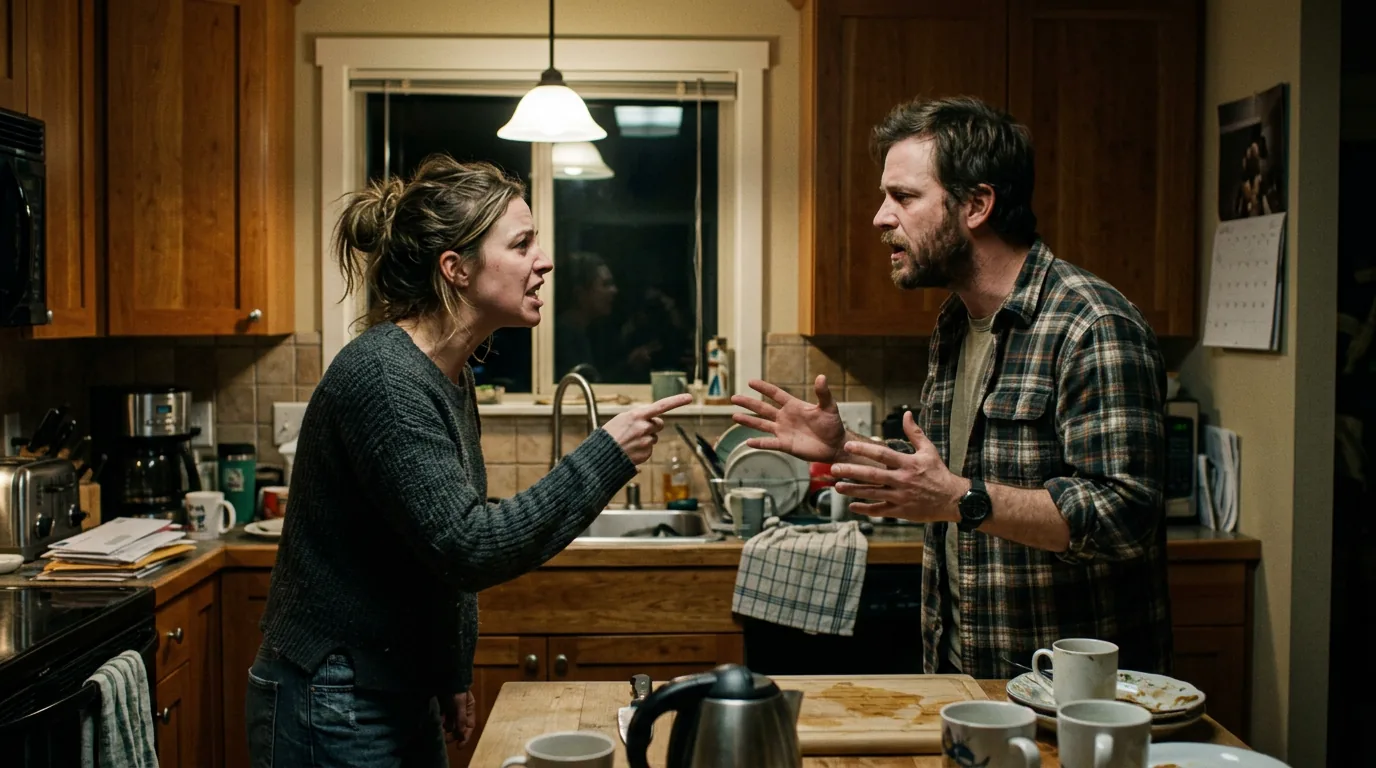
These two visuals work as a pair: the first shows Cinematic workflow still, first angle, 35mm film grain, and the second shifts to Cinematic workflow still, second angle, 35mm film grain - compare them briefly, then move on.

What Makes Argument Dialogue Repetitive
Repetition usually appears when one or more of these is missing:
clear objective per speaker,
stakes escalation,
new information,
tactical shifts,
behavioral consequence.
Without these, characters recycle wording instead of advancing conflict.
In argument scenes, each exchange should either reframe the issue or raise the cost.
Core Formatting and Craft Patterns That Work
Pattern 1: Objective Shift Beats
Track objective changes in-scene: defend, accuse, deflect, confess, bargain, withdraw.
When objective shifts are visible, dialogue naturally avoids repetition.
Pattern 2: Topic Ladder
Structure argument around escalating subtopics rather than one circular claim.
Topic 1: event.
Topic 2: motive.
Topic 3: identity.
Topic 4: consequence.
Pattern 3: Tactical Variety in Line Types
Use different attack vectors:
question,
fact drop,
sarcasm,
silence,
redirect,
ultimatum.
Pattern 4: Action Counterpoint
Arguments are not only verbal. Blocking, object handling, exits, proximity shifts, and interruptions can carry turning beats.
Comparison Table: Flat vs Dynamic Argument Scenes
| Feature | Repetitive Argument | Dynamic Argument |
|---|---|---|
| Line function | Restates same point | Introduces new pressure or reframing |
| Topic motion | Circular | Escalating ladder |
| Character tactics | One-note attack | Tactical variation |
| Behavioral consequence | Minimal | Immediate and visible |
Three Beginner Scenarios That Commonly Fail
Scenario 1: The Relationship Fight That Never Leaves Topic One
Characters repeat “you never listen” in different phrasings for two pages.
Fix: force topic escalation with concrete triggers: finances, family boundary, betrayal evidence, future decision.
Scenario 2: The Workplace Argument With No Stakes Delta
Boss and employee argue, but whether they win or lose line exchanges has no effect on outcome.
Fix: attach argument beats to tangible consequences (suspension, project loss, public embarrassment, resignation).
Scenario 3: The Family Confrontation With Identical Voice
Everyone argues in same cadence and rhetorical style.
Fix: differentiate tactics by character psychology: one weaponizes facts, one weaponizes shame, one weaponizes withdrawal.
Step-by-Step Workflow to Eliminate Repetition
Step 1: Write the Argument Spine in Verbs
Before dialogue, map scene verbs per beat:
accuse -> deny -> expose -> deflect -> corner -> concede -> retaliate -> break.
If verb chain is flat, dialogue will repeat.
Step 2: Define Win Condition for Each Character
What does each person want by scene end?
Validation?
Compliance?
Confession?
Exit permission?
Without distinct win conditions, lines become generic venting.
Step 3: Build Topic Escalation Ladder
Do not let scene hover on one claim.
Plan 3-4 escalation levels where each level raises emotional or practical stakes.
Step 4: Assign Tactical Palette
Give each character a default tactic and a stress tactic.
Default tactic fails -> stress tactic appears.
That pivot creates freshness.
Step 5: Insert Physical Turning Beats
Use movement and props as conflict pivots: grabbing keys, opening door, deleting text, revealing document, stepping into/out of space.
Step 6: Trim Redundant Assertions
During rewrite, delete any line that does not add new information, pressure, or tactic.
Step 7: Run Progression Audit
After final pass, summarize each 5-8 line block in one sentence.
If two adjacent blocks summarize the same way, repetition remains.
Body Image: Argument Escalation Ladder
The Trench Warfare Section: What Beginners Get Wrong and Exact Fixes
Failure 1: Volume Inflation
More shouting, same content.
Fix: increase consequence, not decibel level.
Failure 2: Circular Claims
Characters recycle accusations.
Fix: enforce topic ladder progression.
Failure 3: No Tactical Evolution
Each character argues with same strategy throughout.
Fix: force tactic pivot after failed attempt.
Failure 4: No New Information Drops
Arguments stay opinion-only.
Fix: add timed factual reveals or receipts.
Failure 5: Unclear Stakes
Reader cannot tell what is at risk.
Fix: state or show concrete loss conditions.
Failure 6: Identical Character Voice
All speakers use same rhythm and logic style.
Fix: assign unique rhetorical patterns per character.
Failure 7: Static Blocking
Characters stand and argue with no spatial change.
Fix: use movement shifts as power indicators.
Failure 8: Emotional Plateau
Scene starts hot and stays same heat.
Fix: vary intensity via silence, withdrawal, or sudden calm.
Failure 9: Overlong Scene Tail
Conflict resolved but dialogue keeps going.
Fix: end at decision pivot or relationship rupture beat.
Failure 10: No Aftermath Trace
Argument ends, next scene behaves unchanged.
Fix: carry behavioral residue into subsequent action.
Repetition dies when every line has a job and every beat has a consequence.
Advanced Craft: Argument as Power Transfer System
High-level argument scenes are less about “who is right” and more about who controls frame, time, and moral narrative.
Frame control: who defines what the fight is about.
Time control: who forces urgency or delay.
Moral control: who claims ethical high ground.
When one character loses control in one domain and gains in another, conflict stays alive and layered.
You can also write argument counter-rhythms:
fast volley section,
sudden silence,
single precise line,
physical action,
re-ignition at higher stakes.
This rhythm variation prevents monotony and gives actors playable turns.
Workflow and Revision Discipline
Keep an argument-scene ledger:
beat number,
speaker objective,
tactic used,
new pressure introduced,
outcome shift.
Use this ledger to cut repetition surgically.
During line edits, mark repeated semantic content and collapse duplicates.
Read scene out loud with two voices. Repetitive beats become obvious in audio even when they hide on page.
For broad dialogue craft references, the <a href="https://johnaugust.com/scriptnotes" rel="nofollow">Scriptnotes archive</a> offers useful perspective on scene dynamics, but your scene-specific objective/tactic progression should drive rewrite choices.
As discussed in our guide on [screenplay formatting for whispered dialogue and hushed scenes], volume modulation can be a tactical tool in argument escalation.
If your argument unfolds across two locations, pair with [how to show simultaneous action in two locations in a script] to preserve shared-clock pressure.
And when argumentative claims are tested against formal records, [how to format a courtroom transcript in a script] helps keep evidence beats clear.
Body Image: Tactic Shift Matrix
YouTube Placeholder
Before-and-After Micro Example
Before:
“INT. APARTMENT - NIGHT
MARA You lied to me.
ELI I didn’t lie.
MARA You did.
ELI No.
MARA You always do this.
ELI You always say that.”
Heat, but no movement.
After:
“INT. APARTMENT - NIGHT
MARA You told me the account was closed.
ELI I told you I handled it.
Mara drops a bank alert printout on the table.
MARA Then why was there a transfer this morning?
Eli reaches for the paper. Mara pulls it back.
ELI It wasn’t for me.
MARA Say her name, then.
Eli looks at the open door, then quietly shuts it.”
Same conflict family.
Now with progression, evidence, tactic shifts, and consequence.
Try it free
Try Screenweaver for free on your script
It is free. Import your existing project, get a clearer view of your outline, and regain control of your story structure in minutes.
Start FreeEnding Perspective: Arguments Need Movement, Not Volume
If your argument scene feels repetitive, the fix is rarely “better insults.”
The fix is structural:
clear objectives,
escalating topics,
tactic variation,
behavioral pivots,
real stakes movement.
Do this, and argument scenes stop sounding like loops.
They become dramatic engines that expose character, force decisions, and leave emotional shrapnel in the scenes that follow.
That is where conflict writing starts to feel professional on the page.
One advanced principle can level up argument scenes quickly: asymmetrical vulnerability release.
If both characters reveal vulnerability at the same pace, scenes can feel overly balanced and predictable.
In stronger scenes, one character reveals too early and loses leverage.
Another withholds too long and loses credibility.
That mismatch creates dynamic instability, which is exactly what arguments need.
You can design this intentionally:
Beat 1-2: both defend positions.
Beat 3: Character A exposes personal wound as tactic.
Beat 4: Character B refuses emotional frame and escalates factual attack.
Beat 5: Character A pivots to threat or withdrawal. Beat 6: Character B cracks unexpectedly.
This structure avoids repetitive “you hurt me / no you hurt me” loops and produces richer progression.
Another high-value tactic is argument object leverage.
Arguments feel repetitive when they are all verbal volley.
Introduce contested objects that carry stakes:
keycard, phone, contract, ring, recording, passport, evidence printout.
As control of object changes, dialogue naturally shifts because tactical reality shifts.
Practical Drill: Duplicate-Meaning Cut Pass
Mark every line whose meaning is already implied by a previous line.
Delete half of them.
Then read scene aloud.
Most argument scenes get stronger immediately because characters stop narrating feelings and start fighting for outcomes.
Practical Drill: Tactic Rotation Exercise
Assign each character three tactics and force no tactic to repeat more than twice consecutively.
Example:
Character A: accusation -> sarcasm -> silence. Character B: denial -> factual proof -> moral inversion.
This artificially constrained pass helps expose repetitive writing habits you may not notice otherwise.
Practical Drill: Exit Attempt Rule
In every major argument scene, script at least one attempted exit (physical or conversational).
Arguments gain energy when someone tries to end them and cannot, or succeeds at a cost. This creates turning points without extra shouting.
Practical Drill: Stakes Delta Check
Before and after scene, write one sentence for each character:
what they can lose now.
If sentence is unchanged after argument, scene likely has heat but no consequence.
You can also improve argument realism by differentiating rhetorical logic systems.
One character argues from evidence.
One from emotional memory.
One from status hierarchy.
One from future fear.
When logic systems clash, repetition drops because lines are not mirror images. When both characters argue from same logic system, loops appear quickly.
From pacing perspective, insert strategic negative space.
Not every beat needs a spoken reply. A glass set down too hard, a message deleted, a door locked, a long look at a packed suitcase - these can advance conflict more effectively than one more accusation line.
This is where no-dialogue craft strengthens dialogue scenes.
Operationally, keep an argument progression ledger:
topic state, tactic state, power holder, stake level, relationship status.
Update it during rewrites. If two adjacent beats show no state change, you likely found repetition. Revise there first.
One final sequence-level strategy: vary argument architecture across your script.
Do not write every conflict scene as immediate explosion.
Use different entry patterns:
cold restraint that fractures late, mid-scene ambush, public argument with private subtext, quiet argument with lethal implications, argument interrupted before resolution.
This variety keeps conflict fresh and prevents tonal fatigue.
At the highest level, great argument writing is less about “angry lines” and more about systems under stress: identity systems, relationship contracts, social roles, and future plans. Each line should test one of those systems.
If your scene tests systems and changes outcomes, repetition disappears naturally.
And once repetition is gone, readers can feel the real thing hiding underneath all conflict: fear of irreversible change.
One final high-impact framework is argument outcome taxonomy.
Not every argument should end in the same mode. If your script repeatedly lands on “one person storms out,” repetition returns at scene level even if line writing is strong.
Use varied outcomes:
forced truce,
pyrrhic win,
mutual damage,
deferred detonation,
public mask/private fracture,
false resolution.
Different outcomes create narrative variety and prevent conflict fatigue.
Another advanced strategy is asymmetrical information release timing.
Character A may know the crucial fact early and choose when to deploy it.
Character B may discover it mid-argument and reframe entire scene.
Character C (if present) may misunderstand both and trigger accidental escalation.
This timing geometry keeps arguments dynamic because stakes are attached to reveal timing, not just reveal content.
Practical Drill: Outcome Diversity Audit
List all major argument scenes in your script.
Tag each by ending mode.
If same ending mode appears too often, redesign at least one scene with a different conflict result.
Practical Drill: Reveal Timing Swap
Take one key reveal line and move it two beats earlier, then two beats later in alternate drafts.
Observe which placement creates best escalation curve.
This test often exposes hidden repetition because many scenes repeat not due to line quality, but due to mistimed reveals.
Practical Drill: Argument-to-Action Bridge
For every argument scene, script the first concrete action in the next scene that proves emotional residue.
If no bridge exists, conflict may feel isolated.
If bridge is strong, scene impact compounds across structure.
From a professional rewrite standpoint, argument scenes are often where producers give notes like “feels samey” or “we’ve heard this already.” The fastest fix is not more punchlines. It is beat redesign: new objective, new tactic, new consequence.
You can even use a hard rule in revision: no two consecutive argument beats can share both topic and tactic. If they do, rewrite one immediately.
This constraint sounds strict; it rapidly improves scene velocity.
Finally, remember that memorable arguments are rarely about winning the line. They are about exposing what each person is willing to risk to preserve identity, love, power, or survival.
When each line forces that risk into the open, repetition disappears because stakes keep mutating in real time.
That is where conflict scenes stop feeling written and start feeling inevitable.
One last practical lens: argument scenes are often where audience allegiance shifts. Track allegiance drift intentionally. If both characters remain equally sympathetic from first line to last in every fight, emotional stakes can feel static. Let one scene tilt empathy one direction, another scene correct it, a third scene complicate both. This creates narrative friction without needing bigger plot events.
Practical Drill: Allegiance Drift Map
At three points in each argument scene (opening, midpoint, ending), mark which character the audience is likely to empathize with most and why.
If map never changes, consider adding a reveal, tactic pivot, or vulnerability beat.
Practical Drill: Sentence-Length Volatility
Read your argument aloud and mark sentence length patterns. If all lines are similarly short and punchy, scene can feel monotonous. If all lines are similarly long and explanatory, scene can feel heavy. Mix clipped attacks with one or two longer strategic lines to vary rhythm and keep tension unpredictable.
Practical Drill: Nonverbal Counterclaim
Add one nonverbal counterclaim beat for each major verbal accusation.
Example:
Accusation: “You abandoned me.” Counterclaim action: character quietly presents timestamped voicemail list showing twelve unanswered calls.
This prevents arguments from becoming purely rhetorical loops.
From a production standpoint, directors and actors often reshape argument dialogue heavily in rehearsal. If your underlying beat architecture is strong, the scene survives line changes. If architecture is weak, improvisation tends to amplify repetition. So focus first on beat progression, then on word-level polish.
When you do that, argument scenes become resilient - not just well-written in draft, but adaptable under real-world collaboration.
Final Step
Build your next script with Screenweaver
Move from ideas to production-ready pages faster with timeline-native writing and AI-assisted story flow.
Try Screenweaver