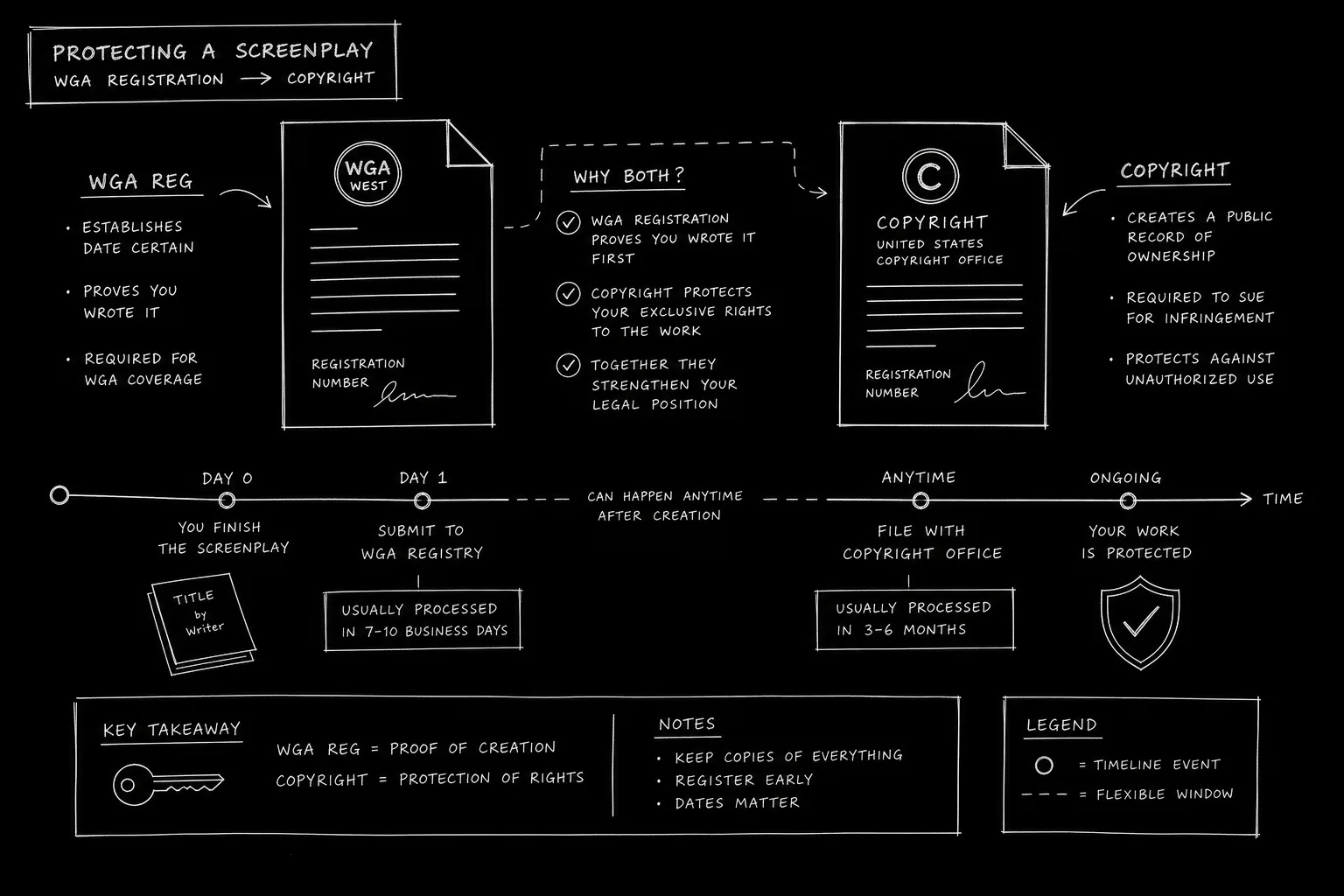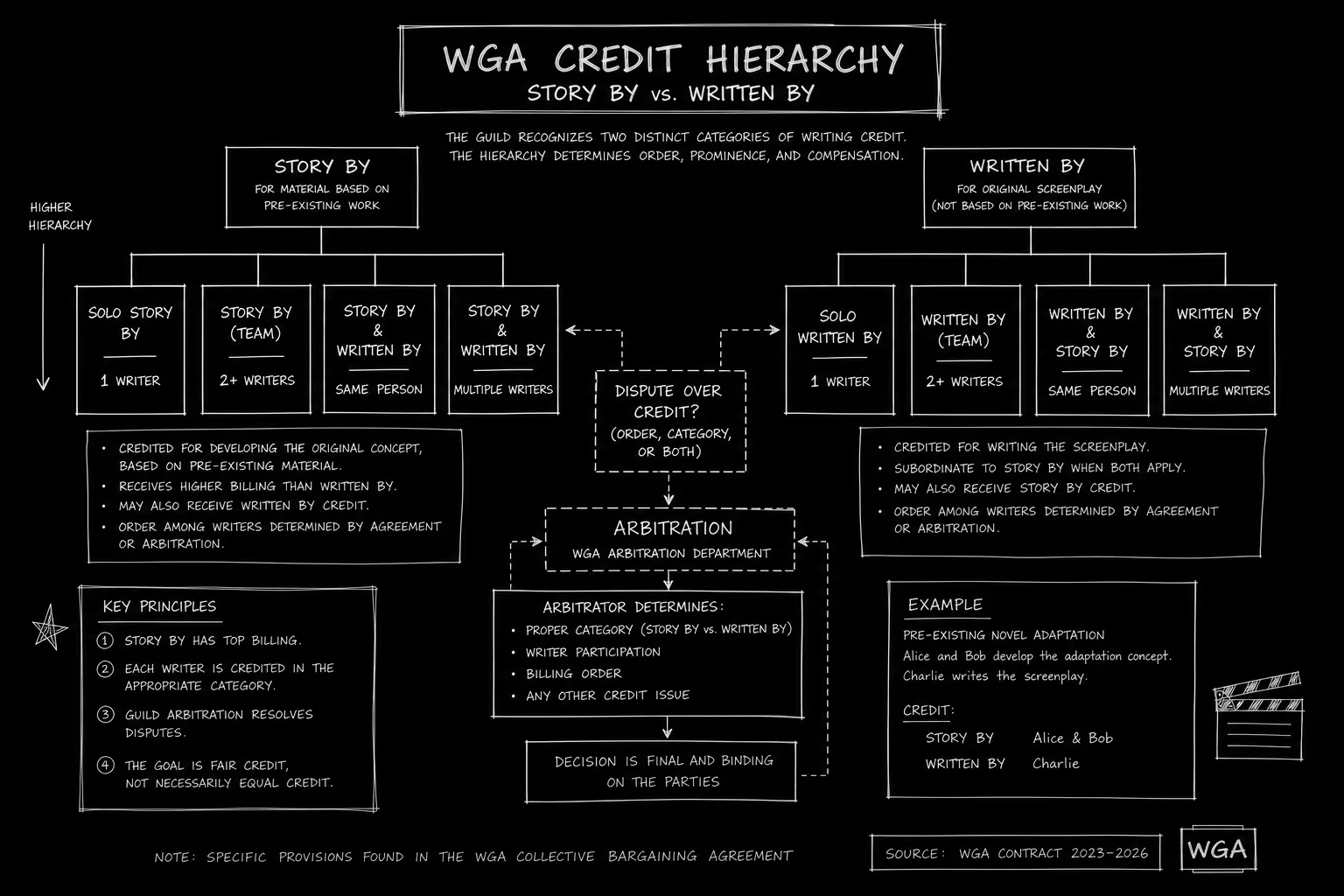

Credit is not gratitude. On WGA-covered projects, screen credit is contract language that affects residuals, career signaling, and who gets blamed in public when the movie works or does not. Two writers in a room can finish a brilliant draft and still lose sleep over whether the card should read "Story by" or "Written by," or whether the "&" vs "and" fight is worth a process fee.
This article explains WGA credit concepts in plain production terms so co-writers document work early, negotiate honestly, and avoid surprises at arbitration.
This is general educational information, not legal advice. Specific projects follow Guild agreements, company policies, and arbitration outcomes.
Free tool: use the Beat Sheet Calculator to map these beats to exact page numbers for your script length.
How It Works: Separation of Story and Screenplay Credit
The WGA distinguishes story contribution from screenplay execution. In simplified terms:
- Story by: credit for narrative material (plot, characters, structure) that may not be the final script draft.
- Written by: credit for screenplay work on the script that shoots (or the final development draft that qualifies under rules).
On many films, cards read Story by X, Screenplay by Y or combined forms when the same writers earned both levels per process. Television has its own credit matrices by format (episodic, limited, room), but the underlying idea persists: who built the narrative engine vs who wrote the pages.
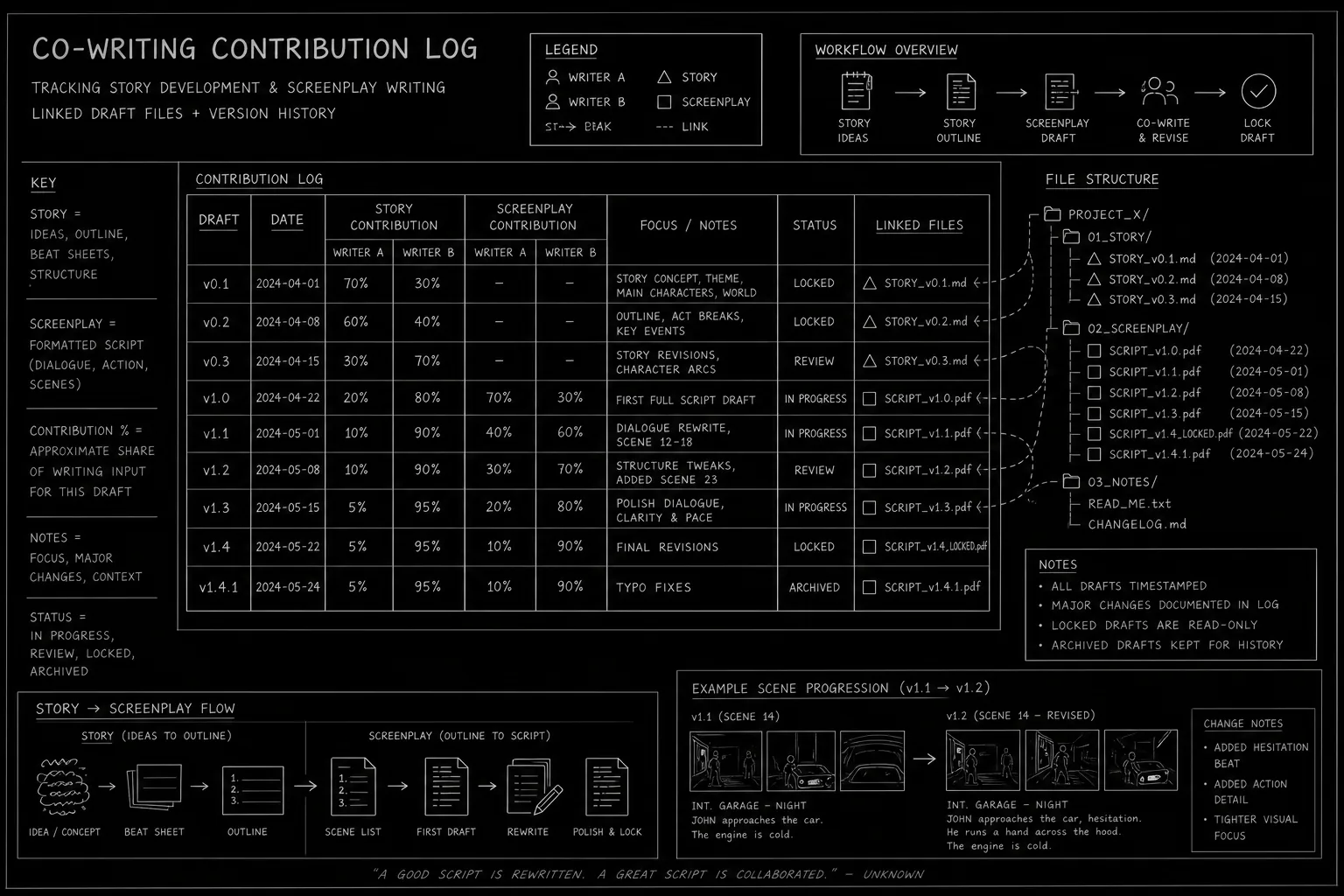
Co-writing teams should track contributions from day one. Not because friendship ends. Because memory is unreliable and studios document everything.
For revision documentation habits, see WGA revision colors explained and color-coding rewrites.
Platform and Use-Case Sections
Theatrical Features
Feature credit often goes to arbitration if writers disagree. Treatments, prior drafts, and pitch documents become evidence. "We outlined together" is weaker than dated draft exports with writer initials.
Television Writers' Rooms
Room credit rules differ from feature rules. Staff writers may receive "Story by" or shared teleplay credit depending on draft contribution and showrunner allocation. Showrunner sign-off is political and contractual.
Streaming Limited Series
Limited series sometimes blur feature and TV customs. Clarify credit expectations in the deal memo before the room opens, not at picture lock.
Non-WGA or Indie Projects
Outside WGA jurisdiction, contracts still matter. Write credit terms into option agreements and collaboration contracts explicitly.
Relatable Scenario: The Room Rewrite Surprise
You built the treatment and Act One. A staff writer joins for a production polish and rewrites seventy percent of dialogue. They ask for "written by" on the feature. Your draft history shows story architecture vs late polish. Without exports, the conversation becomes memory vs memory. With exports, you negotiate from facts.
Relatable Scenario: The "&" Friendship Breaker
Two writers agree to "&" before anyone reads the contract. Later, one writer is largely unavailable during production rewrites. Guild customs and company policy may not match the friendship promise. The "&" conversation should include availability during production, not only writing the first draft.
Television vs Feature: Quick Comparison
| Context | Story Credit Often Reflects | Written Credit Often Reflects |
|---|---|---|
| Feature | Treatment, pitch, structure | Drafts that shoot |
| TV pilot | Series premise, bible | Teleplay execution |
| Episodic room | Breaks, story area | Draft assignments |
| Rewrite hire | Prior material | New pages only |
Step-by-Step: Protecting Co-Writers Before Arbitration
Step 1 - Define roles in a collaboration memo
Even among friends, one page: who handles structure, who handles dialogue, how revisions split, how credit will be proposed.
Step 2 - Version every draft with names and dates
Use software with history or dated PDF exports. "Final_draft2_BLUE.pdf" is not evidence; metadata is.
Step 3 - Log story milestones
Outline approvals, beat sheet sign-offs, and pilot story breaks are story-credit relevant. Save emails.
Step 4 - Separate story pitches from polish passes
If one writer joins late for dialogue polish, credit expectations differ from the writer who built the treatment.
Step 5 - Discuss "&" vs "and" early
Ampersand traditionally implies equal writing partnership on produced screenplay; "and" can imply sequential contribution. Confirm with your reps.
Step 6 - Engage reps before signing anything
Never accept informal verbal credit promises without contract reflection.
[YOUTUBE VIDEO: Entertainment attorney or WGA representative explains a simplified credit arbitration timeline using anonymized examples of story vs screenplay evidence.]
Try it free
Try Screenweaver for free on your script
It is free. Import your existing project, get a clearer view of your outline, and regain control of your story structure in minutes.
Start FreeOperational Requirements: Documentation, Room Etiquette, and Deals
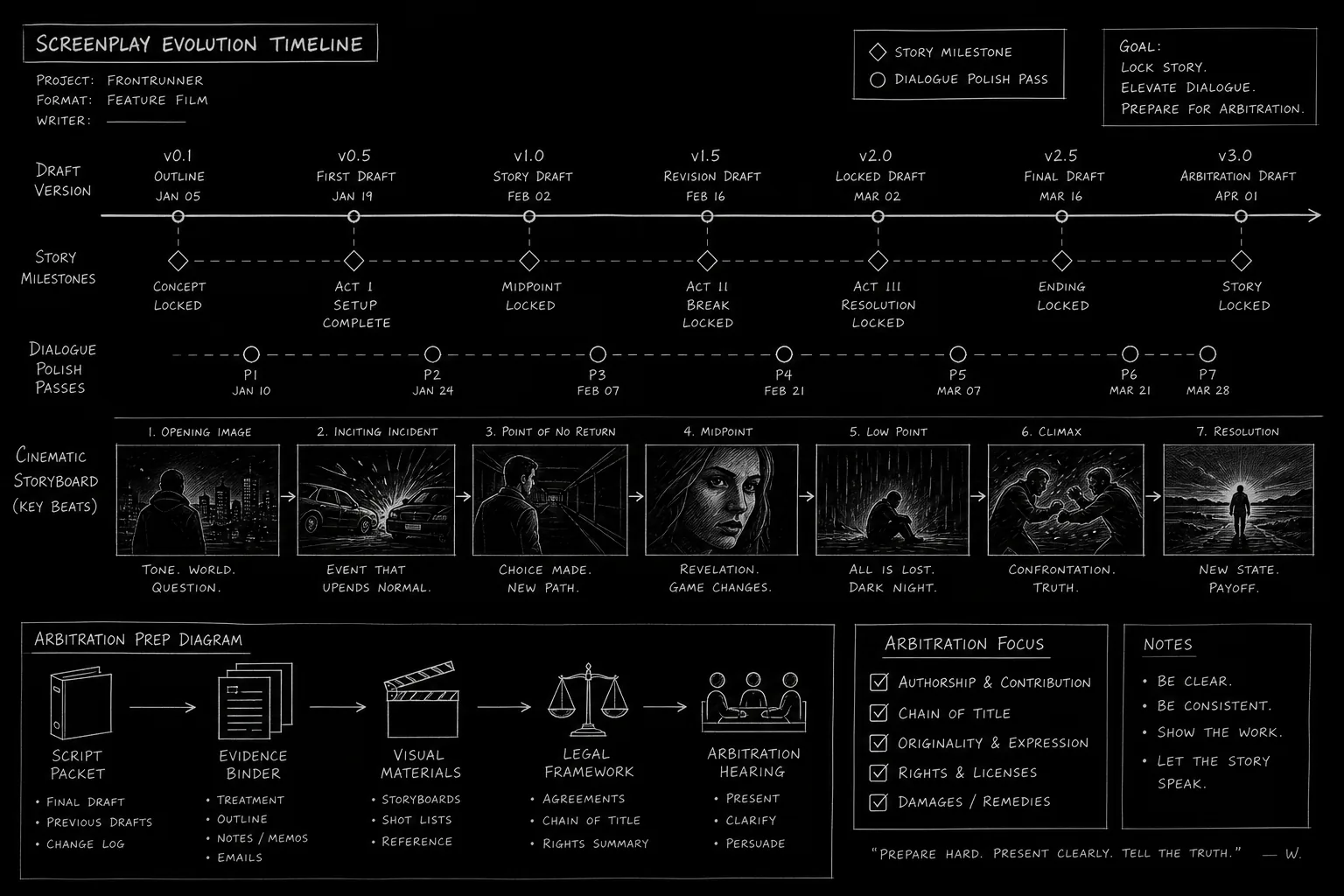
Draft chain: Arbitration reviewers examine draft progression. Gaps hurt credibility.
No ghosting: Uncredited substantial work still happens; fight it with documentation, not Twitter.
Showrunner notes: In TV, note which writer executed note passes; polish passes can be teleplay credit relevant.
Separated rights: Feature writers care about separated rights implications tied to credit. Ask reps.
International co-writes: Credit customs differ abroad; WGA arbitration may still apply on WGA signatory productions.
| Term | Plain Meaning | Writer Action |
|---|---|---|
| Story by | Narrative architecture credit | Save outlines, pitches |
| Written by | Screenplay draft credit | Save script versions |
| Screenplay by | Common on-card phrasing | Align with contract |
| & vs and | Partnership vs sequence signal | Clarify with reps |
| Arbitration | Formal dispute resolution | Prepare draft history |
When co-writing in software, use workflows that support real-time co-writing sync and export history.
Outcome: Fair Cards and Functional Partnerships
When co-writers document early, credit conversations stay professional. Many teams reach agreement without arbitration because the draft record makes contribution visible. Fair cards protect friendships and futures: residuals follow credit, and next hires follow credit.
Even wrong outcomes hurt less when the process was understood upfront.
Why It Matters: Vibes-Based Credit vs Evidence-Based Credit
The old way: "We will split everything 50/50, we are best friends," no dated drafts, panic when the studio picks one name for marketing.
The new way: Collaboration memo, version discipline, early rep involvement, credit proposed from evidence.
Vibes do not survive development. Evidence does.
Conclusion
"Story by" and "written by" are not vanity lines. They are economic and professional fact on WGA-covered work. Co-writers who love the work should love the paperwork too: memo, dated drafts, clear division of labor, rep conversations before signatures.
Write the script together. Document the script like adults. When credit questions rise, you will have answers instead of arguments. For the craft side of splitting work, pair this with screenplay revision passes so you know which pass you each own.
If you are entering a co-write, schedule a credit conversation the same week you schedule writing sessions. Awkward early beats save friendships and careers. Ask: What happens if we disagree? Who is the rep? What is our proposed card before the studio proposes one for us?
Remember that credit on screen is not the only recognition that matters, but it is the one that pays residuals and opens doors. Generosity is a virtue; documentation is how generosity stays honest when studios apply pressure.
When you option or sell, verify how credit will be determined in the contract: predetermined, subject to WGA arbitration, or subject to company policy. "We will figure it out later" is how later becomes expensive. Ask your representative to explain the path before you celebrate the deal.
Junior writers joining established partners should clarify story contribution vs polish contribution in writing before the first shared outline session. Assumptions favor the person who has been in the industry longer unless paperwork says otherwise. Paperwork is cheaper than arbitration fees and cheaper than a friendship.
Final Step
Build your next script with Screenweaver
Move from ideas to production-ready pages faster with timeline-native writing and AI-assisted story flow.
Try Screenweaver