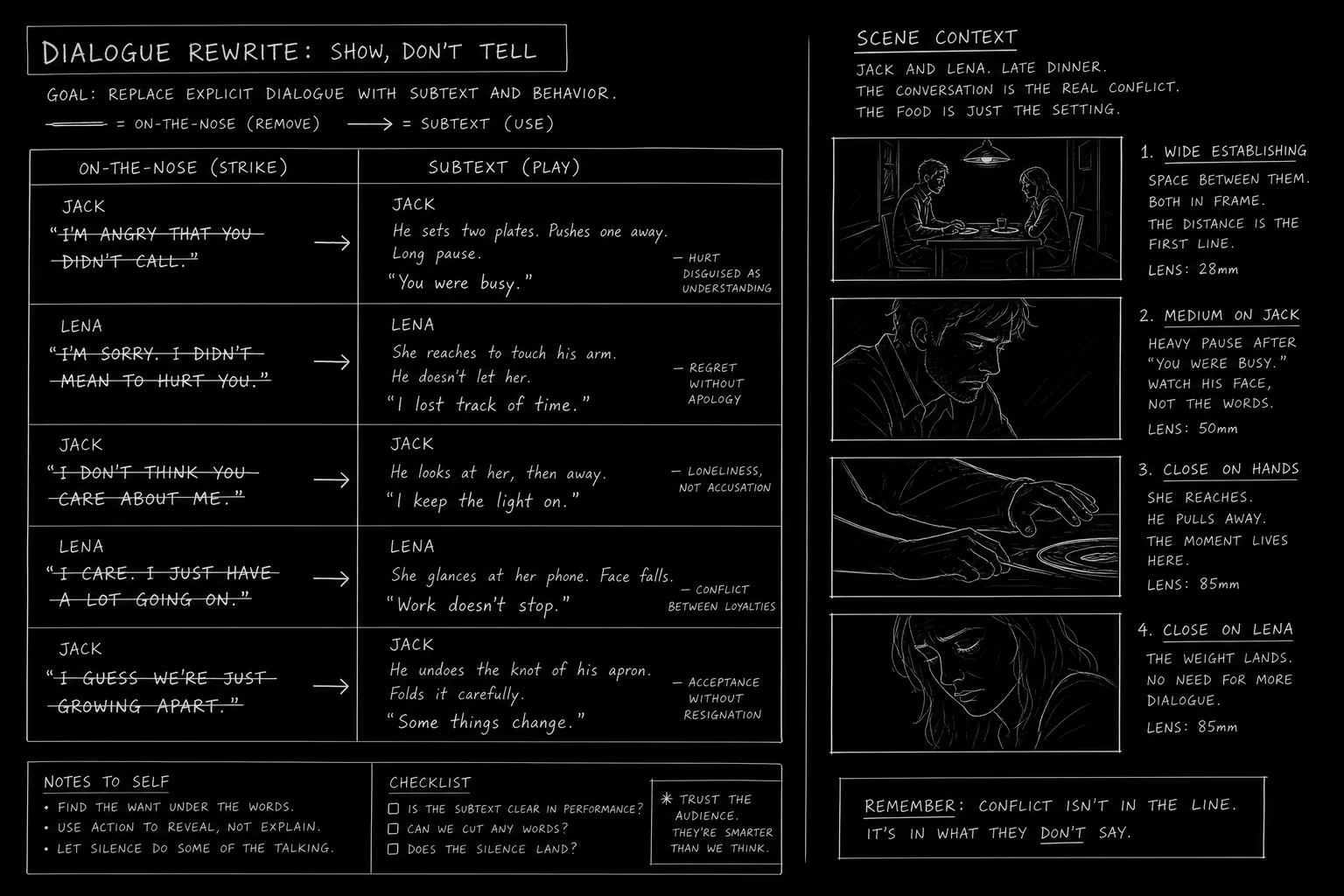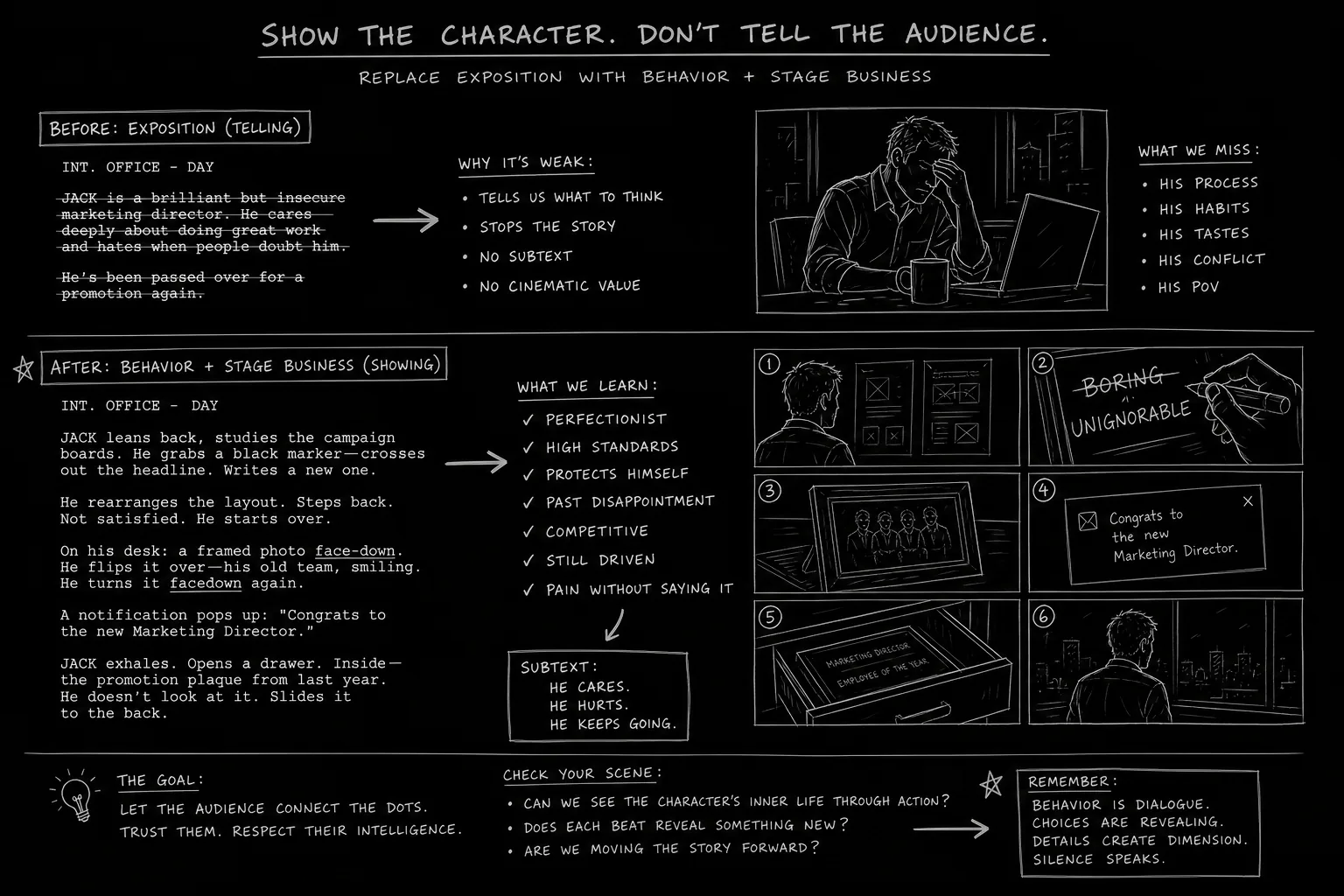

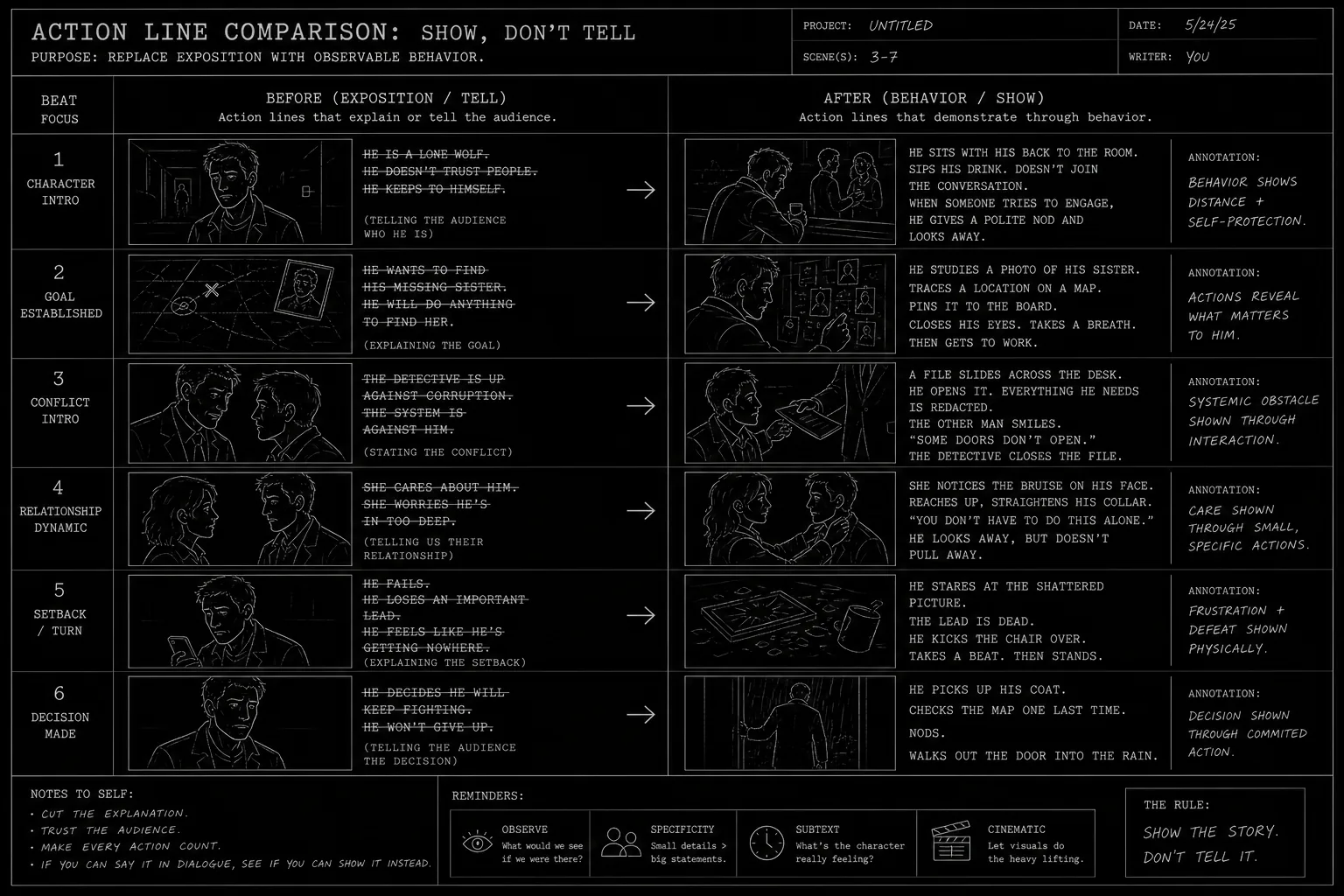
Readers do not owe you their imagination. They owe you clarity. "Show don't tell" is not a ban on words. It is a ban on explaining what the camera and actor could already prove. When action lines read like a novelist summarizing psychology, the script feels literary and unshootable. When action lines describe behavior, objects, and spatial pressure, the same story feels like cinema.
This is a dedicated action lines pass: a revision mode where dialogue stays mostly frozen while you rewrite what we see.
Free tool: use the Script Time Calculator to estimate your runtime from page count.
How It Works: Behavior on the Page
Film tells through visible choice. A character who is nervous taps a pen, avoids a mirror, answers a question with a wrong name. A character who is powerful lets others speak first, touches nothing, leaves early. Your pass converts label lines ("She is anxious") into behavior stacks the actor and DP can execute.
The pass runs after structure is stable. If you show-dont-tell a scene that should be cut, you polished furniture in a burning house. Run structure first via screenplay revision passes, then return here.
Platform and Use-Case Sections
Features
Features reward economical action lines that survive scheduling pressure. One strong behavior beat per paragraph beats three adjectives.
Television
Procedural and serialized TV needs readable pages for speed. Behavior-based action helps directors block quickly on a 8-day episode.
Limited Series / Prestige
Slower pacing allows richer visual storytelling, but still avoid internal state exposition. Use silent scene craft as your north star for low-dialogue sequences.
Action and Genre
Genre scripts sometimes over-describe stunts. Show character intent through action choices, not blow-by-blow novelization. Leave room for stunt coordination.
Relatable Scenario: The Grief Scene That Explains Grief
Your character learns a parent died. The action line reads: "She is devastated, years of regret hitting her at once." The actor has nothing to play except a face. Rewrite: she irons a shirt already pressed, hangs it, removes it, folds it wrong, stops. No tear adjectives. The behavior sequence is grief. The audience supplies the word you were tempted to write.
Relatable Scenario: The Power Office
You introduce a CEO with a paragraph about intimidation and market dominance. Rewrite with room behavior: assistants stand when she enters but she never acknowledges them; she reads a tablet during someone else's pitch; she touches nothing on the desk because nothing there is hers. Status without biography.
The Trench Warfare Section: What Beginners Get Wrong
Adjective stacks. "Cold, relentless, exhausted rain" slows the read. Pick one shootable rain behavior: wipers failing, collar turned up, missed bus.
Novelist camera. "We crane over the city feeling the loneliness." Either write a justified INSERT or cut.
Explaining subtext in action. "He lies" after dialogue that already lied. Trust the scene.
Uniform behavior. Every sad character sighs. Vary physical vocabulary per character.
Blocking the actor. Micro-direction every glance. Give one strong behavior, let performance breathe.
Step-by-Step: The Action Lines Pass
Step 1 - Highlight all "state" sentences
Search for "feels," "is angry," "realizes," "knows," "thinks." Flag interpretive language.
Step 2 - Translate each flag into behavior
Replace state with one observable action. If you need two actions, the emotion may be complex. Good.
Step 3 - Cut redundant dialogue that repeats the action
If she slams the door, dialogue should not announce she is mad unless irony matters.
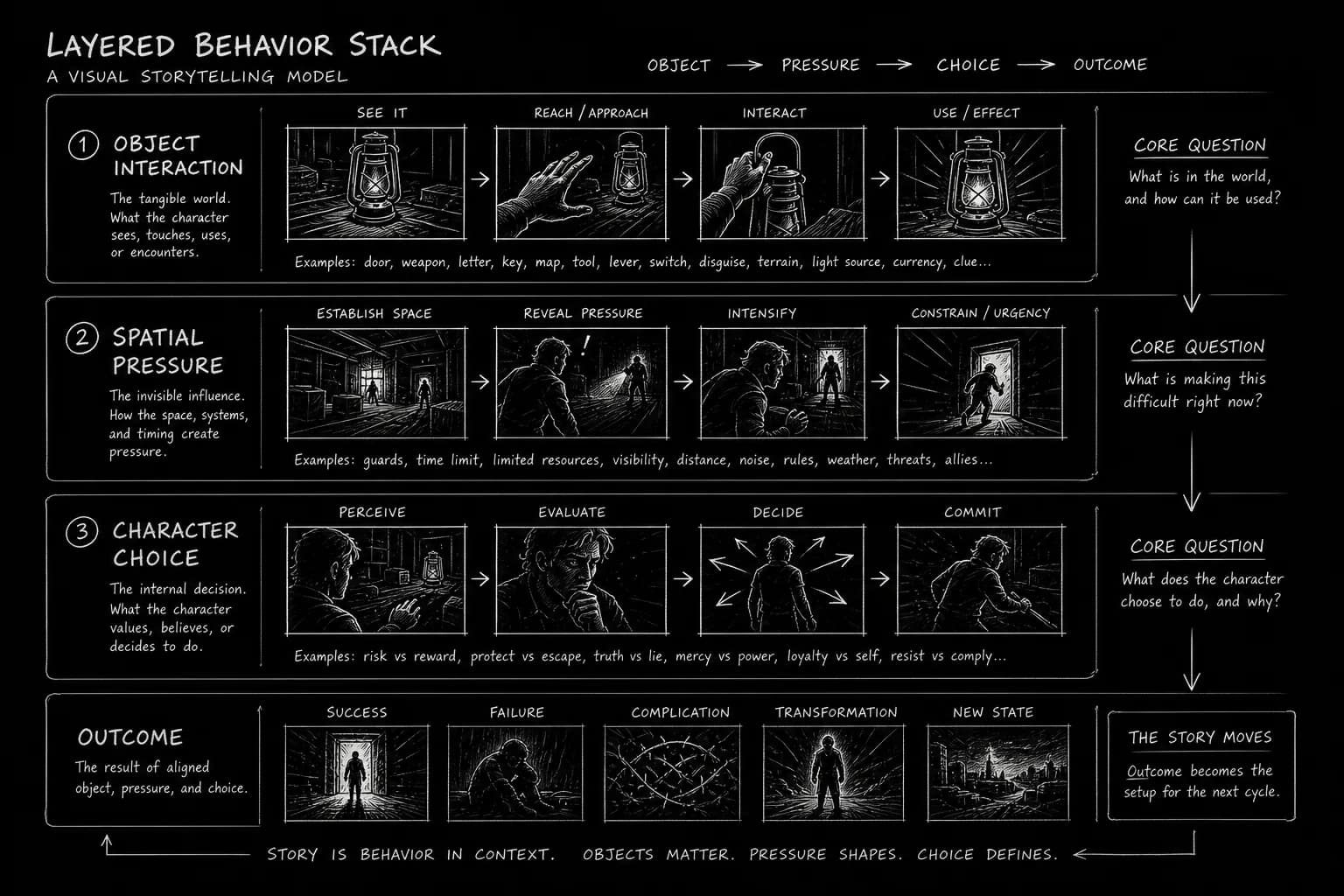
Step 4 - Add object interaction
Objects carry status: unpaid bills, wrapped gifts never sent, a phone face-down. Behavior plus object equals show.
Step 5 - Check unfilmable abstraction
If the line cannot be photographed, reframe or cut. See unfilmable action lines for edge cases like unseen backstory.
Step 6 - Read aloud for rhythm
Action lines should breathe. Long dense blocks slow reads. White space is pacing.
Step 7 - Compare before/after scene length
Effective showing often shortens pages. That is a schedule gift.
[YOUTUBE VIDEO: Script supervisor and director read two versions of the same scene, one tell-heavy and one behavior-heavy, noting blocking and performance possibilities from each.]
Try it free
Try Screenweaver for free on your script
It is free. Import your existing project, get a clearer view of your outline, and regain control of your story structure in minutes.
Start FreeOperational Requirements: Style, Clarity, and Production
Present tense: Industry standard. Behavior lands sharper in present tense.
Camera direction: Avoid unless you are directing or the shot is story-critical. Behavior implies framing without ordering the DP.
Capitalization: Character first appearances and key sounds only. Do not capitalize every emotion word for emphasis.
Diversity sensitivity: Behavior descriptions should be actable without stereotype. Show status and wound through choice, not cliché tics alone.
Accessibility: Behavior helps actors build performance without dialogue crutches. Pair with before-and-after status scenes for pure visual turns.
| Tell Line | Show Replacement |
|---|---|
| He is intimidated | He waits for permission to sit |
| She realizes he lied | She stops pouring water mid-pour |
| They are in love | They fold laundry in sync, no eye contact |
| The room is tense | Nobody touches the central chair |
| He is an alcoholic | Morning drawer: empty bottles behind cereal |
Outcome: Pages That Read Like Shootable Cinema
After a true action pass, readers report "I saw the movie." That phrase means behavior carried subtext. Directors mark fewer confused margins. Actors highlight lines they can play physically.
Page count often drops while perceived production value rises. That is the rare rewrite win-win.
Why It Matters: Literary Script vs Shooting Script
The old way: Action lines describe inner life, backstory, and theme in paragraph form. Dialogue explains what we already saw.
The new way: Action lines stack behavior and objects. Dialogue does what only speech can do: misdirect, charm, threaten, lie.
Literary scripts win workshops. Shooting scripts win schedules.
Conclusion
Show don't tell is a pass, not a personality trait. Flag interpretive language, replace with behavior, cut redundant dialogue, read aloud. Your script should make a silent reader see bodies in space making choices.
Run this pass on your ten most expensive or emotional scenes first. When you need dialogue to stay lean afterward, continue with writing dialogue subtext vs exposition. The camera is not a novelist. Write like it is already in the room.
Build a personal tell-word list in your notes: feels, realizes, seems, angry, sad, nervous. Search your PDF exports for those words before every submission. Professional readers notice patterns. A tell-free action pass signals you understand production grammar even if the story is your first feature.
When Telling Is the Right Tool
Rare action lines should name internal state when you are setting up a deliberate contrast the next beat subverts, or when a character narrates in voice-over that contradicts the image. Documentary scripts and mockumentary formats also bend the rule. Know you are bending it.
Cold opens sometimes use one tell line for orientation speed, then switch to behavior for the remaining pages. That is craft, not laziness, if the tell is doing compression work nothing else can do in two seconds of screen time. Default to behavior. Earn the tell.
Schedule this pass on a printed PDF if you can. Screen fatigue makes writers miss their own "feels" and "seems" lines. Paper reveals them. One afternoon with a highlighter beats a week of vague "make it more cinematic" notes from coverage.
Pair behavior passes with props tracked through the script. A coffee cup that appears full in scene one and sits cold and full in scene nine tells abandonment without a line. Chekhov's gun discipline applies to mundane objects too. Showing is often object continuity, not prettier adjectives.
Final Step
Build your next script with Screenweaver
Move from ideas to production-ready pages faster with timeline-native writing and AI-assisted story flow.
Try Screenweaver