
A long time ago, in a galaxy far, far away...
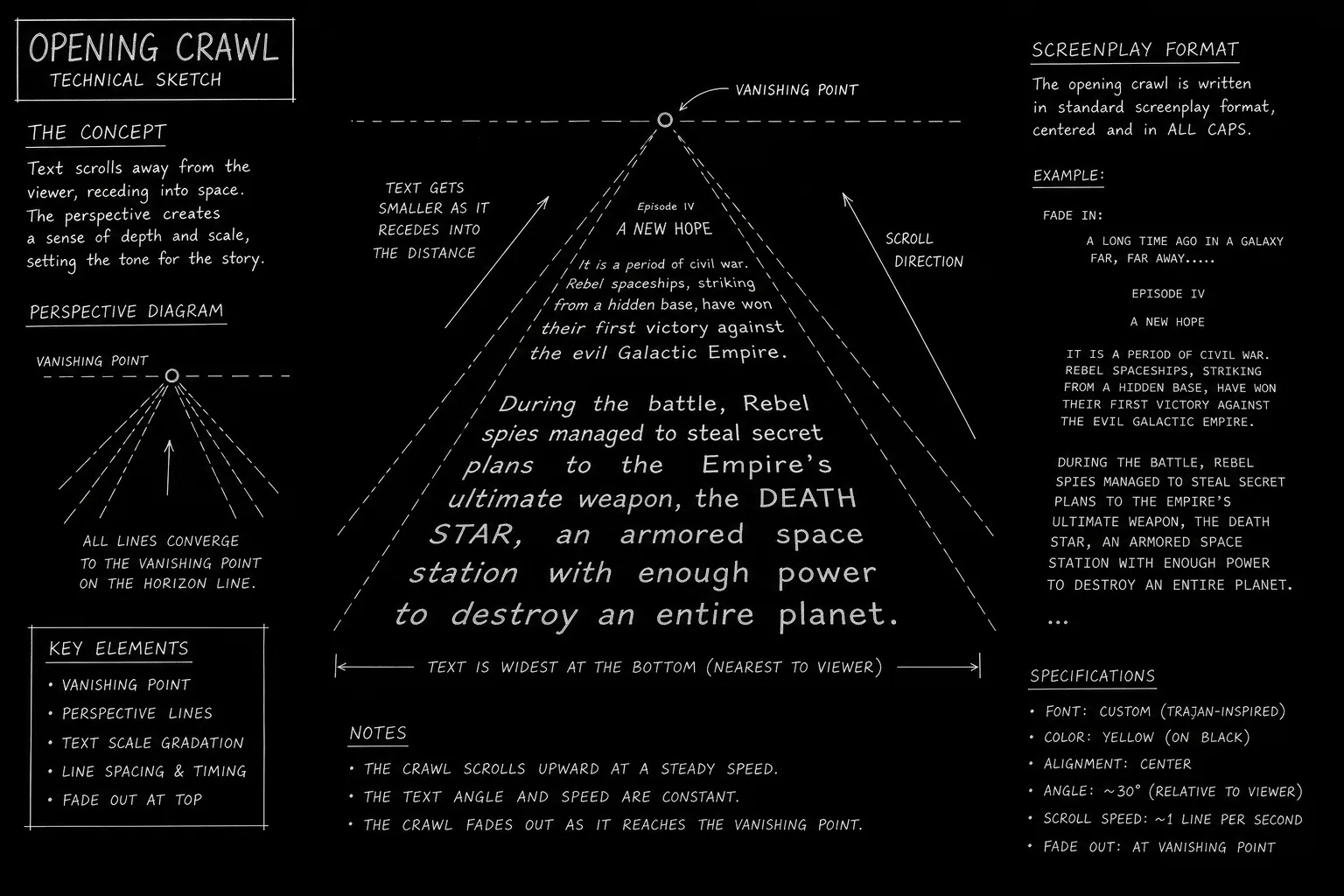
Yellow text crawls into infinity. John Williams swells. Before a single character speaks, the audience knows the war, the stakes, and the mood. The opening crawl is not decoration. It is compressed world-building that buys you minutes of screen time later.
But how do you write it on the page? Screenplay format books rarely cover the crawl. Writers either omit it, bury it in a parenthetical, or paste three paragraphs of prose that production cannot use. This guide shows how to format Star Wars-style opening crawls (and their cousins) so readers, directors, and VFX teams know exactly what appears on screen.
Free tool: use the Slugline Formatter to clean up and standardize your scene headings.
How It Works: What an Opening Crawl Does
An opening crawl delivers context before conflict. It answers questions the audience needs early:
- Where are we in time and space?
- What happened before this story starts?
- Who is fighting whom, and over what?
- What tone should we expect?
The crawl trades cinematic patience for narrative efficiency. You ask the audience to read before they watch. That contract only works if the text is lean, rhythmic, and essential.
Standard placement: Before the first scene heading, or immediately after a [STARFIELD] or OPENING CRAWL slug.
Standard format elements:
- Optional
[LOGO CARD]or title treatment note OPENING CRAWLorTITLE CRAWLheader- The crawl text itself, often in quotation marks or block format
- Transition note:
The crawl recedes into space.orCUT TO:
The crawl is a scene with no characters. Treat it with the same intentionality.
For related on-screen text conventions, see chyrons and supers. For hard sci-fi world-building tone, see hard sci-fi vs. space opera.
Platform and Use-Case Sections
Star Wars-Style Space Opera
Characteristics: Episode number, chapter title, expository prose in paragraph blocks, scroll into starfield.
When to use: Galactic scope, ongoing war, saga storytelling where the audience needs history.
Format example:
OPENING CRAWL

Episode IV
A NEW HOPE

"It is a period of civil war. Rebel spaceships, striking from a hidden base, have won their first victory against the evil Galactic Empire..."

The yellow text recedes into the starfield.

CUT TO:
Historical / Period Drama Crawl
Characteristics: Dates, locations, factual context. White text on black, static or slow push.
When to use: True stories, war films, political thrillers where timeline clarity prevents confusion.
Example opener: OPENING TEXT - SUPER: "Berlin. November 1989. The wall did not fall in one night - but this is the night that changed everything."
Franchise Recap Crawl (Previously On...)
Characteristics: Shorter. Bullet or prose summary of prior installment events.
When to use: Sequel entry points. Streaming "previously on" energy translated to theatrical grammar.
Parody / Subversion
Characteristics: Same visual language, comic or ironic content. Format identically so the reader sees the joke on the page.
When to use: Comedy, satire, films commenting on franchise tropes.
When NOT to Use a Crawl
- Contained single-location thrillers with no backstory requirement
- Character-driven dramas where mystery serves the opening
- Stories where in-scene exposition is more cinematic
If you can open on image and action without confusion, skip the crawl. Respect screen time.
Step-by-Step: Writing Your Opening Crawl
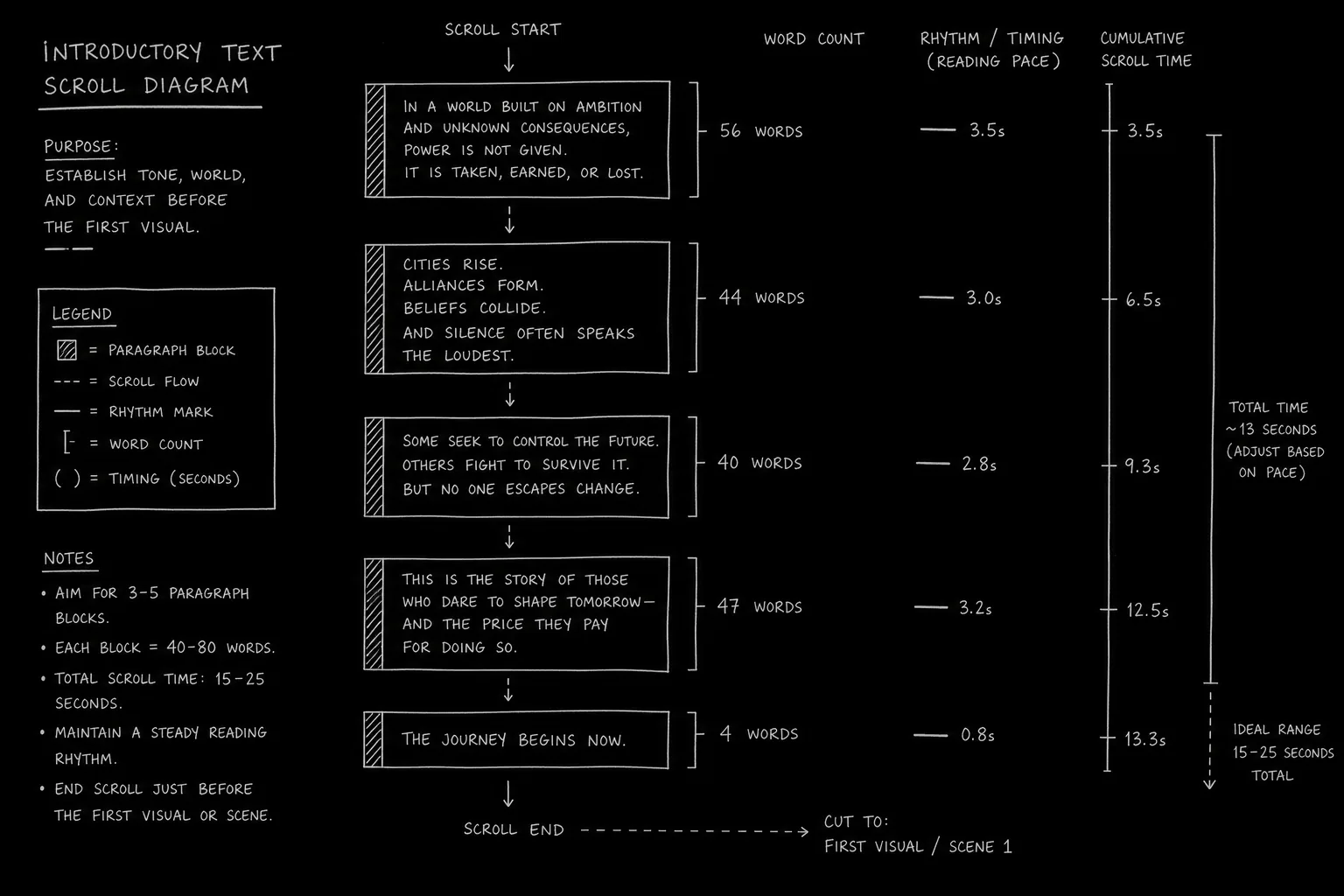
Step 1 - Draft the crawl in a separate document. Write three to five short paragraphs without worrying about format. Focus on clarity and rhythm.
Step 2 - Cut fifty percent. Crawls bloat fast. Remove every clause that does not change audience understanding. Adjectives are suspects.
Step 3 - Read aloud. Crawl text will be read silently by viewers but heard in their inner voice. Short sentences. Active verbs. Parallel structure across paragraphs.
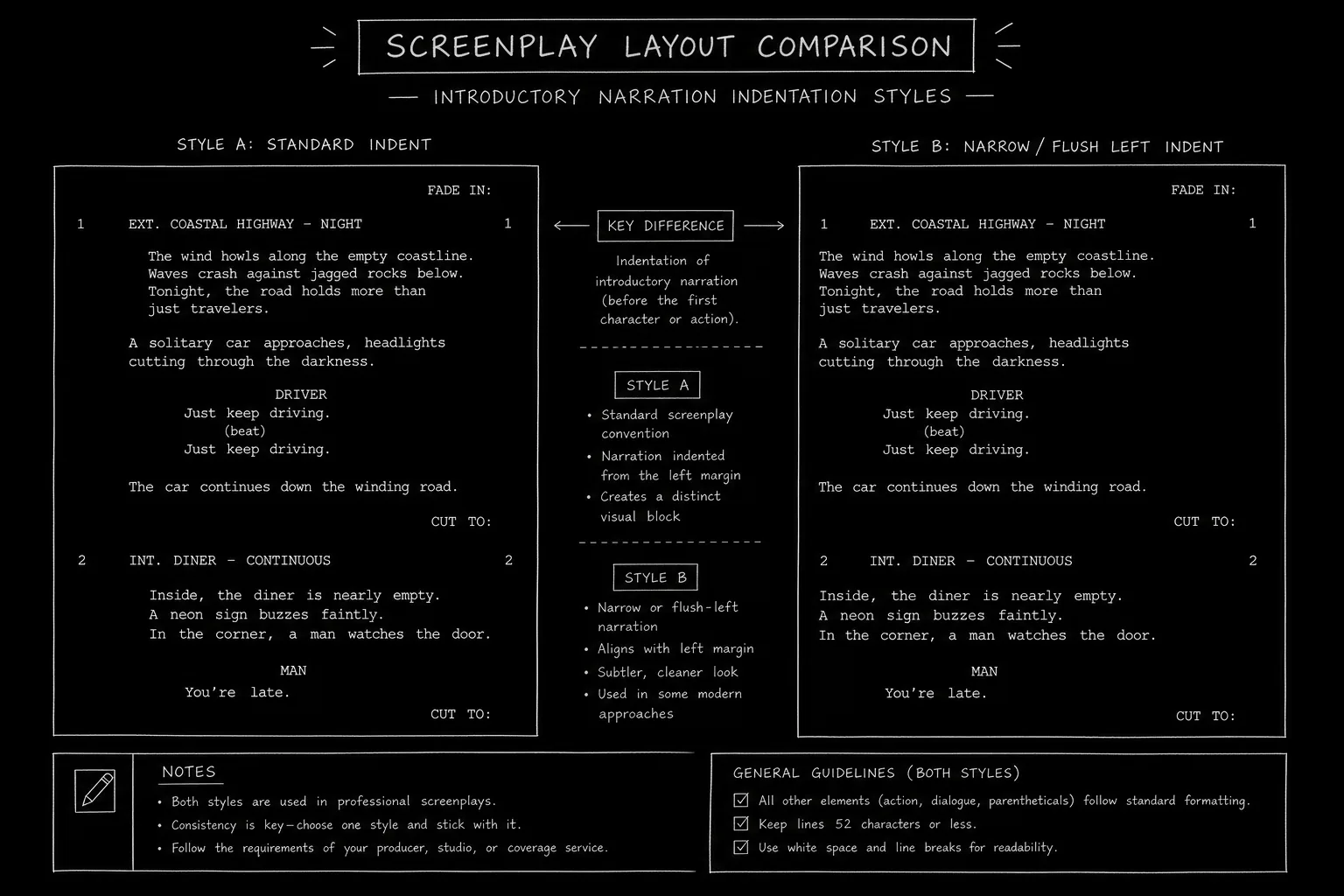
Step 4 - Add episode or chapter line if applicable. One line max. Title case. Centered in production; left-aligned in script is fine.
Step 5 - Format under OPENING CRAWL header. Use quotation marks for the crawl body or indent as a block. Be consistent throughout the script.
Step 6 - Specify the visual transition. "Text recedes into starfield." "Fade to black as text completes." "Dissolve to first scene." One line. Production needs the out.
Step 7 - Open Scene One with confidence. The crawl bought you context. Do not repeat the crawl information in dialogue five minutes later. That is double payment for the same beat.
[YOUTUBE VIDEO: Opening crawl text animation demo with side-by-side script formatting notes on screen.]
Try it free
Try Screenweaver for free on your script
It is free. Import your existing project, get a clearer view of your outline, and regain control of your story structure in minutes.
Start FreeOperational Section: Formatting Requirements and Production Notes
Script Format Conventions
| Element | Recommended format |
|---|---|
| Header | OPENING CRAWL or TITLE CRAWL |
| Episode line | Episode VII (optional) |
| Title line | THE LAST STAND (optional) |
| Body text | Quoted paragraphs or indented block |
| End transition | Action line: crawl recedes / cuts / dissolves |
Length Guidelines
- Theatrical feature: 75-150 words typical. More than 200 tests patience.
- Pilot: Shorter unless world is genuinely complex.
- Parody: Length is joke-dependent; still keep readable.
Typography and Design
Writers specify content, not font. Production and VFX choose typeface (Franklin Gothic tradition for Star Wars homage). Note if crawl is YELLOW TEXT or WHITE TEXT only when color is story-relevant.
Legal and Homage Boundaries
"Star Wars-style" describes grammar, not copyrighted text. Do not reproduce Lucasfilm crawl copy. Write original prose. Avoid trademarked logos in spec scripts unless you own the IP.
Integration with Score
Note (MUSIC: Main theme swells) or (SCORE: Over crawl) if timing matters. Composer and editor use this for pacing.
Outcome Section: What a Good Crawl Achieves
Audience orientation without dialogue. Viewers enter Scene One knowing factions, stakes, and tone.
Pacing gift to Act One. You skip "as you know" exposition in character mouths. The crawl already delivered the map.
Brand signal. Certain crawls tell the audience what kind of movie this is before the first shot. Space opera. Epic history. Saga continuation.
Measurable failure signs:
- Audience reads crawl, then characters explain the same war in the next scene
- Crawl is so long the score repeats
- Crawl text is vague poetry with no facts
- Parody crawl is indistinguishable from accidental comedy
Success test: can a reader skip the crawl and still follow the film? If yes, the crawl is optional enrichment. If no, integrate critical facts into scenes or tighten the crawl until it carries unique information only.
Why It Matters: Old Way vs. New Way
The old way: Writers imitated Star Wars visually in fan films but left crawls out of spec scripts, assuming "production will add it." Readers hit Scene One cold, confused about scope.
The new way: Franchise filmmaking treats the crawl as a authored beat. Streaming recaps, saga pilots, and IP reboots put text upfront with intention. Spec writers format crawls clearly so executives see you understand cinematic grammar beyond dialogue scenes.
The crawl is unfilmable in the traditional sense - it is pure typography in motion. Yet it is one of the most remembered "scenes" in cinema history. Writing it well proves you think in audience experience, not only in character conflict.
For title cards and lower thirds elsewhere in your script, see formatting title cards and chyrons.
Final CTA: Write the Text That Scrolls
Open your space opera, historical epic, or saga sequel. Draft the crawl in plain prose first. Cut half. Format it under OPENING CRAWL. Specify the transition out.
The starfield is waiting. The audience will read every word you give them. Make each one carry weight no scene could deliver faster.
Write the crawl. Then write Scene One as if the audience already knows the war - because they will.
Final Step
Build your next script with Screenweaver
Move from ideas to production-ready pages faster with timeline-native writing and AI-assisted story flow.
Try Screenweaver