
Comedy dies in the margins. It dies when a joke’s setup and payoff sit on different pages without you noticing. It dies when rhythm gets “fixed” by software that thinks it is helping. It dies when you rewrite in a vacuum and lose the run of a scene because your tool makes jumping between setups painful.
Comedy writers in 2026 need the same professional formatting everyone else needs, plus something harder to advertise: speed of iteration, clarity of line breaks, and enough structural visibility to protect joke architecture while you rewrite character truth.
Here is why that matters: a comedy draft is not a slower drama draft with punchlines. It is timing rendered as text. Your stack should make timing legible to you before it becomes legible to a reader.
Funny is not a font setting. But bad pagination can make funny feel clumsy before anyone says a word.
Free tool: use the Beat Sheet Calculator to map these beats to exact page numbers for your script length.
Cinematic workflow frames
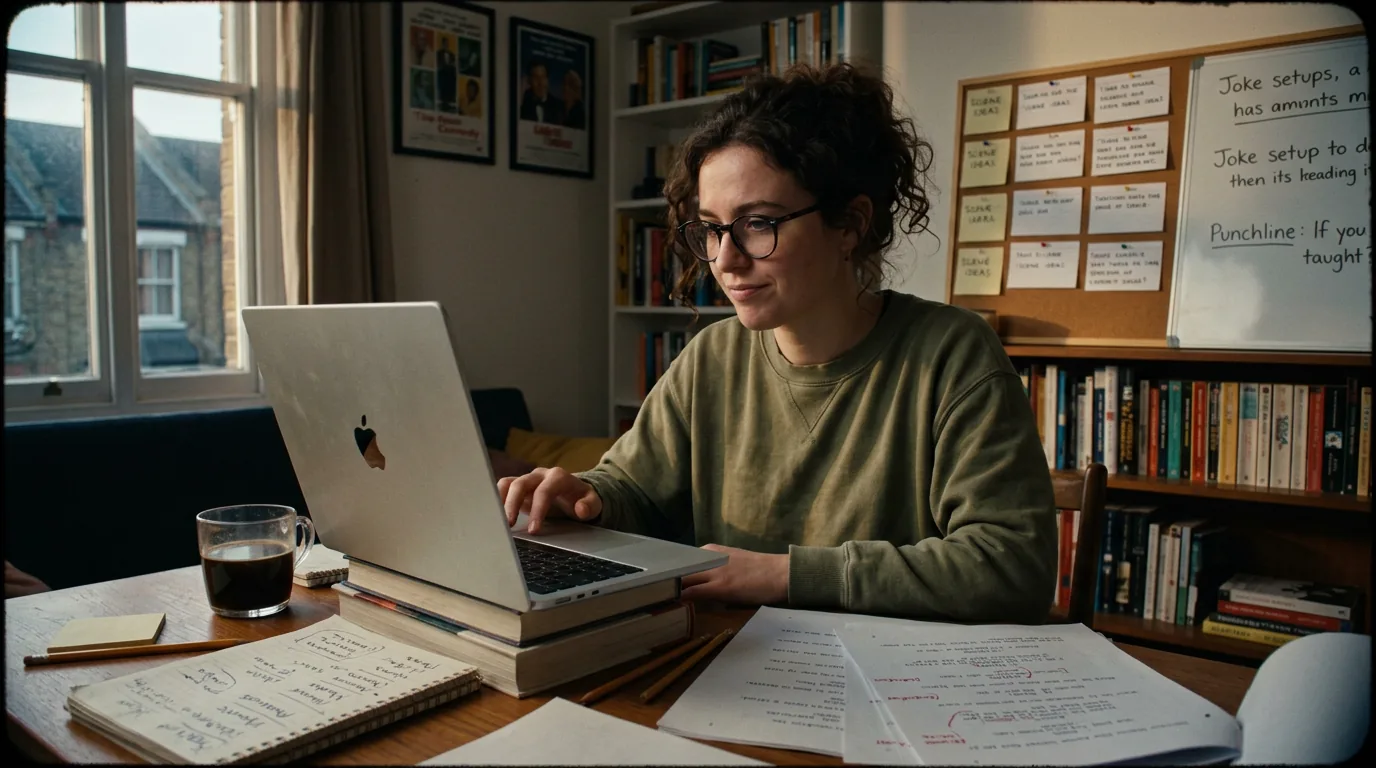
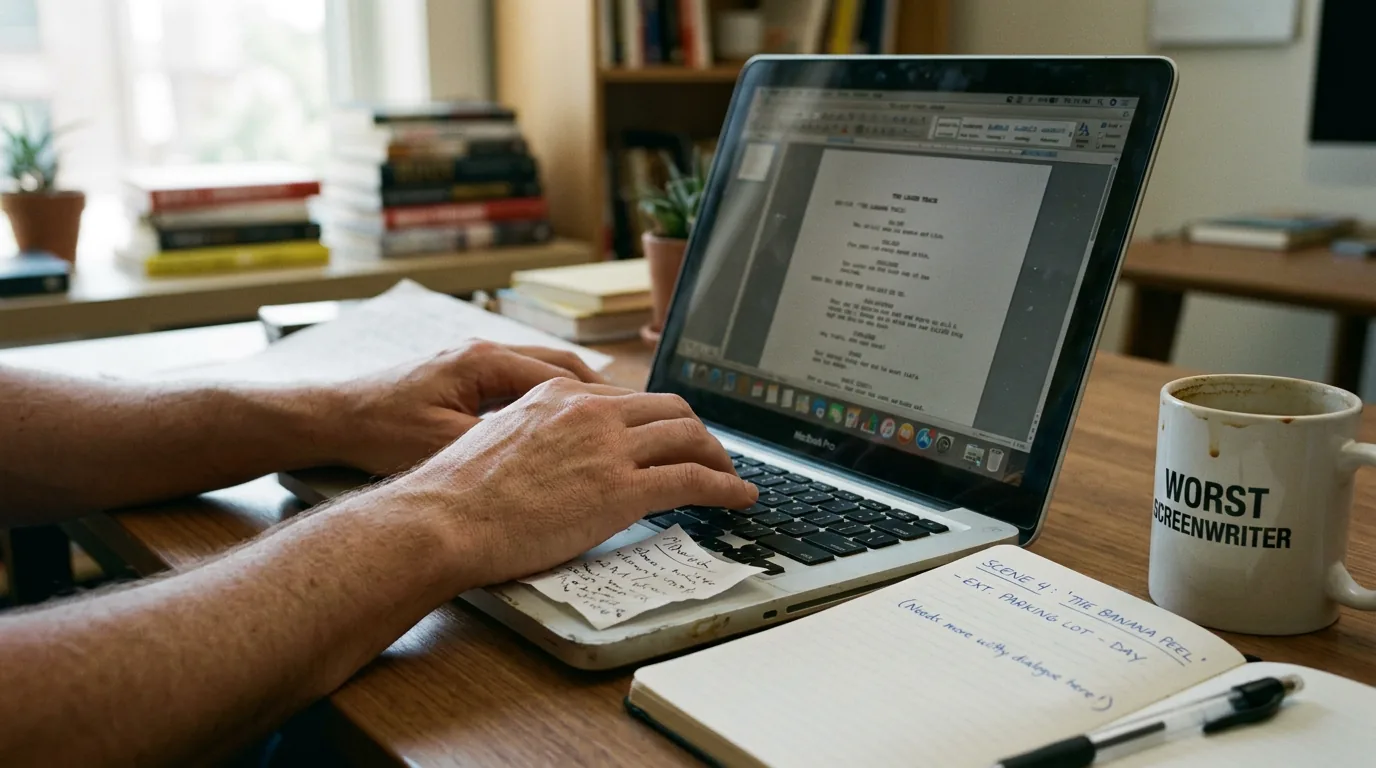
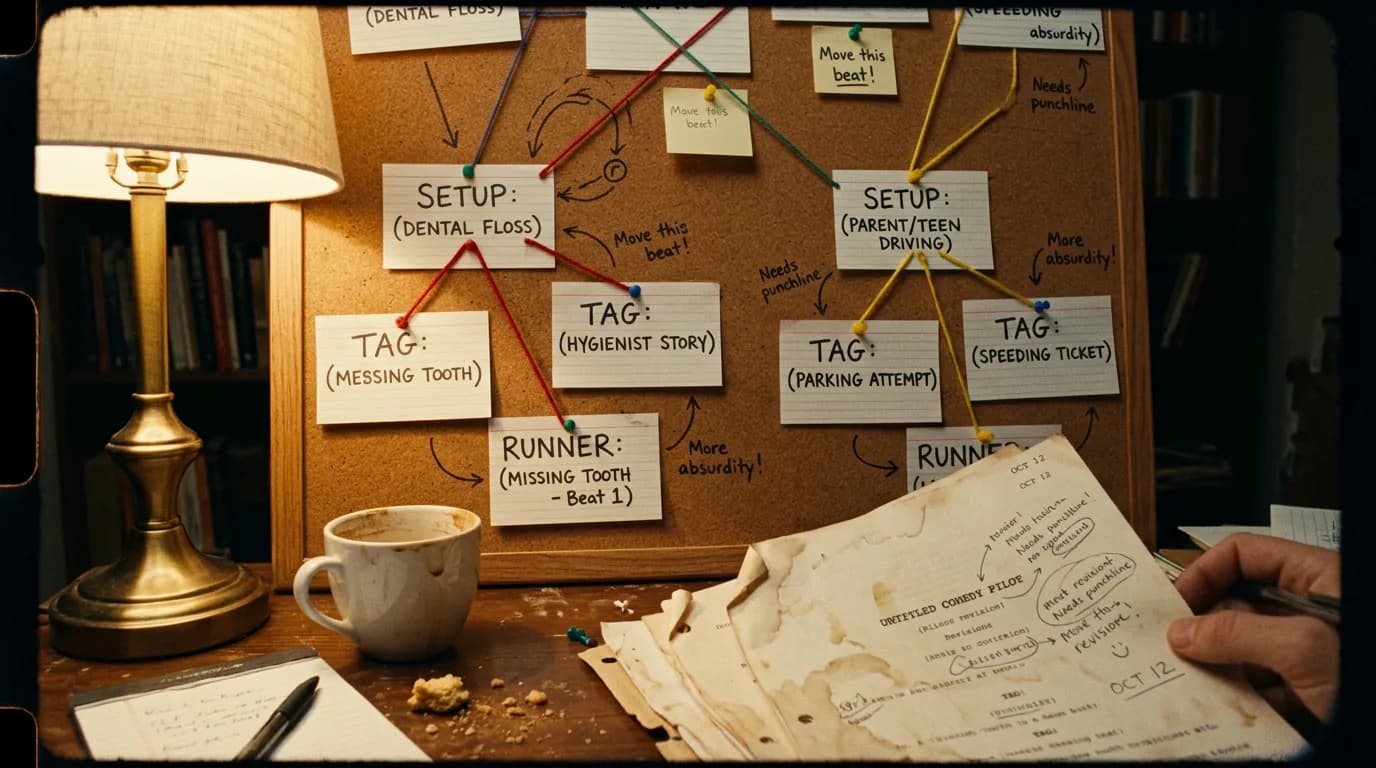
These two visuals work as a pair: the first shows Cinematic workflow still, first angle, 35mm film grain, and the second shifts to Cinematic workflow still, second angle, 35mm film grain - compare them briefly, then move on.
How Comedy Writing Stresses Software Differently
Drama can survive a little friction. Comedy often cannot. You are managing density: short lines, interruptions, overlapping voices, callbacks, tags, runs, and sometimes deliberate awkwardness that must remain visually obvious on the page.
That workload shows up as frequent micro-edits, rapid scene reordering to test rhythm, and obsessive comparison between “version A” and “version B” of the same exchange.
| Comedy Need | What to Look For | Red Flag |
|---|---|---|
| Dual dialogue / overlap | Clean formatting and export | Broken wraps in PDF |
| Fast scene shuffle | Drag scenes without metadata rot | Lost numbering chaos |
| Punch-up passes | Comment threads that stay tied to lines | Notes floating in chat |
| Read-aloud prep | Clean PDF, stable page breaks | Actors tripping on layout |
| Room collaboration | Permissions + merge clarity | “Who touched the joke?” fights |
How to Start: Pick Your Non-Negotiable First
Before brand loyalty, name your bottleneck. Is it punch-up speed? Room collaboration? Export trust for a production-bound PDF? Beat tracking for a sitcom engine?
Step 1 - Write a three-page comedy stress sample: interruption-heavy dialogue, a dual-dialogue moment, a runner callback, one long run-on purposefully ugly sentence you will later trim.
Step 2 - Reorder two beats and confirm joke setup still sits correctly relative to payoff.
Step 3 - Export PDF and read aloud from paper or tablet. Comedy lives in the mouth.
Step 4 - If you co-write, simulate a merge: two passes on the same scene, then reconcile.
Step 5 - Decide whether you need a board layer for season runners or only script-first drafting.
Step 6 - Lock naming conventions for runners: “TAG - COFFEE BIT” beats losing jokes because you renamed a scene casually.
Step 7 - Schedule weekly “rhythm audits,” not just plot audits. Plot notes miss joke death.
As discussed in our guide on writing dialogue subtext versus exposition, comedy still needs playable behavior under the laugh lines.
Platform and Format Realities
Single-cam, multi-cam, half-hour streamers, and feature comedy all share DNA but not identical pacing laws. Your software should not pretend otherwise. Templates help when they reduce repetitive element switching; they hurt when they smuggle in pacing assumptions that do not match your market.
Writers pitching to networks with specific act-break habits need revision discipline and stable scene numbering through those breaks. Writers building indie features may care more about export simplicity than beat board complexity.
Operational Section: What Production Will Ask For
Even if you are early in development, comedy still collides with reality: table reads, staged readings, and eventually sides. That means PDFs that do not embarrass actors, and revision colors that do not turn your script into a ransom note unless you intend that for a specific pass.
If you use dual dialogue, test it ruthlessly on export. Comedy rooms have horror stories about overlapping lines becoming sequential lines in the wrong reader.
Outcomes: What “Good” Looks Like After Four Weeks
You can reorder scenes without fear. Your PDF reads cleanly at a cold table read. Your notes attach to lines, not to vibes. You can point to where a runner lives across episodes without opening six apps.
Why the Old Way Fails Comedy Writers
The old way is scattered: drafts in one place, punch-up notes in another, runner memory in your head. Heads forget. Chat scrolls bury. The old way also treats jokes as optional ornaments rather than structural load-bearing walls.
The improved way treats punchlines like engineering: you track dependencies.
Trench Warfare: What Comedy Writers Get Wrong
They polish lines before rhythm exists. Rhythm first. Jokes second. Heart third. Software cannot reorder your creative priorities.
They confuse “funny words” with architecture. A funny word in a broken scene is a meme, not a story.
They avoid table reads because embarrassment feels risky. Table reads are diagnostic instruments. Software should make exporting a clean read painless enough that you do it weekly.
They collaborate without joke ownership rules. Co-writing comedy without explicit ownership of runs and tags creates silent resentment.
They treat parentheticals like a hiding place for jokes that should be playable. Parentheticals are not a laugh track.
They ignore page turns. A page turn can be a punchline delivery device. Pagination matters.
They over-trust spellcheck for comic voice. Voice is not correctness.
They let note threads become novels. Long notes are often fear wearing a trench coat.
They forget musicality. Comedy dialogue has meter. Read aloud or pay the price.
They ship PDFs without reading them in another viewer. Export schizophrenia is real.
If your software makes you dread small edits, you will protect bad jokes out of exhaustion.
For craft reference on scene discipline, see <a href="https://www.oscars.org/nicholl/about/screenwriting-resources" rel="nofollow">Nicholl Fellowship screenwriting resources</a>.
[YOUTUBE VIDEO: Table read of a comedy scene with on-screen markup showing setup/payoff distance and dual-dialogue pitfalls]
Comedy Is Rhythm Engineering, Not Just "Funny Lines"
Writers say this all the time: "The joke worked yesterday and died today." Usually nothing mystical happened. Rhythm shifted. A setup moved half a page down. A callback lost its anchor. A reaction line became too clean and removed the awkward tension that made the beat funny. Comedy is fragile because timing is contextual, and context moves every time you revise.
That is why software choices matter more for comedy than many people admit. You need fast movement between setup and payoff, clear visibility across scenes, and clean exports that preserve line breaks. If your tool turns each punch-up into a scavenger hunt, your material will flatten before the room even reads it.
The joke is not a sentence. The joke is a timed relationship between sentences.
Try it free
Try Screenweaver for free on your script
It is free. Import your existing project, get a clearer view of your outline, and regain control of your story structure in minutes.
Start FreeScenario: The Runner That Vanished in Rewrite
A writers' room builds a strong runner in Episode 1: a tiny coffee-order argument that grows into character shorthand. Everybody loves it. Then production notes force scene swaps, and the runner appears in the wrong emotional context. By Episode 4, the payoff feels random.
The room solves this by tagging runner beats in scene notes and tracking dependency distance. Any scene move triggers a "runner integrity" check. The same joke becomes durable because the team treats it as structure, not ornament.
Scenario: Stand-Up Voice vs Character Voice Collision
Another beginner trap: a writer with a strong personal comic voice makes every character sound like their stand-up persona. Early pages read "funny." Mid-script everything sounds samey. The fix is not less humor. The fix is voice partitioning. Each main character gets a short voice profile tied to behavior, not catchphrases. During revisions, dialogue lines are tested against those profiles.
Software that allows quick per-character search and note pinning helps this pass happen quickly. Without that support, the writer relies on intuition alone, and intuition under deadline gets sloppy.
Scenario: Table Read Panic and the Wrong Fix
At table read, half the jokes miss. Panic hits. The room starts rewriting individual punchlines while ignoring scene objective. The result is noisier but not funnier pages.
A better method is objective-first triage. Identify which scenes missed because premise was unclear, which missed because turn timing was off, and which missed because line choice was weak. Only then punch lines. This sequence protects story logic while improving laughs.
Granular Workflow: Weekly Comedy Rewrite Loop
A practical loop looks like this. Monday: structural rhythm pass, checking setup/payoff spacing and runner placement. Tuesday: character voice pass, focusing on distinction and intention. Wednesday: read-aloud pass with breath and interruption marks. Thursday: merge and continuity pass for callbacks across scenes. Friday: export QA in at least two PDF viewers.
No glamorous secret. Just repeatable pressure-tested process.
| Pass Type | Core Question | Deliverable |
|---|---|---|
| Rhythm pass | Are setups and payoffs still married? | Marked script with timing flags |
| Voice pass | Does each character sound uniquely motivated? | Dialogue notes per character |
| Read-aloud pass | Where does breath or pace collapse? | Revised line breaks and pauses |
| Callback audit | Do runners escalate and land? | Runner map with scene references |
| Export QA | Does formatting preserve timing cues? | Final PDF ready for room read |
For long-form structure support, writing ensemble cast storylines is useful when comedy involves multiple arcs colliding.
Trench Warfare, Expanded: Advanced Mistakes Beginners Repeat
Beginners often chase novelty over precision. They write five new jokes when one clean setup would do more work. They confuse surprise with randomness. Random lines can get a laugh once, then die on repetition. Precision scales. Precision survives stress.
Another failure mode is over-annotation. Writers bury scenes under note blocks, parentheticals, and side comments intended to "help" actors land tone. Usually this signals fear that the line itself is weak. Strong comedic writing is playable without a mini-essay attached.
There is also the merge drift problem in collaborative comedy. Two writers punch the same scene in parallel. One improves premise logic. The other improves lines. A rushed merge loses one set of gains. Fix this with explicit merge ownership and a pre-merge checklist. Do not rely on memory.
Writers also misread silence. Silence in comedy is not dead air by default. It can be a punchline amplifier. But only if it is intentional and visible. Marking pause logic in draft notes helps preserve that intention through revisions.
Then there is escalation fatigue. Teams keep turning volume up instead of raising stakes. Louder dialogue, bigger reactions, more interruption. If emotional stakes do not rise, noise replaces humor. Good tools help you inspect scene progression so escalation remains narrative, not just sonic.
If every line is trying to be the funniest line, the scene has no rhythm left to breathe.
Operational Section: Production-Adjacent Comedy Reality
Comedy scripts travel through hands quickly. Performers, directors, ADs, sometimes producers who read fast and decide faster. Clean scene headers, stable pagination, and clear revision tracking make you easier to trust. This is not corporate politeness. It is survival in collaborative environments where confusion burns schedule.
For the handoff layer, screenplay formatting guide 2026 remains essential because timing dies when formatting drifts.
Unique Visual Prompt Blocks
The "Funny Because It's True" Audit: Tracking Character Truth
Comedy often fails when characters start acting "funny" instead of acting like themselves in a funny situation. This is a character consistency problem. If your protagonist is a cynical lawyer, they should not suddenly become a slapstick clown in Episode 3 just to land a joke.
Writers use character voice profiles to prevent this "drift." By pinning a character’s core motivations and "voice rules" (e.g., "never uses slang," "always deflects with sarcasm") to the side of the script, you can test every joke against their truth. If a joke requires the character to break their own rules, the joke is a "liar." Liar jokes get a laugh in the room but kill the story on screen.
A character who lies for a laugh is a character the audience stops trusting.
Scenario: The "Ensemble Balance" Pass
In ensemble comedy, the danger is "clumping." All characters start sounding like the funniest person in the room. You lose the contrast that makes the ensemble work. A structural pass focuses on "voice distribution." You look at each scene and ask: who is driving the comedy, and who is the "straight man" providing the anchor?
By rebalancing these roles, you create a more dynamic rhythm. Software that allows you to filter the script by character name makes this pass much faster. You can read one character’s entire arc in twenty minutes and see where their voice starts to blur into the others.
The Comedy Audit: How to Tell if Your System Is Helping
By week four, you should have a rhythm you trust. If you can reorder a scene without breaking three callbacks, your system is working. If your PDF reads cleanly at a cold table read, your formatting is working. If you can point to where a runner lives across episodes without opening six documents, your organization is working.
Comedy writers who succeed under pressure are often the ones with the most boring file systems. They do not waste energy on "where is that joke?" They spend energy on "is that joke still funny?" That shift in focus is what professional tooling buys you.
There is also a collaborative morale gain. When everyone in the room knows where notes live and how merges happen, trust rises. Trust allows for riskier, weirder, better comedy. When process is chaotic, people play it safe to avoid breaking the script.
The goal of comedy software is to make risk cheap.
One Final Scenario: The "Network Note" Punch-up
A network sends notes on a pilot. They want a stronger "B" story and more "punch" in the third act. In a loose workflow, this means a weekend of panic and scattered edits. In a structured workflow, the team identifies which runners are impacted, which setups need to move, and which character voices need sharpening.
The punch-up becomes a series of targeted strikes instead of a blind overhaul. The resulting draft is cleaner, faster, and funnier because the team could see the architecture they were changing.
Final CTA: Choose for Rhythm, Then Protect Rhythm
Pick the tool that lets you iterate jokes without fighting navigation. Pick collaboration rules that protect the fragile part of comedy: shared understanding of what the scene is trying to do, not just what it says.
Then write the kind of comedy that survives bad projection equipment, tired readers, and skeptical executives - because the page rhythm is doing work even when the room is cold.
Your stack does not write jokes. It clears space for them.
Clear the space.
Then make them laugh on purpose.
As discussed in our article on color-coding rewrites without confusing directors, revision clarity keeps comedy notes from becoming production fog.
Final Step
Build your next script with Screenweaver
Move from ideas to production-ready pages faster with timeline-native writing and AI-assisted story flow.
Try Screenweaver