
You finished a draft. Maybe you finished a draft you even trust. Now someone asks for the deck.
Not “eventually.” Soon.
The pitch deck is not your script in Keynote cosplay. It is a compression argument: why this story, why this tone, why this scale, why this team, why now. Yet decks die when they drift from the script’s real spine. They become beautiful paragraphs that describe a movie you did not write.
Software cannot replace taste in deck design. It can reduce friction between manuscript truth and presentation truth. That friction reduction matters because every hour spent hand-copying loglines into five tools is an hour not spent sharpening the one scene executives actually remember.
Here is why that matters: in 2026, you are often building multiple surfaces at once - script PDF, series overview, look bible, sizzle outline, seasonal engine notes. Without a workflow, you maintain parallel universes. Parallel universes create pitch meetings where everyone argues about different films.
A pitch deck workflow is a synchronization ethics. It keeps you honest.
Free tool: use the Logline Workshop to build and pressure-test your logline.
Cinematic workflow frames

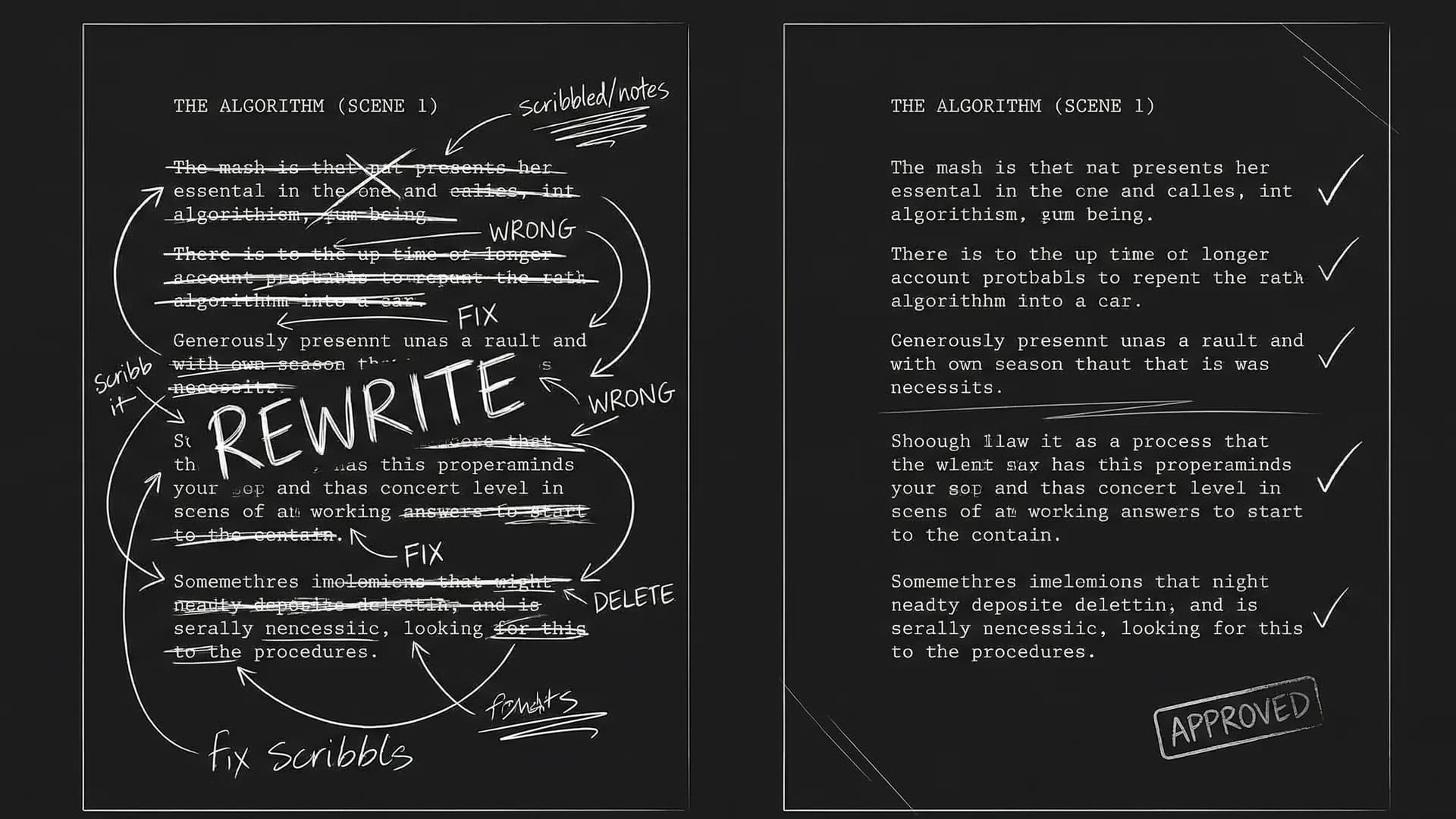
These two visuals work as a pair: the first shows Cinematic workflow still, first angle, 35mm film grain, and the second shifts to Cinematic workflow still, second angle, 35mm film grain - compare them briefly, then move on.

The Core Chain: Script Spine → Deck Claims → Visual Proof
Your chain must move in one direction when truth changes: script changes lead deck changes. Not the reverse.
| Artifact | Must Reflect | Drift Risk |
|---|---|---|
| Logline | Core conflict | Trendy vagueness |
| Tone | Genre + aesthetic | Moodboard lying |
| Comparables | Market clarity | Delusional comps |
| Season engine | Duration promise | Pilot-only illusion |
| Key scenes | Script reality | Fantasy sequences |
Scenario One: Feature Pitch With Lookbook Pressure
Writer generates deck text from engine notes linked to scenes. Visual references are labeled “tone reference” vs “sequence reference” to prevent implied production commitments.
Scenario Two: Series Pitch With Character Grid
Deck includes character wants-by-season table derived from bible fields. When pilot rewrites shift wants, table updates in same work session.
Scenario Three: Investor Meeting With Numbers Adjacent
Deck may include budget-adjacent hints. Writer keeps feasibility notes near scene references for sanity checks without leaking unvetted numbers publicly.
As discussed in our guide on pitch deck slides that survive executive scrutiny, structure beats decoration.
Step-by-Step Workflow You Can Replicate This Week
Step 1 - Freeze a script milestone: not “perfect,” but internally coherent enough to pitch without embarrassed wincing.
Step 2 - Extract spine sentences: thesis, engine, main escalation, finale transformation.
Step 3 - Build slide skeleton from spine, not from random template grabs.
Step 4 - Map three to six script anchors: scenes that prove tone and scale. Pull dialogue/action excerpts carefully; respect readability.
Step 5 - Visual lane: gather references with source labels; separate aspirational from achievable.
Step 6 - Version naming: script date matches deck date in filename convention.
Step 7 - Rehearsal pass: read deck aloud while script PDF sits beside you. Contradictions surface.
As discussed in our article on concept art generated from scene descriptions for decks, scene-grounded visuals outperform generic stock fantasy.
Try it free
Try Screenweaver for free on your script
It is free. Import your existing project, get a clearer view of your outline, and regain control of your story structure in minutes.
Start FreeTrench Warfare: Script-to-Deck Failures
Deck writes checks the script cannot cash.
Comps chosen for ego, not positioning.
Too much plot summary, too little reason-to-care.
Lookbook images imply locations you cannot access.
Series deck sells eight episodes of substance with three ideas stretched thin.
If your deck is better than your script, your career learns the wrong lesson.
For external craft grounding, see <a href="https://www.oscars.org/nicholl/about/screenwriting-resources" rel="nofollow">Nicholl Fellowship screenwriting resources</a>.
[YOUTUBE VIDEO: Live rebuild of a pitch deck after a script rewrite - showing what must change slide by slide]
Tooling Reality: Manuscript App + Deck App
Many teams keep screenplay in screenplay tools and decks in deck tools. The workflow glue is discipline: a shared metadata doc listing scene anchors, logline versions, and comparable titles with rationale. Glue sounds humble. Glue holds buildings.
When Integrated Platforms Help
If your platform exports story artifacts into presentation-ready structures without inventing new plot, integration saves time. If integration generates plot, distrust it.
Closing Perspective
Pick a workflow that treats the deck as a dependent child of the script: loved, attended, corrected when the parent changes.
Then pitch one coherent movie - not two competing fantasies split across file types.
Final Step
Build your next script with Screenweaver
Move from ideas to production-ready pages faster with timeline-native writing and AI-assisted story flow.
Try Screenweaver