
Dramedy pilots fail in the room for a boring reason: the read is funny until it is not, and the "not" feels like a different show. Not because weight is illegal. Because the pilot did not teach the audience how to hold both frequencies in one hand. Half-hour dramedy is not sitcom plus tears taped on at minute twenty-two. It is a single engine that converts embarrassment into insight and insight into embarrassment, usually in the same scene.
Your job in episode one is not to prove you can write jokes. It is to prove you can run a tone contract for twenty-eight to thirty-four produced minutes without betraying the promise of the premise.
If the audience laughs at minute four and checks out at minute eighteen, you did not lose them to sadness. You lost them to a tone reset you did not earn.
Free tool: use the Logline Workshop to build and pressure-test your logline.
What a Dramedy Pilot Must Prove (Beyond "It's Funny")
Buyers use dramedy when they mean life with teeth: flawed people, real stakes, jokes that do not erase consequences. The pilot must establish four proofs in one pass.
Proof one: the comic lens. We understand what the show finds absurd about the world. Not random quips. A point of view.
Proof two: the emotional spine. We understand what the protagonist cannot say out loud yet, or cannot afford to lose.
Proof three: the series engine. We see a repeatable way episodes will move: family chaos, workplace moral tests, grief group, startup cult, small-town politics.
Proof four: tone integrity. A heavy beat lands and the show does not panic into sitcom reset before the audience has felt the weight.
That fourth proof is where structure matters more than punchlines. Structure is how you schedule permission for the audience to feel something, then return to levity without whiplash.
Page targets for half-hour pilots shift by lane. Our breakdown of TV pilot page count for half-hour vs hour-long gives 2026 bands; dramedy often sits in the hybrid row where scenes breathe longer than multi-cam but shorter than prestige hour drama. Treat page count as a clock contract, not a scoreboard.
A Tone Scheduling Table (Use as a Map, Not a Law)
| Pilot module | Dramedy job | Common mistake | Fix that usually works |
|---|---|---|---|
| Cold open | Establish comic lens + hint of wound | Joke barrage with no POV | One clear protagonist want |
| Act one | Introduce engine and supporting orbit | Filler "wacky friends" without pressure | Each friend tests the wound |
| Midpoint | Turn that deepens stakes without losing lens | Sudden melodrama monologue | Physical action + subtext |
| Act two | Complicate want with social cost | Detour episode inside pilot | Merge B-story into A-story |
| Tag / final beat | Series promise + emotional aftertaste | Joke that erases the turn | Button that remembers the turn |
The table is blunt on purpose. Dramedy rooms argue about minute eighteen the way thriller rooms argue about the midpoint bomb. Your outline should know where the turn lives before you polish lines.
Relatable Scenario: The Funeral Pilot That Became Two Shows
Jae pitches a half-hour dramedy: a woman returns home to run her father's funeral home while her brother sells influencer caskets online. The pilot draft is thirty-seven pages. Pages one to twelve are sharp, bleakly funny, specific. Pages twenty to thirty-seven introduce a rival funeral conglomerate and a caper beat about stolen ashes.
Coverage says "tone whiplash" and "unclear series."
Jae thought act two needed plot. What act two needed was emotional plot: sibling rivalry over guilt, not corporate villainy. The conglomerate could exist as a phone call, a letter, a news clip. The pilot did not need a heist. It needed a scene where the sister laughs at the wrong moment during a viewing, then cannot forgive herself, and the brother chooses whether to protect her or tell the truth to the family.
Jae cut eighteen pages and moved the laugh-from-pain beat to the midpoint. The conglomerate became season-two fuel, not pilot noise. The read finally felt like one show because the jokes commented on the wound instead of escaping it.
Relatable Scenario: The "Very Special Episode" Pilot
Lena writes a dramedy about teachers in an underfunded school. She opens with a perfect cold open: a student joke, a dry reply, a glimpse of care. Then act two becomes a full drama about layoffs with almost no jokes. Her writer friends call it brave. Coverage calls it "a drama with occasional banter."
Lena violated tone scheduling, not bravery. Weight scenes in dramedy still need the comic lens active. That does not mean jokes during layoff announcements. It means the protagonist's coping style is visible under stress: deflection, inappropriate truth, petty ritual, gallows humor that costs them respect.
She rebuilt act two so every dramatic beat asked: what would this character joke about if they were afraid to cry? Not punchlines on tragedy. Behavior that reveals character. The layoff scene kept silence. The break room scene after kept one line that landed wrong and hurt someone. The hurt carried into act three.
If you are deciding whether your pilot is procedural or serialized in how it promises future episodes, our guide on writing the TV pilot: procedural vs serialized pairs with tone work: engines and tone fail together when the pilot promises the wrong kind of tomorrow.
Structuring the Half-Hour Dramedy Pilot as Modules
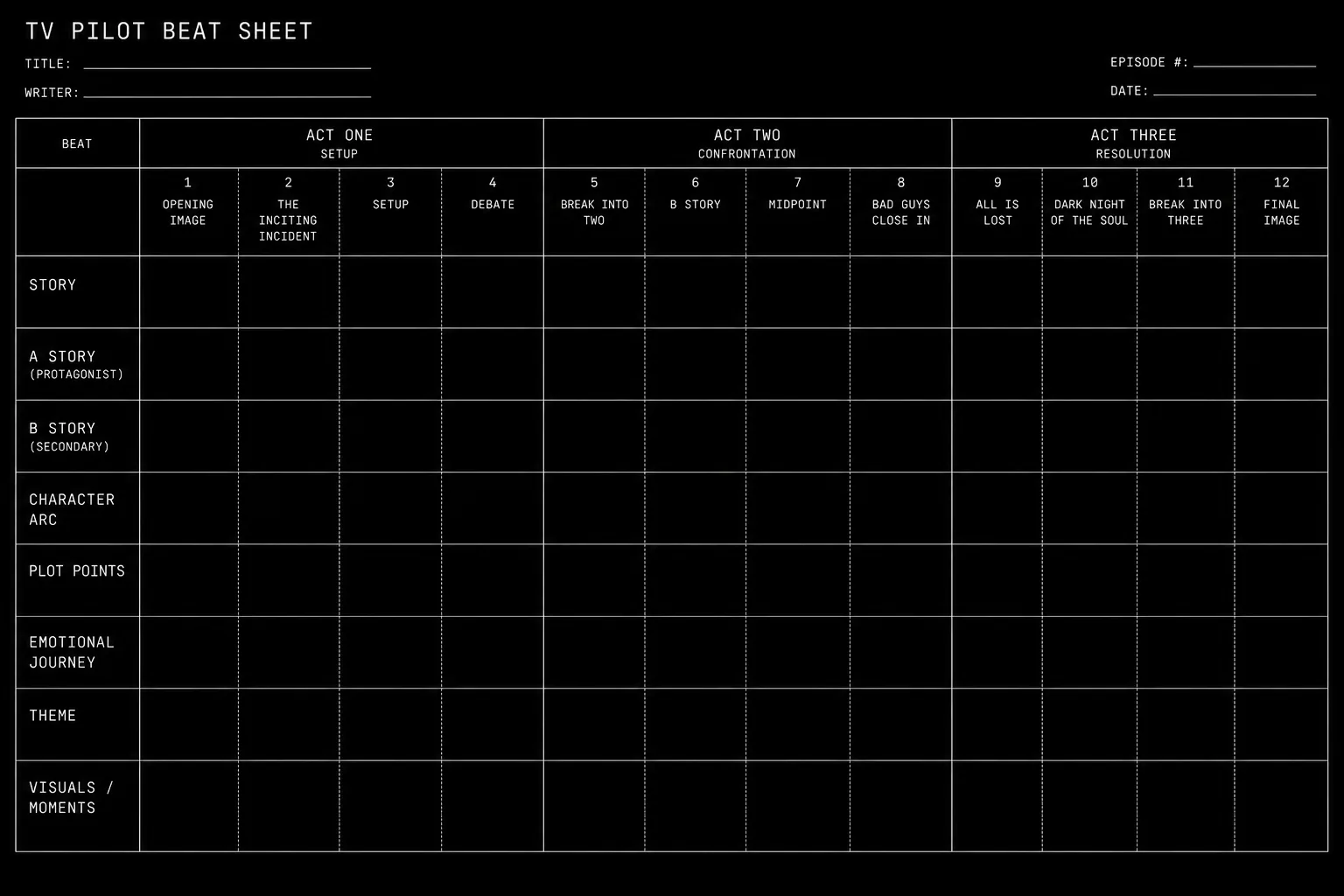
Think in modules even if the buyer says streaming has no acts. Cold open is a handshake. Act one is world plus want. Act two is complication plus social cost. Act three is consequence plus new equilibrium. Tag is series promise.
Cold open should be short and authoritative. One or two scenes. Introduce voice. Avoid exposition dumps disguised as banter.
Act one ends when the protagonist commits to a goal for the episode or the season seed. Commitment can be reluctant. It must be visible.
Midpoint in dramedy is often under-built because writers think midpoints are for hours. Half-hours need a midpoint too: a reveal, a public failure, a line crossed. Something that makes act two back half more expensive emotionally.
Act three resolves the episode story while pointing at the series wound. Resolution does not mean neat. It means earned.
Tag trains tone. A great dramedy tag holds two truths: we can laugh again, and we remember what we learned.
For serialized dramedy, the tag might plant a mystery. For episodic dramedy, the tag might restate the engine with a fresh case. Either way, the tag should not feel like a different writer.
Joke Density vs Breath: The Clock You Cannot Fake
Half-hour produced time is ruthless. Jokes eat seconds. Silence eats seconds. Weight eats seconds. You are budgeting attention, not just pages.
Read your pilot aloud with a stopwatch per module. If act one runs long because jokes stack with no behavior change, cut lines, not scenes first. If act two feels slow without weight, you may have under-turned, not under-joked.
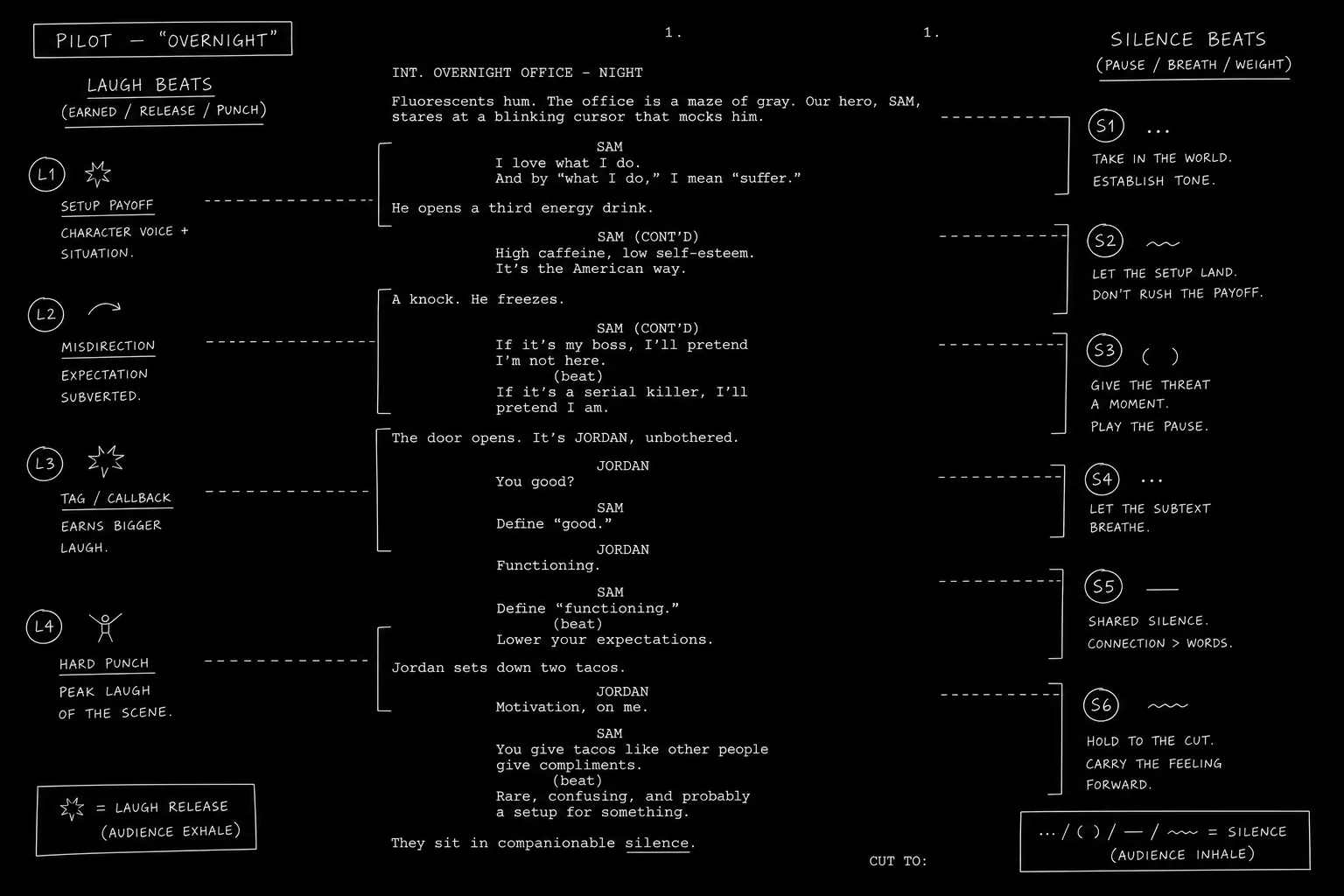
Dramedy dialogue often plays faster on screen than on paper because actors land reactions. Still, plan for breath. A beat after a truth is not dead air. It is audience processing.
When you compare your draft to comps, compare turn density, not joke count. Two shows with similar jokes per page can feel different because one rotates emotional mode every four minutes and the other loops banter.
Try it free
Try Screenweaver for free on your script
It is free. Import your existing project, get a clearer view of your outline, and regain control of your story structure in minutes.
Start FreeGranular Workflow: Tone-Balance Pass Before You Send
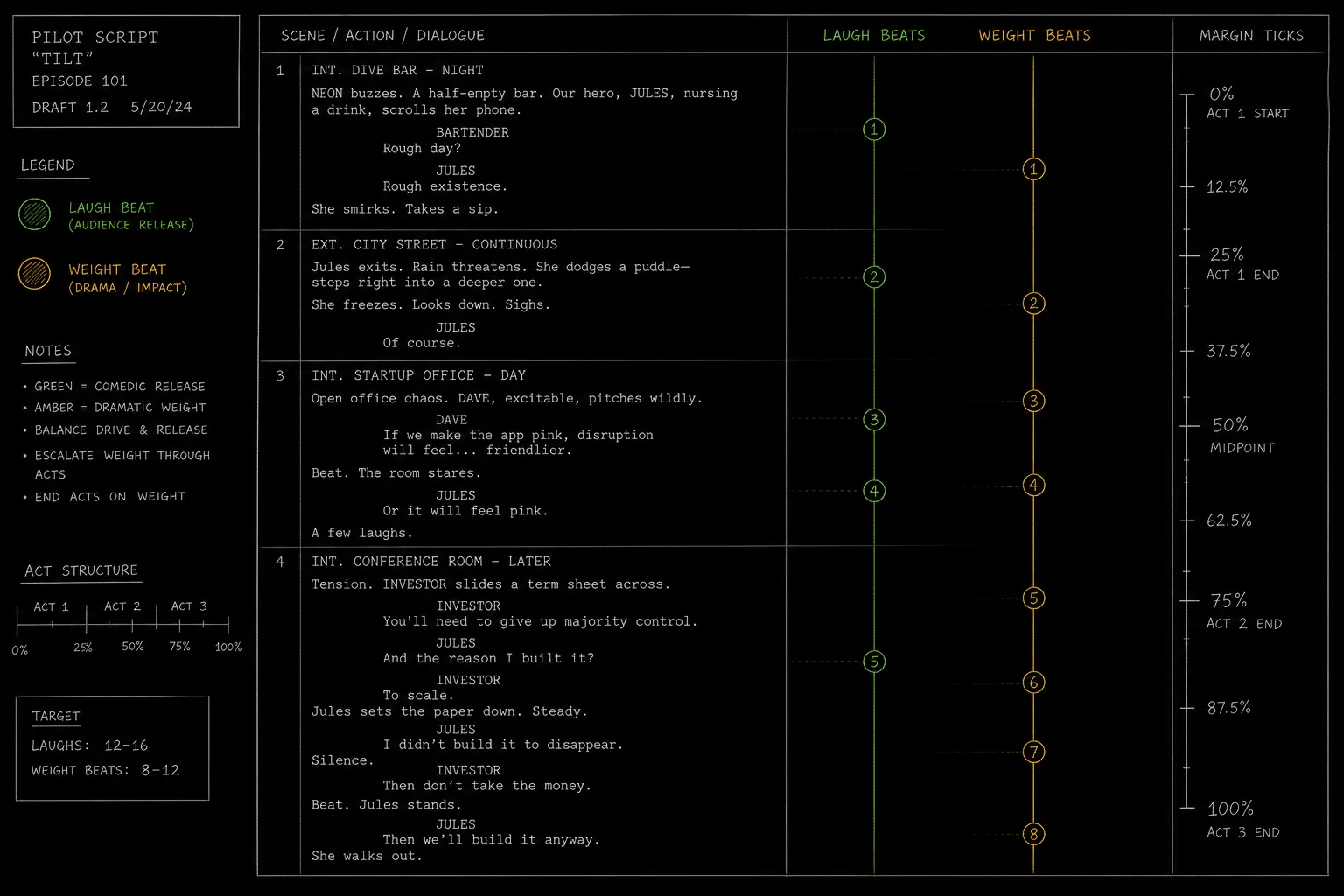
Step one: highlight every joke beat in one color and every weight beat in another. If one color clusters in a single ten-page slab, you have a tone island. Spread or bridge islands with scenes that carry both.
Step two: write the "unacceptable coping" list for your lead. What do they do when hurt that causes story? Sarcasm, control, vanishing, overfunctioning, brutal honesty. Coping is structure fuel.
Step three: map the episode want vs series wound. Episode want is what they try to win today. Series wound is what they cannot fix in one episode. Jokes should poke the wound, not erase it.
Step four: design one set piece that forces public behavior. Dramedy needs bodies in space: assembly, classroom, church, office party. Public scenes make tone visible.
Step five: rewrite the tag last. Tags written early often apologize for weight. Write the tag after you know what the episode cost.
Step six: run a "whiplash read" with one honest friend. Ask them to mark the line where the show felt like it changed channels. Fix bridges, do not only fix jokes.
[YOUTUBE VIDEO: Side-by-side clips from two acclaimed dramedy pilots with on-screen markers showing where laugh sequences hand off to weight beats without reset music]
Room Realities: Notes You Will Hear and How to Answer With Structure
"You need to be funnier" sometimes means the engine is unclear. "You need to ground it" sometimes means jokes are punching down or avoiding stakes. Learn to translate notes into structural tasks before you add or cut jokes.
If they say the lead is unlikable, you may need an early vulnerability beat that does not solve the problem, only reveals it. If they say the supporting cast is thin, you may need pressure characters who disagree with the lead's coping style, not new protagonists.
If they say the ending is soft, you may need a choice, not a speech. Dramedy finales land when someone picks a cost.
External references help calibrate professionalism. The <a href="https://www.wga.org/writers-room/101/writing-for-television" rel="nofollow">WGA writing for television overview</a> is a useful reminder that pilots are employment samples as much as art samples. Tone discipline signals you can survive a room.
The Trench Warfare Section: Dramedy Pilot Mistakes
Wrong: saving all weight for the last eight minutes. The audience feels manipulated. Fix: plant weight early, pay with specificity.
Wrong: using a guest star trauma to give the lead feelings. Fix: make the lead's wound active in scene one behavior.
Wrong: quirk without consequence. Fix: tie quirks to social cost or plot.
Wrong: parodying the genre in the pilot to show you are smart. Fix: earn meta from character, not from writer wink.
Wrong: copying punchline rhythm from a show with different production. Multi-cam density is not single-cam breath. Fix: read comps in your production lane.
Wrong: treating the tag as optional. Fix: write the tag as tone proof.
Wrong: ignoring page band reality. Fix: compare your footer to half-hour vs hour pilot targets and time the read.
Wrong: blending procedural case and serialized wound without linking them. Fix: case reveals wound, wound complicates case.
Dramedy is not the absence of pain. It is the presence of a voice that knows pain is part of the joke's cost.
Relatable Scenario: The Room Read Where Jokes Die in Silence
Andre gets a staffing sample read for a dramedy pilot, not the sell pilot, an episode that is supposed to be clean and represent voice. The room laughs in three places and sits in heavy silence everywhere else. The showrunner says, "I do not know what this show is yet."
Andre's draft treated jokes as decorations on drama scenes instead of treating tone as behavior under pressure. The fix was not "add jokes." Andre re-outlined the episode so every scene had a coping behavior at the door: avoid, perform, fix, provoke, confess. Jokes became the visible part of coping. Silence became the cost.
In the next read, the room laughed less often but longer. The showrunner could name the show: "It is a comedy about people who think competence will protect them from grief." That sentence is a tone contract Andre could defend in notes.
Single-Cam vs Multi-Cam: Same Word, Different Physics
"Dramedy" on a network half-hour and "dramedy" on a premium single-cam half-hour are not the same clock. Multi-cam often wants joke rhythm predictable enough for live audience energy, even when the show films single-camera. Single-cam dramedy can let pauses sit. Writers who paste multi-cam joke density onto single-cam structure create reads that feel exhausting without feeling funny.
Watch your comp lane. If your comp is a single-camera show with long takes, your pilot should not read like a punch machine. If your comp is a network hybrid, your pilot may need clearer act outs and a stronger engine statement in act one.
When you time the read, compare module length to the page bands in our half-hour vs hour-long pilot page count guide. Drift high on pages often means drift high on produced minutes, which means your weight beats steal time from your comic lens unless you earned them with turns.
Handoff: What to Put in the Pitch Line vs What to Put on the Page
Your logline should not say "dramedy." It should imply tone by pairing an absurd premise with a real stake. On the page, prove tone with scheduling, not adjectives.
When you send to a competition or a producer, pair the pilot with a tight series paragraph that names the engine. For how much story to put in supporting docs without rewriting the pilot, see our piece on the one-pager that summarizes your show. The pilot carries tone. The one-pager carries promise. Do not make the pilot do the one-pager's job.
Closing the Loop: One Episode, One Contract
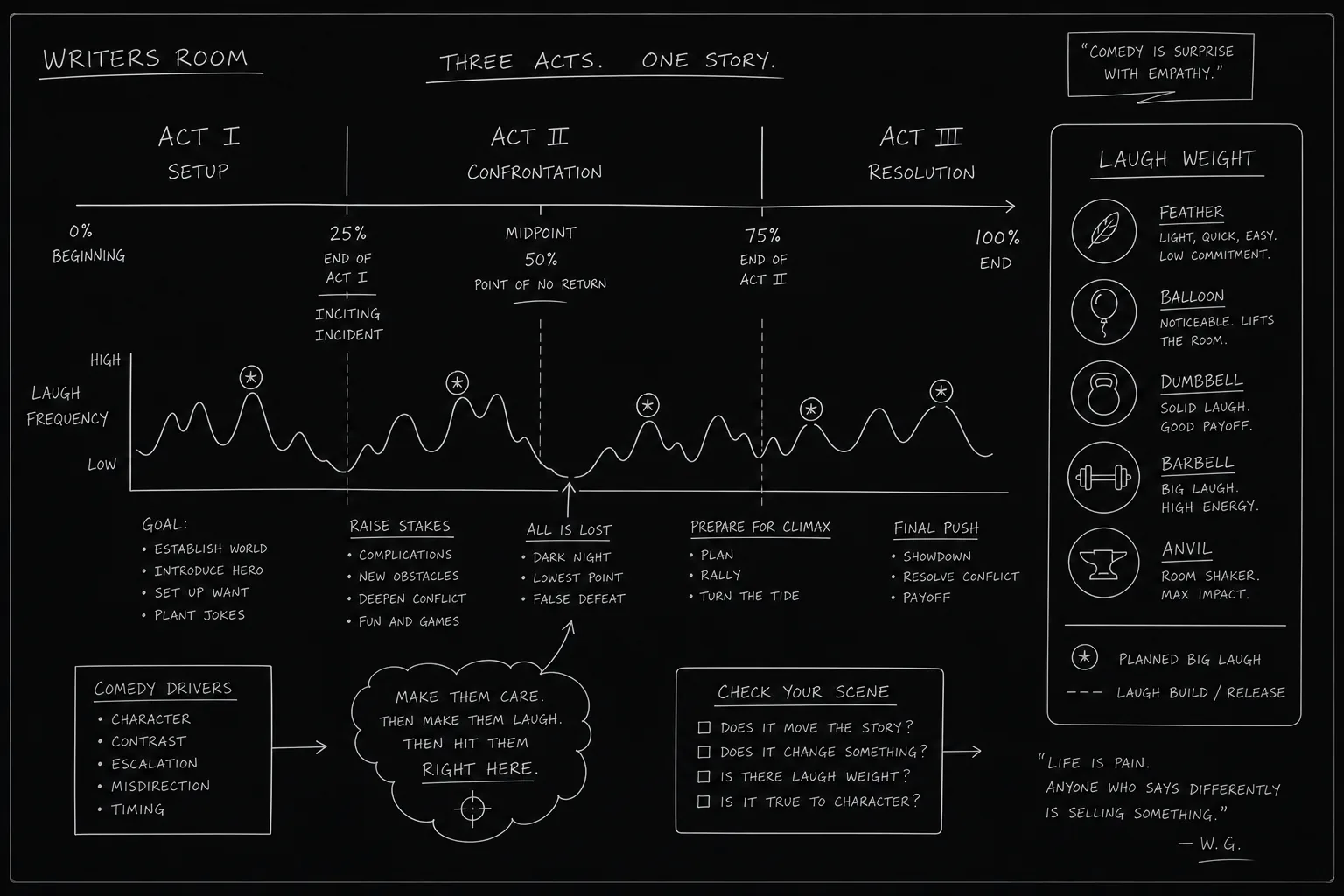
Balancing jokes and weight is not a math problem where laughs cancel tears. It is a sequencing problem where each scene knows what it owes the audience next. Build modules. Rotate coping. Turn at the midpoint. Tag with memory.
Write the dramedy pilot you would trust to watch with a friend who hates bait-and-switch. If they laugh, then go quiet, then laugh again without feeling tricked, you did not balance tone by accident. You structured permission for a life that is both, which is the only promise dramedy ever needed to keep.
Final Step
Build your next script with Screenweaver
Move from ideas to production-ready pages faster with timeline-native writing and AI-assisted story flow.
Try Screenweaver