
Failed audition scenes are everywhere.
Most of them are forgettable.
You know the pattern: actor enters, stumbles, gets interrupted, leaves devastated. Maybe rain outside. Maybe a "next!" from behind the table. The scene checks a box and moves on.
That version is functional.
It is rarely meaningful.
A strong failed audition scene is not about embarrassment. It is about identity under evaluation pressure. The character is not merely "not cast." They are confronting a gap between self-image, industry expectation, and current readiness. That gap can trigger growth, denial, compromise, reinvention, or collapse.
Here is why that matters: in stories about ambition, artistry, class mobility, performance, or self-worth, failed auditions are structural turning points. If you write them as one-note rejection moments, you waste major arc energy.
Why Failed Audition Scenes Feel Generic
Most weak scenes fail for one reason: they focus on outcome, not process.
The audience already knows failure happened because the scene title practically tells them. Tension should come from how failure unfolds and what it reveals.
Another common issue is casting-panel caricature. Readers get cartoon gatekeepers: bored, cruel, dismissive. Sometimes that is true to experience. Often it becomes lazy writing that simplifies institutional dynamics.
Third issue: no aftermath design. Character fails audition, cries in hallway, then next episode starts fresh. No residue, no strategic shift.
Think about it this way: if your audition failure could be replaced with "they didn't get it," your scene is probably underbuilt.
A failed audition scene should change the character's method, not just their mood.
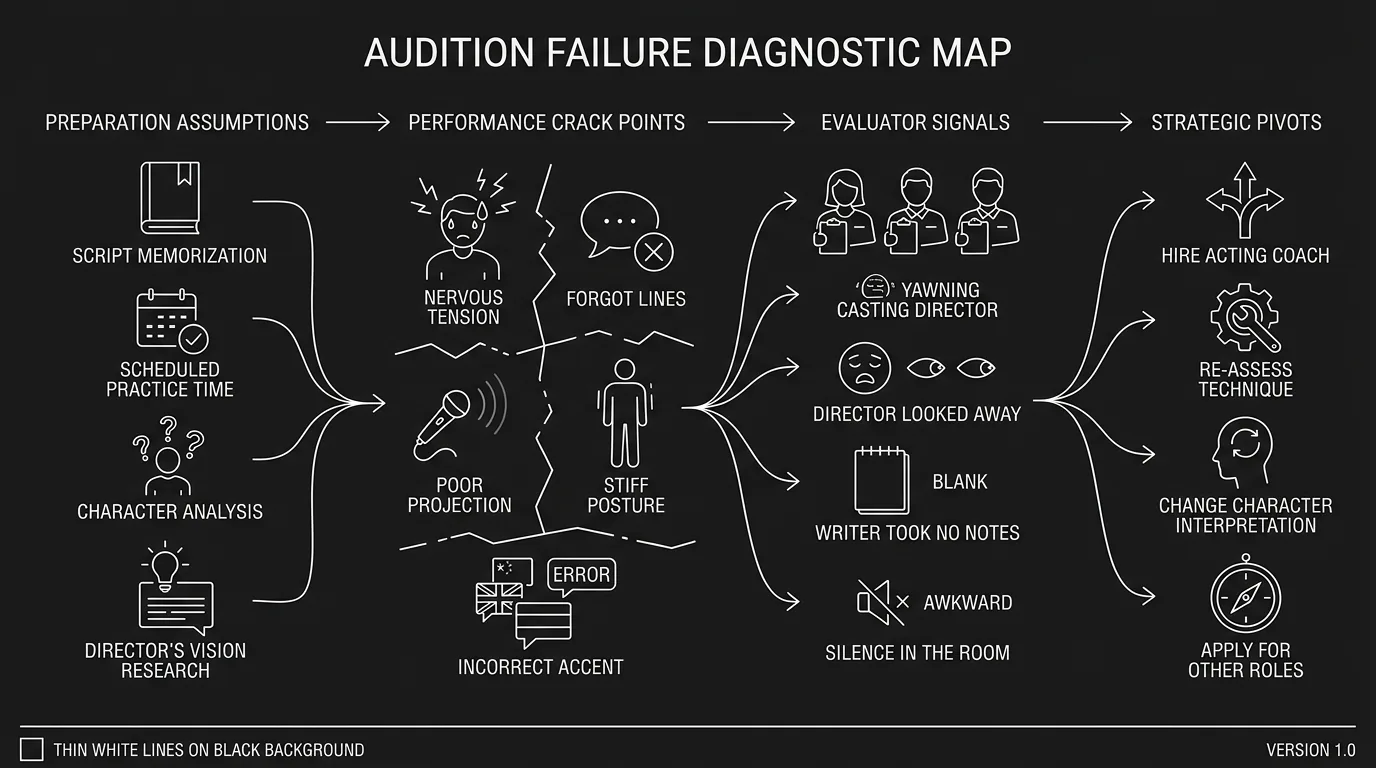
The Core Model: Preparation Myth, Performance Crack, Evaluation Signal, Exit Behavior, Strategic Reorientation
A robust failed audition scene usually follows five beats.
Preparation Myth: what the character believes will carry them.
Performance Crack: where reality destabilizes that belief.
Evaluation Signal: explicit or implicit indicator from panel/context that failure is likely.
Exit Behavior: how character manages public failure in real time.
Strategic Reorientation: what they do next because of this failure.
Without Performance Crack, failure feels arbitrary.
Without Exit Behavior, failure feels abstract.
Without Strategic Reorientation, failure feels episodic.
Scenario One: The Technically Good Actor Who Still Fails
Beginner scripts often equate failure with obvious poor performance.
But many strong scenes involve characters who perform well and still do not land the role. This creates richer tension because rejection is about fit, market logic, type politics, timing, or chemistry - not just talent.
If you write this version, make the mismatch specific. Perhaps actor nails emotion but misses tone genre. Perhaps panel seeks vulnerability and reads polish as armor. Perhaps role has hidden production constraints.
Now failure reveals industry complexity, not personal incompetence alone.
Scenario Two: The Self-Sabotage Audition
Another common pattern: character fails because nerves overwhelm them.
That can work, but avoid cliché panic-only framing.
A stronger version maps self-sabotage logic. Character over-rehearses one interpretation and cannot adjust direction. Or they reject a note to protect artistic identity. Or they derail by trying to "impress" rather than connect.
Failure then becomes character-consistent behavior under pressure.
Scenario Three: The Nepotism/Power-Filter Audition
Stories sometimes include unfair systems. If you use this, avoid reducing everything to "rigged from start."
More compelling: ambiguity plus evidence.
Panel may be constrained by sponsor demand, branding strategy, legal risk, or pre-attached talent. Character senses this but cannot prove full corruption. This tension can motivate political strategy arc, not just victim narrative.
Step-by-Step Workflow for Writing Failed Audition Scenes That Matter
Step 1: Define What Success Meant to Character (Before Scene)
Success might mean:
money stability,
family validation,
industry breakthrough,
self-worth repair,
escape from current life.
Failure hurts differently depending on this meaning.
Step 2: Define Failure Type Precisely
Not all failed auditions are equal.
Choose failure type:
technical breakdown,
direction mismatch,
panel bias,
timing conflict,
self-sabotage,
category error.
Precision creates dramatic truth.
Step 3: Build Pre-Audition Setup Debt
Scene impact depends on what was invested beforehand.
Travel cost, emotional promises, coaching debt, sacrificed opportunities, relationship strain. Show at least one stake before the room.
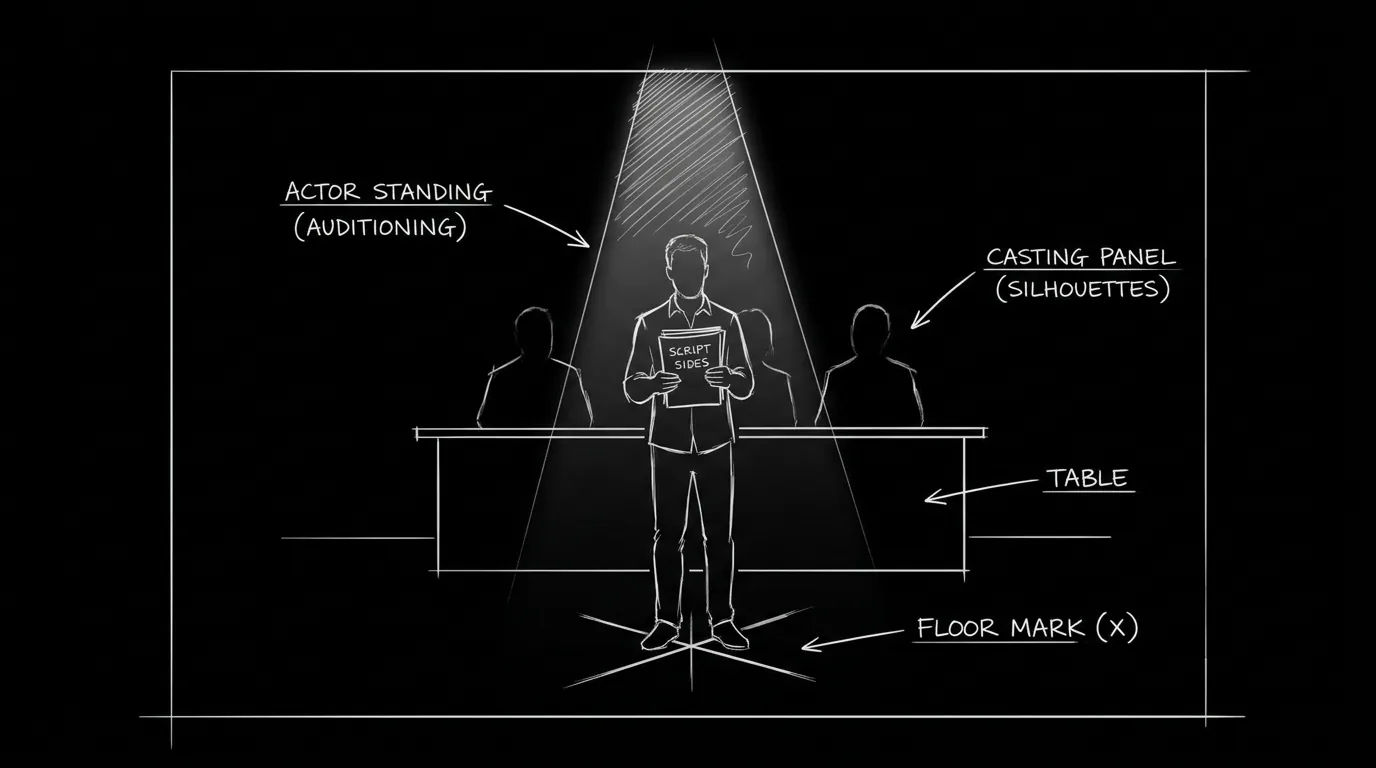
Step 4: Stage Audition Room Power Dynamics
Who has authority?
Who gives notes?
Who remains silent?
Who checks phone?
Who controls clock?
Room dynamics should communicate evaluation logic.
Step 5: Write One Performance Crack Beat
Crack can be vocal, emotional, interpretive, or relational.
A forgotten line is obvious.
A better crack is often subtler: inability to take adjustment, overcommitment to persona, emotional disconnection, defensive response to redirect.
Step 6: Script Exit Behavior with Character Specificity
How does character leave?
Polite composure?
Forced charm?
Visible anger?
Silent shutdown?
Exit behavior often reveals more than in-room performance.
Step 7: Force Immediate Strategic Reorientation
What now?
Different acting class?
Agent conflict?
Career pivot?
Compromise role acceptance?
Revenge strategy?
No reorientation means wasted failure.
Table: Cliche Audition Failure vs Arc-Driving Audition Failure
| Dimension | Cliche Version | Arc-Driving Version |
|---|---|---|
| Failure cause | Generic nerves | Specific mismatch or system pressure |
| Panel portrayal | Flat antagonists | Distinct evaluators with constraints |
| Character reaction | Cry and leave | Voice-specific exit behavior |
| Scene function | Emotional dip | Method and strategy pivot |
| Stakes linkage | Vague ambition | Concrete life and identity stakes |
| Aftermath | Quickly forgotten | Alters next decisions and relationships |
The Trench Warfare Section: What Beginners Get Wrong (and How to Fix It)
This is the practical repair section.
Mistake one: failure with no defined cause.
Fix by selecting one primary failure mechanism.
Mistake two: panel as one-dimensional villains.
Fix by giving each evaluator a distinct role and signal pattern.
Mistake three: overacting description instead of process detail.
Fix by writing adjustments, interruptions, and response dynamics.
Mistake four: no stakes before audition.
Fix by establishing what character risked to be here.
Mistake five: same failure reaction every time.
Fix by tailoring exit behavior to character coping style.
Mistake six: no follow-up consequence.
Fix by writing immediate next-step decision.
Mistake seven: generic "you were great but..." feedback trope.
Fix by using specific evaluative language or silence cues.
Mistake eight: no power map in room.
Fix by clarifying who actually decides.
Mistake nine: no social witness impact.
Fix by showing peers/agents/assistants observing failure.
Mistake ten: emotional speech overload post-failure.
Fix with compressed lines and behavior-led reaction.
Mistake eleven: all auditions written same.
Fix by varying format: self-tape, callback, chemistry read, dance call, cold read.
Mistake twelve: failure framed as personal defect only.
Fix by balancing craft gaps and system realities.
Mistake thirteen: no agency after rejection.
Fix by giving character strategic response option.
Mistake fourteen: tonal mismatch.
Fix by aligning scene intensity with genre contract.
Mistake fifteen: no bodily realism.
Fix with selective performance-stress cues (dry mouth, timing errors, breath control changes).
Mistake sixteen: no thematic connection.
Fix by tying failure to story's core question about identity, worth, or compromise.
Mistake seventeen: no contrast between pre-audition confidence and in-room reality.
Fix by writing one belief that visibly collapses.
Mistake eighteen: feedback treated as objective truth.
Fix by showing subjectivity and institutional bias in evaluation.
Mistake nineteen: repetitive audition montage syndrome.
Fix by ensuring each failed audition reveals new character layer.
Mistake twenty: failure scene used as filler.
Fix by demanding structural consequence before keeping scene.
Failed auditions become unforgettable when they expose not only whether someone can perform, but what they are willing to change to keep pursuing the dream.
Try it free
Try Screenweaver for free on your script
It is free. Import your existing project, get a clearer view of your outline, and regain control of your story structure in minutes.
Start FreeBody Image: Audition Failure Diagnostic Map
Practical 45-Minute Rewrite Drill
Take your failed audition scene and run this pass.
First ten minutes: define primary failure type and cut generic rejection lines.
Next ten minutes: add one clear room-power signal and one performance crack beat.
Next ten minutes: rewrite exit behavior in character-specific voice.
Next ten minutes: script one immediate practical consequence.
Final five minutes: connect failure to next-scene objective shift.
This pass typically upgrades failed audition scenes from emotional cliché to narrative engine.
Advanced Calibration: Hope Without Sentimental Reset
A mature failed audition scene can end with hope, but not denial.
Hope should be directional, not magical.
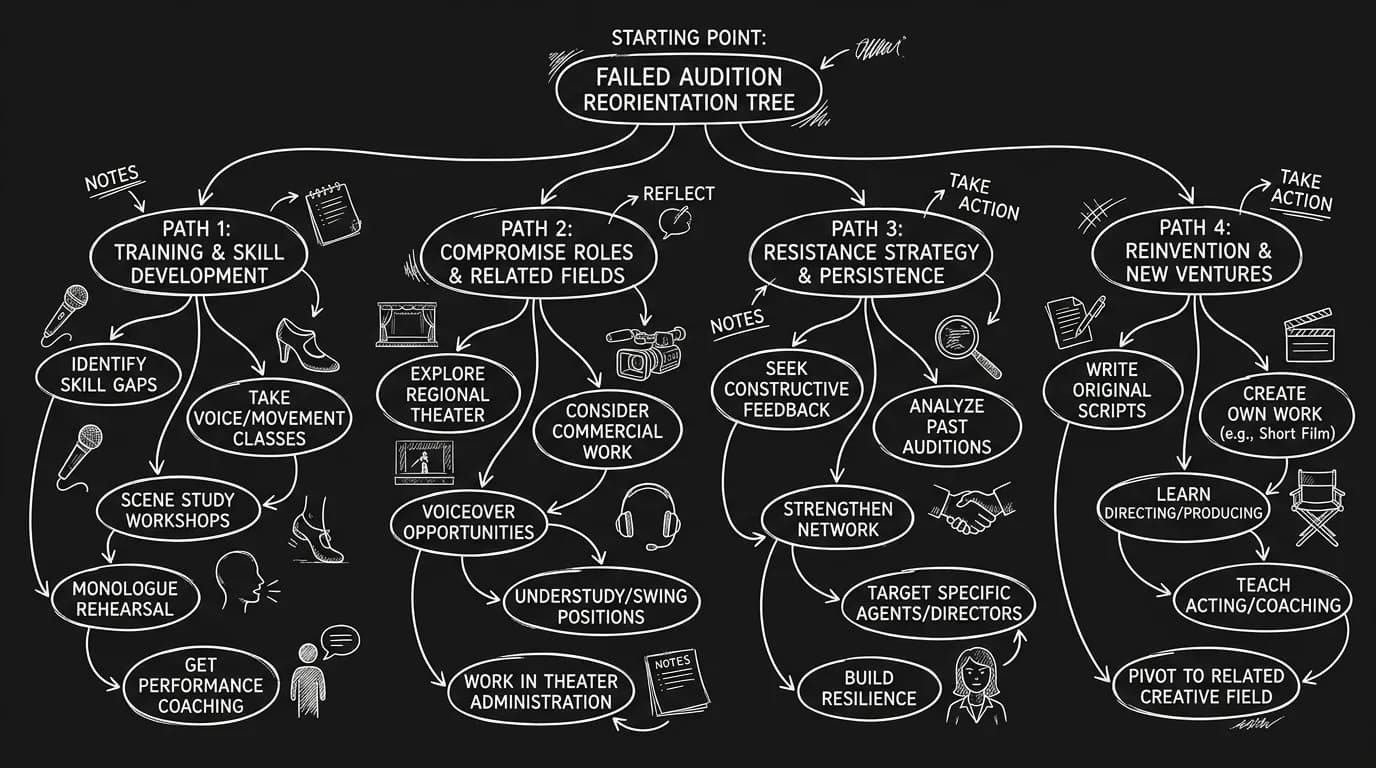
Character may choose disciplined training, strategic networking, or role recalibration. They may also choose to quit, which can be equally powerful if thematically coherent.
Another advanced move is split truth. A failure can simultaneously prove one weakness and one strength. This duality avoids binary "you are not good enough" messaging and creates richer arc options.
For external script-study references, the Writers Guild Foundation Library is useful and should be treated as nofollow in publishing workflows.
As discussed in our guide on [how to write a job interview scene that reveals character], evaluation settings reveal identity under institutional pressure.
If failure triggers public embarrassment dynamics, the framework in [how to write a public humiliation scene in a screenplay] helps stage social fallout credibly.
And when the failed audition pushes a character toward climactic choices, our principles in [how to write a final confrontation scene that feels earned] support payoff design.
Body Image: Post-Failure Reorientation Paths
YouTube Placeholder
[YOUTUBE VIDEO: A practical script-doctor session converting a cliché failed audition beat into a character-defining scene with concrete consequences and strategic aftermath.]
Extra Deep Dive: Writing the Room Before the Read
Many failed audition scenes start too late.
They begin at "Action."
You lose tension when you skip the corridor.
The pre-room environment carries vital pressure signals:
other actors rehearsing outside,
assistant mispronouncing names,
schedule delays,
callback hierarchy cues,
agent text pressure,
costume mismatch anxiety.
These beats can foreshadow failure mechanism without obvious setup dialogue.
A practical approach is pre-read triad:
one external pressure cue,
one self-regulation attempt,
one confidence mask behavior.
Then enter room.
This triad makes failure feel earned.
Scenario Layer: Self-Tape Failure in Isolation
Not all audition failures happen in front of panels.
Self-tape failures can be quietly devastating and highly cinematic on the page when written with intention.
Character records take after take, technical issues stack, performance stiffens, deadline approaches. No external villain, only collapsing bandwidth.
This setup is ideal for stories about perfectionism and self-surveillance.
Failure here can reveal control pathology and resource inequality (space, equipment, coaching access).
Writing Assistant and Reader Dynamics
In live auditions, assistants and line readers influence scene tone. Beginners often ignore them.
An assistant's procedural tone can increase anxiety.
A neutral reader's rhythm can destabilize or support performance.
A delayed redirect from panel can imply disinterest before explicit feedback.
These micro-signals are valuable because they communicate rejection trajectory without blunt dialogue.
The "Second Chance" Beat
A strong failed audition scene may include a tiny second chance:
"Could we try that once more?"
How character uses this chance often defines arc.
Do they adapt?
Do they repeat the same choice?
Do they overcorrect into inauthenticity?
This beat can transform failure from random outcome to character revelation.
Practical Compression Pass for Overwritten Audition Scenes
Audition scenes are easy to overwrite because writers transcribe whole reads.
You usually need less.
Keep:
one setup line,
one key performance moment,
one redirect or signal,
one crack beat,
one exit beat,
one consequence beat.
Cut the rest unless genre specifically requires full read.
Designing Repeat Audition Arcs Across a Script
If your story contains multiple failed auditions, each must fail differently.
Failure 1 can expose technical weakness.
Failure 2 can expose psychological pattern.
Failure 3 can expose strategic misalignment.
Then later success (or chosen exit) feels earned because method changed across failures.
Without variation, repeated audition scenes feel episodic.
With variation, they build cumulative arc.
Extended Craft Layer: Dignity in Failure Writing
Failed audition scenes can easily tip into humiliation voyeurism. Protect character dignity by writing interior complexity, not mockery.
Dignity does not mean shielding from pain.
It means granting agency, specificity, and meaningful response.
A character can fail visibly and still leave with self-authored next move. That balance is often what separates mature drama from exploitative scenes.
Five-Question Integrity Check
Before locking the scene, ask:
Is the failure mechanism specific and legible?
Does the room power map influence outcome?
Is the character's exit behavior voice-true?
Does failure alter next-scene strategy?
Would removing this scene weaken the arc materially?
If yes, your scene is likely carrying real narrative weight.
Micro-Exercise: One Audition, Three Failure Lenses
Take one audition setup and rewrite it three times from different failure lenses:
Lens A: craft failure (technique or adaptability gap).
Lens B: context failure (fit, timing, market, institutional constraint).
Lens C: self-protection failure (fear-driven choice to avoid vulnerability).
Compare which version best serves your character arc and theme.
This exercise prevents generic "bad audition" writing and clarifies narrative purpose before line polish.
Additional Scenario Bank: Fast Templates for Rewrite
Template 1: Callback Collapse
Character enters with confidence after first-round praise.
Panel asks for tonal pivot.
Character cannot release winning first-round choices.
Failure reveals attachment to approval over adaptability.
Template 2: Chemistry Read Mismatch
Character performs strongly alone.
Partner read exposes emotional disconnect.
Panel selects chemistry over technical precision.
Failure reveals relational blind spot, not talent absence.
Template 3: Last-Slot Fatigue
Character auditions at end of long day.
Panel attention is depleted, cues are minimal.
Character mistakes low affect for hostility and spirals.
Failure reveals interpretation bias under uncertainty.
These templates are not formulas; they are diagnostic tools for creating distinct failure signatures.
Use them to pressure-test causality before drafting full scenes.
Then run a final continuity pass to ensure each failed attempt leaves a different psychological residue and tactical adjustment, so the audience experiences progression rather than repetition.
That progression is where credibility and emotional investment compound.
Ending Perspective: Failed Auditions Should Change the Method
If your failed audition scene feels familiar, do not make the rejection meaner.
Make the consequence clearer.
What belief cracked.
What strategy changed.
What cost became unavoidable.
What version of the dream survives.
When those answers are on the page, failure stops being humiliation content.
It becomes transformation pressure.
Final Step
Build your next script with Screenweaver
Move from ideas to production-ready pages faster with timeline-native writing and AI-assisted story flow.
Try Screenweaver