French Scene Breakdown
Generate a character presence chart from any script
This free french scene breakdown generator builds the classic character-presence chart from a pasted screenplay or stage play, the assignment that film and theater programs still make students do by hand with a ruler and a highlighter. Paste your script, get the grid: characters down the side, scenes and their French scene subdivisions across the top, an X for every presence.
A French scene is the unit that begins whenever a character enters or exits, a convention from 17th-century French theater where scene numbers changed with every entrance. Directors still chart them because the grid exposes things a read-through hides: which actors can rehearse together, where the cast balloons, which character disappears for thirty pages. The tool detects sluglines in screenplays and ACT and SCENE headings in stage plays, then subdivides each scene wherever the set of speaking characters changes.
Everything runs in your browser. Your script is never uploaded or sent to any server.
Paste your script above to see the breakdown. Fountain, standard screenplay format, and printed-play text (HAMLET: ...) all work.
How it works
The parser first finds scene boundaries: INT and EXT sluglines for screenplays, ACT and SCENE heading lines for stage plays, with an ACT heading merging into the SCENE that follows it. Within each scene it collects dialogue cues, groups them into conversation cycles, and starts a new French scene whenever the set of speakers changes, since a changed speaker set is the textual trace of an entrance or exit. Extensions like (V.O.) and (CONT'D) are stripped so one character is counted once. The result is an approximation of the true French scene breakdown: silent entrances need the manual toggle, which is exactly the judgment call the hand-drawn version of this chart always required.
What is a french scene breakdown and why do directors use it?
A french scene breakdown is a character scene chart: a grid mapping which characters are present in each French scene, the unit bounded by any entrance or exit. The name comes from neoclassical French theater, where printed scripts renumbered the scene every time the cast on stage changed. Directors, stage managers, and film programs still build the chart because it turns a script into a rehearsal-schedulable object: any two actors' shared French scenes are exactly the calls they must attend together.
The grid is also a diagnostic. A character presence grid for a play makes pacing problems visible at a glance: a protagonist absent for a full act, a scene where nine characters speak and seven of them could be cut, a two-hander stretch that gives the rest of the cast a week off. The cast size row along the bottom is a budget document too, since the biggest columns are the most expensive days on a film set and the hardest scenes to block on stage.
In directing and script analysis courses, making a french scene breakdown by hand is a rite of passage precisely because it forces a slow read. This generator does the mechanical pass, detecting scenes and speaking presence, and leaves the interpretive pass to you: click cells to add silent characters, then export the finished chart as CSV for your prompt book, rehearsal schedule, or script analysis assignment.
Who this is for
- Directors and stage managers: build the rehearsal schedule from shared French scenes, so actors are only called when their scenes are on the floor.
- Film and theater students: produce the script analysis assignment in minutes, then spend the saved hours on the interpretive work the chart is meant to provoke.
- Screenwriters and playwrights: audit your own structure: spot the character who vanishes for an act and the scenes whose cast size will scare a producer.
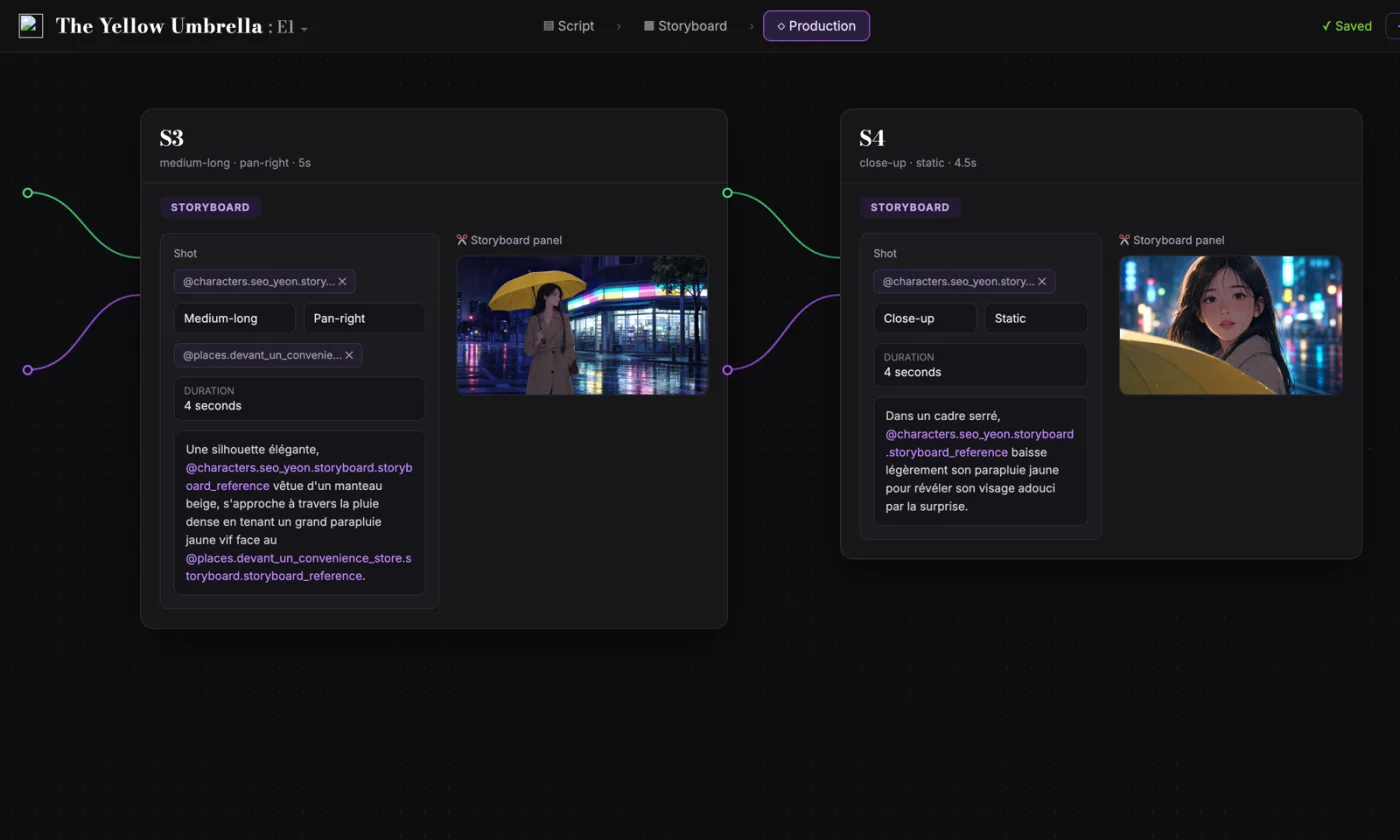
From script to shots,in one place.
ScreenWeaver turns your screenplay into an automatic shot breakdown, then a storyboard. Characters, locations and references carry from shot to shot.
- $0, does not expire
- PDF and Final Draft export
- Mac, Windows, Linux, iPad
French Scene Breakdown: the complete guide
It parses a pasted screenplay or stage play, detects scenes and speaking presence, subdivides scenes where the speaking cast changes, and outputs an editable grid with CSV export.
For this workflow, the central problem is clear: the character-presence chart every directing program assigns is still built by hand, one highlighter pass per character. Left unresolved, this creates downstream friction and slower decisions. The practical target is a complete presence grid with French scene subdivisions, per-character totals, and cast sizes, ready for rehearsal scheduling or a class assignment.
Limitation to keep in mind: It detects presence from dialogue only, so silent characters and line-less entrances need a manual cell toggle, and unconventional formatting can hide cues from the parser.
Advanced workflow: Directors pair the grid with a calendar: group columns into rehearsal calls, sum each call's required actors from the rows, and schedule the biggest-cast French scenes first while everyone's availability is still open.
Step-by-Step Workflow
- Paste the full script, or one act at a time for very long plays, and check the detected scene count against your own.
- Scan the grid for characters the parser missed or merged, and toggle cells for silent presences you know from the text.
- Read the cast size row for blocking and budget pressure, and the per-character totals for imbalance.
- Export the CSV into your prompt book or scheduling spreadsheet and group columns into rehearsal calls.
Use Cases By Profile
- Director: find every French scene two leads share and build their rehearsal block in one afternoon.
- Stage manager: paste the acting edition and hand the director a presence chart before the first production meeting.
- Student: complete the script analysis breakdown mechanically, then write the essay about what the pattern reveals.
Common Mistakes To Avoid
- Trusting dialogue detection for characters who listen more than they speak.
- Charting by printed scene numbers only and missing the entrances and exits inside them.
- Building the chart after scheduling rehearsals instead of before.
Professional Best Practices
- Run the breakdown on your own draft before a reader does; a lead missing for an act is easier to fix at page one of notes.
- Sort rehearsal priorities by French scene count per actor pair, not by scene order.
- Keep one exported CSV per draft so structural changes between drafts are diffable.
Treat this tool output as a decision support layer, not a replacement for authorship. Great scripts are remembered for specific choices, emotional precision, and clarity of dramatic movement. Tools help by removing noise so your energy can go where it matters: character, conflict, escalation, and payoff. If you review outcomes after each pass and keep an explicit log of accepted changes, your workflow becomes faster and more predictable from draft to draft. That consistency is exactly what professional collaborators value: fewer surprises, clearer rationale, and a script that evolves with intent.
Extended FAQ
Where does the term French scene come from?
From 17th-century French neoclassical theater, where printed scripts started a new numbered scene at every entrance or exit. English-language practice kept location-based scenes and borrowed the French unit for analysis, hence the name.
How do directors use a French scene breakdown for rehearsal scheduling?
Each French scene lists exactly who is needed on the floor. Grouping French scenes that share a cast into one rehearsal call means no actor sits idle, which is why stage managers build this chart before the first scheduling meeting.
What is the difference between a scene breakdown and a French scene breakdown?
A standard breakdown follows the script's scene divisions (sluglines or numbered scenes). A French scene breakdown subdivides further at every entrance and exit, so one location scene can contain several French scenes with different casts.
Does this work for both stage plays and screenplays?
Yes. It reads INT and EXT sluglines for screenplays (including Fountain) and ACT and SCENE headings for stage plays, and it accepts printed-play inline cues like HAMLET: as well as centered uppercase cue lines.
Why does cast size per scene matter?
On stage, big-cast French scenes are the hardest to block and the most expensive to call. On film, the widest columns are the days with the most actors on set. The cast size row turns that pressure into one visible number per column.
Can I edit the generated breakdown?
Yes. Every cell toggles on click, so you can add silent characters or remove false positives, and the totals, cast sizes, and CSV export all follow your manual corrections.
Frequently asked questions
The stretch of action between any character's entrance or exit. When someone walks on or off, the current French scene ends and a new one begins, even if the location and the printed scene number stay the same.
Screenplays with INT and EXT sluglines (including Fountain, with forced sluglines and @ character names), stage plays with ACT and SCENE headings, and printed-play text with inline cues like HAMLET: or HAMLET. followed by the line. Plain dialogue with no headings is treated as one scene.
Presence is detected from dialogue cues, so a character who is on stage but never speaks in that stretch will not be marked. Click the cell to toggle them in; the totals, cast sizes, and CSV export update with your correction.
The tool groups each scene's dialogue into conversation cycles and starts a new subdivision when the set of speakers changes, which is the textual footprint of an entrance or exit. It is an honest approximation: entrances without lines still need a manual toggle.
Yes. The CSV has one column per French scene and one row per character, plus totals and a cast size row, so it drops into a spreadsheet where you can group columns into rehearsal calls and see instantly which actors each call requires.