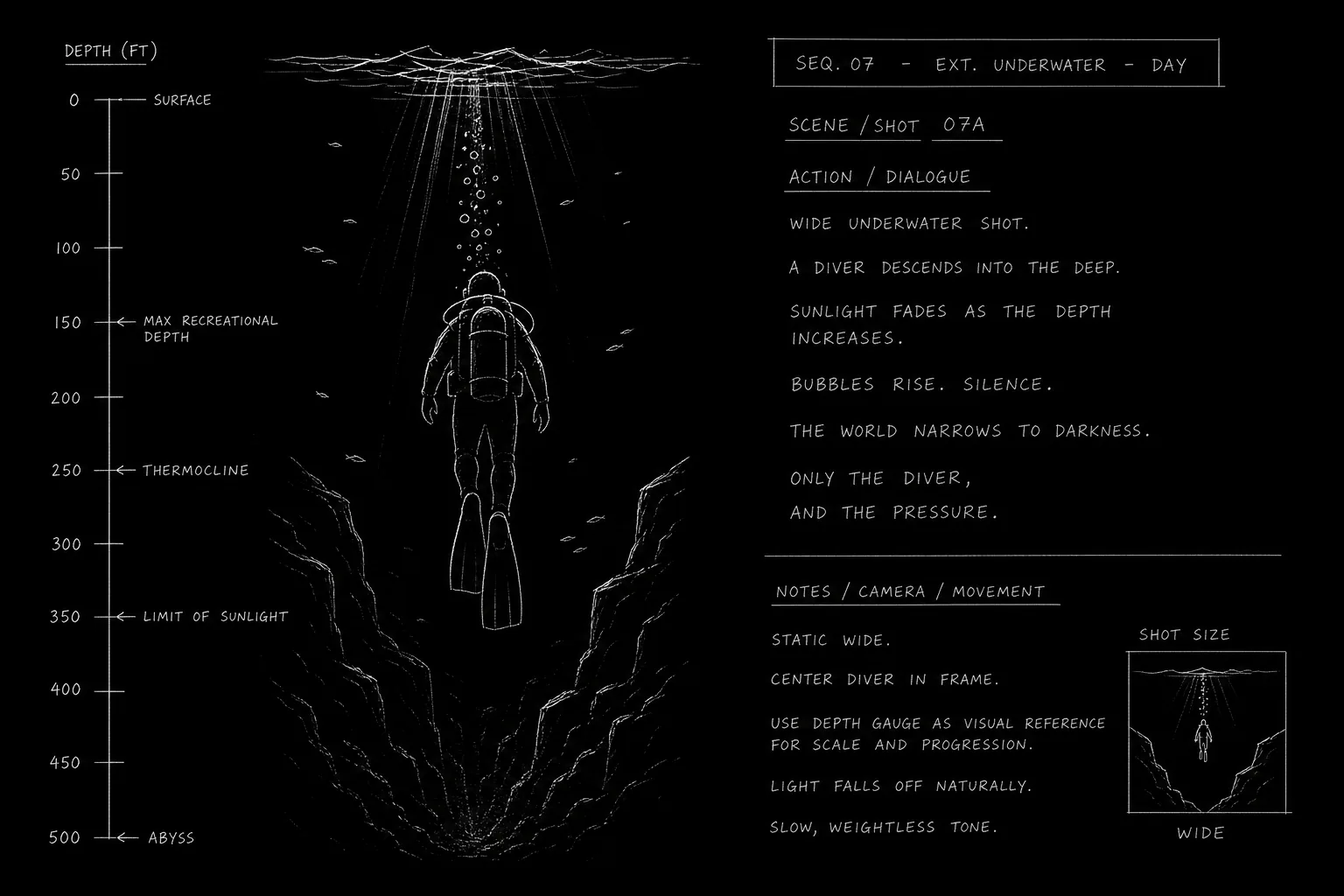

She loses the regulator. Thirty feet down. Visibility six inches. The villain's boot kicks sediment into her face. Above her, the hull breach spills silver bubbles. Below her, the trench goes black.
Underwater action is visceral on screen and chaotic on the page. Writers default to vague lines like "They fight underwater" or drown the script in technical diving jargon. Neither reads. Production needs clarity on depth, breath, movement, visibility, and equipment without a manual from PADI.
This guide formats underwater sequences for action screenplays so readers feel the physics and stunt coordinators see the plan.
Free tool: use the Beat Sheet Calculator to map these beats to exact page numbers for your script length.
How It Works: Underwater Has Different Rules
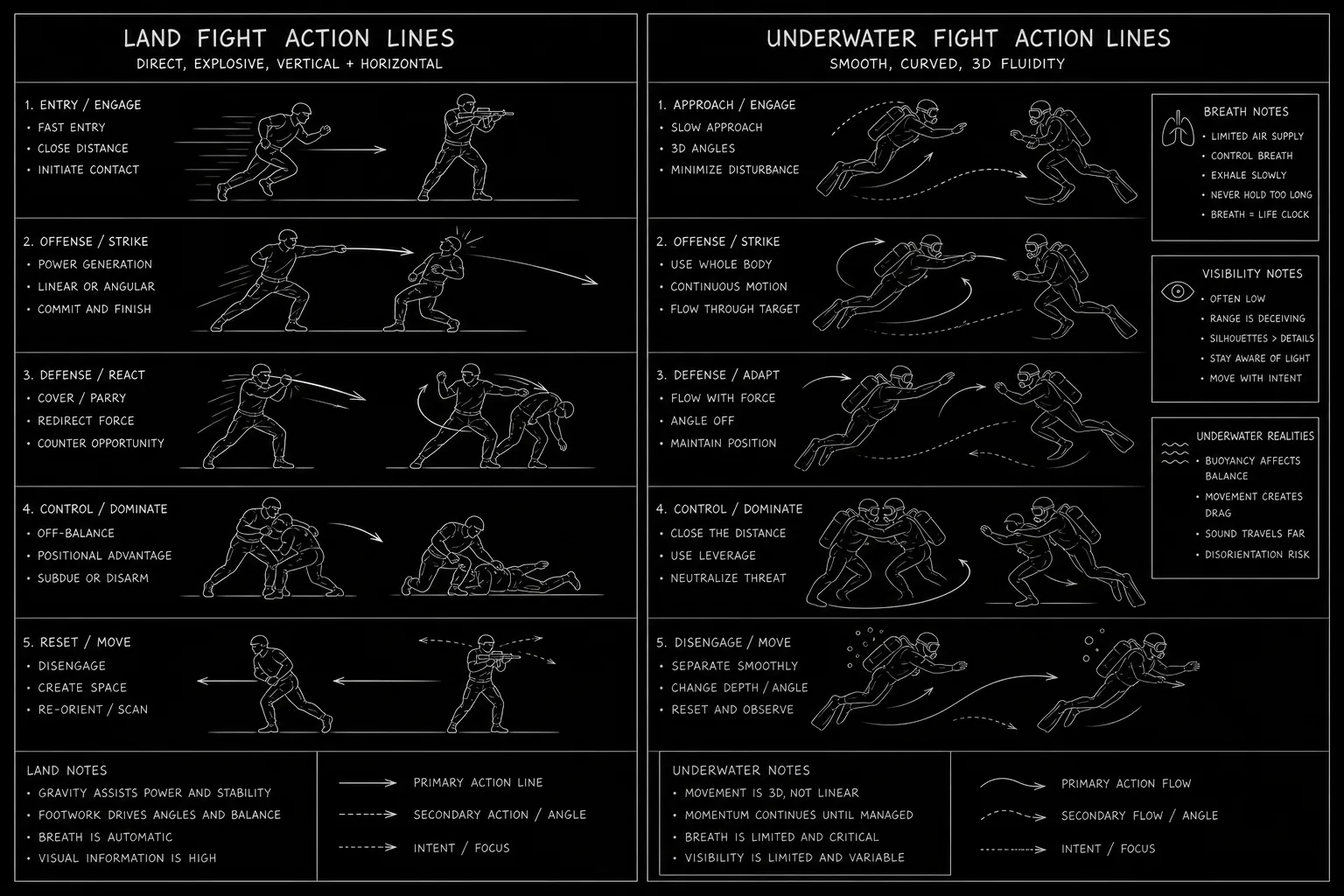
On land, action lines track punches, chases, cover. Underwater adds:
- Breath clock - How long can a character hold?
- Buoyancy - Sinking, neutral, rising
- Visibility - Murk, silt, blood diffusion
- Sound grammar - Muffled, heartbeat, silence
- Equipment state - Regulator, tank pressure, mask, line, cage
You are writing hostile environment action. The water is an antagonist with constant pressure.
Underwater scenes fail when writers forget humans cannot speak clearly or breathe casually.
For general unfilmable action pitfalls, see writing unfilmable action lines. For continuous-shot clarity in complex sequences, see the oner: describing one take. For animal unpredictability in action (similar environmental chaos), see writing animals in action scripts.
Platform and Use-Case Sections
Thriller / Spy (Harbor, Pool, Dam)
Engine: Covert infiltration, drowned evidence, escape through flooded compartment.
Format focus: Gear checks before entry, clock on air supply, hand signals when voice fails.
Disaster Film (Flood, Sinking Vessel)
Engine: Trapped corridors, rising water line, pocket air.
Format focus: Water level in scene heading or action. INT. PASSAGE - FLOODED - CONTINUOUS Track vertical position.
Horror (Open Water, Creature)
Engine: Isolation, limited visibility, predator proximity sensed not seen.
Format focus: Sound design notes. What the character cannot see.
Sci-Fi / Deep Sea Research
Engine: Suits, ROVs, crushing depth, lights failing.
Format focus: Depth in meters/feet. Suit integrity. Comm static.
Training / Character Montage
Engine: Learning to trust gear or self.
Format focus: Shorter beats. Clear skill progression. Less dialogue.
Step-by-Step: Formatting an Underwater Sequence
Step 1 - Establish entry. How do we get wet? Dive off boat, flood fills room, character pulled under. One clear transition.
Step 2 - State gear and depth once. She checks her gauge. 40 feet. Regulator hisses. Do not repeat every line.
Step 3 - Replace dialogue with physical intent. Underwater speech is rare and stylized. Use looks, gestures, written slates, rope pulls.
Step 4 - Write short action lines. One physical beat per line. Land kicks sediment. Mask floods. She clears it with a sharp exhale.
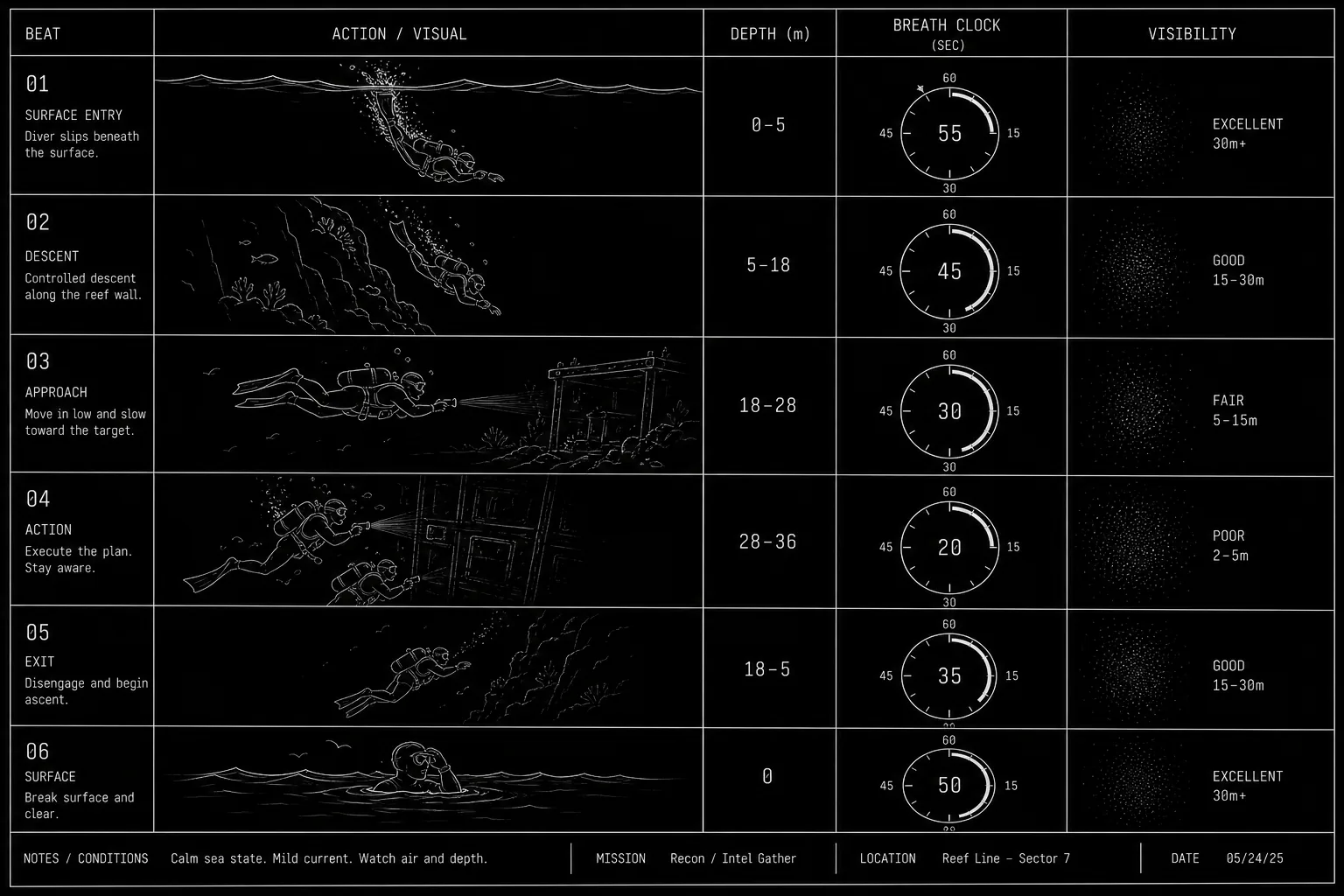
Step 5 - Track the breath clock. Note when breath becomes critical. His chest spasms. He needs air in ten seconds.
Step 6 - Use scene geography. Wreck port side, cave ceiling, hull breach above. Reader must orient in 3D.
Step 7 - Exit the water with consequence. Decompression omitted in drama is common, but emotional and physical cost should land on surface.
[YOUTUBE VIDEO: Underwater action sequence with script overlay showing breath clock and gear state annotations.]
Operational Section: Format Conventions and Safety Notes
Scene Headings
EXT. OCEAN - UNDERWATER - DAY

or

INT. SUNKEN CARGO HOLD - FLOODED - NIGHT
Add depth when relevant: (40 FEET) in heading or first action line.
Action Line Vocabulary (Consistent Terms)
| Term | Use |
|---|---|
| Regulator | Breathing mouthpiece |
| Gauge / SPG | Air supply readout |
| BCD | Buoyancy vest inflate/deflate |
| Silt | Kicked-up visibility kill |
| Free flow | Regulator malfunction |
| Mask flood | Water in mask, cleared by exhale |
Pick one term per object. Do not alternate jargon randomly.
Sound and Dialogue
Indicate muffled speech: (muffled) or write that words are unintelligible. For critical information underwater, use:
- Hand signals described in action
- Slate board written message shown to camera
- Diver comm with static:
DIVER COMM (V.O., filtered)
Stunt and Production Flags
Note STUNT: Underwater fight. Safety divers per coordination. in production draft if your team uses such flags. Spec scripts can keep prose clean but should not require impossible breath holds without noting stylization.
Common Beginner Errors
- Characters have full conversations at depth
- No air anxiety ever mentioned
- Fighting looks like land choreography with blue filter
- Depth changes with no ear pressure or time cost
- Blood behaves like air smoke (note diffusion: crimson clouds, slow billow)
Sample Sequence: Flooded Corridor Fight
INT. CARGO SHIP - LOWER PASSAGE - FLOODED - NIGHT

Water at chest height. Emergency lights strobe red.

MARA wades forward. Each step costs force. JONAH ahead,
gripping a wrench.

JONAH
(muffled, unintelligible)

She reads his gesture: Up. Ladder rung above the waterline.

The HULL GROANS. A surge hits. Jonah slips under.

Mara dives. Visibility drops to inches. Silt swallows the frame.

His hand flails. She grabs his collar. Pulls.

His mask flooded. He claws at her. Panic.

She pins his arms. Presses her forehead to his. Holds him still.
Clears his mask with two sharp exhales. Shows her gauge: red zone.

They kick upward together. Not fast. Controlled.
Every stroke a negotiation with buoyancy.

They break surface in a shrinking air pocket near the ceiling.

Jonah gasps. Water drips from the overhead pipes.

MARA
(barely audible over metal stress)
We have forty seconds before this room is full.
This block tracks depth, gear, visibility, breath, and exit pressure without a single clear underwater sentence of dialogue.
Coordinating With Stunt and Safety
Underwater sequences are rewritten in safety meetings. Clear beats help coordinators slot safety divers, line pulls, and oxygen windows. If your script requires a character to hold breath beyond two minutes of screen time, note (STYLIZED) or restructure so survival logic stays credible.
Try it free
Try Screenweaver for free on your script
It is free. Import your existing project, get a clearer view of your outline, and regain control of your story structure in minutes.
Start FreeOutcome Section: What Good Formatting Achieves
Readable suspense. Reader tracks breath and position without consulting a dive manual.
Production clarity. Stunt and underwater unit see gear beats and hazard order.
Cinematic texture. Muffled sound, limited visibility, and buoyancy create flavor land action lacks.
Measurable failure: Reader cannot answer "What happens if she does not reach the surface in the next thirty seconds?" If stakes are vague, the sequence is decoration.
Why It Matters: Old Way vs. New Way
The old way: "Underwater fight ensues." One line. Editor and stunt team invent everything while the script page offers no tension logic.
The new way: Writers map breath clocks, gear failures, and visibility shifts beat by beat - the same discipline applied to oner sequences on land. Underwater units are expensive. Clear pages respect the budget.
Water remakes physics. Format for that reality and your action reads as inevitable, not as a blue-tinted afterthought.
When in doubt, read the sequence aloud and tap your chest every time a character should need air. If you never tap, the scene is probably land fight in disguise. Add silt, add gauge anxiety, add the surface as a horizon line the reader can see.
Final CTA: Write the Pressure, Not Just the Splash
Open your underwater sequence. State depth and gear once. Cut dialogue to gestures. Track the breath clock. Make visibility a character.
The audience should hold their own breath reading the page. Give them physics, geography, and a surface that might be too far.
Write wet. Write tight. Write like the air is running out.
Final Step
Build your next script with Screenweaver
Move from ideas to production-ready pages faster with timeline-native writing and AI-assisted story flow.
Try Screenweaver