
A two-hander is not a genre. It is a load-bearing contract. You promise the audience that the film's emotional weather will move through two bodies in shared space, interrupted only when you earn a third presence. When that contract holds, producers hear "contained" and "castable" in the same breath. When it slips, you get a ninety-page draft that reads like a play trapped in a movie, or a road movie that keeps inventing side characters because the central pair ran out of oxygen.
The craft question is not whether two leads are romantic, comic, or lethal. The question is whether every scene knows which relationship voltage it is selling and whether your structure rotates that voltage without repeating the same argument in different furniture.
A two-hander succeeds when the movie is secretly about one relationship seen from two angles, not two monologues that happen to share a zip code.
Free tool: use the Script Time Calculator to estimate your runtime from your script text or word count.
What "Two-Hander" Actually Means on the Page
Industry people use the term loosely. Sometimes they mean two leads with nearly equal screen weight. Sometimes they mean two characters alone for most of the runtime (a car, a house, a jury room, a weekend cabin). Sometimes they mean a duel: heist partners, exes, cop and suspect, caregiver and patient.
For structure, tighten the definition to this: the story's primary dramatic engine is the negotiation between Character A and Character B, and removing either one collapses the premise. Supporting cast can exist, but they function as pressure, not replacement engines.
That distinction matters when you outline. If your second lead could be swapped for a journal, a dog, or a voice on the phone without rewriting the spine, you do not have a two-hander. You have a solo story with a guest star.
Compare that to films that feel like two-handers but cheat: the buddy who disappears for twenty minutes while the protagonist has a separate adventure, the couple who split for act two so each can have a "personal" B-story that the audience did not buy tickets for. Audiences forgive separation when the separation changes the reunion. They do not forgive it when it feels like the writer needed air because the dialogue well ran dry.
A Structural Range Table (Pick a Lane, Then Defend It)
| Two-hander profile | Typical containment | Act-two risk | What "supporting cast" should do |
|---|---|---|---|
| Domestic pressure cooker (one location) | Single house, single night | Repetition of the same fight beat | Knock on the door, phone call, neighbor as fuse |
| Road / travel bond | Moving locations, few sets | Scenic detours that dilute the pair | Gas station clerk as mirror, not new protagonist |
| Professional duel | Office, courtroom, war room | Plot machinery overshadowing relationship | Third parties deliver stakes, not sympathy |
| Survival / horror pair | Wilderness, bunker, vessel | Monster as excuse to stop talking | Threat forces truth, not random action |
| Comedy negotiation | Apartment, wedding weekend | Joke density hiding missing turns | Ensemble as obstacle course, not co-leads |
The table is not a formula. It is a diagnostic. If your act two adds three friends with their own arcs, you are writing an ensemble piece with two loud voices. That can work commercially. It is not a two-hander structure, and coverage will say so.
Relatable Scenario: The Cabin Draft That Became a Play
Priya sells a relationship drama: two sisters inherit a cabin, one weekend to divide their mother's belongings. The pitch is intimate, castable, low budget. The first draft is one hundred six pages, almost every scene is the sisters in a room, talking. The dialogue is sharp. The read is exhausting.
The problem is not length alone. Priya wrote variations of the same scene: accusation, deflection, wounded silence, repeat. No structural rotation. Act one establishes the wound. Act two should change the rules of engagement (a discovery, a guest, a weather trap, a confession with consequences). Act three should force a choice that cannot be undone with another cup of tea.
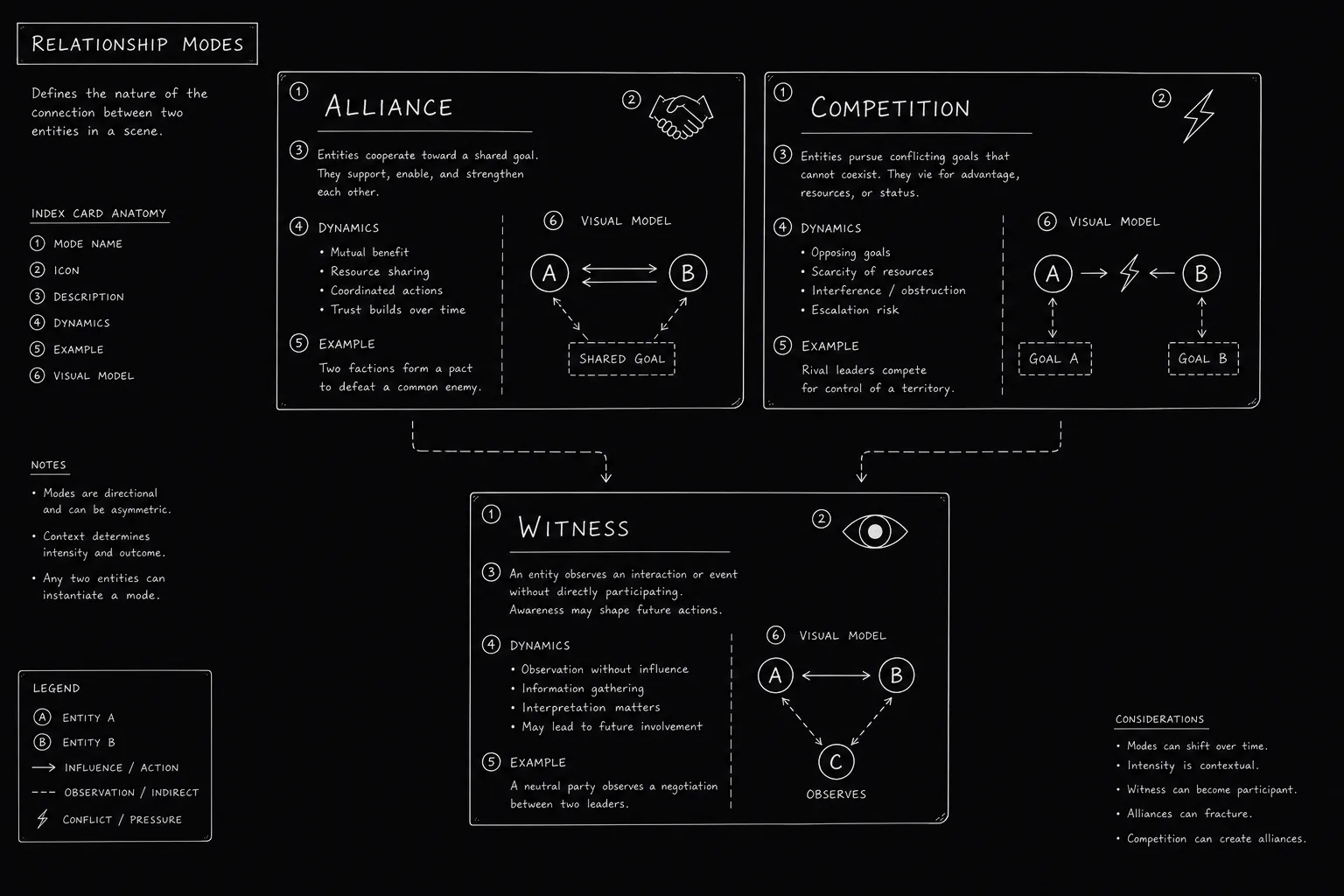
Priya's fix started on index cards, not in prose. A French scene breakdown, which splits the script by entrances and exits instead of sluglines, made the problem visible first: twelve straight units with the same two sisters and nobody arriving or leaving. Then she labeled every scene with a relationship mode: alliance, competition, caretaker, witness, estranged. Act one needed two modes. Act two needed four, including one mode the audience had not seen. Act three needed a final mode that recontextualized the opening image.
She added one exterior scene with a neighbor who returns a misdelivered box. The neighbor stays seven minutes. The box contains a letter that re-frames the mother. The neighbor is not a third lead. The neighbor is a wrench. The film stays a two-hander because the wrench tightens the sister bond rather than replacing it.
Relatable Scenario: The Road Movie That Kept Collecting Passengers
Marcus writes a dramedy: two former bandmates drive to a funeral, three states, old tapes on the dash. By page forty he introduces a hitchhiker with a full backstory. By page sixty the hitchhiker has a romance beat with a diner waitress. Coverage calls it "sprawling" and "unclear whose movie this is."
Marcus thought he was writing color. He was writing avoidance. The bandmates stopped changing, so he imported new people to create event. The fix was cruel and simple: cut every character who did not force the bandmates to renegotiate their history. The waitress stays if she reveals something one man hid from the other. The hitchhiker stays only if the hitchhiker is a walking mirror of their breakup, then leaves before act two ends.
Road two-handers live or die on scene purpose. Each stop should answer: what do we know about the pair now that we could not know in the last stop? If the answer is "they argued about the same grudge with different wallpaper," merge stops or cut one.
For rhythm on the page while you revise, pairing this structure work with screenplay revision passes keeps relationship turns separate from line-level polish, which is how you avoid rewriting jokes into a broken spine.
How the Three-Act Spine Changes When Only Two Voices Matter
Act one must do more than introduce people. It must introduce the relationship's default lie. One character believes X about the other. The other is protecting Y. The inciting event should attack that lie in a way that traps both in proximity: shared obligation, shared crime, shared grief, shared deadline.
Act two is where two-handers die from sameness. In ensemble films, subplot friends carry act two. In two-handers, you need relationship escalation types instead of new friends. Escalation types include: public exposure (someone could overhear), private revelation (a secret lands), role reversal (caretaker becomes dependent), moral test (one asks the other to cross a line), external clock (they will lose the house, the trial ends, the storm hits).
Rotate types. If act two scene eight feels like act two scene three, you are not escalating. You are looping.
Act three should compress space and time. Two-handers often benefit from returning to the opening location with new meaning. The audience feels completion when the same room holds different people emotionally, even if the furniture never moved.
Midpoint design deserves its own sentence because beginners skip it: the midpoint is not "a twist." It is a point of no return for the relationship. They kiss, they betray, they confess, they witness something together they cannot un-see. After that, going back to act-one banter without addressing the midpoint reads as cowardice.
Dialogue as Structure, Not Decoration
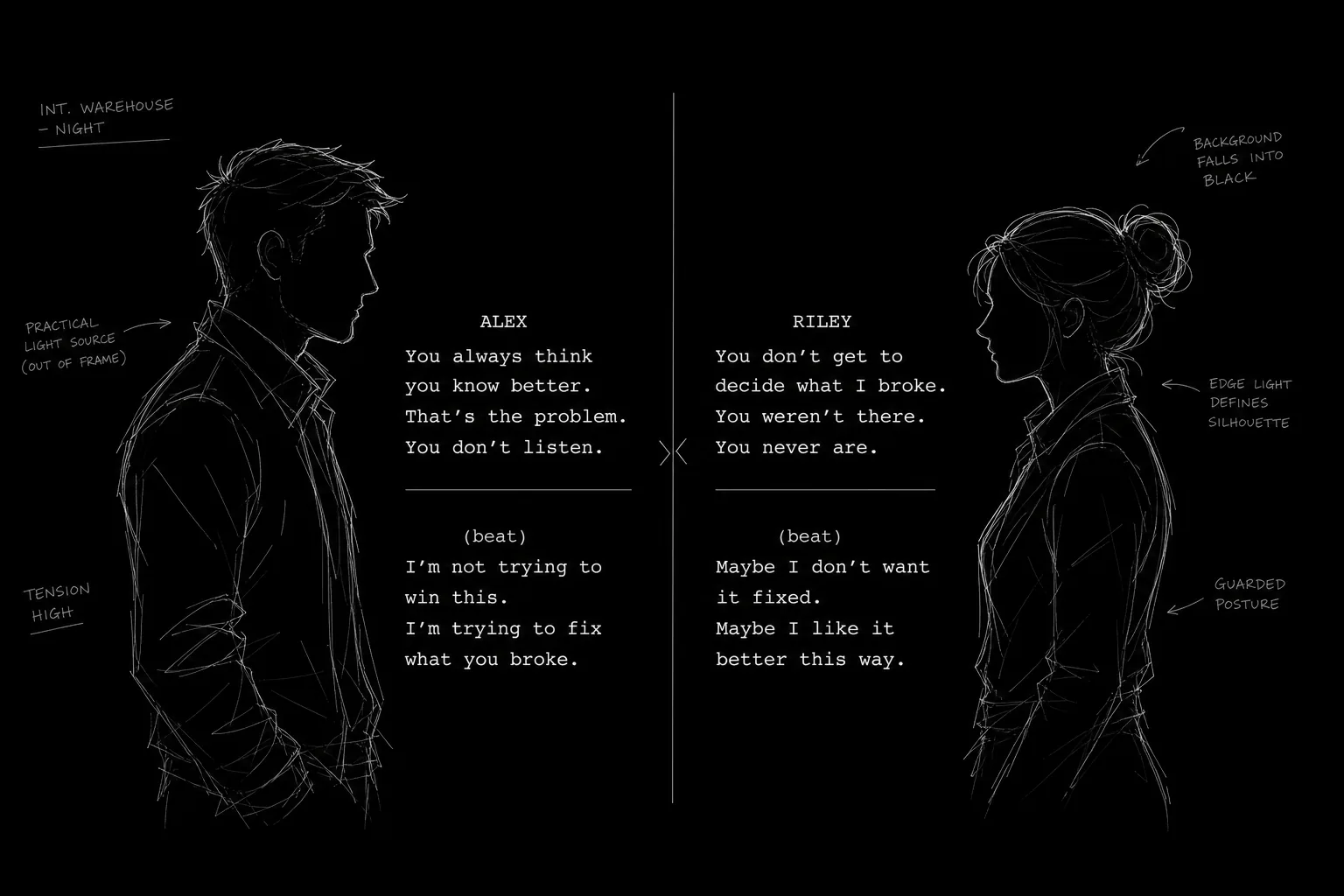
In a two-hander, dialogue is not flavor on top of plot. Dialogue is plot when physical stakes are modest. That does not mean every scene is talk. It means talk must move obligation.
Train yourself to hear each exchange as a transaction. What is being requested? What is being refused? What status shifts? If you cannot answer in one sentence per scene, the scene is atmosphere, and atmosphere without turn is where readers quit.
Subtext carries more weight here than in spectacles. When only two people matter, the audience learns to listen for what is not said. On the page, resist explaining subtext in action lines. Let gaps exist. Directors and actors will thank you. Readers will lean in.
Blocking matters even in spec scripts. Where bodies are in the room changes power. A character at the door is different from a character seated at the table. You do not need camera directions. You need spatial truth so the read feels cinematic rather than theatrical.
Try it free
Try Screenweaver for free on your script
It is free. Import your existing project, get a clearer view of your outline, and regain control of your story structure in minutes.
Start FreeGranular Workflow: Build a Two-Hander Outline That Survives Draft Two
Step one: write the relationship thesis in one line. Example: "He wants forgiveness without confession; she wants confession without forgiving." That line is your compass. Scenes that do not test it go.
Step two: map eight relationship modes across the film. Alliance, rivalry, seduction, mentorship, indifference, dependency, performance (public face), rupture. Assign modes to sequences. No sequence longer than fifteen pages should use only one mode.
Step three: design three set pieces that force physical cooperation or conflict. Even talky films need bodies doing something: moving a body, fixing a car, hiding evidence, cooking a meal under stress. Set pieces break dialogue monotony and give trailers footage.
Step four: audit every supporting character with a brutal question. Does this person make A and B more necessary to each other? If no, cut or fold their function into an object (letter, voicemail, news clip).
Step five: write act three as a choice scene, not a speech scene. The audience should see what each character sacrifices. Speeches can follow action. Action rarely follows a speech that replaced a decision.
Step six: read aloud with one reader per lead. If one voice dominates page count by thirty percent without story reason, rebalance. Two-handers can have a slight lean, but lean without purpose reads like miscasting.
Genre Pressure: Comedy, Thriller, Horror
Comedy two-handers live on rhythm and rule-breaking. Establish what is normal between the pair in ten pages, then violate normal repeatedly. The violation must escalate. Jokes are not structure, but pattern and break is. If you are balancing laugh density with story, remember that performance time often runs longer than page count suggests; our guide on screenplay runtime and the one-page-per-minute rule helps you estimate read time before you hand pages to a producer who will schedule a table read.
Thriller two-handers need clarity about trust. The audience should always know what each character knows, unless you are writing a deliberate unreliability film. Ambiguity is a tool, not a fog machine. When trust shifts, show the evidence on screen or on page, even if characters misinterpret it.
Horror two-handers use the pair as emotional insulation. We endure fear because we care about the bond. Split the pair too early and you lose insulation. Keep them together until separation is the scare.
External Craft Context (Without Outsourcing Your Spine)
The <a href="https://www.wga.org/" rel="nofollow">Writers Guild of America</a> materials will not teach you your specific relationship thesis, but they reinforce a professional reality: two-lead pieces are often budget conversations as much as artistic ones. Contained casts attract financiers who fear crowd scenes. Your structure should make containment feel chosen, not cheap.
When you study produced two-handers, watch turn density: how often the relationship changes state per ten minutes. Novelists can live in a mood for a chapter. Film punishes mood without turn.
The Trench Warfare Section: What Writers Get Wrong
Wrong: calling it a two-hander because there are two names on the poster. Poster billing is marketing. Structure is what happens scene by scene. Fix: run the collapse test. Remove one lead mentally. If the movie still works, you are not writing the structure you think you are.
Wrong: using side characters as act-two padding. Fix: every outsider must tighten the dyad or exit fast.
Wrong: repeating the same emotional beat because the dialogue is good. Good lines do not excuse static structure. Fix: change mode, location, stakes, or secret.
Wrong: splitting the pair for convenience without reunion payoff. Separation must alter the reunion. Fix: write the reunion scene before you justify the split.
Wrong: hiding exposition in monologue because there are only two mouths. Fix: embed exposition in conflict, object, or mistake.
Wrong: writing eighty pages in one room without visual strategy. Fix: use objects, weather, light, tasks. Cinema is behavior.
Wrong: forgetting that silence is a line. Two-handers need negative space. Fix: mark one beat per sequence where nobody speaks and something still changes.
Wrong: aiming for "naturalistic" talk that never threatens. Fix: every scene should risk something: status, safety, love, money, truth.
The audience does not owe you patience because the dialogue sounds real. They owe you attention because the relationship moves.
Before You Lock: A Producer-Shaped Sanity Check
Ask whether your draft delivers castable peaks. Actors take two-handers when they see three or four scenes where they can win awards without stealing from a co-lead. Those scenes are usually reversals, not speeches.
Ask whether your ending reframes the opening image. The first image should mean something different after we know how the pair changed. If the opening and closing images are identical emotionally, you may have written a long conversation, not a film.
Ask whether budget readers will see locations you can defend. Ten locations is not death. Ten locations with no relationship turn is death.
If you are exporting for notes, keep pagination stable while you restructure. Sudden page shifts break trust in contained pieces where producers track length tightly. Our notes on exporting production-ready PDFs apply here as much as in any spec handoff.
Why This Structure Still Sells in a Franchise Era
Studios chase IP. Indies chase voices. Two-handers sit in the middle as proof of craft. They tell a buyer you can carry emotion without a cape, without a universe bible, without a crowd of speaking roles. They also train you for every other form, because relationship rotation is how scenes work in ensembles too, just with more cards on the table.
Write the two-hander when the story is honestly about two people negotiating the same wound from different sides. Protect that negotiation from intruders. Rotate voltage. Compress the ending. Let the audience feel that no one else in the world could have said the last line except these two, in this room, after everything you made them survive together.
Final Step
Build your next script with Screenweaver
Move from ideas to production-ready pages faster with timeline-native writing and AI-assisted story flow.
Try Screenweaver