Screenplay Format Checker
Check screenplay formatting online, free
Paste your script or load a .fountain or .txt file, and this free screenplay format checker runs about 17 deterministic checks on sluglines, character cues, dialogue, and parentheticals. Every finding comes with a line number, the offending text, and a one-line fix. Built for writers preparing contest entries, queries, and producer submissions.
Readers reject on format because format signals process quality. The rules themselves are simple: sluglines in caps starting with INT. or EXT. and ending with a time of day, character names in caps above their dialogue, parentheticals wrapped in parentheses, no scene numbers or camera directions in a spec draft. This tool checks that syntax the way WriterDuet's paid Check Formatting feature does, except it costs nothing and reports everything it finds.
Everything runs in your browser; your script never leaves it. The checker only reports, it never rewrites a word. Formatting rules are syntax, and syntax can be checked mechanically. What stays in a scene is taste, and that call is yours.
Paste your script above or load a file to see the format report.
How it works
The checker classifies every line of your text as a slugline, character cue, parenthetical, dialogue, or action, using the same conventions Fountain and professional screenwriting software rely on. It then runs rule-based checks on each element: caps and time of day on sluglines, length and spelling consistency on cues, structure on dialogue blocks, and hygiene checks like tabs, double spaces, and camera directions across the whole document. Findings are grouped as errors (a reader will notice), warnings (a careful reader will notice), and notes (worth a look, not a rule). Nothing is rewritten. You get a report, you decide what to change.
Why screenplay formatting errors get scripts rejected
Script readers process stacks of submissions, and format is the first filter because it is the cheapest one. A lowercase slugline or a cue followed by another cue does not make your story worse, but it tells the reader you have not internalized the conventions of the trade, and that prediction colors every page after it. Running a script format checker before submission removes that noise so the read is about the writing.
The rules come from a physical standard: US Letter, Courier 12, a 1.5 inch left margin for the brads, roughly 55 lines per page. That layout is why one page tracks to about one minute of screen time, and why margins and spacing drift matters. When this tool's density note says your estimated page carries 400 words, the practical question is whether your export settings match the standard, not whether your prose is too rich.
Spec scripts and shooting scripts follow different rules, and mixing them is one of the most common screenplay formatting errors. Scene numbers, CUT TO: transitions, WE SEE, and ANGLE ON belong to production paperwork, where a script supervisor needs them. In a spec draft they read as the writer directing from the page. A screenplay lint pass like this one flags them as notes, because a handful is a choice and thirty is a habit.
Who this is for
- Contest and fellowship submitters: run the checker as the formatting step of your submission checklist, so Nicholl or Austin readers never see a fixable slugline error.
- Writers drafting in plain text or Fountain: verify that your markup will parse cleanly before converting to PDF or importing into Final Draft.
- Script coordinators and assistants: catch inconsistent character spellings and stray tabs before a draft goes into breakdown or distribution.
Stop fixing margins.Formatting is built in.
ScreenWeaver handles industry-standard formatting and exports to PDF and Final Draft (.fdx). Free, with unlimited pages.
- $0, does not expire
- PDF and Final Draft export
- Mac, Windows, Linux, iPad
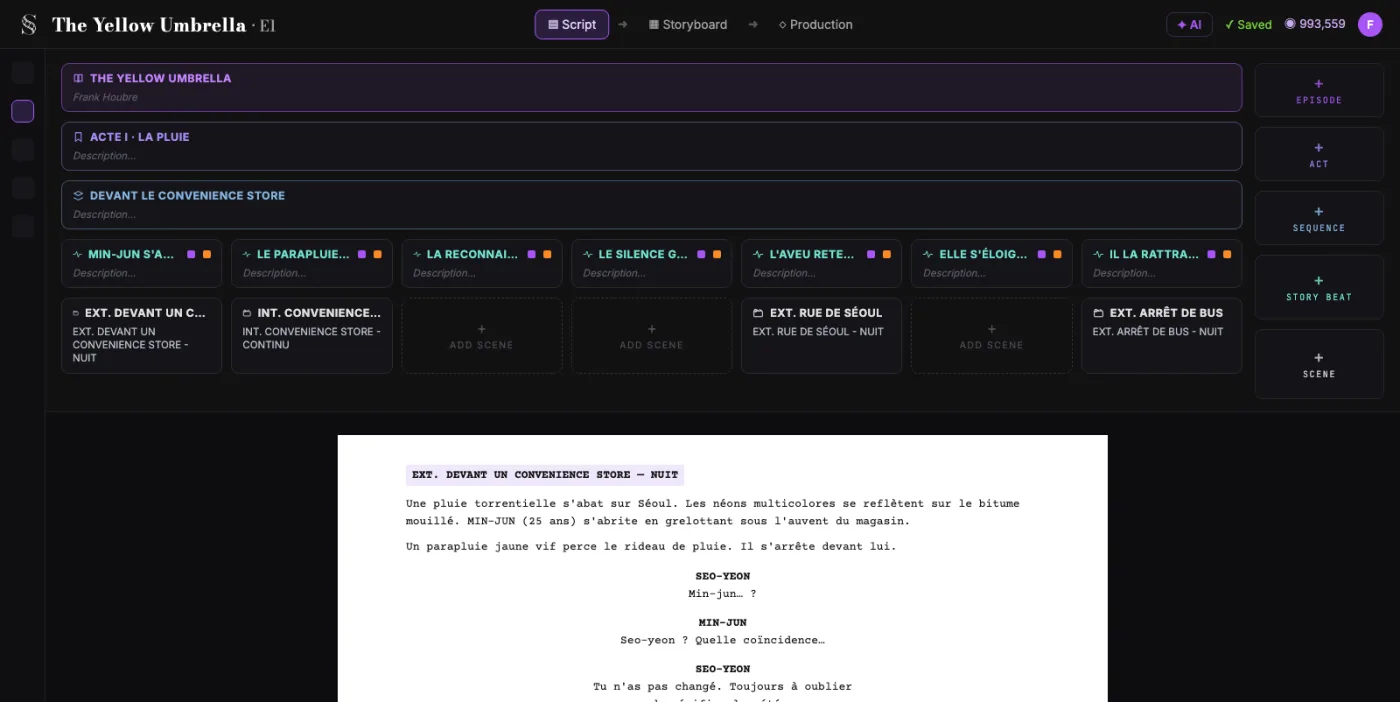
Screenplay Format Checker: the complete guide
It classifies every line as slugline, cue, parenthetical, dialogue, or action, then runs about 17 rule-based checks: caps and time of day on sluglines, cue length and spelling consistency, orphaned parentheticals, tabs, double spaces, camera directions, and scene numbers in spec drafts.
For this workflow, the central problem is clear: scripts get rejected or downgraded on formatting mistakes the writer never sees, because format signals process quality before a reader judges the story. Left unresolved, this creates downstream friction and slower decisions. The practical target is a line-numbered report of formatting errors, warnings, and notes with a concrete fix for each, so submissions go out mechanically clean.
Limitation to keep in mind: It checks syntax, not taste. It cannot judge whether a long speech earns its length, whether a bold formatting choice is intentional, or whether the writing works; it only reports what a reader would flag mechanically, and it never rewrites the text.
Advanced workflow: Teams run the checker as a pre-submission gate: every draft passes it before PDF export, warnings are triaged in a notes doc, and cue spelling findings feed a canonical character name list used across breakdowns and revisions.
Step-by-Step Workflow
- Paste your script or load a .fountain or .txt file; the report runs instantly in the browser with nothing uploaded.
- Fix errors first: lowercase sluglines and cues with missing dialogue are the findings a reader notices on page one.
- Work through warnings next, deciding case by case; a missing time of day is sometimes a deliberate CONTINUOUS omission.
- Read the notes last and treat them as questions, not rules: an 8-line speech or a WE SEE can stay if it is a choice.
Use Cases By Profile
- Writer: clear every fixable formatting error before a contest deadline so readers judge the story, not the margins.
- Script coordinator: catch inconsistent character spellings and stray tabs before a draft enters breakdown software.
- Fountain user: verify plain-text markup parses cleanly before converting to PDF or importing into Final Draft.
Common Mistakes To Avoid
- Treating notes as errors and stripping intentional choices, like a caps line used for a deliberate sound effect.
- Fixing findings in the PDF instead of the source file, so the same errors return on the next export.
- Assuming a clean report means the script is ready, when structure and pacing were never checked at all.
Professional Best Practices
- Run the checker after every major revision pass, not only before submission; formatting drift creeps in during rewrites.
- Use the cue spelling check to build one canonical character name list and paste from it instead of retyping names.
- Copy the report as text and keep it with the draft version, so you can prove which findings you accepted deliberately.
Treat this tool output as a decision support layer, not a replacement for authorship. Great scripts are remembered for specific choices, emotional precision, and clarity of dramatic movement. Tools help by removing noise so your energy can go where it matters: character, conflict, escalation, and payoff. If you review outcomes after each pass and keep an explicit log of accepted changes, your workflow becomes faster and more predictable from draft to draft. That consistency is exactly what professional collaborators value: fewer surprises, clearer rationale, and a script that evolves with intent.
Extended FAQ
How do I check screenplay formatting online for free?
Paste your script or load a .fountain or .txt file into this checker. It runs about 17 rule-based checks in your browser and returns a report grouped by severity, each finding with a line number and a one-line fix. No account, no upload, no cost.
What are the most common screenplay formatting errors?
Lowercase or incomplete sluglines, character cues without dialogue under them, orphaned parentheticals, inconsistent character name spellings, and hygiene issues like tabs and double spaces. Camera directions and scene numbers in a spec draft are close behind.
Do contests reject scripts for formatting mistakes?
Rarely on a single mistake, but readers score with format in mind because it predicts process quality. A script full of mechanical errors starts the read with a handicap, and some contests do disqualify clear non-compliance like wrong fonts or missing standard elements.
What is the difference between spec script and shooting script formatting?
A spec script sells a story: no scene numbers, minimal transitions, no camera directions. A shooting script is a production document: numbered scenes, CUT TO: transitions, and technical notes for the crew. This tool checks against spec conventions and flags shooting-script markers as notes.
What font and margins does a screenplay use?
Courier 12 point on US Letter, with a 1.5 inch left margin for binding and roughly 1 inch elsewhere, which yields about 55 lines per page. That standard is why one page maps to about one minute of screen time, and why this tool includes a words-per-page density check.
Can a script format validator replace screenwriting software?
No. Software like WriterDuet, Fade In, or Final Draft enforces layout while you type; a validator audits text you already have. Use the checker when you draft in plain text or Fountain, or as an independent second opinion before a submission goes out.
Frequently asked questions
Zero errors and warnings means the mechanical layer is clean: sluglines, cues, parentheticals, and hygiene checks all pass. The tool cannot judge taste, pacing, or whether a bold formatting choice is intentional, so treat a clean report as necessary, not sufficient.
Yes. It reads .fountain and .txt files, understands Fountain conventions like forced sluglines with a leading period and scene numbers between # marks, and skips the title page block. Plain screenplay text pasted from any editor works the same way.
No. It only reports findings with line numbers and suggested fixes. Checking is free of false authority: the tool tells you what a reader would flag, and you decide what to change. Your text stays exactly as you pasted it.
Errors break a hard convention, like a lowercase slugline or a cue with no dialogue after it. Warnings are things a careful reader will notice, like a missing time of day or an orphaned parenthetical. Notes are judgment calls worth reviewing, like an 8-line speech or camera directions in a spec draft.
No. All checks run in your browser with no server, no account, and no network calls. Loading a .fountain or .txt file uses the browser's local file reader, so the script never leaves your machine.