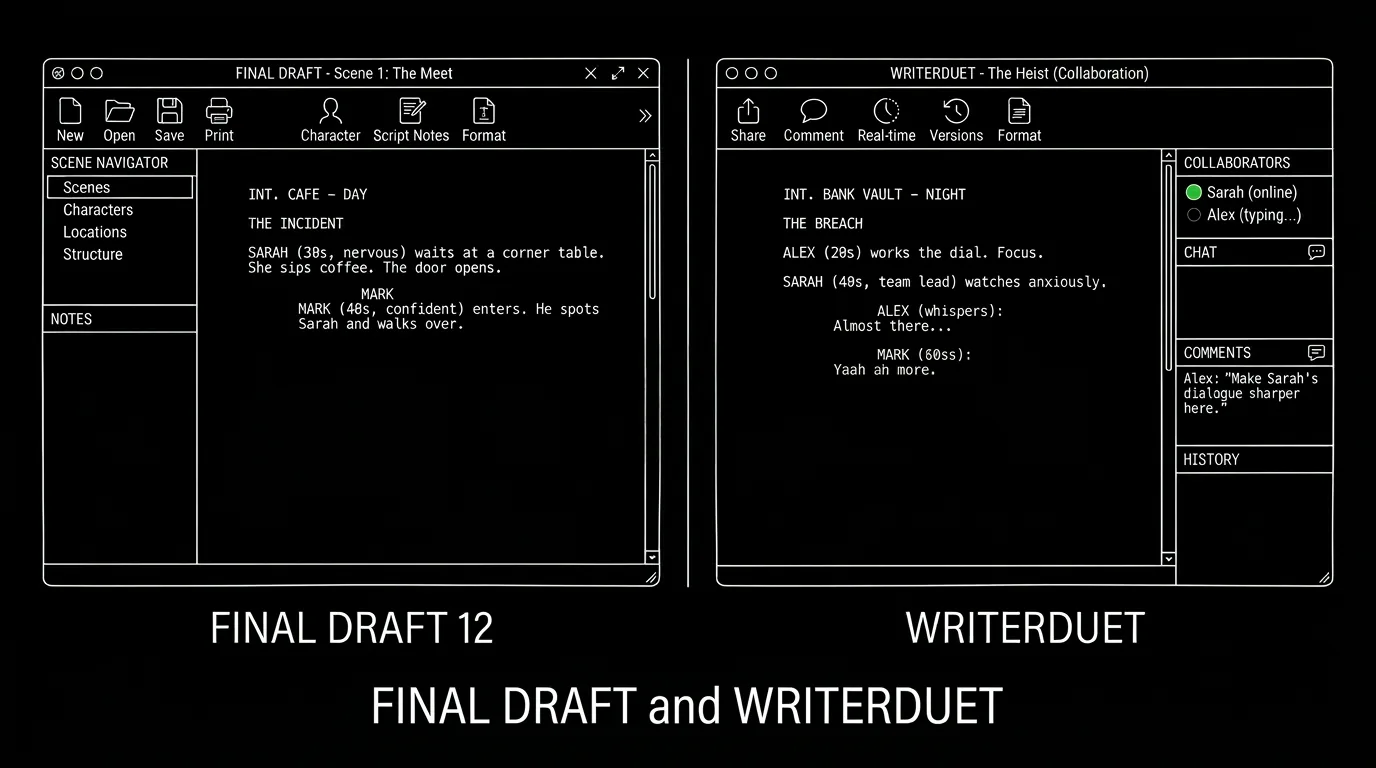

Final Draft is the industry standard, desktop, robust formatting, and a deep entrenchment in studios. WriterDuet is built for real-time collaboration and cloud-first workflow. In 2026 the choice isn't just "which formats better?", it's "who do you write with, and where do you need the file to go?" Here's a straight comparison so you can pick the right tool.
Final Draft wins on "everyone knows it." WriterDuet wins on "we're in the same doc at the same time."
Think about it this way. Final Draft 13 gives you the same core that production expects: industry-standard elements, pagination, and export to PDF and FDX. It's local (or optionally cloud). WriterDuet is cloud-native: two (or more) writers in the same script, seeing each other's cursor, with minimal lag. If you're solo and your buyers expect Final Draft, FD is the safe bet. If you're in a writers' room or co-writing, WriterDuet's collaboration can be the differentiator. Our guide on cloud collaboration compares real-time tools; this piece is FD vs WriterDuet head-to-head. If you want the tier-by-tier pricing on one side of that fight, our WriterDuet review for 2026 decodes every plan. For export standards, see exporting for production.
Pair WriterDuet with Final Draft in a search bar and you are really asking one thing: do I write alone on a disk, or do I breathe the same file as someone else? No global winner. Different rooms, different religion. Final Draft is still the name some pipelines mutter when they want a file that “feels” like the last twenty years. WriterDuet is the reflex when the room wants colored cursors and zero “sending v7_FINAL” email.
Final Draft 13: Strengths
Formatting: Industry-standard. Everyone in production knows it. Offline: You can work without the internet. Ecosystem: Templates, script notes, and integrations that studios already use. Export: PDF and FDX are native. For templates and macros, see script templates and macros. For version control in FD, see version control.
WriterDuet: Strengths
Real-time co-writing: Multiple cursors. Live updates. Cloud: Access from any device; no "send me the file." Price: Often more affordable for teams. Export: Also exports PDF and FDX so you can hand off to production. For collaboration in depth, see cloud collaboration.
When to Choose Which
Choose Final Draft when you're solo or in a studio pipeline where FD is the default, and you don't need real-time co-writing. Choose WriterDuet when you're co-writing or in a room and you want everyone in the same doc at once. For breaking down the script for production, see breaking down the script, FD has a stronger link to Movie Magic and similar tools.
The Trench Warfare: What Beginners Get Wrong
Assuming FD is "better" because it's standard. For collaboration, WriterDuet can be better. Assuming WriterDuet can't deliver for production. It can, export FDX and PDF. Not testing both. Try the free or trial version of each with a real scene and a co-writer if you have one. For more comparisons, see our best screenwriting software alternatives.
Try it free
Try Screenweaver for free on your script
It is free. Import your existing project, get a clearer view of your outline, and regain control of your story structure in minutes.
Start FreeComparison at a Glance
| Final Draft 13 | WriterDuet | |
|---|---|---|
| Strength | Industry standard; offline; studio fit | Real-time collaboration; cloud |
| Best for | Solo; studio pipeline | Co-writers; rooms |
| Export | PDF, FDX | PDF, FDX |
| Learning curve | Familiar to pros | Slight shift if coming from FD |
Step-by-Step: Deciding
First: Solo or team? Team → lean WriterDuet (or try both). Second: Who receives the file? If they only know FD, either tool can export FDX. Third: Try both with a short scene and, if possible, a co-writer. For export, see exporting for production. For collaboration, see cloud collaboration.
The Perspective
Final Draft 13 = industry standard, offline, studio-friendly. WriterDuet = real-time collaboration, cloud, room-friendly. Choose by who you write with and where the file has to go. Both can deliver PDF and FDX. So match the tool to the room, or go FD if you're solo and the pipeline expects it. If neither fits your budget, our Final Draft alternative and WriterDuet alternative pages compare each one with a free option.
Final Step
Build your next script with Screenweaver
Move from ideas to production-ready pages faster with timeline-native writing and AI-assisted story flow.
Try Screenweaver