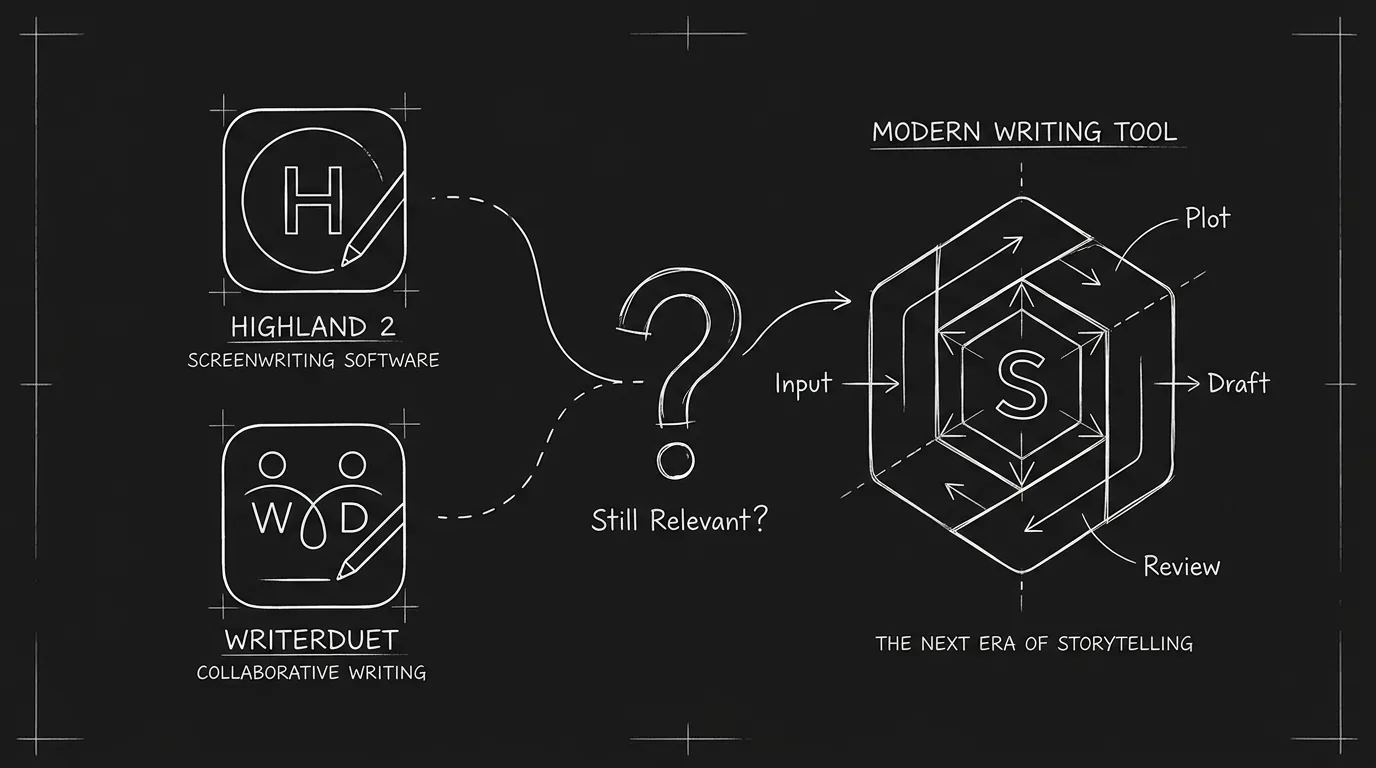

You've been using Highland 2 for years. Or WriterDuet. They did the job: clean Fountain support, real-time collaboration, a price that didn't feel like a studio tax. Now your feed is full of tools that promise structure-as-a-map, AI-assisted beats, or a single timeline that is the script. You're wondering whether the apps you trust have been left behind. The question isn't "Are Highland 2 and WriterDuet obsolete?", it's "Obsolete for whom, and for what?" Both are still capable. Both still have loyal users. But the bar has moved. This piece looks at where they stand in 2026, where they still win, and where writers are jumping ship, and why.
Highland 2 is a Fountain-native writer. You write in plain text; it renders screenplay format. No vendor lock-in, no binary format you can't open in a text editor. WriterDuet (and WriterSolo) pushed real-time co-writing into the mainstream: two cursors, one document, no "pass the file" chaos. For a long time that was enough. Then the market shifted. Tools started offering beat boards that talk to the script, story maps that reflow when you drag a scene, and collaboration that goes beyond "see my cursor." Highland and WriterDuet didn't stop working. They just stopped being the only answer. Here's where they stand, and when it still makes sense to stay.
Obsolete doesn't mean "broken." It means "no longer the default choice for the problem you're trying to solve." For some problems, Highland and WriterDuet are still the answer. For others, the answer has moved.
Free tool: use the Beat Sheet Calculator to map these beats to exact page numbers for your script length.
Where Highland 2 Still Holds Up
Highland 2 is built around Fountain. If you care about plain-text scripts, human-readable files, and format that survives any app, Highland is one of the cleanest implementations. You write; it formats. Export to PDF, HTML, or Fountain. No subscription required for the core product, since Highland 2 used a one-time unlock. That model ended when Quote-Unquote replaced the app with the subscription-based Highland Pro; our Highland 2 review covers what that means if you still own the old version. For writers who want to own their files, avoid subscriptions, and work in a format that any tool can read, Highland 2 is not obsolete. It's a deliberate choice. The limitation is that it doesn't try to be a structure tool or a collaboration hub. It's a writer. If that's all you need, it's still fit for purpose. For context on how other tools handle format and ownership, see our screenplay format guide and .fdx and cloud backup.
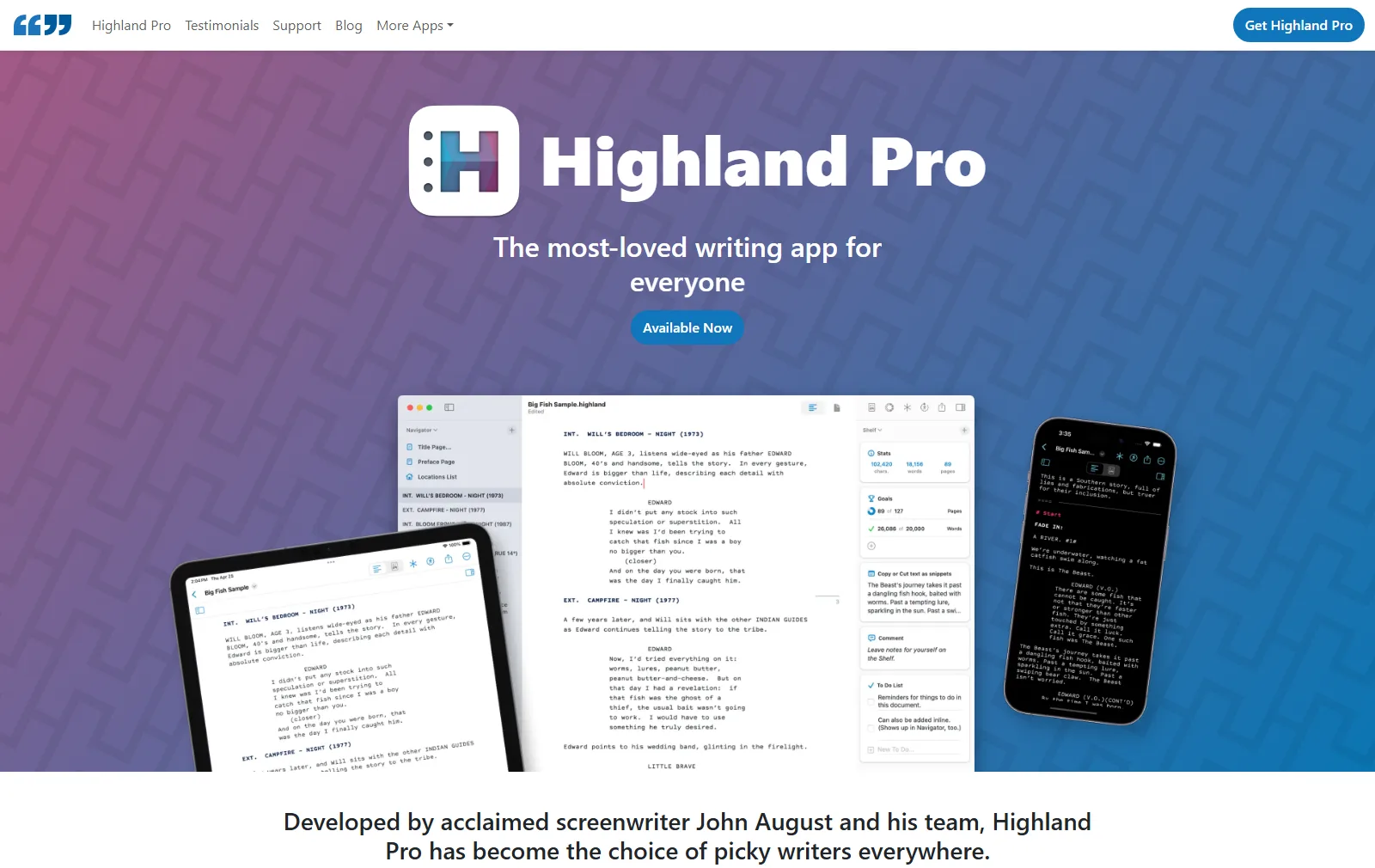
The Highland Pro page on quoteunquoteapps.com, captured 24 October 2026. Highland Pro is the subscription app that replaced Highland 2.
Where WriterDuet Still Holds Up
WriterDuet (and WriterSolo for solo use) is still one of the benchmarks for real-time co-writing. Two people in the same script, see each other's cursor, no merge conflicts. That's not trivial. Many "collaborative" tools are really "share a link and take turns." WriterDuet does actual sync. If you're in a writers' room or a co-write and that's the core need, WriterDuet is not obsolete. The question is whether you also want structure tools, story maps, or a different writing environment. WriterDuet added features over the years, but its heart is still collaboration. Newer tools have caught up in some areas and passed in others, especially where the script and the story map are one object. For a comparison of how different apps handle real-time sync, see cloud collaboration and real-time co-writing. For Final Draft vs WriterDuet, we break down when each makes sense.
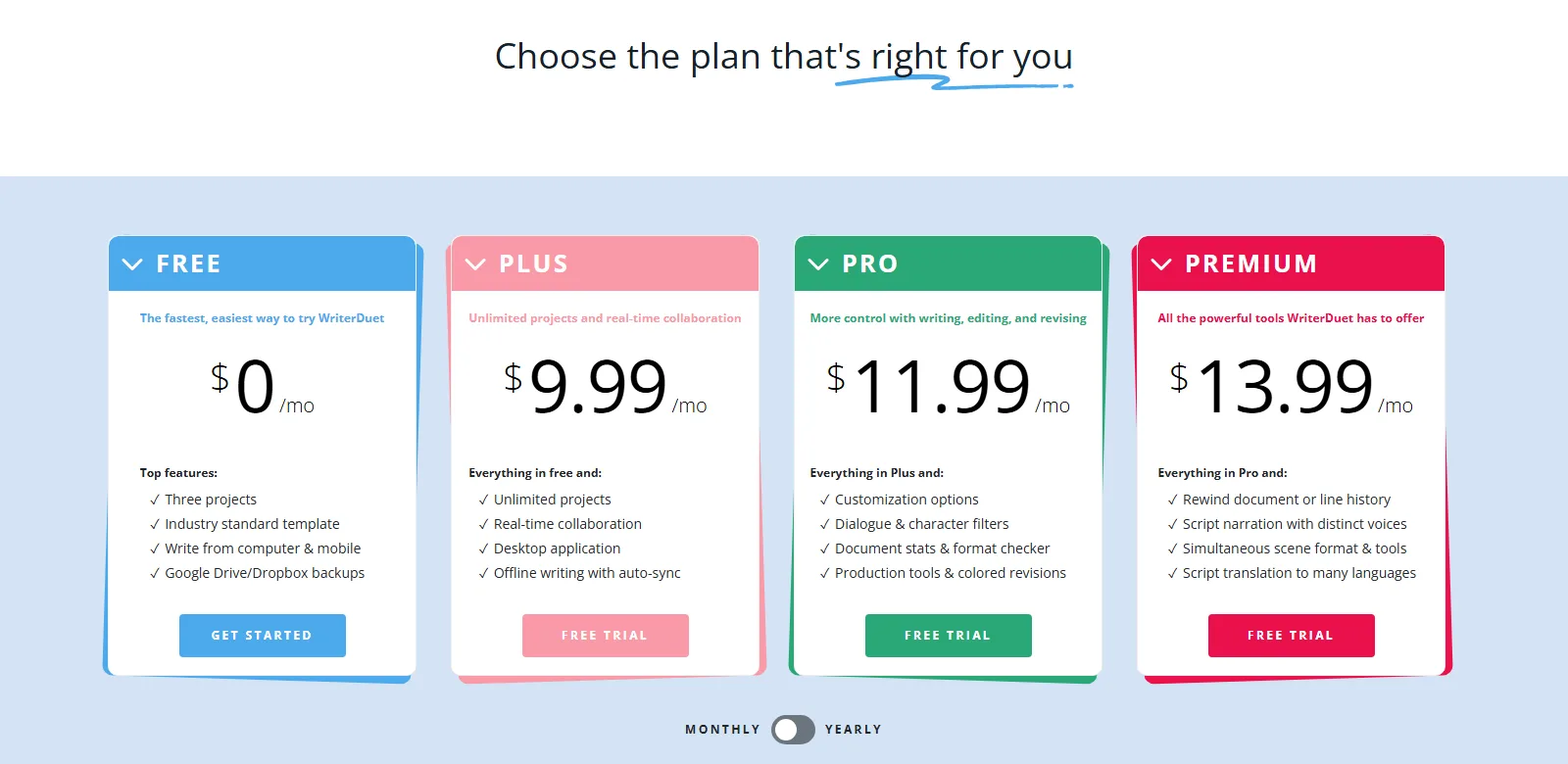
WriterDuet's pricing page on the monthly setting, captured 24 October 2026. Real-time collaboration is listed from the Plus plan up.
Relatable Scenario: The Fountain Purist Who Tried a "New" Tool and Came Back
Jordan writes in Fountain. They've tried Highland 2, and they've tried a flashy new app that promised structure and AI. The new app locked them into a proprietary project format. Export to Fountain was an afterthought, and the export was messy. Jordan went back to Highland. For them, "obsolete" was the wrong frame. The new tool was better at structure and worse at the thing they cared about: owning a plain-text script. Highland 2 isn't obsolete for Jordan. It's the only tool that does what they need without compromise. The lesson: obsolete is relative to your priorities. If plain text and format portability are top of the list, Highland 2 is still in the running.
Relatable Scenario: The Co-Writing Team That Tried to Leave WriterDuet
A writing team has been on WriterDuet for three years. They heard about a newer app with beat boards and a timeline. They switched. Within a month they were frustrated. The new app's real-time sync was laggy. Sometimes changes didn't show up for seconds. They'd gotten used to WriterDuet's responsiveness. They moved back. For them, WriterDuet wasn't obsolete, it was still the best at the thing they couldn't give up: reliable real-time collaboration. The new tool was better at structure and worse at the core collaboration experience. So "obsolete" depends on what you're optimizing for. For tools that prioritize structure and script as one object, the tradeoff is different.
Relatable Scenario: The Writer Who Wants "One Place" for Outline and Script
Sam outlines in a separate app. They write in Highland 2. When they restructure, they have to update the outline and the script by hand. They've started looking at tools where the outline is the script, move a beat, the script reflows. For Sam, Highland 2 feels outdated not because it's bad at writing, but because it doesn't try to solve the outline–script bind. WriterDuet has some structure features, but it's not built around a single story map that drives the document. So for Sam, "obsolete" means "doesn't do the thing I need next." That's a feature gap, not a product failure. For options that unify structure and script, see best screenwriting software alternatives.
Highland 2 vs. WriterDuet vs. Newer Tools: Where Each Fits
| Need | Highland 2 | WriterDuet | Newer structure-first tools |
|---|---|---|---|
| Plain-text / Fountain | Strong | Weaker (proprietary project) | Mixed |
| Real-time co-writing | No | Strong | Varies; some match, some don't |
| One-time purchase | Yes | Check current model | Often subscription |
| Structure = script (reflow on drag) | No | No | Some yes |
| Beat boards / story map | No | Some | Often core feature |
| Industry FDX round-trip | Export path exists | Yes | Usually yes |
So: Highland 2 is not obsolete if Fountain and ownership matter more than structure tools. WriterDuet is not obsolete if real-time collaboration is non-negotiable and you've tested alternatives. Newer tools pull ahead when you want structure and script as one object, or a different UX. For a full round-up, see best screenwriting software alternatives.
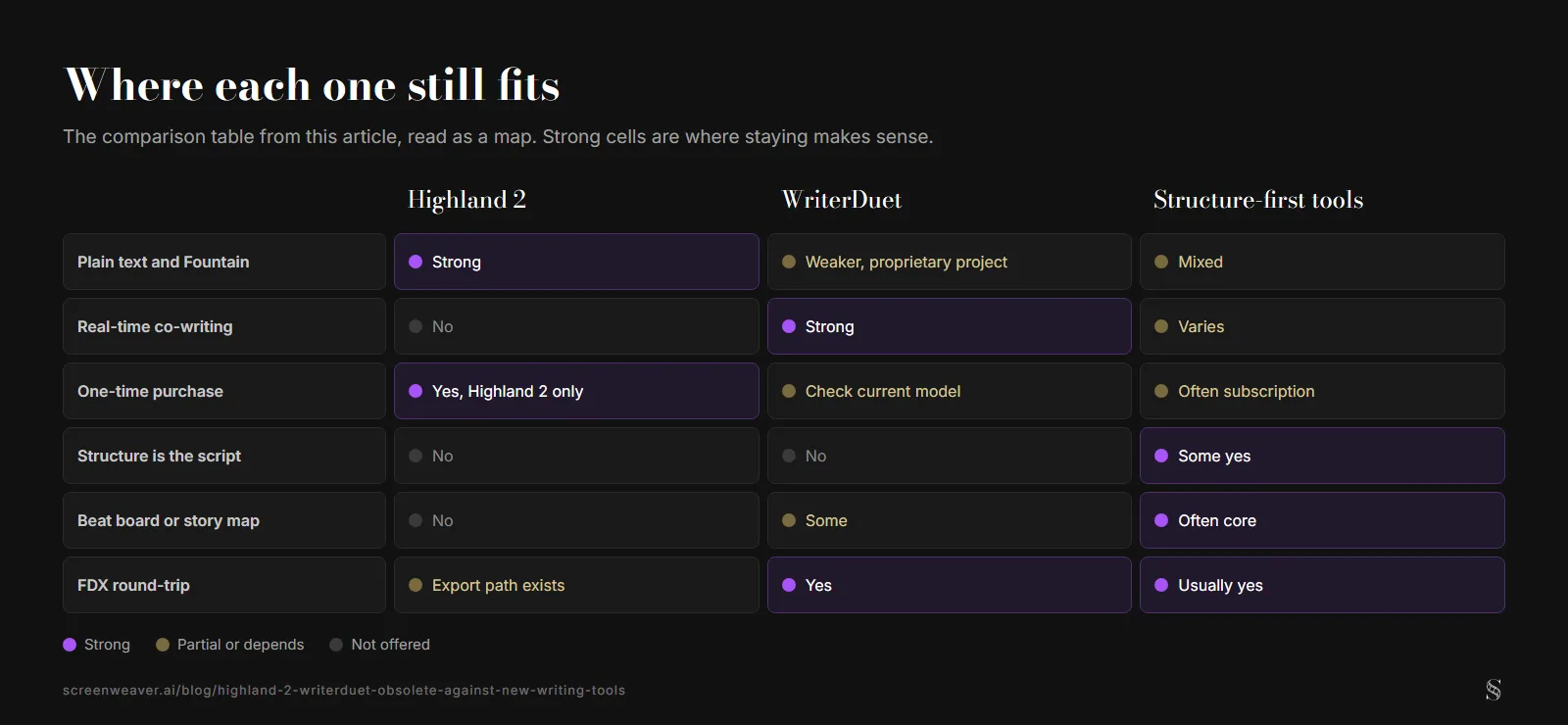
The comparison table above as a map. The one-time purchase applies to Highland 2 only, not to Highland Pro.
Try it free
Try Screenweaver for free on your script
It is free. Import your existing project, get a clearer view of your outline, and regain control of your story structure in minutes.
Start FreeWhere Highland 2 and WriterDuet Fall Short (Compared to Newer Tools)
Highland 2 doesn't offer a beat board, a story map, or a timeline that reflows the script. You write in Fountain; you get beautiful output. The outline is yours, in another file or in your head. That's by design. But writers who've gotten used to tools where the outline and the script are the same object notice the gap. They have to maintain two things. When they restructure, they do it twice. Highland isn't trying to be that tool. So "obsolete" here really means "doesn't do the thing some writers now expect." WriterDuet added outline and structure features over time, but its strength is still collaboration. The story map that is the script, where dragging a beat reorders the document, is not WriterDuet's center of gravity. Newer entrants built that from the ground up. So if your priority is "one place for structure and script," Highland 2 and WriterDuet both sit on the wrong side of that line. They're not bad. They're focused elsewhere. For a tool that makes the timeline and the script one object, see Arc Studio Pro vs ScreenWeaver and best screenwriting software alternatives.
The Trench Warfare: What Writers Get Wrong
Assuming "new" means "better." Newer tools often excel at one thing (e.g. story map) and lag at another (e.g. Fountain export or real-time sync). Fix: List what you actually need. If it's Fountain and portability, Highland 2 may still be the best fit. If it's real-time co-writing, WriterDuet may still win. Don't switch because the marketing is newer.
Ditching a tool that works for a promise. You're productive in Highland or WriterDuet. You switch to something "modern" and spend months fighting the new workflow. Fix: Only switch when you've hit a concrete limit (e.g. "I need one object for outline and script") and you've tested the new tool with a real project. Otherwise you're trading a known good for an unknown.
Ignoring export and lock-in. Some newer tools are great until you want to leave. Can you export to Fountain? To FDX? Fix: Before you commit, check export. Highland 2 and WriterDuet both offer paths out. If the new tool doesn't, that's a reason to stay, or to demand that feature before you move. For protecting your script across tools, see .fdx files and the cloud.
Comparing on features you don't use. WriterDuet has a lot of features. So do newer apps. If you only need co-writing and PDF export, the "obsolete" debate is noise. Fix: Use the feature set you actually need. If your current tool delivers that, it's not obsolete for you.
Expecting Highland or WriterDuet to become something they're not. Highland is a Fountain writer. WriterDuet is a collaboration-first writer. They're not going to turn into a timeline-as-script tool. Fix: If you need that, add a different tool or switch. Don't wait for your current app to morph.
Treating "obsolete" as a yes/no vote. It's not. It's "obsolete for my workflow." Someone else's "yes" might be your "no." Fix: Run your own audit. What do I use every day? What do I wish I had? If your current tool covers the first and the gap on the second is small, you're fine. If the gap is big, look elsewhere. For cost and when to pay for what, see why your screenwriting software shouldn't cost a fortune.
When to Stay, When to Look Elsewhere
Stay with Highland 2 if: You write in Fountain. You want a one-time purchase and no subscription. You don't need real-time collaboration or a built-in story map. You're happy with "write, format, export." That's still a valid stack. Look elsewhere if: You need beat boards or a timeline that reflows the script. You want structure and script in one place. You've outgrown plain text and want a more visual workflow. For options, see screenwriting software alternatives.
Stay with WriterDuet if: Real-time co-writing is essential and you've tried alternatives and they're not as smooth. You're in a room or a co-write and sync quality matters more than structure features. Look elsewhere if: You need a single story map that drives the script, or you want to prioritize structure over collaboration. For Arc Studio Pro vs ScreenWeaver and similar comparisons, the structure-first tools are the ones to evaluate.
How to Decide: A Quick Audit
Step 1 – List what you use today. In Highland 2 or WriterDuet, what do you actually use? Fountain? Export to PDF? Real-time sync? Beat cards? If you're only using write + format + export, you're in the sweet spot for Highland. If you're only using real-time co-write + export, you're in the sweet spot for WriterDuet. Step 2 – List what you're missing. Do you wish the outline and script were one thing? Do you want a timeline that reflows when you drag? If yes, that's the gap. Step 3 – Test before you switch. Try a structure-first or newer tool with a short project. See if the gain is worth the learning curve and the possible loss (e.g. Fountain purity, or WriterDuet-level sync). Step 4 – Check export before you commit. Whatever you move to, ensure you can get your work out, Fountain, FDX, or PDF, so you're never locked in. For backup and portability, see .fdx and cloud. One final rule: if you're productive now, don't switch on a whim. Switch when the gap is real and the new tool has proven it can fill it.
The Perspective
Highland 2 and WriterDuet are not obsolete in the sense of "broken" or "unusable." They're obsolete only for the writer whose needs have shifted: toward structure-as-script, toward a different collaboration model, or toward a tool that does one thing they care about more. For the Fountain purist and the real-time co-writing team, both are still in the game. For the writer who wants one object for outline and script, the answer has moved. Use the tool that matches the problem you have today. If that's Highland or WriterDuet, stay. If not, switch, and do it with your eyes open, with export paths checked and a real project in the new app before you burn the boats. The industry will keep shipping new features. Your job is to pick the tool that fits your process, not the one with the loudest launch. For more on choosing and protecting your workflow, see .fdx and cloud and best screenwriting software alternatives. For WriterDuet's current offering, WriterDuet is the source of record.
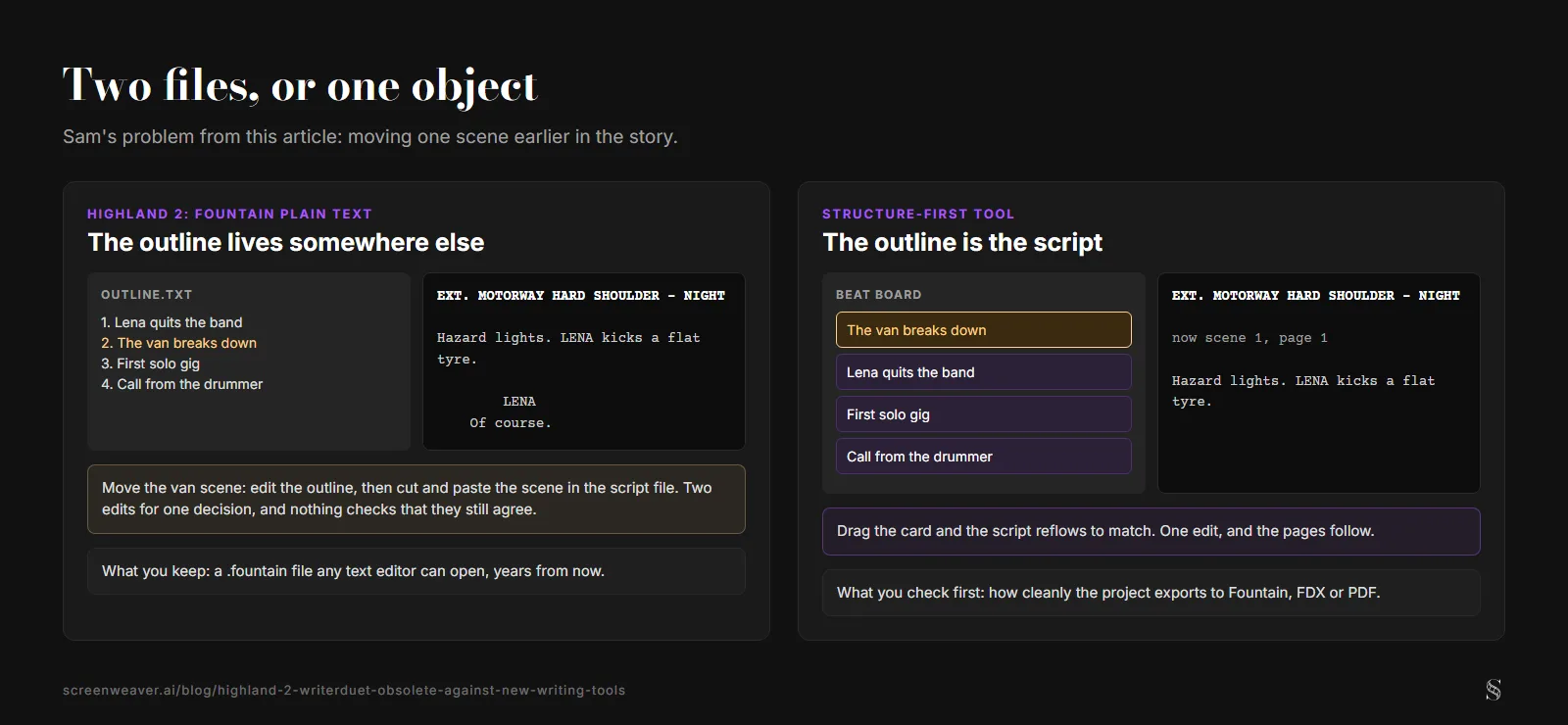
Sam's restructure in both setups. The scene and the outline are an original example written for this article.
Granular Takeaway
Whether Highland 2 or WriterDuet is "obsolete" depends on what you're trying to do. Fountain and ownership: Highland 2 is still a top choice. Real-time co-writing: WriterDuet is still a benchmark. Structure and script as one object: that's where newer tools lead. Don't let the buzz push you off a tool that works. Let your own limits, format, collaboration, structure, drive the decision. For a full comparison of where each tool sits, see best screenwriting software alternatives.
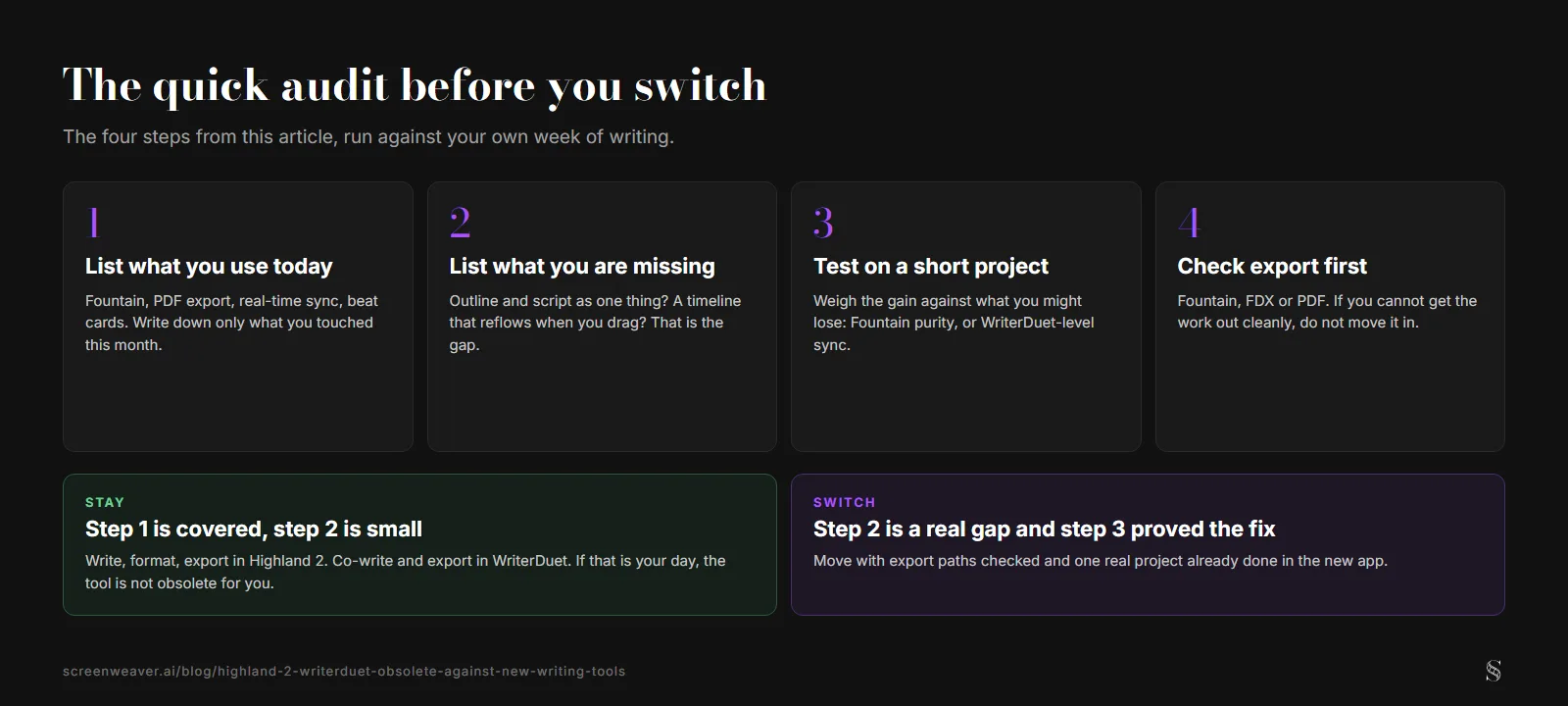
The four-step audit from this article, with the stay and switch outcomes it leads to.
Final Step
Build your next script with Screenweaver
Move from ideas to production-ready pages faster with timeline-native writing and AI-assisted story flow.
Try Screenweaver