Story Circle Generator
Dan Harmon's 8 steps with page targets for your story
This free story circle generator maps Dan Harmon's 8-step structure onto your script's actual length. Enter a page count (or runtime in minutes), draft a line for each of the eight steps, and get a beat sheet with computed page targets, the midpoint, and the descent/return split. Built for TV writers, feature writers, and anyone outlining with the Harmon story circle.
Harmon compressed Joseph Campbell's monomyth into eight steps he could reuse every week in a TV writers room: You, Need, Go, Search, Find, Take, Return, Change. Each step takes roughly one eighth of the story, the character crosses into the unfamiliar after step 2, hits bottom at the midpoint after step 4, and comes home changed. If you are outlining a feature on the Blake Snyder model instead, our Save the Cat beat sheet calculator handles the 15-beat version; this tool is for the circle.
Everything runs in your browser. Your step notes autosave to this browser only and are never sent to any server.
Optional. Write one or two lines per step for your story; whatever you type is injected into the beat sheet below and autosaved as a draft in this browser.
Your story circle beat sheet
- 1. YouPages 1-14
A character in a zone of comfort. Establish who we follow and what their ordinary world looks like.
- 2. NeedPages 15-28
But they want something. Name the desire, spoken or not, that the routine cannot satisfy.
- 3. GoPages 29-41
They enter an unfamiliar situation. The character crosses the threshold and cannot easily walk it back.
- 4. SearchPages 42-55
They adapt to the new world. Trial, error, and the road of trials: the character learns the rules the hard way.
Midpoint at 55: the bottom of the circle. The descent (steps 1 to 4) ends here and the return (steps 5 to 8) begins.
- 5. FindPages 56-69
They get what they wanted. The goal is reached, but it rarely looks like the character imagined.
- 6. TakePages 70-83
They pay a heavy price for it. The cost of the prize lands, and the character loses something real.
- 7. ReturnPages 84-96
They return to their familiar situation. The character heads back to where they started, carrying what happened.
- 8. ChangePages 97-110
Having changed. Show how the old world and the character read differently now. The circle closes where it opened.
How it works
The story circle generator divides your total length into eight equal spans, one per step, and rounds the boundaries to whole pages so the eight ranges tile your script exactly. Steps 1 to 4 form the descent (order into chaos), steps 5 to 8 the return, with the midpoint pinned to the end of step 4. Your notes for each step are injected into the sheet, so what you copy or print is an outline for your story, not a blank story circle template.
How the Dan Harmon story circle works
Harmon built the story circle for the Channel 101 wiki and later used it on Community and Rick and Morty. He took Campbell's hero's journey, cut it to eight moves, and drew it as a clock: 1 at the top, the midpoint at the bottom. The top half is order, the world the character knows. The bottom half is chaos, the world they do not. Every episode is one lap around that clock, which is why the harmon story circle 8 steps loop where a feature structure ends: the character comes back to the start position, changed, and is ready to go around again next week.
The halves matter more than the individual steps. Crossing from step 2 to step 3 is the threshold into the unconscious, unfamiliar world; crossing from step 6 to 7 is the climb back. On a 110-page feature each step gets about 14 pages, and on a 22-minute episode each gets 2 to 3 minutes, which is why the same story circle worksheet works for both. The circle is a proportional tool: the math scales, the order of operations does not.
Story circle vs hero's journey is mostly a question of resolution. Campbell's monomyth has 17 stages and mythic vocabulary; Harmon's plot embryo keeps the same descent-and-return shape at a resolution a writers room can hold in its head on a Tuesday. If you want the feature-film version with named beats and page numbers, use our Save the Cat beat sheet calculator, which computes Blake Snyder's 15 beats for any page count. Use the circle when you are shaping character want and change, and the beat sheet when you are placing plot events.
Who this is for
- TV writers: outline an episode as one lap of the circle, with minute targets that fit a 22-minute half hour or an hourlong slot.
- Feature writers: check that the descent and return each get half the script before drilling into scene work.
- Writing students: learn the harmon story circle 8 steps by filling in a real story instead of reading another summary of it.
Your beats needa script attached.
In ScreenWeaver, the outline and beats live in the same project as your screenplay. Structure and pages stay linked. Free.
- $0, does not expire
- PDF and Final Draft export
- Mac, Windows, Linux, iPad
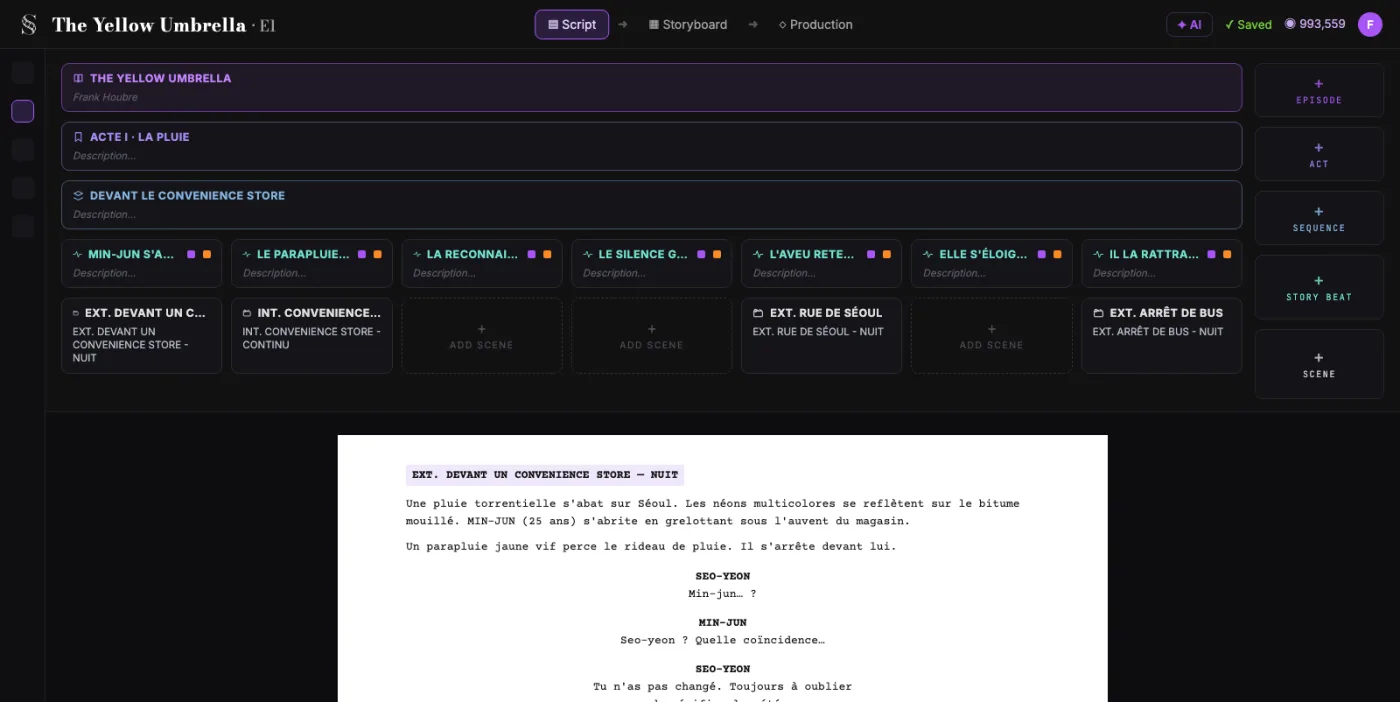
Story Circle Generator: the complete guide
It divides your script length into eight proportional spans, injects your own notes for each step, and outputs a copyable, printable beat sheet built on your numbers instead of a generic template.
For this workflow, the central problem is clear: the story circle is easy to memorize but hard to apply, because writers rarely know which pages each of the 8 steps should occupy in their specific draft. Left unresolved, this creates downstream friction and slower decisions. The practical target is a filled-in story circle beat sheet with exact page or minute targets for each step, the midpoint, and the descent/return split.
Limitation to keep in mind: It computes proportions and positions, not story quality; it cannot tell you whether your Need is strong enough or your Change is earned, only where they should land.
Advanced workflow: Serialized writers run one circle per episode and a slower season-level circle in parallel, checking that each episode's step 8 repositions the character for the season's next step.
Step-by-Step Workflow
- Enter your total page count, or switch to minutes for a runtime-based outline at the 1 page per minute convention.
- Draft one or two lines for each of the eight steps in your own story's terms, not the template's.
- Read the computed ranges and check your planned scenes against the midpoint and the two threshold crossings.
- Copy or print the finished sheet and keep re-running it as your page count changes between drafts.
Use Cases By Profile
- TV writer: outline next week's episode as one lap of the circle with minute targets that fit the slot.
- Feature writer: verify the descent and return each hold half the script before committing to scene cards.
- Script consultant: diagnose a saggy middle by checking whether Search (step 4) actually reaches the midpoint page.
Common Mistakes To Avoid
- Treating the eighths as laws instead of proportions: a step can run a page long if the neighboring step gives it back.
- Putting the midpoint where the character wins; the bottom of the circle is where they get what they wanted, which is different.
- Using the circle for plot events only and skipping the want-based steps (Need, Take, Change) that make it work.
Professional Best Practices
- Write step 2 (Need) as a want the character would say out loud and a need they would deny; the gap between them is your ending.
- Check steps 3 and 7 against each other: the way in and the way back should rhyme visually or thematically.
- For episodic TV, make step 8 restore the status quo with one visible difference, so the series can loop without going stale.
Treat this tool output as a decision support layer, not a replacement for authorship. Great scripts are remembered for specific choices, emotional precision, and clarity of dramatic movement. Tools help by removing noise so your energy can go where it matters: character, conflict, escalation, and payoff. If you review outcomes after each pass and keep an explicit log of accepted changes, your workflow becomes faster and more predictable from draft to draft. That consistency is exactly what professional collaborators value: fewer surprises, clearer rationale, and a script that evolves with intent.
Extended FAQ
Story circle or Save the Cat: which should I use?
Use the story circle when you are shaping character want and change, especially for TV episodes that need to loop. Use a Save the Cat beat sheet when you are placing feature-film plot events against 15 named beats. Many writers run both: circle first for the character spine, beat sheet second for the plot skeleton.
What is the plot embryo?
Another name for Harmon's story circle, from the embryo-like drawing in his original Story Structure posts on the Channel 101 wiki. Plot embryo, story circle, and Harmon circle all describe the same 8-step loop.
What do the two halves of the story circle mean?
The top half is order: the conscious, familiar world of steps 1, 2, 7, and 8. The bottom half is chaos: the unconscious, unfamiliar world of steps 3 through 6. The character crosses down after step 2 and climbs back after step 6, and those two crossings carry most of the structure's meaning.
Why does the story circle loop instead of ending?
Harmon built it for episodic television, where the character must arrive back at a stable position so next week's episode can start another lap. The change in step 8 is real but compatible with the series engine, which is why the same character can circle hundreds of times.
Can I use the story circle for a novel or short film?
Yes. The proportions are medium-agnostic: give each step an eighth of your word count or runtime. For a short film, minutes mode works directly; for a novel, treat chapters or scenes as the unit and keep the descent/return halves balanced.
Do all 8 story circle steps need to be the same length?
No. Equal eighths are the neutral starting grid, and produced work routinely stretches Search or compresses Return. The value of computed ranges is knowing exactly how far you are deviating and on purpose.
Frequently asked questions
1 You (a character in a zone of comfort), 2 Need (but they want something), 3 Go (they enter an unfamiliar situation), 4 Search (adapt to it), 5 Find (get what they wanted), 6 Take (pay a heavy price), 7 Return (go back to the familiar), 8 Change (having changed). Steps 1 to 4 descend into chaos, steps 5 to 8 return to order.
Roughly one eighth of the script each. On a 110-page feature that is about 14 pages per step; on a 96-page draft, exactly 12. This generator computes the exact ranges for your page count, including how odd totals round.
Both. Harmon designed it for episodic TV, where the character loops back to a stable start position every week, but the descent-and-return shape is the same one features use. The tool accepts anything from an 8-minute short to a 500-page total, and the eighths scale proportionally.
At the bottom of the circle, after step 4 (Search) and before step 5 (Find). On the page that is the halfway point of your script: page 55 of a 110-page draft. It marks the moment the character stops adapting to the new world and starts getting what they came for.
Only in your own browser, via localStorage, so you can close the tab and come back to your outline. Nothing you type is sent to a server, and Reset clears the saved draft.