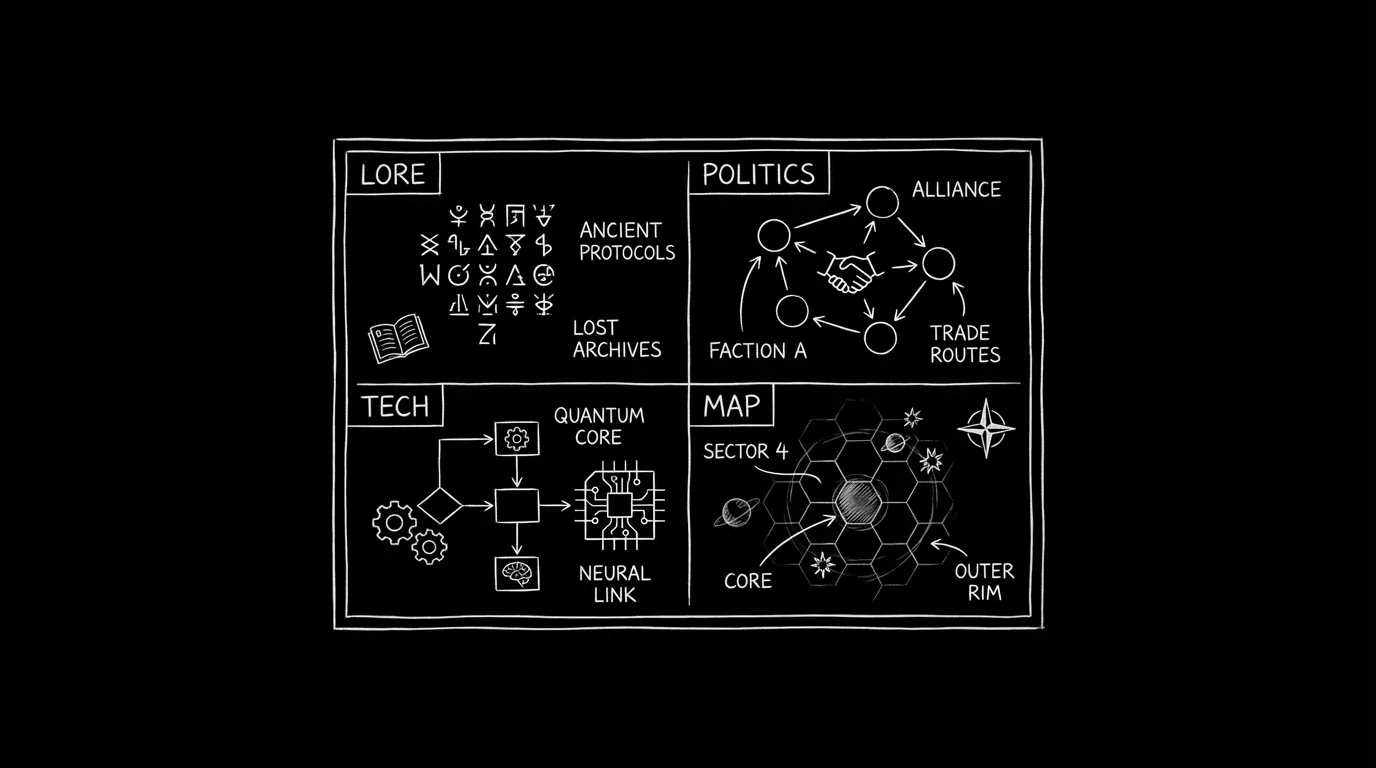
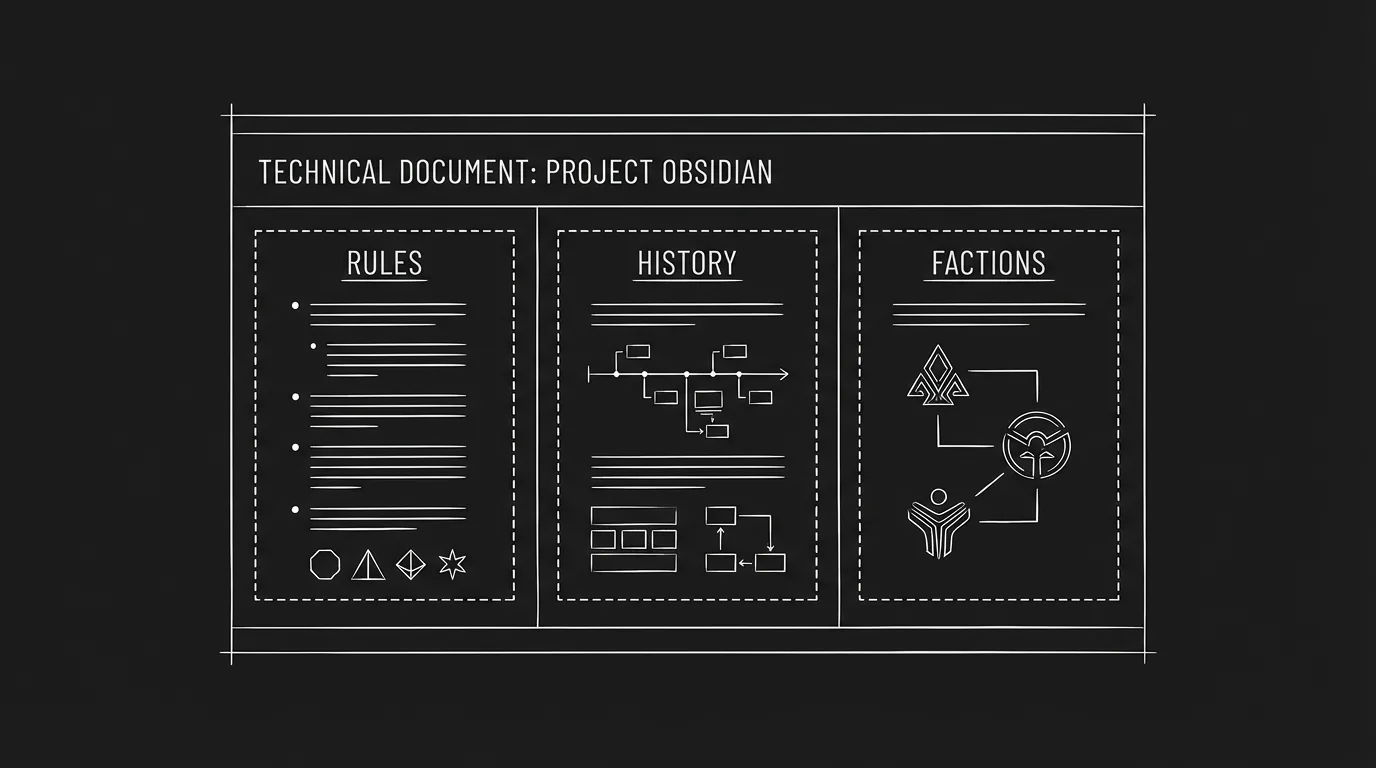
Hero image prompt: Dark mode technical sketch. Solid black background, thin white hand-drawn lines. A single document or schematic with sections: lore, tech, politics, map. Minimalist, high-contrast. The sense of a reference document.
You’re 60 pages in. A character mentions the war. Which war? When was it? Who won? You had it in your head at page one. Now you’re not sure. The sci-fi (or fantasy) script that spans worlds, eras, or power systems needs a bible, not for the reader, for you. A single place where the rules, the history, and the map live so you don’t contradict yourself and so the world feels consistent. Here’s how to build one without getting lost in it.
The bible isn’t the script. It’s the backstage. You use it to check your work. The audience never sees it. They feel it when the world holds together, and they feel it when it doesn’t.
Think about Dune or The Expanse. The worlds have rules. FTL or no FTL? How do people communicate? Who holds power? The writers (or the original authors) had to keep track. So do you. The bible can be a document, a spreadsheet, or a set of notes. It doesn’t have to be pretty. It has to be there, and you have to use it. When you introduce a new faction, you write it in. When you need to know what happened in the war, you look it up. The script stays clean. The world stays consistent. Our guide on exposition and avoiding “as you know, Bob” is about what the audience sees; the bible is about what you need to know before you write it. For more on delivering lore through action, see exposition dump and hiding info in conflict.
Free tool: use the Beat Sheet Calculator to map these beats to exact page numbers for your script length.
What Belongs in the Bible
The rules. What can and can’t happen in this world? FTL travel: yes or no? If yes, how? Magic: what are the limits? Technology: what’s possible, what’s not? The rules don’t have to be on the page. They have to be in your head (and in the bible) so you don’t break them. When a character does something that the world shouldn’t allow, the audience feels it. So write the rules down. One page. Then when you’re writing a scene, check. Can they do this? If the rule isn’t there yet, add it. For more on rules and conflict, see writing magic systems, limitations create conflict, the same principle applies to tech and politics.
The history. What happened before the story starts? Wars. Treaties. Disasters. Who’s in power and why? You don’t need a full timeline. You need the events that the story touches, and the events that characters refer to. When a character says “since the Collapse,” you need to know what the Collapse was. Put it in the bible. One paragraph per big event is enough. Then when you need it, it’s there. For more on using the past without dumping it, see family secrets and the slow reveal, the bible holds the secret; the script reveals it in pieces.
The map (or the structure). Where are the factions? The territories? The power centers? You don’t need a drawn map for every script. You need to know who’s where and who’s against whom. A simple list or a rough diagram is enough. “The Core worlds control X. The Belt is independent. Mars is in between.” When the plot moves, you know who’s in the room and what they want. For more on why geography affects plot, see the fantasy map and why geography matters.
The factions and their wants. Who are the main groups? What does each want? What do they believe? One paragraph per faction. When you write a character from a faction, you know their default stance. You don’t have to invent it on the fly. Consistency comes from having a reference. For more on designing conflict, see rivalry and constructing professional conflict, factions are a form of rivalry at scale.
| Section | What to Put There |
|---|---|
| Rules | What’s possible and what’s not; tech, magic, physics |
| History | Key events before the story; wars, treaties, disasters |
| Map / structure | Who’s where; power centers; who’s against whom |
| Factions | Main groups; what each wants; what they believe |
Relatable Scenario: The Script Where You Forget Your Own Rules
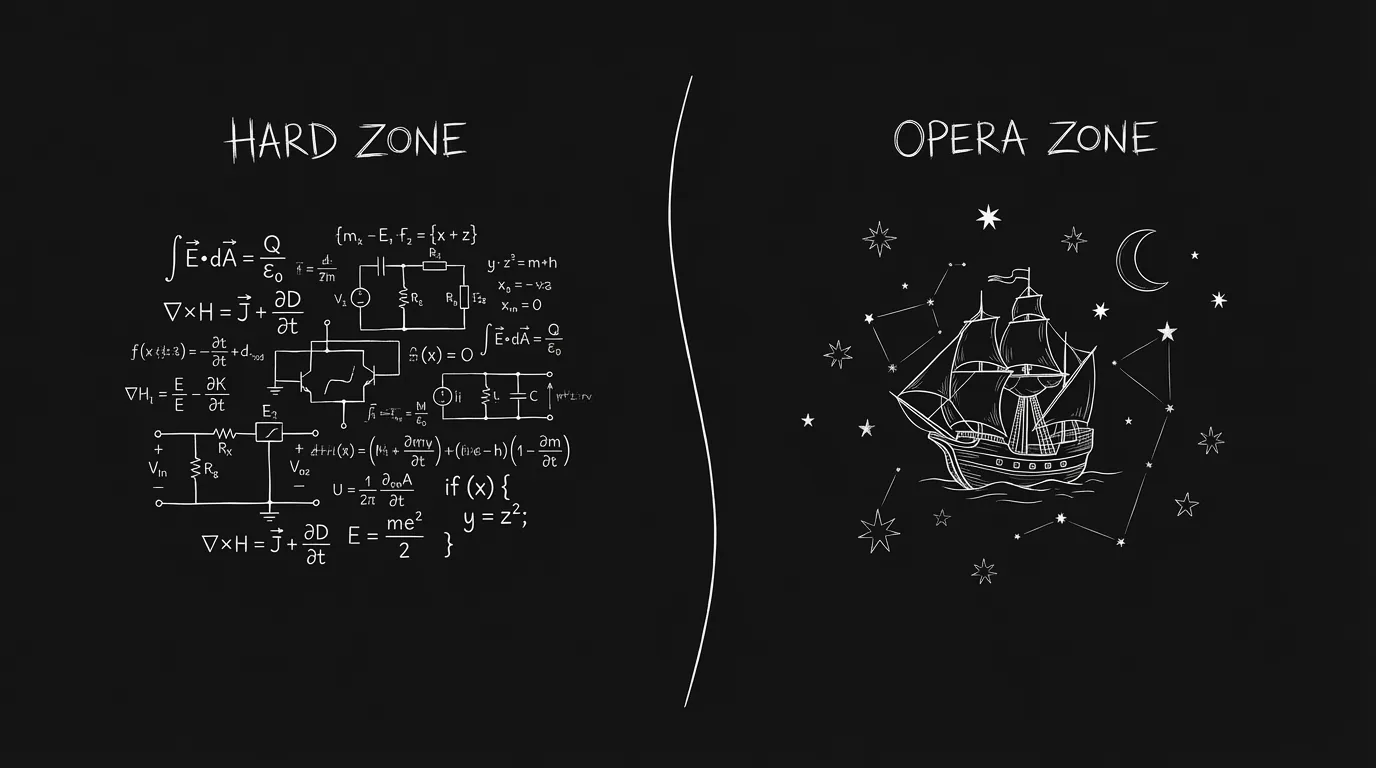
You’ve established that communication between worlds takes weeks. Then in act two, a character gets a message in real time. The audience notices. So you go back. You check the bible. The rule was there, you broke it. Fix: before you write a scene that uses tech or travel or communication, check the bible. If the scene requires a new rule, add it, and make sure it doesn’t break earlier scenes. The bible is your fact-check. Use it. Our piece on hard sci-fi vs space opera is about the level of rigor you choose; the bible is where you store that choice so you can stick to it.
Try it free
Try Screenweaver for free on your script
It is free. Import your existing project, get a clearer view of your outline, and regain control of your story structure in minutes.
Start FreeRelatable Scenario: The Bible That Eats the Script
You love worldbuilding. You’ve written 50 pages of history, maps, and faction lore. The script is 30 pages. Fix: the bible is for you. It doesn’t have to be exhaustive. It has to cover what the script needs. Start with the minimum. What do I need to know to write the first act? Add that. Then add as you go. When you need to know something, put it in the bible. When you don’t need it, don’t write it. The script is the product. The bible is the tool. For more on structure that keeps the story moving, see beat boards vs outlines, the bible supports the outline; it doesn’t replace it.
The Trench Warfare Section: What Beginners Get Wrong
Making the bible before you know the story. You build the world. Then you try to fit a story into it. The story feels forced. Fix: build the bible alongside the story. Start with the rules and factions the first act needs. Add as the script grows. The bible and the script develop together.
Contradicting the bible in the script. You have a rule. You break it for a cool moment. The audience feels the break. Fix: if you need to break a rule, make it a big deal. A one-time exception. A cost. Or change the rule in the bible and make sure the rest of the script still works. Don’t break the rule by accident. For more on consistency, see time travel logic and consistent rules.
Putting everything in the script. The bible has great lore. You want to share it. So you put it in dialogue. The script bogs down. Fix: the audience only needs what the story needs. The bible holds the rest. When you need to deliver info, do it through action and conflict, not through a lecture. See exposition in fantasy.
No bible at all. You’re holding it in your head. By page 80 you’re not sure what you said on page 10. Fix: even a one-page document helps. Rules. Factions. One or two key events. You don’t need a novel. You need a reference. For more on organizing complex material, see Scrivener for screenwriters, the bible can live in the same project as the script.
Step-by-Step: Starting the Bible
Before you write the script (or when you’re early in the first act), open a document. Title it “[Project] Bible.” Add four sections: Rules, History, Map/Structure, Factions. Under Rules, write what’s possible and what’s not, tech, travel, communication, power. Under History, write the one or two events that the story will touch. Under Map/Structure, write who’s where and who’s against whom. Under Factions, write each major group and what they want. Keep each section to one or two pages. Then, as you write, when you need something new, add it. When you’re not sure what you established, check. The bible grows with the script. It never replaces it. For more on building a world that supports conflict, see writing magic systems and the fish out of water, the bible supports both.
One External Resource
For a concise overview of worldbuilding in speculative fiction, see Worldbuilding on Wikipedia. Reference only; not affiliated.
The Perspective
The bible isn’t for the audience. It’s for you. It keeps the world consistent so the audience can believe it. Start small. Add as you go. Use it. When the rules are clear and the history is there when you need it, the script can focus on the story, and the world will hold.
Final Step
Build your next script with Screenweaver
Move from ideas to production-ready pages faster with timeline-native writing and AI-assisted story flow.
Try Screenweaver