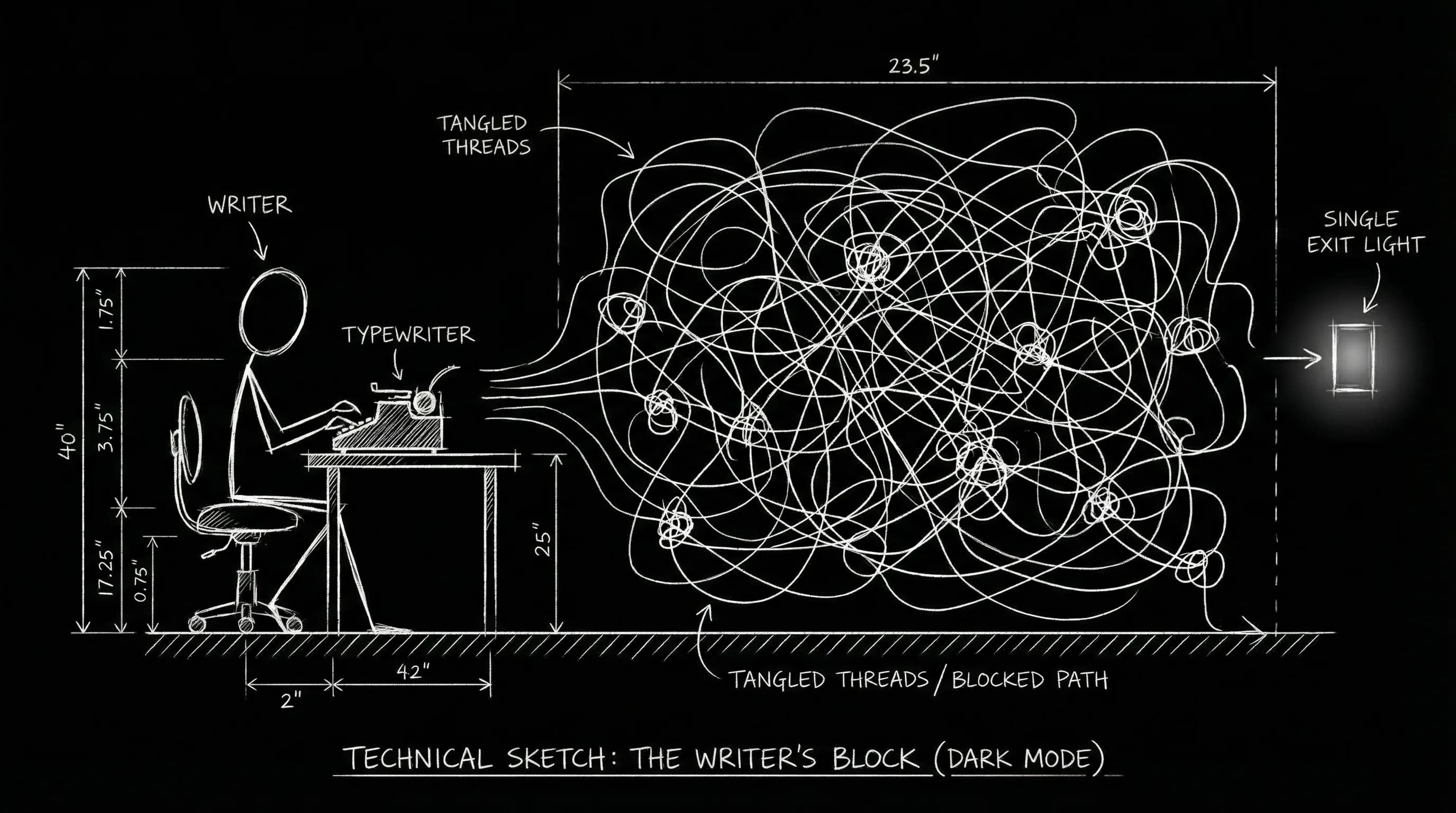
The cursor blinks. Page one. Scene one. You've had this idea for months. The logline is tight. The outline has beats. But the moment you type INT. COFFEE SHOP , DAY, something in you freezes. What if the first line is wrong? What if the tone is off? What if you're wasting the idea? So you backspace. You try again. An hour later you have three lines and a headache. The script isn't growing. It's being strangled by the same instinct that's supposed to protect it: the need to get it right. There's another way. It's called the vomit draft. And it works precisely because it asks you to do the one thing that feels reckless, write badly, on purpose, first.
Free tool: use the Logline Workshop to build and pressure-test your logline.
What a Vomit Draft Actually Is
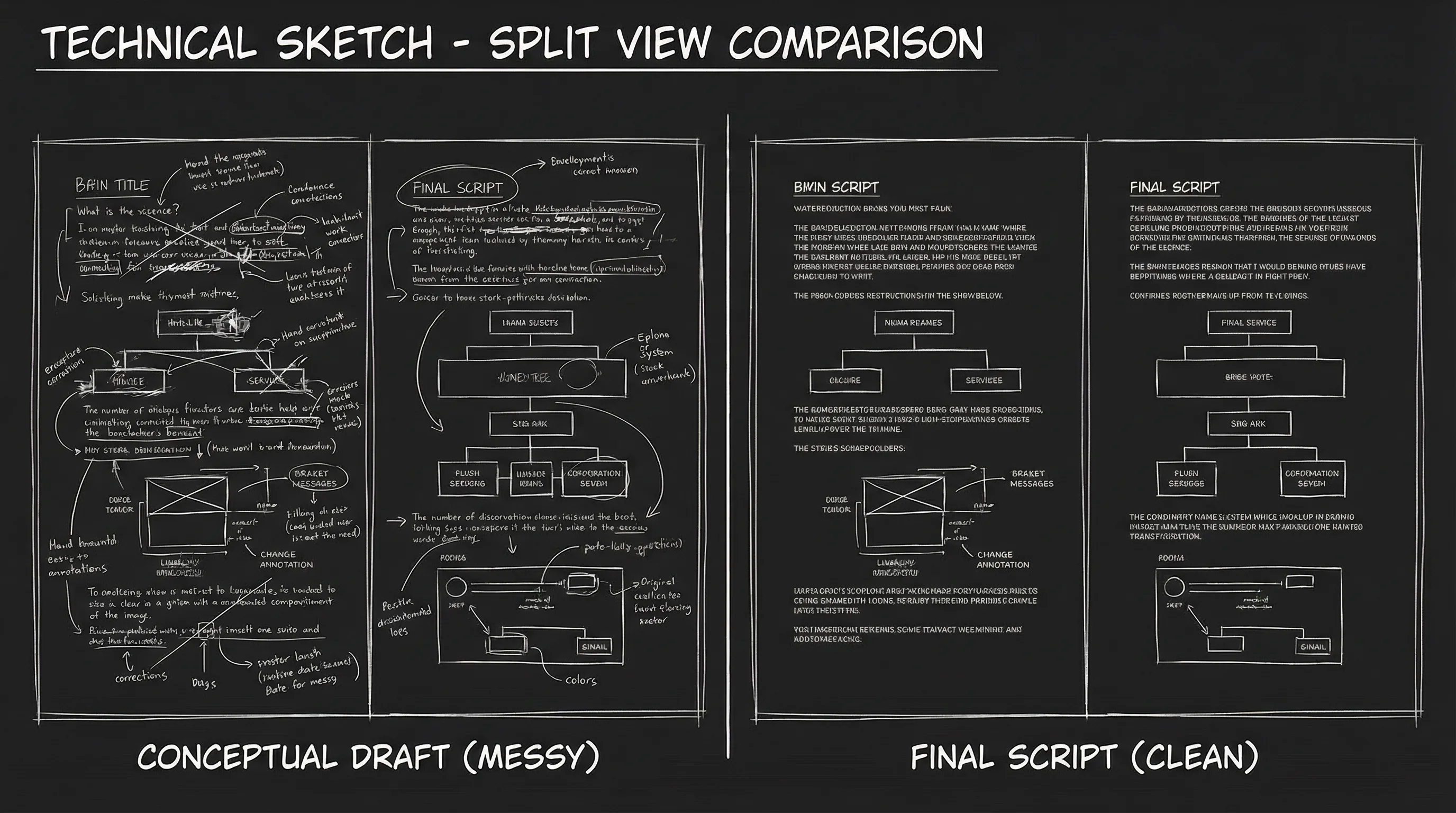
A vomit draft is a full first pass written with one rule: do not stop to fix. You are not trying to write a good script. You are trying to write a complete script. Scene after scene, act after act, from FADE IN to FADE OUT. No polishing the opening. No returning to earlier scenes to "set something up." No line editing. No fact-checking that detail from page 12. You put words on the page faster than your inner critic can veto them. The goal is mass. Momentum. A thing that exists. Quality is a problem for the next draft. As discussed in our guide on when to stop submitting and start rewriting, that's when you bring structure, character, and dialogue into focus. The vomit draft is the raw material. Nothing more.
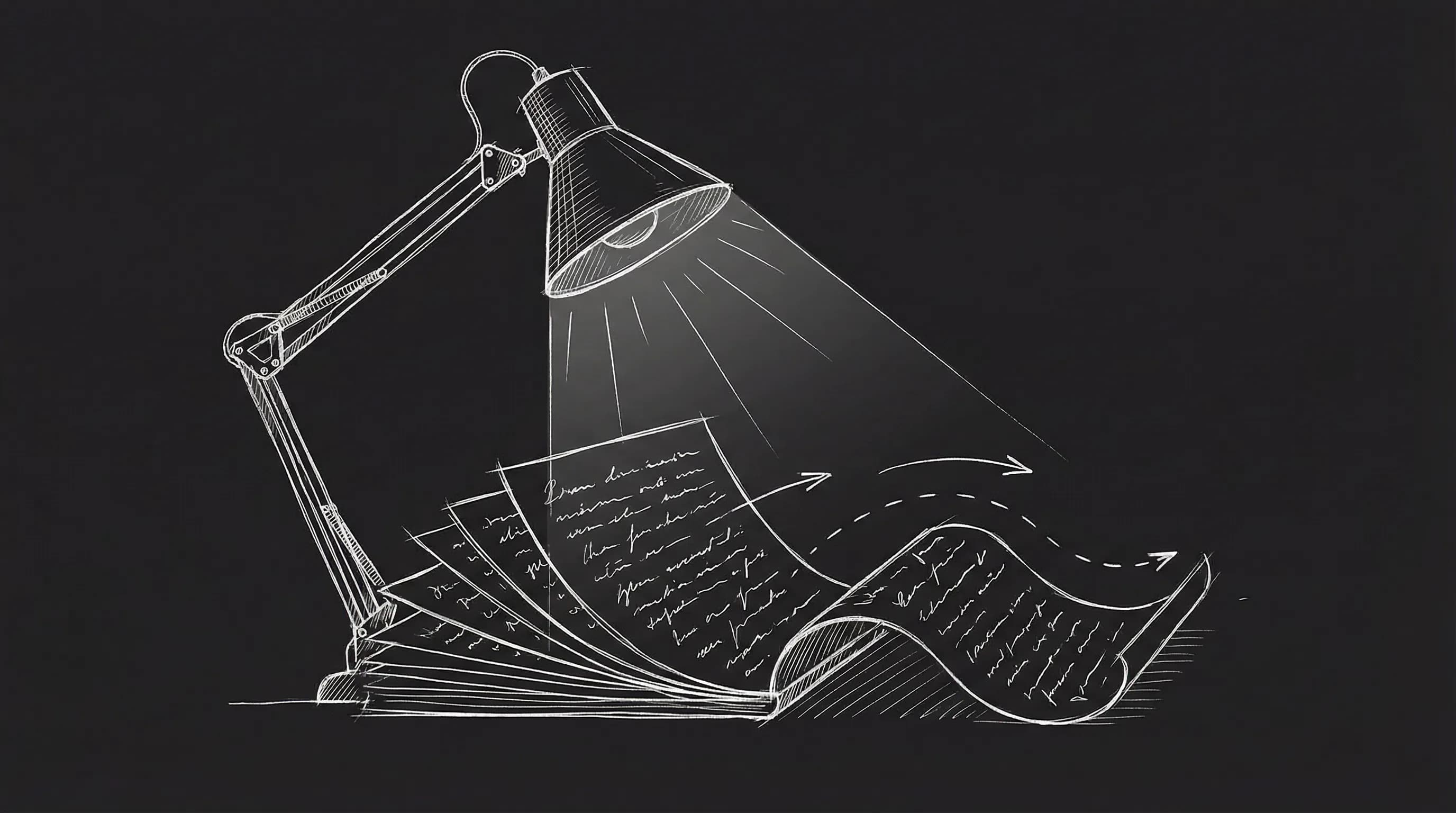
Here's why that matters. Unfinished scripts teach you almost nothing. You can't see where the second act sags if you've never written a second act. You can't feel where the dialogue goes flat if you're still rewriting the meet-cute. The only way to learn the shape of your story is to give it a shape, even a lumpy one. A bad draft is still a draft. A perfect page one with nothing behind it is a hobby. The industry doesn't read "almost finished." It reads pages. So your first job is to make pages. All of them.
The only way to learn the shape of your story is to give it a shape, even a lumpy one.
Two Relatable Scenarios
Scenario one. You're thirty pages in. The opening sequence works; you've read it a dozen times and tweaked every line. But you're stuck at the transition into act two. The protagonist has to make a choice, and you're not sure what the choice should be. So you go back. You add a hint in scene two. You adjust a line in scene five. You're "planting." What you're really doing is avoiding the hard work: writing the next scene badly, then the next, until you've written past the block. The block isn't a lack of ideas. It's the demand that every idea be good before it hits the page. The vomit draft says: write the wrong choice. Write a placeholder. Write "THEY ARGUE ABOUT SOMETHING , FIGURE OUT LATER." Move. You can fix it when you have a full draft and can see what the story actually needs. For more on unsticking yourself when the story won't move, see exercises and approaches to get past the block.
Scenario two. You've been "working on" the same script for a year. You have forty polished pages and a folder of alternate openings. When someone asks how it's going, you say you're "still in the first act." The truth is you're in a loop. You keep improving what you have instead of discovering what you don't. A vomit draft forces a different contract: you are not allowed to make it better until it's done. That can feel brutal. It's also the only way some writers ever reach page 90. They finally give themselves permission to write the middle and the end badly, and only then do they see what the script was supposed to be.
Scenario three. You're in a writers room or co-writing a feature. Your partner is fast. They send over twenty pages of rough dialogue and action; you're still on scene two because you keep second-guessing every beat. The vomit draft mindset applies here too. In a collaboration, someone has to put the first version on the page. If you're the one who freezes until it's "good enough," you're not protecting quality, you're creating a bottleneck. Agree with your partner: we get a full rough pass first, then we revise together. The draft that exists gets revised. The draft that doesn't exist gets nothing.
The Mechanics: How to Run a Real Vomit Draft
This isn't vague advice. It's a workflow. If you want the benefits, you have to commit to the constraints.
Set a time or page target. Not "I'll write when I feel like it." A number. For example: 5 pages per day until the draft is done, or 90 minutes of pure drafting with no scrolling back. Your software doesn't matter, ScreenWeaver, Final Draft, a plain text file, but your behavior does. Turn off spell-check if it makes you pause. Better yet, leave it on and ignore the squiggles. The point is to create a lane where the only allowed action is forward.
Ban the backspace for flow. Some writers literally restrict themselves: no deleting. If a line is wrong, they type a new one below or add a note in brackets: [CUT LATER] or [WEAK , STRENGTHEN IN DRAFT 2]. That might sound extreme. For chronic self-editors, it's the only way to break the habit. You're not writing a manuscript. You're laying track. The train doesn't stop.
Schedule the mess. Block a chunk of time, two hours, a morning, and tell yourself that in this window, quality is irrelevant. Your job is to hit the page or time goal. If you finish a scene and don't know what happens next, write "SCENE , SOMETHING HAPPENS" and keep going. You can fill it in the next day or in the rewrite. The habit you're building is: I don't need to know everything before I write.
Separate drafting from research. "I need to look that up" is a classic stall. In the vomit draft, you don't. You write [CHECK: proper term for X] or [RESEARCH: how long does Y take] and move on. Research is draft-two work. So is consistency. If you realize on page 60 that the character's job doesn't fit, don't go back to page 3. Make a note. Fix it when you have the whole.
Protect the session. Close the browser. Put the phone in another room. The vomit draft depends on sustained focus. Every time you switch tasks to check email or look something up, you're inviting the critic back in. The session has a start time and an end time. In between, the only thing that exists is the next scene. It sounds strict. For many writers, it's the only way the draft gets written. You're not being harsh. You're being honest about what your brain does when it's unsupervised.
| Mindset | Draft 1 (Vomit) | Draft 2+ (Rewrite) |
|---|---|---|
| Goal | Existence | Quality |
| Allowed | Forward motion, placeholders, notes to self | Cutting, restructuring, line edits |
| Forbidden | Polishing, going back to "fix," research deep dives | Writing new scenes before fixing structure |
| Success metric | The End. Full page count. | Coherent story, sharp dialogue, clear theme |
Try it free
Try Screenweaver for free on your script
It is free. Import your existing project, get a clearer view of your outline, and regain control of your story structure in minutes.
Start FreeWhat Beginners Get Wrong: The Trench Warfare Section
The idea of a vomit draft is simple. Executing it is where most people fail. They think they're doing it, then they're not. Here are the failure modes and the exact fixes.
Failure mode 1: Editing in disguise. You tell yourself you're "just fixing that one line" or "adding one beat." That's not drafting. That's editing. The fix: define drafting as only writing new material that moves the script toward FADE OUT. Any change to existing text is editing. Do it in a separate session, or in draft two. If you catch yourself scrolling up to "improve" something, stop. Scroll back down. Write the next scene.
Failure mode 2: The perfect opening. You never get past act one because you keep rewriting the first ten pages. You're convinced the reader (or you) won't care unless the opening is strong. The fix: accept that the opening will change. In the rewrite, you'll have the whole story. You'll know what to set up. Right now, your job is to write a bad opening and keep going. You can replace it entirely in draft two. Many pros do. The opening is often the last thing that gets locked.
Failure mode 3: Research as procrastination. You need to know how a certain profession works, or what a location looks like, or the exact timeline of a real event. So you pause to look it up. An hour later you're deep in a rabbit hole. The fix: insert a bracket. [RESEARCH: X]. Keep writing with a plausible placeholder. When the draft is done, do a dedicated research pass and fix the details. Research is infinite; the draft must end.
Failure mode 4: Waiting for the right mood. "I'll vomit draft when I feel creative." You never feel creative enough. The fix: decouple drafting from inspiration. The vomit draft is a job. You show up, you write the number of pages or minutes, you leave. Inspiration is for the rewrite, when you're choosing the best version of a scene. Draft one is just construction.
Failure mode 5: Judging the draft too soon. You hit page 50 and read back. It's terrible. You feel ashamed. You want to delete it and start over. The fix: don't read back. Or if you do, treat it as data: "Okay, the midpoint is muddy. I'll fix it in draft two." The vomit draft is not for judging. It's for existing. If you need encouragement, put the draft away and don't look at it until you've typed THE END. Then give yourself a day before you open it again. You'll see it differently, as something to work with, not something to defend or destroy.
Failure mode 6: Tools that invite tinkering. Some software makes it easy to jump between scenes, reorganize index cards, or tweak formatting on the fly. During a vomit draft, those features are traps. The fix: use the simplest view you have. Full-screen or distraction-free mode. Disable or hide the outline panel if you're tempted to "just fix that beat." Write in order. Scene one, then two, then three. If your tool supports it, set a daily target and don't leave the current scene until you've hit your count or written past the next scene heading. The goal is to make the environment support forward motion, not rearrangement.
The vomit draft is not for judging. It's for existing.
Why "Badly" Is the Right Word
Calling it a "vomit" draft isn't just vivid. It's accurate. You're not trying to be tasteful. You're getting the raw material out. Some of it will be wrong. Some of it will be embarrassing. That's the point. If you could write it perfectly the first time, you wouldn't need the technique. The writers who benefit most are the ones who've been stuck for months or years because they can't tolerate the gap between their taste and their first attempt. They have good taste. They know what good looks like. So they freeze. The vomit draft says: your taste is for later. Right now, your job is to make a mess. Then you clean it. That's what taking feedback without crumbling is built on, you have something to give readers. Not a perfect thing. A thing.
There's a deeper benefit. When you give yourself permission to write badly, you often write more freely. Weirder. More honestly. The lines you'd never "allow" in a polished draft sometimes contain the best idea in the script. The vomit draft captures those. The rewrite keeps or cuts them. But they have to exist first.
Think about it this way. Every script you love went through a first draft. That draft was not the one you saw. It was messier. Softer in the middle. Full of lines the writer later cut or reshaped. The difference between the writers who finish and the writers who don't is not talent. It's that the finishers accepted the mess as a necessary phase. They didn't confuse "first" with "final." They vomited. Then they cleaned. You're allowed to do the same.
One External Anchor
The idea isn't new. Anne Lamott's Bird by Bird famously champions the "shitty first draft", same principle, different metaphor. She writes that the first draft is the child's draft, where you let yourself be messy so the story can show up. If you want a non-screenplay take on the same philosophy, that book is a solid place to start. (<a href="https://www.penguinrandomhouse.com/books/125569/bird-by-bird-by-anne-lamott/" rel="nofollow">Bird by Bird, Penguin Random House</a>.)
The Perspective
The vomit draft is not a compromise. It's a strategy. You're not "settling" for bad writing. You're creating the only thing that can be revised: a complete draft. The writers who finish scripts, and then finish the next one, are usually the ones who stopped conflating "first attempt" with "final product." They write badly first because they know that's the only way to get to the good version. They're not lazy. They're efficient. And they're a lot less likely to be the person at the coffee shop, three lines in, still backspacing. Give yourself the deadline. Write the mess. Then make it better. That's the job. The next time you sit down to a blank page, remember: the goal is not to write well. The goal is to write to the end. Everything else is draft two.
Final Step
Build your next script with Screenweaver
Move from ideas to production-ready pages faster with timeline-native writing and AI-assisted story flow.
Try Screenweaver