You have a job. Maybe kids. Maybe a commute. The script is the thing you do "when you have time." But "when you have time" never comes. Or it comes in scraps, fifteen minutes here, twenty there, and by the time you're in the scene, the block is over. You're not lazy. You're under-scheduled. The writers who finish scripts while holding down a day job don't have more hours. They have a system. They treat the writing block like a meeting. They protect it. They know exactly when it is and what they're doing in it. Here's how to find that block, defend it, and make it count.
The One-Hour Rule
You don't need four hours a day. You need one. Or thirty minutes. Or even twenty. The number is less important than the consistency. A writer who writes twenty minutes every morning for six months will have a draft. A writer who waits for the free weekend that never arrives will have an outline and a lot of guilt. The math is simple. Twenty minutes a day is roughly ten hours a month. Ten hours is enough to add pages. Over a year, it's enough to finish a feature or multiple pilots. The trap is believing you need a "real" block, three hours, a whole day, before you're allowed to start. You don't. You need a block that exists and that you show up for.
A writer who writes twenty minutes every morning for six months will have a draft.
Where the Hour Hides
Most people say they don't have time. What they mean is they haven't looked. Time gets eaten by default activities: scrolling, TV, "winding down," errands that could be batched, meetings that could be shorter. The hour is usually there. It's just not named. So name it. Audit a typical week. Write down every block of 30 minutes or more that isn't work, sleep, or non-negotiable family time. That's your pool. One of those blocks becomes the writing block. It might be 6 a.m. before anyone wakes up. It might be lunch in the car with a laptop. It might be 10 p.m. after the kids are in bed. It might be Saturday 7 a.m. while the house is quiet. The best block is the one you can protect. Not the one that sounds writerly. The one that actually happens.
Relatable Scenarios
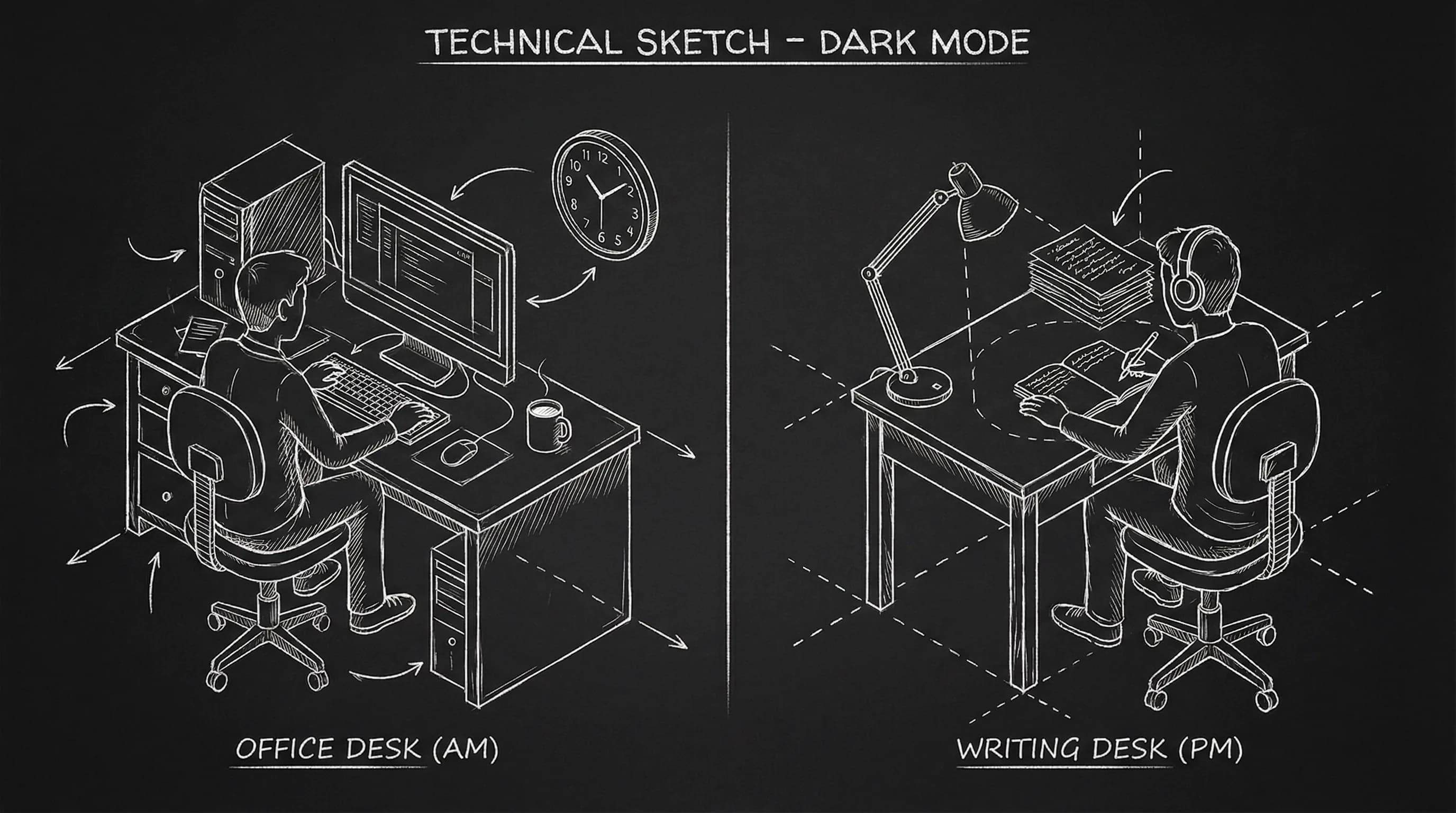
Scenario one. You get home at 7. You eat, you help with homework, you collapse. By 9 you're too tired to write. You tell yourself you'll write on the weekend. Saturday comes; you're catching up on life. Sunday you're dreading Monday. The fix: move the block earlier. Get up 45 minutes before you usually do and write before the day starts. Yes, it hurts at first. But the morning block is the one that doesn't get stolen. Nothing has happened yet. No one has asked you for anything. You're not depleted. It's the same principle Sorkin, Tarantino, and Gerwig use in different ways: find when you're capable and put the writing there.
Scenario two. You have the hour. But when you sit down, you spend twenty minutes "getting back into it", rereading, checking email, opening the outline. The actual writing gets maybe twenty minutes. The fix: define the block as writing only. No rereading from the top. No "just checking" anything. Open the document at the last scene you wrote. Set a timer. Write until the timer goes off. If you need to remember where you were, do that in the last two minutes of the previous session (write yourself a one-line note: "Next: she confronts him"). The block starts the moment you sit down. No warm-up that isn't typing.
Scenario three. You're a parent. The only quiet time is after the kids sleep. But by then you're done. You've been "on" all day. The fix might be to shorten the block and lower the bar. Twenty minutes. Two pages or one scene. That's it. You're not writing a masterpiece. You're adding to the draft. Some writers do their best work in that compressed window because there's no time to overthink. The constraint is the feature. If twenty minutes is all you have, make it non-negotiable. Close the door. Phone in another room. Write.
The Mechanics: How to Lock the Block
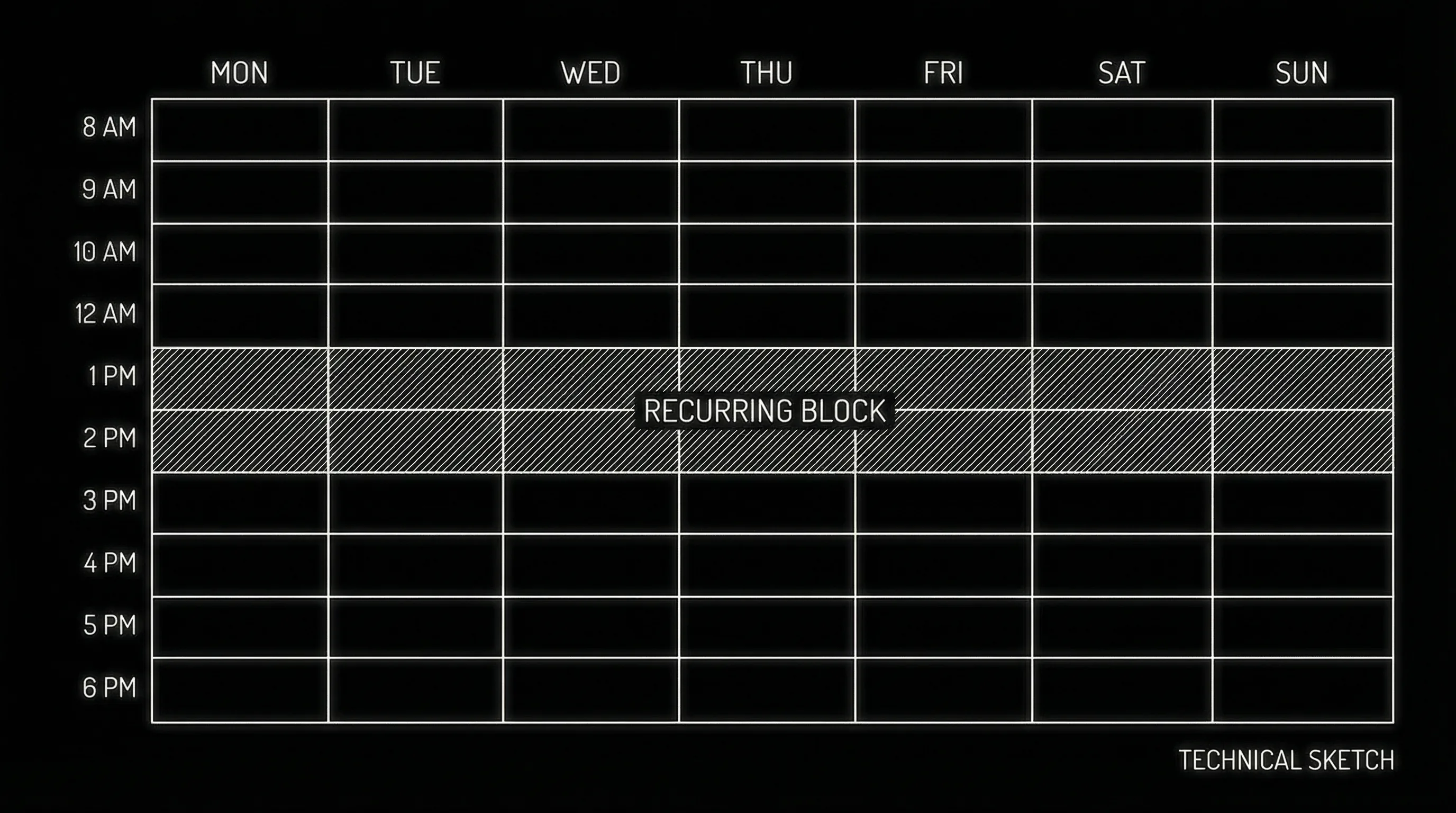
Put it on the calendar. If it's not scheduled, it's optional. Block the same time every day (or the same days every week). Label it. "Writing." Not "maybe write." When someone asks for that time, you have an answer: "I have a commitment." You don't have to say it's your script. You just have to protect the slot.
Reduce friction. The more steps between you and the page, the more chances you have to bail. Keep the script open in a tab or a dedicated workspace. Have one place you write, same chair, same room, same laptop. Don't spend the block setting up. Sit down and the document is already there. The vomit draft works precisely because it removes the friction of "getting it right." Same idea here: remove the friction of "getting started."
Set a page or time target, not both. Either "I write for 30 minutes" or "I write until I've added 2 pages." Don't make it "30 minutes and 2 pages", that's a recipe for anxiety when you're slow. One metric. Hit it. Stop. That way the block has a clear end. You're not wondering when you're allowed to leave.
Communicate with the household. If you live with others, they need to know the block exists. "From 6 to 6:45, I'm not available unless it's an emergency." You're not asking permission. You're giving information. People can respect a boundary they know about. They can't respect one you've never stated.
| Trap | Fix |
|---|---|
| "I'll write when I have time" | Schedule the block; treat it like a meeting |
| Block gets eaten by other tasks | Put it in the calendar; say no to conflicts |
| Too tired by the time the block comes | Move the block earlier (e.g. before the day starts) |
| Spend the block "getting back into it" | No rereading; start at last scene; timer on |
| Guilt when you miss a day | One missed day doesn't erase the system; resume the next |
Try it free
Try Screenweaver for free on your script
It is free. Import your existing project, get a clearer view of your outline, and regain control of your story structure in minutes.
Start FreeWhat Beginners Get Wrong: The Trench Warfare Section
Waiting for the ideal conditions. "When I have a proper office / when the kids are older / when I'm less busy." Conditions are never ideal. The writers who finish with a day job started when it was messy. They wrote in the kitchen, in the car, in the corner of the bedroom. The block doesn't require a perfect room. It requires a decision. Make the decision with the life you have now.
Using the block for everything except new pages. Research, outlining, reading scripts, "thinking about the story", those are real work. But they expand to fill the time. If your goal is to finish a draft, the block should be mostly drafting. Outline in a different slot or in the margins of the day (commute, lunch). Protect the block for putting words on the page. Otherwise you'll have a great outline and no draft. For more on what to do once you have a draft, see the rewriting process.
Quitting after a bad week. You miss three days. You feel like you've broken the habit. So you wait until "next month" or "when things calm down." The habit doesn't require perfection. It requires recurrence. The next time the block comes, show up. You don't have to make up the missed sessions. You have to resume. One session at a time.
Comparing yourself to full-time writers. They have more hours. So what? You're not in a race with them. You're in a race with the version of you who doesn't write. The version who shows up for twenty minutes a day wins. The version who waits for a clear calendar loses. Your pace is your pace. The only question is whether you're moving.
The block doesn't require a perfect room. It requires a decision.
When the Job Is the Problem
Sometimes the issue isn't technique. It's that the job is consuming everything, 60-hour weeks, constant email, no mental margin. In that case, time management has a ceiling. You can optimize the edges, but you might also need to change the edges: a different role, a conversation with a manager, or a timeline for when you'll reduce hours. That's bigger than a blog post. But it's worth naming. If you've done the audit and there is literally no block to protect, you're working, parenting, and sleeping, and nothing else, then the conversation is about what has to give. Sometimes it's the job. Sometimes it's something else. The point is to be honest. One hour a week is still something. Zero is the only number that can't be worked with.
One External Anchor
Laura Vanderkam's work on time management (e.g. 168 Hours) emphasizes that most people have more discretionary time than they think, it's just not allocated. Tracking how you actually spend a week can reveal pockets. (<a href="https://lauravanderkam.com/books/168-hours/" rel="nofollow">168 Hours, Laura Vanderkam</a>.)

The Perspective
Writing with a day job is not a compromise. It's the norm for most writers until they're staffed or selling. The ones who finish scripts aren't the ones with the most time. They're the ones who named the time they had and showed up. Find your hour, or your twenty minutes. Put it on the calendar. Defend it. Write. Repeat. That's the job.
Final Step
Build your next script with Screenweaver
Move from ideas to production-ready pages faster with timeline-native writing and AI-assisted story flow.
Try Screenweaver