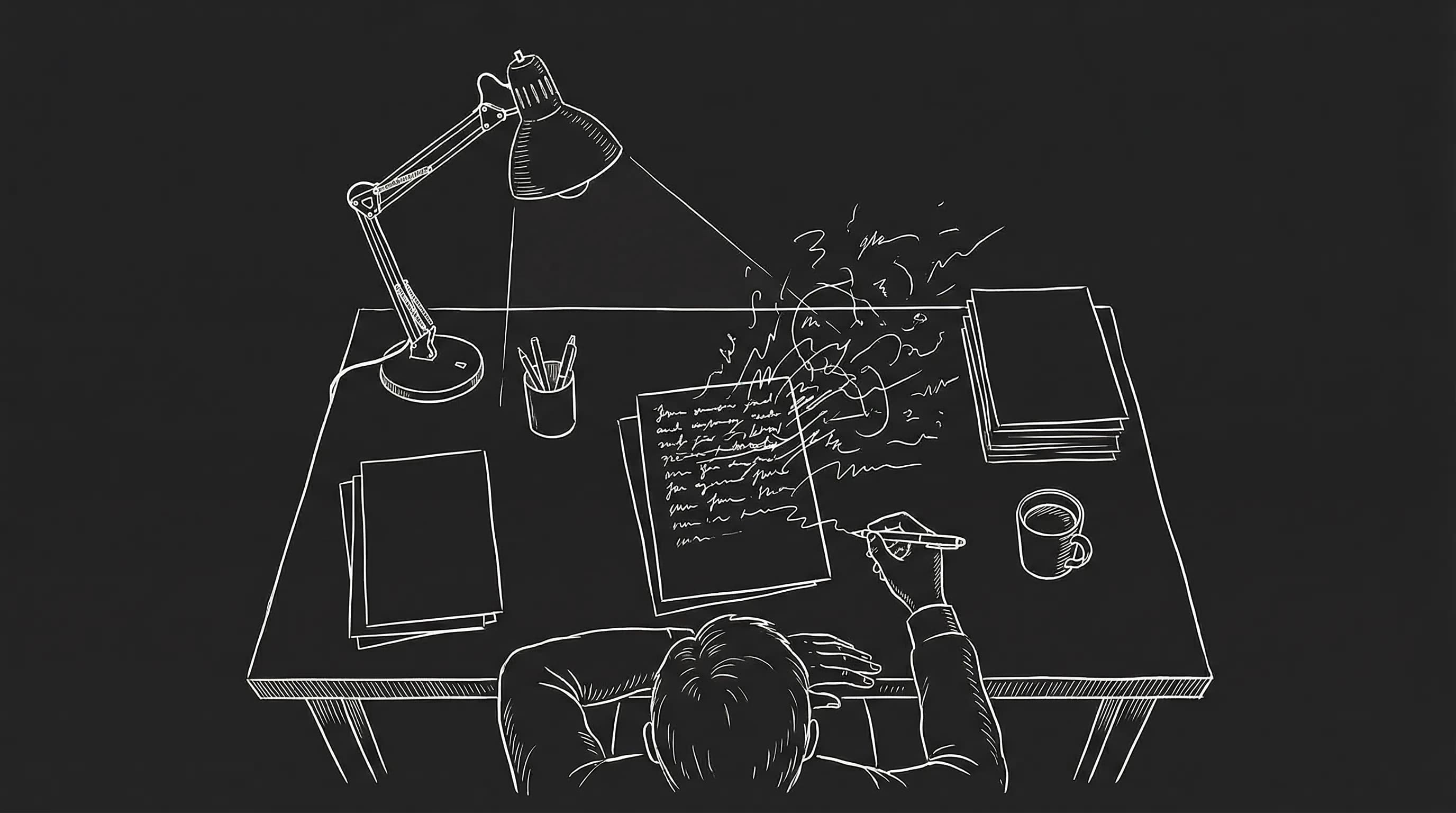
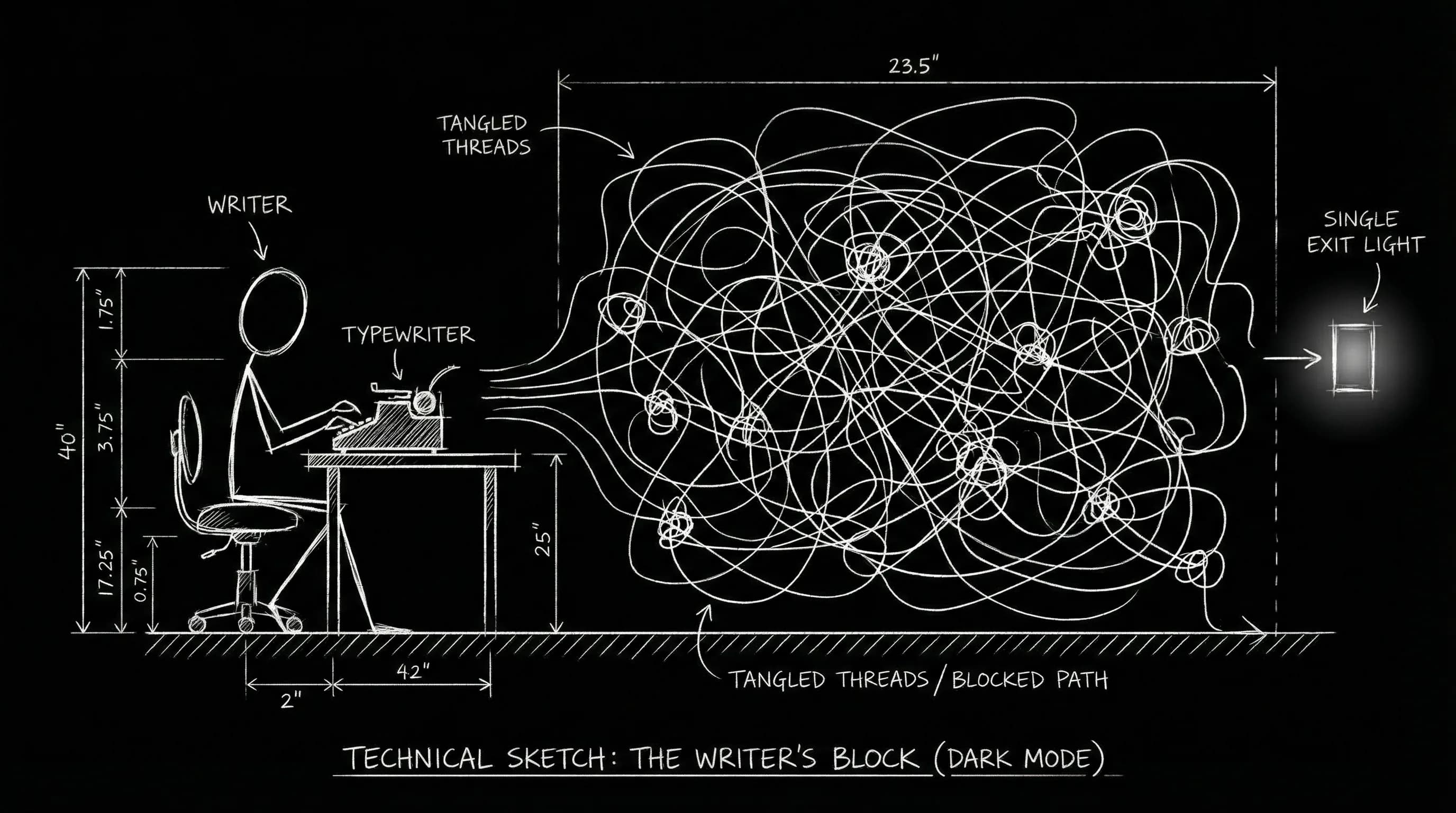
The page is blank. Or it's full of scenes you've rewritten so many times they've gone stale. You know what happens next in the outline. You just can't make yourself type it. That's not laziness. It's not a character flaw. It's writer's block, and it usually has a cause. Sometimes the cause is fear of the next beat. Sometimes it's a story problem you haven't named. Sometimes it's exhaustion. The fix isn't to "try harder." It's to change the task. Here are five concrete exercises that shift the brain out of the stuck state and get words on the page again. They're not magic. They're tactics. Use them when the cursor is blinking and nothing is coming.
What's Actually Going On When You're Blocked
Writer's block isn't one thing. It's a symptom. You might be blocked because you're judging every line before it hits the page. You might be blocked because you don't actually know what the next scene is for. You might be blocked because you're tired or anxious and your brain won't focus. Or you might be blocked because the story has a logical or emotional hole you're avoiding. The exercises below address different layers. Some get you writing again by lowering the bar. Some help you find the story problem. Some break the trance of staring at the same document. The point is to have more than one tool. When "just write" doesn't work, you need a different instruction.
When "just write" doesn't work, you need a different instruction.
Exercise 1: The "What If?" Run
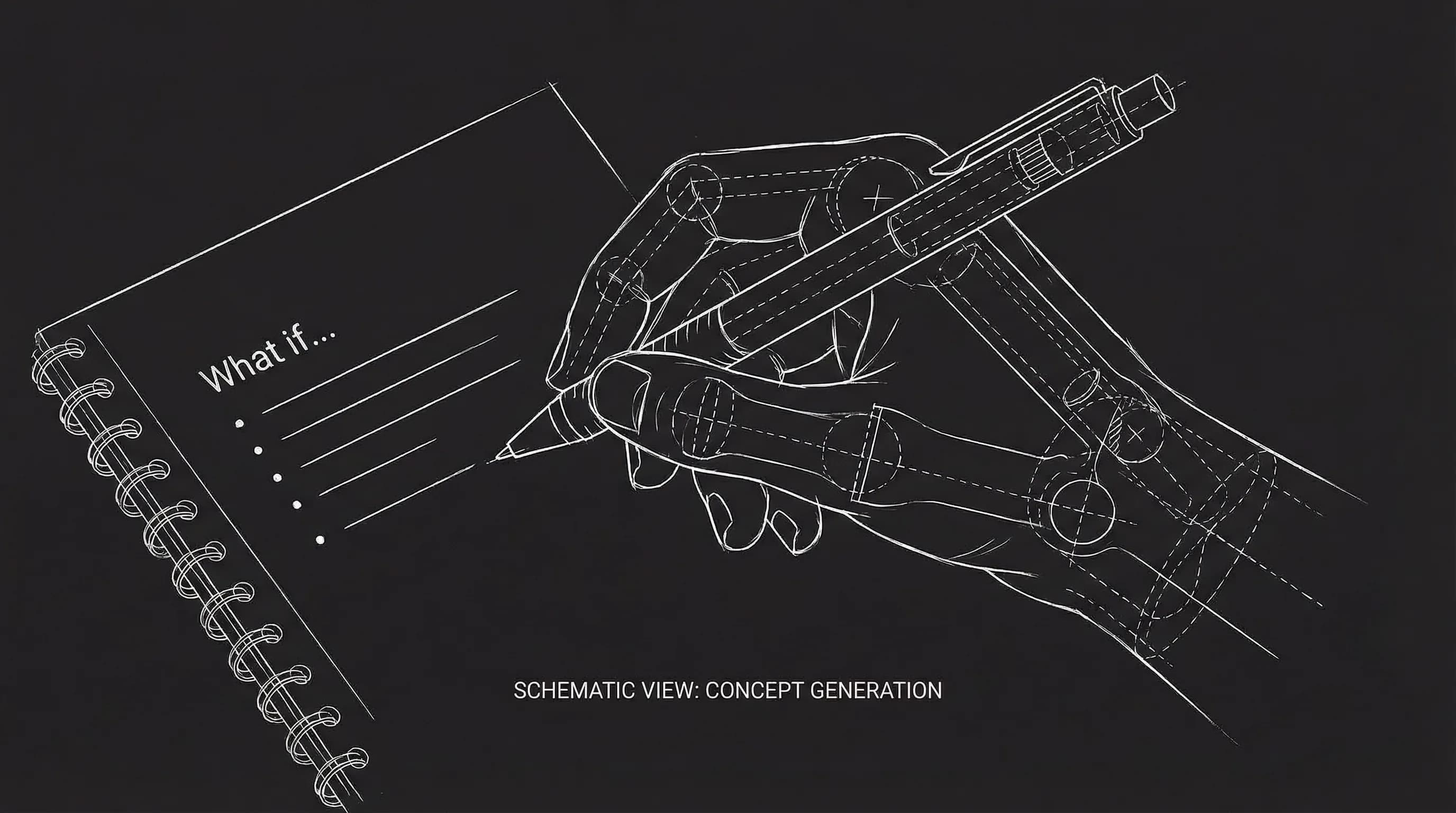
You're stuck at a story beat. The character has to do something, and nothing feels right. So you don't write the scene. You write a list. At the top of a new page or document, type: "What if [character] did X?" Then write five to ten different X's. They don't have to be good. They can be extreme, silly, or wrong. "What if she quits?" "What if he lies?" "What if they never meet?" "What if the gun goes off here?" The goal isn't to pick the best option in the moment. It's to flood the zone with possibilities. One of them will trigger a reaction, "no, but what if instead she...", and that reaction is often the next beat. You're not writing the scene yet. You're writing options until one of them pulls you forward.
When to use it: When you're stuck at a plot decision or a character choice and you keep rewriting the same paragraph. What beginners get wrong: They stop after one or two "what ifs" and pick the first idea. Push to at least five. The later options are often the interesting ones.
Exercise 2: The Worst Version
You're blocked because you're trying to write the scene "right." So give yourself permission to write it wrong. Open the document. Type at the top: "WORST VERSION , WILL DELETE." Then write the scene as badly as you can. On-the-nose dialogue. Clunky action. Cliches. The point is to remove the stakes. You're not trying to impress anyone. You're trying to have something on the page. Once the worst version exists, you have raw material. You can fix a bad scene. You can't fix a blank one. A lot of writers find that the "worst" version isn't as bad as they feared, and that one or two lines are keepers. The rest gets revised or cut. This pairs well with the vomit draft: same principle, applied to a single stuck scene.
When to use it: When you're frozen because the scene feels too important or too hard. What beginners get wrong: They judge the worst version in real time and stop. Commit to finishing the worst version before you allow yourself to edit.
Exercise 3: Write From the Antagonist (or Another POV)
You're stuck in the protagonist's head. So leave it. Open a new page. Write the same moment, or the same sequence, from the antagonist's point of view. Or from a secondary character. Or from the perspective of someone who doesn't appear in the script (a bystander, a character who died earlier). You're not writing canon. You're writing to discover what the other side wants, fears, or knows. That often clarifies what the protagonist is up against and why the next beat matters. When you return to the main script, you have subtext and motivation you didn't have before. The block was partly a lack of information. Now you have more.
When to use it: When the scene feels flat or when you're not sure what the conflict is in the moment. What beginners get wrong: They worry the exercise is "wasted" because it won't go in the script. It's not wasted. It's research. Throw it away after if you want. The value is in what you learn.
Exercise 4: The Five-Minute Sprint
You're not stuck on story. You're stuck on starting. The blank page is the problem. So change the contract. Set a timer for five minutes. Your only job is to type until the timer goes off. You can write "I don't know what happens next" over and over. You can write nonsense. You can write a character complaining about being in a bad movie. The rule is: do not stop typing. When the five minutes are up, you're allowed to stop. Often what happens is that by minute two or three, the brain starts producing real material. The sprint bypasses the critic by giving it no time to intervene. If five minutes gets something going, do another five. You're not writing the script. You're writing until the script shows up.
When to use it: When you can't get yourself to type at all, procrastination, fear, or overwhelm. What beginners get wrong: They set a 30-minute timer and then sit in anguish. Start with five. It's enough to break the seal.
Exercise 5: Skip and Return
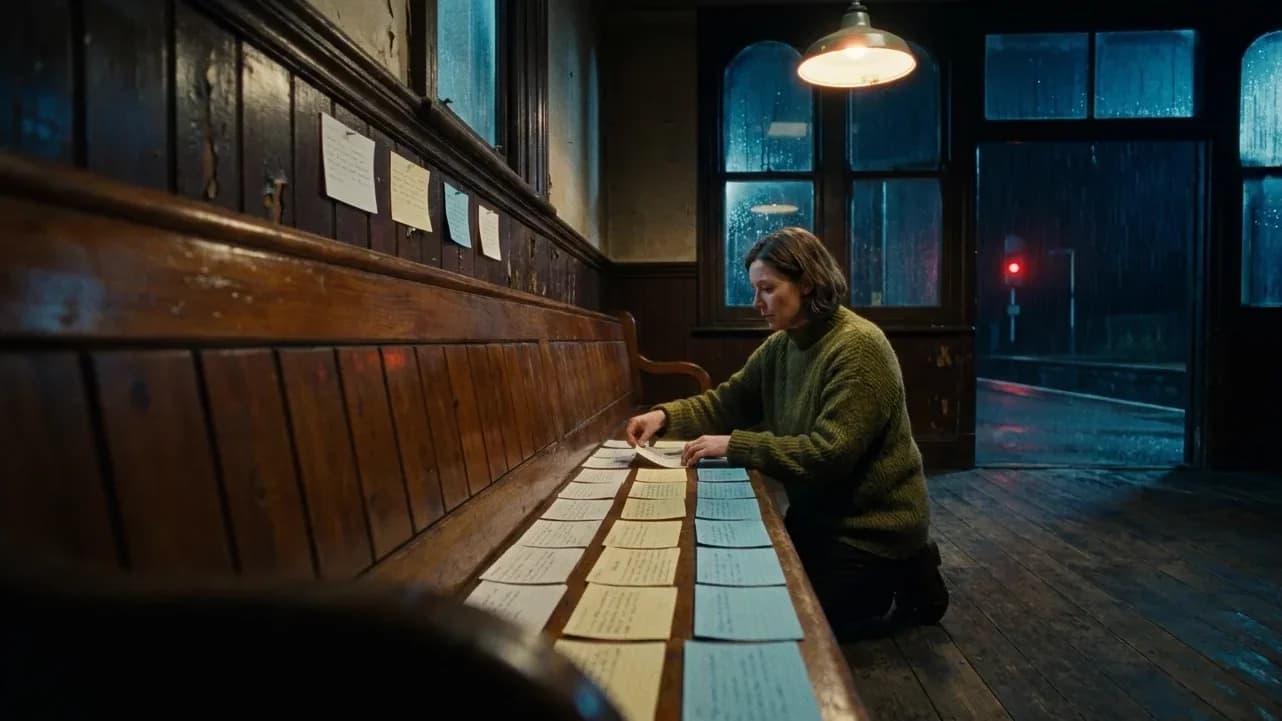
You're stuck on one scene. So skip it. Write the next scene. Or the scene after that. Or the ending. You can type "[SCENE , THEY FIGHT. COME BACK LATER.]" and move on. The block is often local. It's this scene that's the problem, not the whole script. If you keep banging on the same spot, you reinforce the block. If you jump ahead, you keep momentum and sometimes the skipped scene becomes obvious once you've written what comes after. You know what has to happen because you've already written the consequence. Coming back to fill the gap is easier than inventing it under pressure.
When to use it: When you've tried the other exercises and you're still stuck on one specific beat. What beginners get wrong: They feel guilty for "skipping." There's no rule that says you have to write in order. The rewriting process is when you smooth the joins. Draft one is when you get to the end.
| Exercise | Best for | Core move |
|---|---|---|
| What If? Run | Plot or character decision | Generate options until one pulls you forward |
| Worst Version | Fear of writing the scene wrong | Lower the bar; get something on the page |
| Antagonist / Other POV | Flat conflict, unclear motivation | Leave protagonist; discover what the other side wants |
| Five-Minute Sprint | Can't start typing at all | Type without stopping; bypass the critic |
| Skip and Return | Stuck on one scene only | Write the next scene; come back to the gap later |
Try it free
Try Screenweaver for free on your script
It is free. Import your existing project, get a clearer view of your outline, and regain control of your story structure in minutes.
Start FreeRelatable Scenarios
Scenario one. You're in the middle of act two. The outline says "confrontation." You've stared at that word for a week. You try the What If? run. You list ten options. Option seven is "What if she doesn't show up?" You realize the scene you need isn't the confrontation, it's the build-up where he waits and she doesn't come. The block was a wrong target. You were aiming at the confrontation when the real beat was the no-show. You write that instead. The block dissolves because you fixed the story, not the sentence.
Scenario two. You're not stuck on story. You're stuck on life. You're tired, anxious, or distracted. The Five-Minute Sprint might get a few lines out. But the real fix might be rest. If you've been grinding for months without a break, see burnout: signs you need a break from your script. Sometimes the block is the brain saying stop. The exercises are for when the block is creative. When it's physical or emotional, the exercise is to step away.
Scenario three. You've done a What If? run and a Worst Version and you're still stuck. The problem might be structural. The scene might not belong. Or it might be in the wrong place. Try writing the same scene as if it happened earlier, or later, in the script. Or as if a different character initiated it. Changing the when or who can unlock the what.
You can fix a bad scene. You can't fix a blank one.
What Beginners Get Wrong: The Trench Warfare Section
Using the exercise once and giving up. "I tried the Worst Version and it was still bad." The point wasn't to make it good. The point was to have a version. If you wrote two pages of bad dialogue, you now have two pages to cut or fix. That's progress. Repeat the exercise on the next stuck scene. The brain learns that "bad" is allowed. Over time, the block loosens.
Confusing block with a bad idea. Sometimes you're not blocked. You're correctly sensing that the story has a hole. The outline said the character "realizes the truth," but you never set up what the truth is. No amount of sprinting will fix that. You need to go back to the outline or the premise and fix the logic. Use the antagonist POV exercise or a What If? run at the story level: "What if the truth is X? What would we need to set up earlier?" Block can be a signal. Listen to it.
Waiting for the "right" exercise. There is no single fix. Try one. If it doesn't work, try another. If none of them work, the block might be exhaustion, fear of finishing, or a story that's not ready. That's useful information. Take a day off. Talk through the story with someone. Or open a new document and write one paragraph about what you're afraid of (regarding this script). Sometimes naming the fear is enough to move.
One External Anchor
The concept of "writer's block" as a psychological phenomenon has been discussed in creativity research and in books like The War of Art by Steven Pressfield, which frames resistance as the main enemy. (<a href="https://www.stevenpressfield.com/books/the-war-of-art/" rel="nofollow">The War of Art, Steven Pressfield</a>.)
The Perspective
Writer's block is not a moral failure. It's a state. The way out is usually to change the task, smaller, uglier, or from a different angle. The five exercises above are ways to do that. Keep them in your back pocket. When the cursor blinks and nothing comes, don't stare harder. Run a What If? list. Write the worst version. Write from the villain. Sprint for five minutes. Or skip the scene and come back. One of them will get the words moving again. Then your job is to keep going.
Final Step
Build your next script with Screenweaver
Move from ideas to production-ready pages faster with timeline-native writing and AI-assisted story flow.
Try Screenweaver