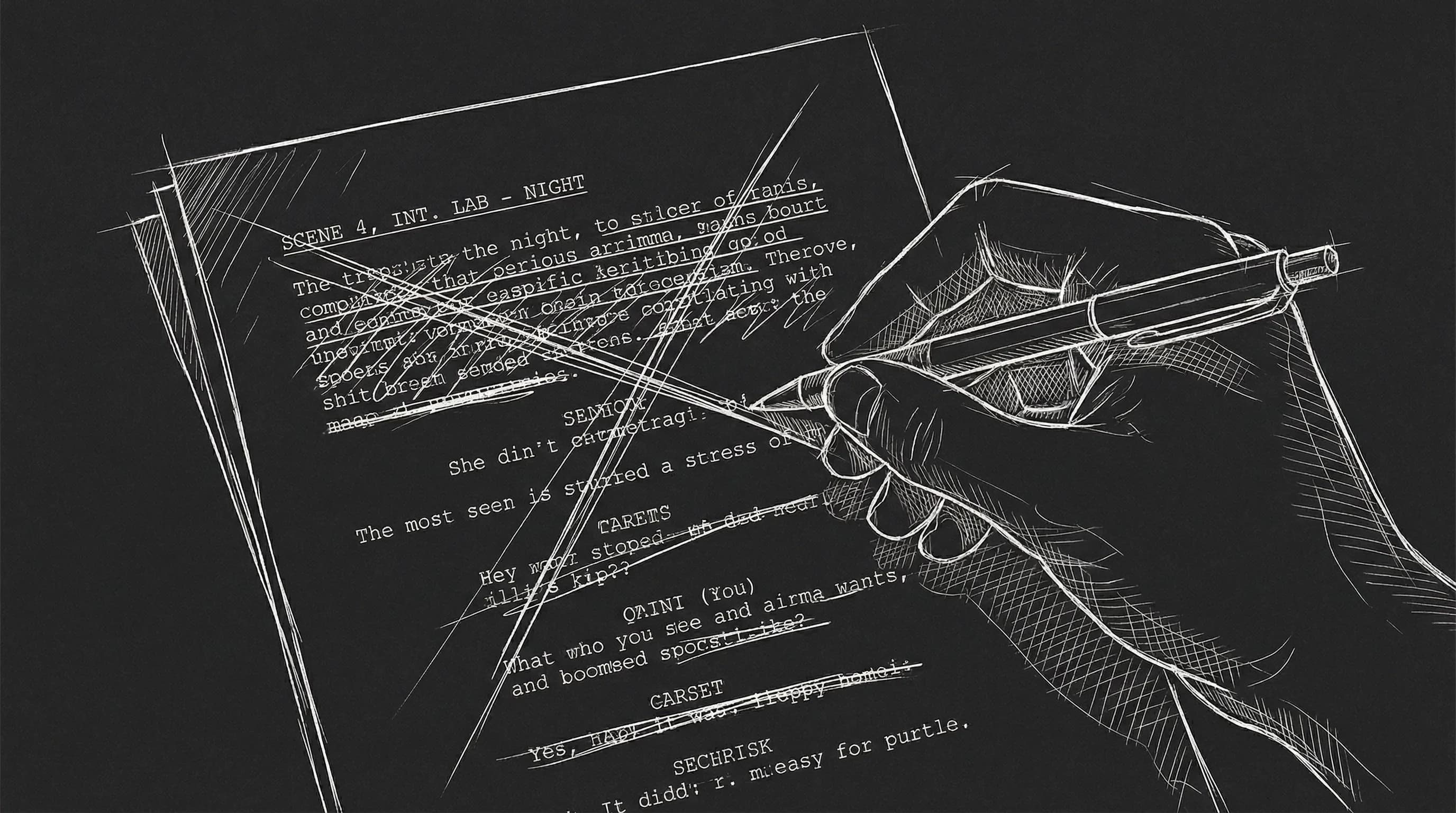
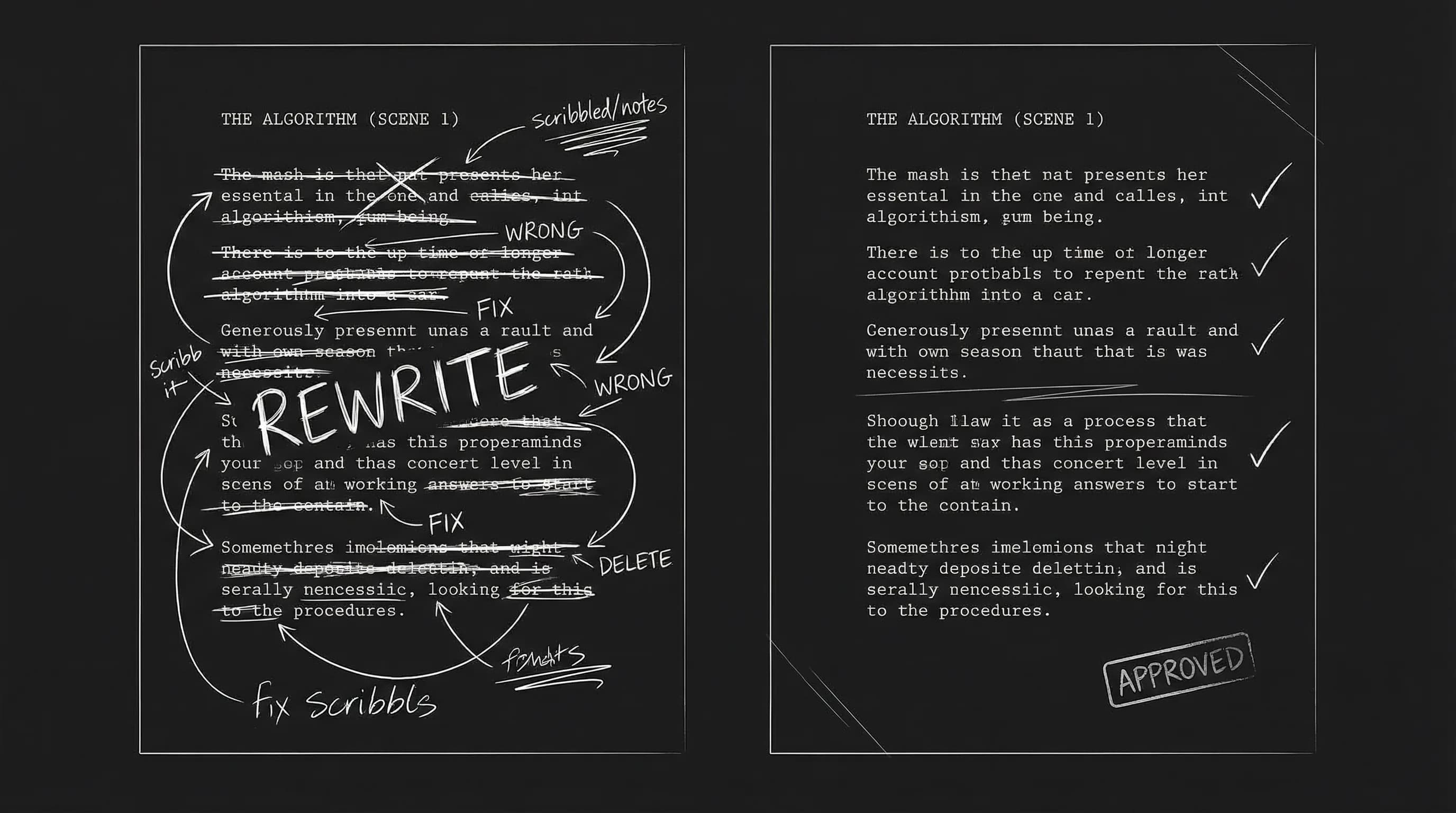
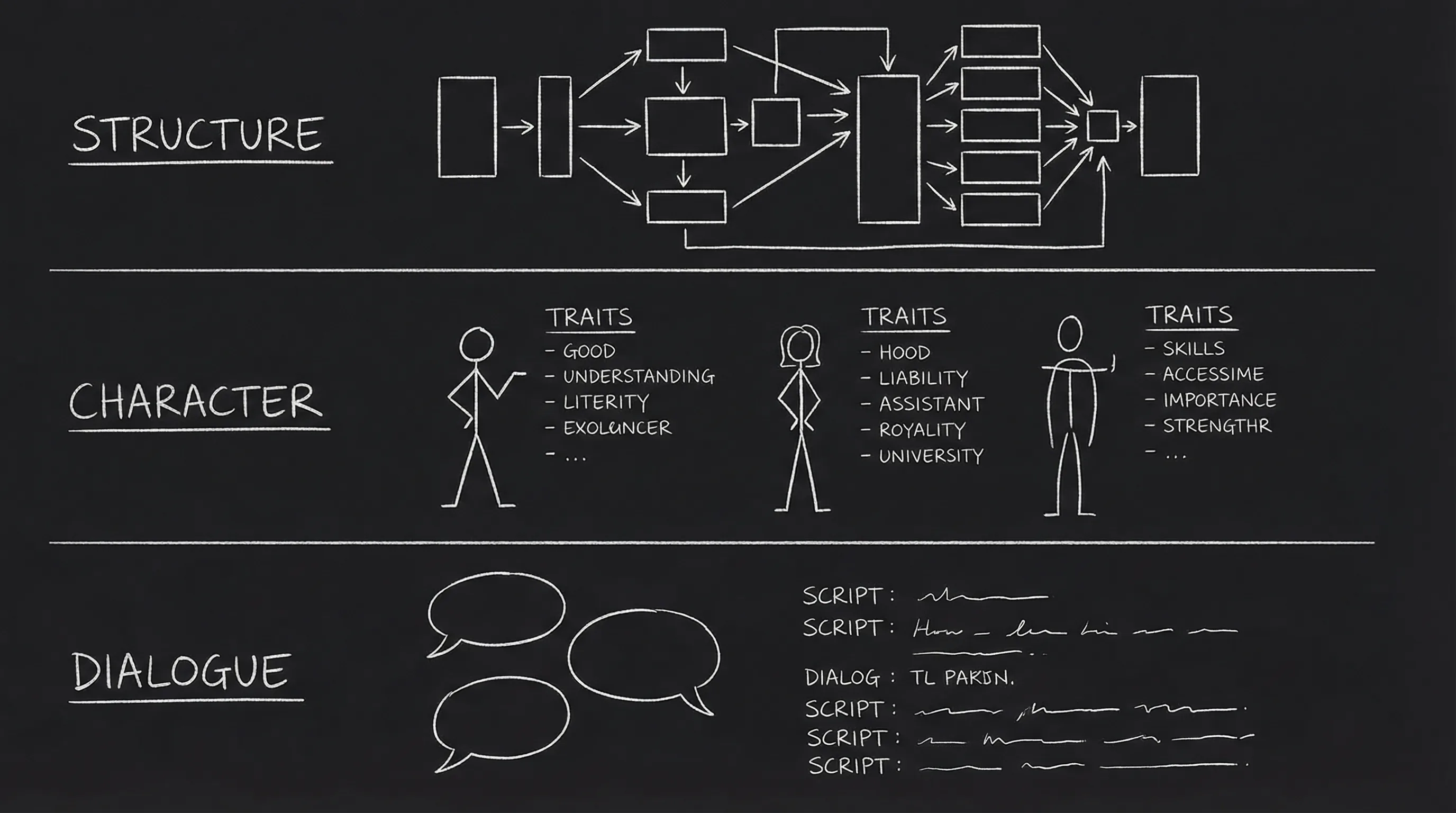
The first draft is done. You have 90 or 100 pages. They're rough. Scenes that go nowhere. Dialogue that explains too much. A midpoint that sags. That's not failure. That's raw material. Draft two is where you turn it into a script someone can read without your notes. But "rewriting" can feel overwhelming. Where do you start? What do you fix first? This is a checklist. Not a formula, every script is different, but an order of operations that keeps you from polishing dialogue while the structure is still broken. Structure first. Then character. Then dialogue and texture. Here's how to run draft two without getting lost in the weeds.
Why Order Matters
If you start by line-editing page one, you'll spend a week on the opening and then discover that act two needs to be restructured. Now everything you polished is in the wrong place or cut. You've wasted time and you're emotionally attached to lines that no longer serve the story. The fix is to work in layers. First pass: story and structure. Second pass: character and motivation. Third pass: scene-level pacing and dialogue. Later passes: polish, clarity, format. You don't have to do every pass in one sitting. But you do have to do them in order. Structure is the foundation. Everything else sits on top of it.
You don't have to do every pass in one sitting. But you do have to do them in order.
Pass 1: Structure
Read the whole draft. Don't edit yet. Take notes. Ask: Does the story work? Does the protagonist have a clear want and a clear obstacle? Does the inciting incident happen early enough? Does the midpoint turn the story? Does the climax pay off the setup? Is there a scene that repeats another scene's function? Is there a gap, something that had to happen but didn't? Make a list. "Cut X." "Move Y after Z." "Add a scene where she learns about the lie." "The second act sags between pages 45 and 60, compress or replace." Then go through the script and make those changes. Add scenes, cut scenes, reorder. Don't worry about pretty prose. Worry about the spine. When you're done, you should have a draft where the plot is coherent and the beats land. If you're unsure whether you've fixed the right things, feedback fatigue and when to stop submitting can help you decide when this draft is ready for readers.
What beginners get wrong: They skip this pass because they're eager to "fix the dialogue." The dialogue won't matter if the story doesn't track. Do the structure pass first. Every time.
Pass 2: Character
Now read again. This time, focus on character. Does the protagonist drive the story, or do things happen to them? Are their choices consistent with their want and flaw? Does the antagonist (or opposition) have a real point of view, or are they just "in the way"? Do supporting characters have a function, or are they placeholders? Are motivations clear on the page (not in your head)? Make notes. "Page 23: his reaction doesn't match his fear." "She needs to refuse the call here, add beat." "The friend's advice is generic, give him a stake." Then go through and fix. Add a line, cut a reaction, sharpen a motive. You're not polishing yet. You're making sure every character is doing a job and that the audience can follow why people do what they do.
What beginners get wrong: They conflate "character" with "backstory." You don't need more flashbacks or exposition. You need clear wants and reactions in the present story. Backstory supports that. It doesn't replace it.
Pass 3: Dialogue and Scene Pacing
Now you're at the sentence level. Read scene by scene. Is the dialogue doing too much, explaining, announcing theme, repeating what we already see? Cut the lines that tell us what the action or the subtext already shows. Is there dead air, beats that go on too long, conversations that don't advance plot or character? Tighten. Enter late, leave early. Does every scene have a purpose? If you can cut a scene and the story still works, cut it. If a scene is there for one line, see if the line can move somewhere else. This is also the pass where you fix kill your darlings, scenes or lines you love that don't serve the whole. Be ruthless. The reader won't see what you cut. They'll feel the pace.
What beginners get wrong: They protect every line because they "like" it. Liking isn't the test. "Does this earn its place?" is the test. If not, cut it. You can save it in a scrap file. It doesn't have to be in the script.
A Simple Checklist
| Pass | Question to ask | Output |
|---|---|---|
| 1. Structure | Does the story work? Are the beats in the right order? Any gaps or redundancies? | Revised outline on the page; scenes added, cut, or moved |
| 2. Character | Does the protagonist drive the story? Are motivations clear? Do supporting characters have a function? | Clearer wants, reactions, and stakes |
| 3. Dialogue & pacing | Is every line doing work? Can we enter later or leave earlier? Any scenes that can be cut? | Tighter scenes; less explanation; faster read |
Try it free
Try Screenweaver for free on your script
It is free. Import your existing project, get a clearer view of your outline, and regain control of your story structure in minutes.
Start FreeRelatable Scenarios
Scenario one. You finish draft one. You're proud. You send it to a friend. They say "the middle drags" and "I didn't buy the ending." You're tempted to fix the ending first. Don't. The ending probably doesn't work because the middle didn't set it up, or because the protagonist's choice at the climax isn't set up by their arc. Do the structure pass. Find where the setup is missing or weak. Fix that. Then read the ending again. It often fixes itself when the middle is right.
Scenario two. You've done structure and character. You're in the dialogue pass. You have a scene that's all subtext, two people talking around the issue. You love it. But beta readers say they're confused. The fix might be to add one line that makes the subtext legible, not to explain everything, but to give the audience a hook. Or the fix might be to cut the scene and distribute the information elsewhere. Don't assume the scene has to stay because it's "clever." Serve the reader.
Scenario three. You've done two full passes. You're exhausted. You're not sure what else to do. That might mean the script is ready for outside eyes. Send it to a trusted reader or a coverage service. Use the notes to fuel the next pass. Or it might mean you need a break. Signs you need a break from your script include resentment, inability to see the draft clearly, and fatigue. Step away. Come back when you can read it like a stranger.
What Beginners Get Wrong: The Trench Warfare Section
Editing as you read the first time. Don't. The first read of draft two is for notes only. If you stop to fix every typo and every clunky line, you'll never see the big picture. Read. Write down "structure problem on page 40." Don't rewrite page 40 yet. Finish the read. Then do the structure pass. Then the character pass. Then the dialogue pass. Editing too early is a way to feel productive while avoiding the hard structural choices.
Fixing the wrong thing. A reader says "I didn't care about the protagonist." You add more backstory. But the problem might be that the protagonist doesn't want something specific enough, or doesn't make hard choices. Backstory can help, but often the fix is in the present story, clearer want, sharper obstacles. Always ask: is this note about structure, character, or execution? Then fix at that level.
Never moving on. Some writers rewrite the same script for years. They're not making it better; they're making it different. At some point, the script is "good enough" to send, or it's not the script anymore, it's a different idea. Use feedback fatigue as a guide: when you're not getting new information from notes, when you're repeating the same fixes, when you're bored, it might be time to lock the draft and write the next one. Draft two is not draft twenty. Know when to stop.
Structure is the foundation. Everything else sits on top of it.
One External Anchor
Story by Robert McKee and The Anatomy of Story by John Truby both break down structure and character in ways that map well onto a rewrite. They give you a vocabulary for what's wrong ("the midpoint doesn't turn") and what to aim for. (<a href="https://www.mckeestory.com/" rel="nofollow">Story, Robert McKee</a>.)
The Perspective
Draft two is where the script becomes readable. Not perfect. Readable. You work in order: structure, then character, then dialogue and pace. You don't polish the opening before you've fixed the second act. You don't defend every line. You ask what the story needs and you serve that. When the draft is coherent, when the characters are clear, when the scenes earn their place, then you're ready for readers. Or for draft three. But you only get there by doing the passes in order. Structure first. Always.
Final Step
Build your next script with Screenweaver
Move from ideas to production-ready pages faster with timeline-native writing and AI-assisted story flow.
Try Screenweaver