
Short answer: a TV pilot title page places the series title centered near the top, in the same position a feature's title occupies, with the episode title, often just "Pilot", centered directly beneath it in smaller text. "Written by" and the writer's name follow underneath, the same as a feature title page. The series title is what identifies the show; the episode title is secondary information, and getting that hierarchy backward is the most common mistake on a spec pilot.
The precise layout
| Element | Position | Notes |
|---|---|---|
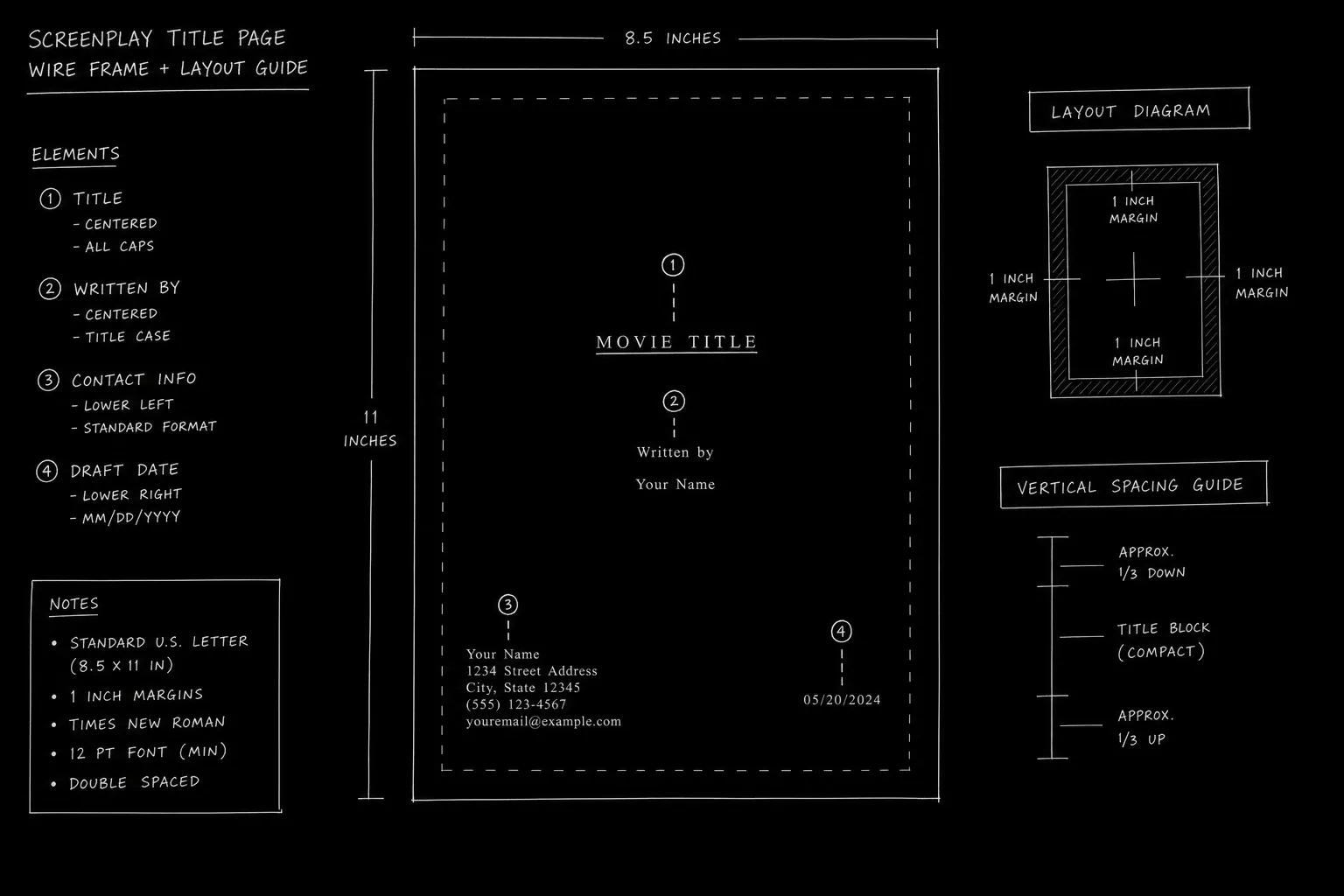
| Series title | Centered, upper third, largest text on the page | This is the show's name, what a reader will call your project |
| Episode title | Centered, directly below series title, smaller text | Often simply "Pilot" for a spec sample; later episodes get their own titles |
| "Written by" | Centered, below both titles | Same placement convention as a feature title page |
| Writer name | Centered, below "Written by" | Identical to feature format |
| Contact or representation | Bottom corner | Omit entirely for anonymized contest submissions |
For every other title page variation, standard spec, represented, anonymous, adaptation, and more, see Screenplay Title Page Examples: 9 Real Layouts Annotated. For the underlying formatting discipline this builds on, Script Title Page Format: Rules, Examples and Free Template covers the feature-format baseline.
The nuance that changes the answer
Series title beats episode title, always. A reader deciding whether to open your pilot is judging the show, not the episode. If your series title is small and your episode title is large, or if "Pilot" is the only prominent text on the page, the hierarchy is backward and reads as a writer who has not seen a produced pilot's title page.
"Pilot" is a placeholder, not a creative choice. Some writers try to give their pilot episode a clever title instead of simply calling it "Pilot." For a spec sample meant to demonstrate the show, "Pilot" is the expected, unambiguous label. Save a distinctive episode title for when the series is ordered and you are titling episode two onward.
Staffing samples follow the target show's template, not your own. If you are submitting a sample written in an existing show's voice for a staffing consideration, use that show's actual title page format if you have access to a real script, not your own pilot's convention. Studios and showrunners often have a house style that differs slightly from the general convention above.
Try it free
Try Screenweaver for free on your script
It is free. Import your existing project, get a clearer view of your outline, and regain control of your story structure in minutes.
Start FreeBuild it in seconds
Do not recreate this layout by hand for every new pilot draft. Use the free screenplay title page maker to generate a correctly hierarchized series-and-episode title page as a clean PDF.
Free tool: the screenplay title page maker builds a properly formatted TV pilot title page in seconds, no signup.
FAQ
Should the series title or the episode title be bigger on a pilot title page?
The series title should be the largest, most prominent text on the page, since it identifies the show. The episode title, usually "Pilot", sits directly beneath it in smaller text.
Is it okay to give my pilot episode a title other than "Pilot"?
For a spec sample meant to sell or demonstrate a series, "Pilot" is the clear, expected label. A distinctive title for the first produced episode is a decision made later, once the series is in production, not on a spec title page.
Does a half-hour pilot title page differ from an hour-long pilot title page?
No, the title page format is the same regardless of runtime. What changes between half-hour and hour-long formats is page count and internal act structure, not the title page layout.
What if I'm submitting a writing sample for a specific existing show instead of my own pilot?
Match that show's actual title page template if you can find or access a real script from it, since studios sometimes use a house style that differs slightly from the general series-title-then-episode-title convention.
Final Step
Build your next script with Screenweaver
Move from ideas to production-ready pages faster with timeline-native writing and AI-assisted story flow.
Try Screenweaver